


Tubal-Cain
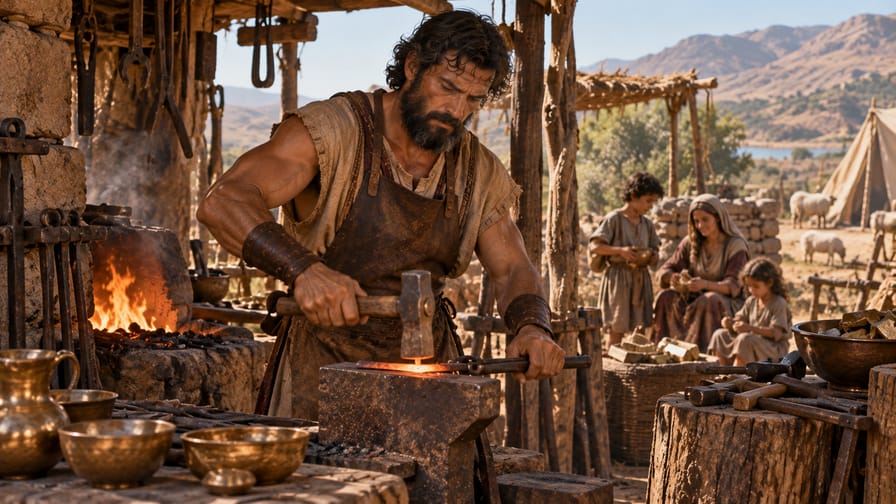
The figure of Tubalcain, mentioned briefly in the book of Genesis, is one of the most intriguing antediluvian characters, representing a crucial milestone in the development of human civilization. His mention, though concise, offers a rich tapestry for biblical and theological analysis, especially from a Protestant evangelical perspective, which values the authority of Scripture and the progressive revelation of redemptive history. He is presented as the pioneer in metallurgy, a skill that would radically transform human society and culture.
This study aims to delve into his onomastic meaning, historical context, role in the biblical narrative, theological implications, and his legacy, contextualizing him within the reformed worldview. The analysis will seek to extract relevant teachings for understanding human nature, cultural progress, and God's common grace, even in a world progressively corrupted by sin before the Flood.
1. Etymology and Meaning of the Name
1.1 Original Name and Linguistic Derivation
The name Tubalcain appears in the original Hebrew text as Tuval-Kayin (תּוּבַל קַיִן). It is a compound of two elements: Tuval and Kayin. The first element, Tuval, is of uncertain etymology, but may be related to the Hebrew root yaval (יָבָל), meaning "to flow," "to bring," or "to produce." Some scholars also suggest a connection to the name of a people or region, possibly the Tibareni, known for their metallurgy in antiquity.
The second element, Kayin (קַיִן), is the same name as his ancestor, Cain, and means "smith" or "metalworker," or also "acquired" or "spear." The association with Cain is significant and intentional in the genealogy presented in Genesis. The combination of the two elements in the name of Tubalcain, therefore, suggests a deep connection to the art of metallurgy.
1.2 Literal and Symbolic Meaning
Literally, the name Tubalcain is often interpreted as "producer of Cain" or "smith of Cain," or even "one who flows with [the art of] Cain." The most common and accepted interpretation, given his biblical description, is that of "metalworker" or "metal artisan." This highlights his vocation and the main characteristic by which he is known in the biblical narrative.
Symbolically, his name and occupation represent the technological innovation and cultural development of antediluvian humanity. He personifies human ingenuity and the capacity to master and transform natural resources. However, this capacity is presented within the context of Cain's line, which is marked by rebellion and sin.
1.3 Variations and Other Characters
There are no significant variations of the name Tubalcain in biblical languages, apart from transliteration differences into Greek (Thobel or Thobelcain in the Septuagint) and other languages. It is important to note that there are no other biblical characters with the same compound name. This confers upon Tubalcain a uniqueness in his identification and role.
Although there are other names like Tubal (mentioned in Genesis 10:2 as a son of Japheth and in Ezekiel 27:13 as a trading people), these are distinct from Tubalcain. The presence of the element Kayin (Cain) is crucial for distinguishing our character and associating him with the specific lineage and context of Genesis 4.
1.4 Theological Significance of the Name
The theological significance of Tubalcain's name lies in his direct connection with Cain and the lineage that distanced itself from God. While his skill in metallurgy is a testament to humanity's creative capacity, this skill is developed in a context of increasing godlessness. The name suggests that human inventiveness, however impressive, is intrinsically linked to humanity's fallen nature, which can use such gifts for both constructive and destructive purposes.
The mention of his name immediately before Lamech's song of vengeance (Genesis 4:23-24) serves as a dark foreshadowing. The metal tools that Tubalcain forged, though useful for agriculture and construction, could also be used for manufacturing weapons, thereby potentiating the violence that characterized Cain's descendants. Thus, his name and his work are a reminder of the ambivalence of human progress in a fallen world.
2. Historical Context and Biblical Narrative
2.1 Historical Period and Context
Tubalcain lived in the antediluvian period, as narrated in the initial chapters of Genesis, specifically in Genesis 4. This period precedes the universal Flood and is characterized by rapid population expansion and notable cultural development, but also by pronounced moral and spiritual degeneration. Biblical chronology does not offer exact dates for his life, but positions him among the generations that preceded the Flood.
The social and religious context of the time is crucial. Humanity had been expelled from the Garden of Eden, and the curse of sin was in full force (Genesis 3:17-19). Society was divided between the lineage of Cain, which increasingly distanced itself from God, and the lineage of Seth, which "began to call upon the name of the Lord" (Genesis 4:26). Tubalcain belongs to the former, immersed in a culture of self-sufficiency and material progress.
2.2 Genealogy and Family Origin
Tubalcain is presented as a direct descendant of Cain, through Lamech. His genealogy is clearly delineated in Genesis 4:19-22: he is the son of Lamech and Zillah, one of Lamech's two wives. His paternal half-brothers are Jabal (father of those who dwell in tents and have livestock) and Jubal (father of all who play the harp and flute), sons of Lamech with his other wife, Adah. He also had a sister, Naamah.
This genealogy is notable for listing the pioneers of different arts and crafts: Jabal in livestock, Jubal in music, and Tubalcain in metallurgy. This concentration of cultural innovations in a single family, that of Lamech, suggests a specialization and flourishing of human culture, even amidst the increasing godlessness of Cain's lineage.
2.3 Main Events and Biblical Passages
The mention of Tubalcain is singular and concise, occurring exclusively in Genesis 4:22. This verse declares: "Zillah, for her part, gave birth to Tubalcain, who forged every cutting instrument of bronze and iron. Tubalcain's sister was Naamah." This is the only time he is named in Scripture, which makes his figure even more enigmatic and subject to in-depth interpretations of his meaning.
There are no specific events or detailed narratives about Tubalcain's life beyond his identification as the ancestor of metalworkers. His importance lies in the revelation of his occupation and what that implies for the development of antediluvian civilization. The brevity of his mention, however, does not diminish its theological impact.
2.4 Geography and Relationships with Other Characters
The Bible does not specify the exact geography related to Tubalcain. Cain's lineage, after the fratricide, settled in the "land of Nod, east of Eden" (Genesis 4:16). It is presumable that Tubalcain and his family lived in this region or its surroundings, where civilization was rapidly developing. There is no mention of specific cities or locations directly associated with him.
His most important relationships are with his parents, Lamech and Zillah, and his siblings, Jabal, Jubal, and Naamah. Lamech's family is presented as a center of cultural and technological innovation. The immediate sequence of Tubalcain's mention with Lamech's "song of the sword" (Genesis 4:23-24) establishes an implicit but powerful relationship between technological innovation and human violence.
3. Character and Role in the Biblical Narrative
3.1 Analysis of Character and Qualities
Tubalcain's character is not explicitly described in the Scriptures, which prevents us from making direct moral judgments about him. However, his occupation as a "forger of every cutting instrument of bronze and iron" (Genesis 4:22) reveals qualities such as ingenuity, technical skill, perseverance, and innovation. He possessed a practical intellect and the ability to transform raw materials into useful tools, a demonstration of human creativity.
His contribution to metallurgy indicates an inquisitive mind and the ability to experiment with and develop new technologies. These are qualities that, in themselves, are not sinful, but are expressions of the image of God in man (Imago Dei), even if distorted by sin. The capacity to create and innovate is a reflection of the Creator.
3.2 Sins and Moral Failings
The Bible records no specific sin or moral failing attributed to Tubalcain. Unlike his father, Lamech, who boasts of his violence and polygamy (Genesis 4:23-24), Tubalcain is presented only by his occupation. However, he is part of Cain's lineage, which is characterized by apostasy, violence, and a life estranged from God (Genesis 4:16-17).
Although he is not personally accused of sin, his craft is placed in a context where violence is glorified by his father. This suggests that even the most impressive human achievements can be corrupted and used for sinful purposes in a fallen world. The absence of a declaration of faith or a call to the Lord in his life aligns him with the rest of Cain's lineage, which did not call upon the name of the Lord.
3.3 Vocation and Specific Function
Tubalcain's vocation is clear and specific: he was the pioneer and master of metallurgy. He "forged every cutting instrument of bronze and iron" (Genesis 4:22). This establishes him as the ancestor or mentor of all who work with metals. His function was to introduce a revolutionary technology, which had profound implications for agriculture, construction, art, and, unfortunately, warfare.
His role in the biblical narrative, therefore, is that of a catalyst for technological and cultural progress. He represents humanity's capacity to develop material civilization. His mention in Genesis 4 serves to show the rapid advancement of human society, even on a path of increasing estrangement from God.
3.4 Significant Actions and Key Decisions
Tubalcain's most significant action is his invention and development of metallurgy. This is not a personal decision in the moral sense, but a technological innovation that had vast consequences. The ability to work bronze and iron allowed for the creation of more durable and effective tools, boosting productivity and the capacity to transform the natural environment.
Although the Bible does not detail his personal decisions, his life, like that of his siblings, demonstrates human effort in building a culture and civilization independent of God. The emphasis on the "culture of Cain" in Genesis 4, with its cities, arts, and technologies, contrasts with the "culture of Seth," which was characterized by "calling upon the name of the Lord" (Genesis 4:26).
4. Theological Significance and Typology
4.1 Role in Redemptive History and Progressive Revelation
Tubalcain, although not a central character in redemptive history, plays a significant role in the progressive revelation of the human condition after the Fall. He illustrates humanity's remaining capacity to exercise the cultural mandate (Genesis 1:28) to subdue the earth, even in a state of sin. His skill in metallurgy is a testament to God's common grace, which allows humanity to continue to innovate and develop civilization, despite its rebellion.
At the same time, his story, embedded in Cain's lineage, serves as a somber reminder that technological and cultural progress is not synonymous with spiritual progress. Indeed, the tools he forged, which could be used for good, could also be used for violence, as Lamech's "song of the sword" suggests (Genesis 4:23-24). This reveals the ambivalent nature of human progress in a fallen world.
4.2 Prefiguration or Christocentric Typology
It is unlikely that Tubalcain functions as a direct prefiguration or typology of Christ. His figure is more associated with human culture in its technological development and the moral ambiguity of progress without God. Instead of pointing to Christ, he serves more as a contrast, highlighting the need for a redemption that transcends human achievements and addresses the root of sin.
His story can be seen as an anti-type or an example of what happens when human creativity deviates from divine purpose, resulting in tools that can be used for destruction and violence. Salvation in Christ is not achieved through technological or cultural innovations, but through faith and God's grace, which transforms the human heart.
4.3 Connection with Central Theological Themes
The figure of Tubalcain is connected to several central theological themes from the Protestant evangelical perspective:
- Common grace: Tubalcain's ability to innovate and create is an example of God's common grace, which sustains and enables humanity, even those outside the covenant, to develop civilization and enjoy certain benefits, preventing complete social disintegration after the Fall (Matthew 5:45 Acts 14:17).
- Cultural mandate: He exemplifies the fulfillment of God's mandate for humanity to "subdue the earth" (Genesis 1:28), through the application of intelligence and labor. However, the context of his lineage shows how this mandate can be fulfilled in a way distorted by sin.
- Total depravity: Tubalcain's story, within Cain's lineage, reinforces the doctrine of total depravity. Even the most impressive human abilities and innovations are affected and can be corrupted by sin, leading to violence and self-sufficiency, instead of to the glory of God (Romans 3:10-12).
- Contrast between the two seeds: Tubalcain belongs to the "seed of the serpent" (Genesis 3:15), the lineage of Cain, which opposes the "seed of the woman" (the lineage of Seth and, ultimately, of Christ). His story illustrates the difference between a culture that seeks human glory and a culture that seeks God's glory.
Reformed theology emphasizes that all creativity and progress, while being gifts from God, need to be redeemed and submitted to Christ so that they may achieve their ultimate purpose and glorify God. Tubalcain's story serves as a backdrop for understanding the need for redemption in all spheres of life.
5. Biblical-Theological Legacy and Canonical References
5.1 Mentions in Other Biblical Books and Tradition
The figure of Tubalcain is mentioned exclusively in Genesis 4:22 within the biblical canon. There are no other direct references to him in any other book of the Old or New Testament. This absence of subsequent mentions underscores the brevity of his appearance, but does not diminish his theological significance for understanding the early history of humanity.
In Jewish tradition, especially in midrashim and texts like the Book of Jasher, Tubalcain is sometimes elaborated upon, with some narratives suggesting that he was the inventor of weapons of war, which aligns with Lamech's song. These traditions, though non-canonical, reflect the perception that his invention had a dark side.
5.2 Influence on Biblical and Reformed Theology
Tubalcain's influence on biblical and Reformed theology lies primarily in his contribution to understanding the tension between cultural progress and human depravity. He is a vivid example of how human capacity, even after the Fall, can produce great technological advancements. However, these advancements are always ambivalent, as fallen humanity can use them for evil.
In Reformed theology, Tubalcain's story is often used to illustrate the concept of common grace, as well as the need for a Christian worldview that integrates culture and technology with God's redemptive purposes. Technological innovation, like Tubalcain's metallurgy, should be seen as a gift from God, but one that needs to be redeemed and directed toward the Creator's glory, not for self-glorification or human destruction.
5.3 Importance for Understanding the Canon
Tubalcain's importance for understanding the canon lies in how he enriches the Genesis narrative about the human condition post-Fall. He helps illustrate the comprehensive nature of sin, which affects not only morality and spirituality, but also culture, technology, and all spheres of human life. Tubalcain's metallurgy is an example of how human creativity, a reflection of the Creator, can simultaneously be a blessing and a curse, depending on the heart of man.
His story reminds us that material progress, by itself, does not lead to redemption or true happiness. On the contrary, the Genesis narrative establishes a fundamental contrast between the materially advanced civilization of Cain's lineage, which culminates in violence and the Flood, and the lineage of Seth, which seeks God. Thus, Tubalcain serves as a point of reference for the theology of culture and work, emphasizing the need for all human activities to be redeemed in Christ (Colossians 3:17).