


Itamar
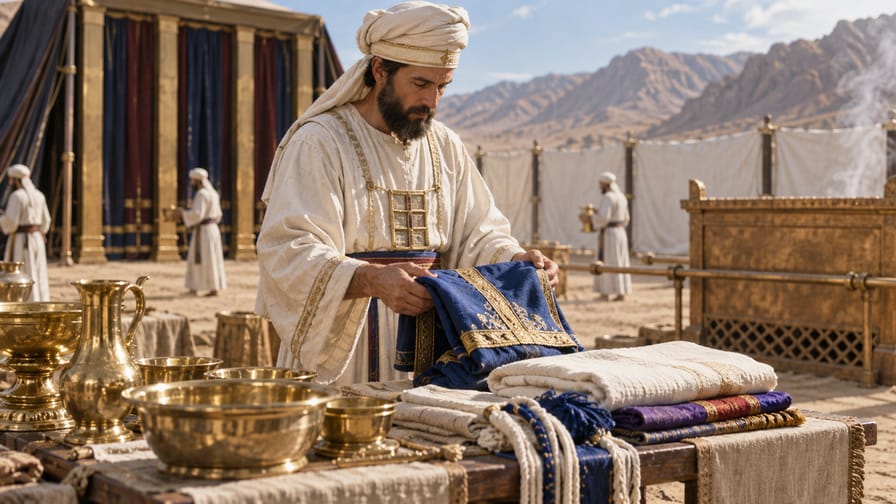
The figure of Itamar (in Hebrew, אִיתָמָר, ’Itamar) is of paramount importance in the history of the Levitical priesthood in Israel, as delineated in the Holy Scriptures. As the youngest son of Aaron, the first high priest, Itamar played a crucial role in the administration of the Tabernacle and the subsequent structuring of priestly service, establishing a lasting legacy for future generations.
His life, though not marked by dramatic events or grand discourses, exemplifies faithfulness and obedience in the service of God. An analysis of his trajectory and function offers valuable insights into the nature of the Levitical ministry, the divine order in worship, and the prefiguration of deeper spiritual truths, culminating in the perfect priesthood of Christ.
This biblical-theological dictionary entry explores the etymology of the name, the historical context, the character, the theological significance, and the legacy of Itamar, from an evangelical Protestant perspective, emphasizing biblical authority and Christocentric typology.
1. Etymology and meaning of the name
The name Itamar (in Hebrew, אִיתָמָר, ’Itamar) is composed of two elements. The first, אִי (’iy), can mean "island" or "coastline," but also "where" or "none." The second element, תָּמָר (tamar), means "date palm" or "palm tree."
Thus, the most accepted meaning for Itamar is "island of the palm tree" or "land of palm trees," or even "palm tree of the coast." This meaning evokes images of beauty, fertility, and resilience, characteristics often associated with palm trees in the biblical context, which symbolize righteousness and prosperity, as in Psalm 92:12.
Although there are no other prominent biblical figures with the same name, the uniqueness of Itamar highlights his distinct position in the priestly lineage. The name, in itself, does not possess a direct theological significance pointing to a specific event, but it reflects the richness of Hebrew nomenclature and a possible connection with elements of nature.
The symbolism of the palm tree, often associated with victory, righteousness, and life, can indirectly be linked to his faithfulness in priestly service. The palm tree is a tree that thrives in arid environments, and its presence is a sign of life and sustenance, paralleling the vital function of the priesthood in maintaining the spiritual life of Israel.
From a theological perspective, the name of Itamar can be seen as a reminder of the beauty and order that God establishes in His creation and in His service. The association with the palm tree, which produces fruit and offers shade, can symbolize the fruitful and protective service that Itamar and his descendants would offer to the people of Israel in priestly ministry.
2. Historical context and biblical narrative
2.1 Family origin and genealogy
Itamar is presented in the Scriptures as the fourth and youngest son of Aaron, the first high priest of Israel, and his wife Elisheba, daughter of Amminadab and sister of Nahshon (Exodus 6:23). His older brothers were Nadab, Abihu, and Eleazar. This genealogy directly places him in the Aaronic priestly lineage, established by God.
His birth likely occurred in Egypt or in the early years of the wilderness wandering, before the construction of the Tabernacle and the formal institution of the priesthood. Aaron's family, belonging to the tribe of Levi, was chosen by God to serve in the sanctuary, a unique and sacred calling for the entire nation of Israel (Exodus 28:1).
2.2 Main events and service in the Tabernacle
The life of Itamar is intrinsically linked to the construction and service of the Tabernacle in the wilderness of Sinai. He and his brothers were consecrated as priests along with their father Aaron, according to the divine instructions detailed in Exodus 29 and Leviticus 8. This consecration marked the formal beginning of the Aaronic priesthood.
A crucial event that profoundly affected Itamar's family was the death of his older brothers, Nadab and Abihu, who offered unauthorized fire before the Lord and were consumed by divine fire (Leviticus 10:1-2). This tragic incident left Itamar and Eleazar as the only sons of Aaron fit for the priesthood, reinforcing the seriousness of obedience in worship.
After the death of Nadab and Abihu, Itamar and Eleazar were instructed by Moses not to mourn publicly, but to continue with their priestly duties, demonstrating the holiness and blamelessness required in divine service (Leviticus 10:6-7). This moment underscored the responsibility and resilience necessary for ministry.
The main function of Itamar, as narrated in Numbers 4, was the supervision of the transportation of the Tabernacle's utensils. While the Kohathites were responsible for the most sacred objects (such as the Ark and the altar), Itamar was entrusted with overseeing the Gershonites and Merarites, who transported the curtains, boards, bars, and pillars of the sanctuary.
Specifically, Itamar was the head of the Gershonite and Merarite Levites, and had the responsibility to ensure that all components of the Tabernacle were transported correctly, according to divine order (Numbers 4:28, 33). He was the "chief of the chiefs of the Levites," reporting directly to Aaron.
The Bible also records that Itamar was responsible for accounting for the materials used in the construction of the Tabernacle, under Moses' direction (Exodus 38:21). This administrative task demonstrates his organizational capacity and his faithfulness in following God's detailed instructions.
Throughout the wilderness wandering, Itamar remained faithful to his duties, contributing to the maintenance of order and worship of God. His descendants, the house of Itamar, continued to serve in the priesthood, being one of the two main priestly divisions, alongside the house of Eleazar (1 Chronicles 24:1-6).
3. Character and role in biblical narrative
3.1 Virtues and spiritual qualities
Although the Bible does not offer extensive descriptions of Itamar's personal character, his actions and the role he played reveal remarkable spiritual qualities. Obedience is a central virtue in his life. He diligently carried out all the instructions of Moses and Aaron, which were, in turn, commands from God.
His faithfulness to the service of the Tabernacle, even after the tragic loss of his brothers and the pressure of such a demanding ministry in the wilderness, demonstrates resilience and dedication. Itamar did not stray, but remained steadfast in his calling, which is a testament to his integrity and fear of God (Leviticus 10:6-7).
Itamar's administrative responsibility, as supervisor of the Gershonite and Merarite Levites, indicates his leadership and organizational capacity. He was entrusted with the task of ensuring that the service of the sanctuary was carried out with order and precision, an essential characteristic for anyone who serves God.
His discretion is also notable. Unlike his brothers Nadab and Abihu, who acted imprudently, Itamar and Eleazar maintained the expected conduct of priests, demonstrating reverence and holiness in dealing with divine matters. This posture of respect for the sacred is a fundamental virtue for ministry.
3.2 Vocation and specific function
Itamar's vocation was priestly, part of the Aaronic lineage chosen by God. His main function, in addition to the general priestly duties of offering sacrifices and mediating between God and the people, was that of administrator and supervisor of the Levites. This was a task of logistics and management of material and human resources.
He was the link between the high priest (Aaron, and later Eleazar) and the Levitical families of Gershon and Merari, who were responsible for transporting the parts of the Tabernacle. His supervision was vital for the mobility of the sanctuary in the wilderness, ensuring that everything was assembled and disassembled according to divine instructions (Numbers 3:36-37 4:28, 33).
The role of Itamar was of extreme importance for maintaining order in worship and in the community life of Israel. Without proper organization and supervision, the Tabernacle, the center of worship and God's presence, could not be moved or established correctly, compromising the spiritual life of the nation.
His contribution, therefore, was no less significant than that of the priests who performed the rituals directly. He was a pillar of support, ensuring that the physical and logistical structure for divine worship was always in conformity with God's requirements, exemplifying the importance of service behind the scenes.
4. Theological significance and typology
4.1 Role in redemptive history and progressive revelation
Itamar's role in redemptive history is intrinsically linked to the establishment of the Aaronic priesthood, which was a central element in God's progressive revelation to His people. The priesthood was the means by which Israel could approach God, offer sacrifices for sins, and maintain the covenant.
Itamar's faithfulness in his role as supervisor of the Levites ensured that the Tabernacle, the place of divine presence, was maintained and transported with due reverence and order. This demonstrates the importance of obedience to the details of the law and of worship, which prefigured the holiness and perfection of God.
The Levitical priesthood, including Itamar's lineage, served as a shadow, a figure of the superior and eternal priesthood of Jesus Christ (Hebrews 8:5 10:1). The order and holiness required in the service of the Tabernacle pointed to the perfect holiness of the Messiah, who would come to fulfill all the law and establish a new and better covenant.
4.2 Christocentric typology and theological themes
Although Itamar is not a direct typological figure of Christ in an explicit prophetic sense, his service and the priesthood in which he was embedded possess rich typological significance. The Aaronic priesthood, with its requirements of holiness, sacrifices, and mediation, prefigured the priesthood of Christ.
Christ, as our High Priest, did not need to offer sacrifices for Himself, for He was without sin, and offered Himself as the perfect and definitive sacrifice for the sins of humanity (Hebrews 7:27 9:12). Itamar's service, which ensured the order of the sanctuary, points to the divine perfection and order that are intrinsic to Christ's ministry.
Central theological themes such as obedience, holiness, service, and mediation are evident in the life and ministry of Itamar. His unquestioning obedience to God's commands, transmitted through Moses, is a model for all believers. The holiness of the priesthood, emphasized by the death of his brothers, highlights the purity required in serving a holy God.
Itamar's service to the Levites and the Tabernacle demonstrates the dignity of diligent and dedicated work in the Kingdom of God, even in roles that may seem less prominent. He contributed to the mediation between God and man by facilitating access to the place where atonement was made, pointing to Christ, the only mediator (1 Timothy 2:5).
Itamar's priesthood, as part of the Levitical priesthood, was not perfect and required continuous sacrifices. This highlights the need for a superior priesthood, which is finally fulfilled in Christ. The transience of the Aaronic priesthood and its dependence on daily sacrifices contrast with the permanence and efficacy of Jesus' priesthood.
Reformed and evangelical theology emphasizes that Christ's priesthood is of a superior order, after the likeness of Melchizedek, not Aaron (Hebrews 7:11-17). Nevertheless, the Aaronic priesthood, including Itamar's lineage, served as divine pedagogy, preparing the people for the understanding of Christ's perfect and ultimate priesthood.
5. Biblical-theological legacy and canonical references
5.1 Mentions in other biblical books and influence
The lineage of Itamar is mentioned in several later Old Testament passages, attesting to his continued importance in the priesthood of Israel. In Numbers 26:60, he is again listed among the sons of Aaron. More notably, the book of 1 Chronicles details the priestly divisions and their organization.
In 1 Chronicles 24, during the reign of David, the descendants of Aaron were divided into twenty-four courses for service in the Temple. The families of Eleazar and Itamar formed these divisions. The lot was cast to determine the order of service, and sixteen heads of families came from the descendants of Eleazar, and eight from the descendants of Itamar (1 Chronicles 24:4-6).
This organization demonstrates the continuity and relevance of Itamar's lineage for centuries after the wilderness wandering. His descendants maintained an active and structured role in priestly service in the Temple of Jerusalem, confirming God's faithfulness in maintaining the order He had established.
Furthermore, the book of Ezra mentions that, upon the return from Babylonian exile, some of the priests who came back were descendants of Itamar. For example, Daniel, from the family of Itamar, is mentioned in Ezra 8:2 as one of those who returned with Ezra, showing that Itamar's priestly lineage persisted until the post-exilic period.
5.2 Presence in interpretive tradition and evangelical theology
In Jewish interpretive tradition, Itamar is recognized as one of the pillars of the priesthood, whose descendants ensured the continuity of service in the Temple. His obedience and administrative role are often praised as examples of diligent and faithful service.
In Reformed and evangelical theology, the figure of Itamar, though not a primary focus of individual study, is viewed within the larger context of the Levitical priesthood. His service exemplifies the importance of order, holiness, and obedience in worshiping God, principles that are transferable to worship and ministry in the Church.
Itamar's faithfulness in supervising the Levites is a reminder that all service in the Kingdom of God is valuable and necessary, whether performed on the front lines or behind the scenes. Evangelical theology values the diversity of gifts and ministries, recognizing that each member of the body of Christ has a vital role (Romans 12:4-8 1 Corinthians 12:12-27).
The legacy of Itamar, therefore, is not only historical, but also theological and practical. He teaches us about the seriousness of the divine calling, the necessity of rigorous obedience to God's commands, and the importance of dedicated and organized service for the glory of the Lord. His life, though discreet, is a testament to God's faithfulness in establishing and maintaining His people and His worship.
In summary, Itamar is a figure who, through his faithfulness and administrative role in the Levitical priesthood, contributed significantly to the structure of worship in Israel and, by extension, to the understanding of divine providence and the typology that points to the perfect and eternal priesthood of Jesus Christ. His story reinforces biblical authority in the institution of the priesthood and God's sovereignty in establishing the order of His worship.