


What Does the Bible Say About Living Together Before Marriage?
The Bible never mentions living together before marriage in so many words, but it describes marriage as a covenant, usually celebrated in view of the community, and the usual reading of its texts on sexual immorality keeps a couple's intimacy inside that covenant. Sharing a home and a bed as if you were married, without the covenant, therefore falls short of the biblical pattern. For those already living this way, there is a path forward, and it does not begin with contempt.
The strictly sexual side of the question has its own answer on this site, in “What does the Bible say about sex before marriage?” This one deals with what is specific to sharing the same roof and the same life.
Is there a verse against moving in together?
No verse forbids cohabitation by name, and it is worth being honest about that. Scripture does not talk about leases; it talks about marriage, and that is where the conclusion comes from. It helps to separate three levels: what the text says, what follows from it, and what applies today.
The New Testament condemns πορνεία (porneia), a word the usual understanding reads as sexual intimacy outside marriage. In 1 Thessalonians 4:3-7, Paul forbids it, and that passage is used here as a prohibition of porneia, not as a text about marriage (the “vessel” of 4:4 has a disputed meaning). The verses and what grace says to those who stumbled in this area are in the answer on sex before marriage, and we will not repeat them.
The conclusion that matters here is an inference, not a quotation: living together without marrying as a “trial marriage” finds no support in Scripture, because in the texts life as a couple grows out of a covenant, not the other way around. Genesis 2:24 narrates a man leaving his father and mother and holding fast to his wife; it is a founding narrative, not a rule about housing, but it shows the order in which the text tells things.
What does a public covenant add to life as a couple?
The Bible never treats marriage as a private feeling. Malachi 2:14 calls the wife a companion and a wife by covenant (בְּרִית, berit) and says the Lord was witness between the husband and the wife of his youth. Proverbs 2:17 speaks of forgetting the covenant of God when one abandons the companion of one's youth; it is usually understood as an allusion to the marriage covenant, though some read it as the covenant of Sinai.
Scripture does not prescribe a rite of vows or require human witnesses. What the narratives show is public celebration and agreement between families: Laban gathered the men of the place for a feast (Genesis 29:22), Jesus performed His first sign at a wedding in Cana (John 2:1-11), and the case of Isaac and Rebekah, sometimes cited as “they simply moved in together” (Genesis 24:67), comes after agreement between the families, gifts, and a blessing (Genesis 24:50-60). There is no single form; the pattern one sees is a covenant, usually celebrated in view of the community.
That changes the nature of the relationship. Sharing a home with the exit door open is one thing; promising permanence is another. Jesus reminds us that no one should separate what God has joined together (Matthew 19:4-6). As an inference, and not as what the text says literally, that warning assumes a union taken on as lasting: it makes little sense to speak of separating what was never joined. There is also witness. The principle of 1 Peter 2:12, exemplary conduct in the sight of all, applies here by extension (the verse is about life among unbelievers, not about cohabitation), and a couple's home without a marriage can send family, friends, and children a confusing message about what God calls marriage.
“I need to test it first” and other common arguments
The reasons people give for moving in together are usually sincere, and they deserve a serious answer.
- “I need to test our compatibility.” Living well together matters, and mature dating and engagement exist to talk through money, children, family, faith, and conflict. What no test can measure is the decision to stay, and commitment with an exit left open is a different kind of relationship, not a rehearsal for the commitment itself. Studies on the subject disagree, and this answer does not lean on any number.
- “The paper doesn't matter, love does.” The Bible says nothing about a state certificate; it describes marriage as a covenant, usually celebrated in view of the community. Where the law asks for registration, the principle of Romans 13:1-7, respecting the authorities, leads the Christian to comply with the formality, which is why it is common to do both the civil and the religious ceremony. Some countries, such as Brazil with its união estável, give legal effect to shared life, which protects rights but is not, by itself, the covenant made before God and the community. Each country treats civil marriage, religious marriage, and shared life differently, so it is worth checking local law before setting the date.
- “We are already married in God's eyes.” The intention is usually good, but Jesus tells the Samaritan woman that the man she now has is not her husband (John 4:18). The text does not discuss cohabitation in general, so this is an inference, but it suggests that in Jesus' vocabulary, living together and being married are not synonyms.
- “We can't afford a wedding.” What the Bible describes as marriage is the covenant, not the party. A simple ceremony with family and church, plus the civil registration, is enough and costs far less than a big celebration. Saving for the wedding is a project the couple can take on without sharing a roof: the engagement can be the time to plan and save together, each in their own place.
We already live together: now what?
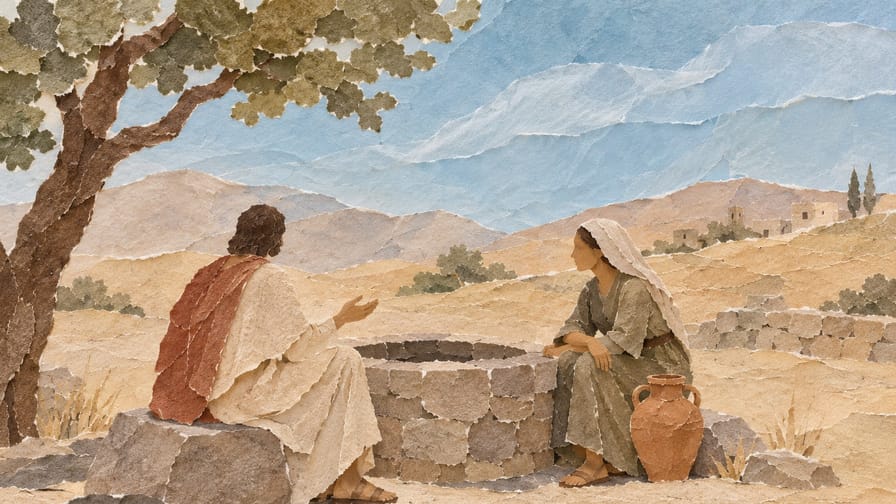
Anyone in this situation needs to hear first that they are not beyond the reach of grace, and that the church should not treat them with contempt. Jesus talks with the Samaritan woman at the well, tells the truth plainly about her life (John 4:16-18), and in the same encounter reveals to her that He is the Messiah. She runs to the town, and many believe (John 4:28-30, 39). There is no condemnation for those in Christ (Romans 8:1), and whoever confesses finds a God who is faithful and just to forgive (1 John 1:9). Repentance (μετάνοια, metanoia) is a change of mind and direction with God on your side, not humiliation.
For those who already live together, here are some concrete steps:
- Talk frankly and pray together, and find out whether you both really want marriage. If only one of you does, that is important information.
- If you both do, marry. Set the date, enter the covenant before God, your families, and your church, and take care of the civil registration. It is common for churches to welcome and celebrate the weddings of couples who were already living together, and it is worth asking your pastor.
- If the wedding is still some time away, consider moving back into separate homes until then, and ask for help to live in purity (Romans 13:14; 2 Timothy 2:22).
- Go to a pastor or a trusted counselor. Children, shared property, a previous divorce, or a partner who is not a Christian call for a case-by-case conversation, and none of them has a one-line solution.
- Do not walk alone. Galatians 6:1-2 calls us to restore with gentleness and to carry one another's burdens.
The same goes for the community that welcomes them: it is possible to hold the biblical standard for marriage without ceasing to embrace those who are still on the way to it.
Key Bible references
Genesis 2:24 · Malachi 2:14 · Matthew 19:4-6 · Matthew 1:18-25 · 1 Thessalonians 4:3-7 · Hebrews 13:4 · John 4:16-18 · Romans 8:1