


Rephaiah
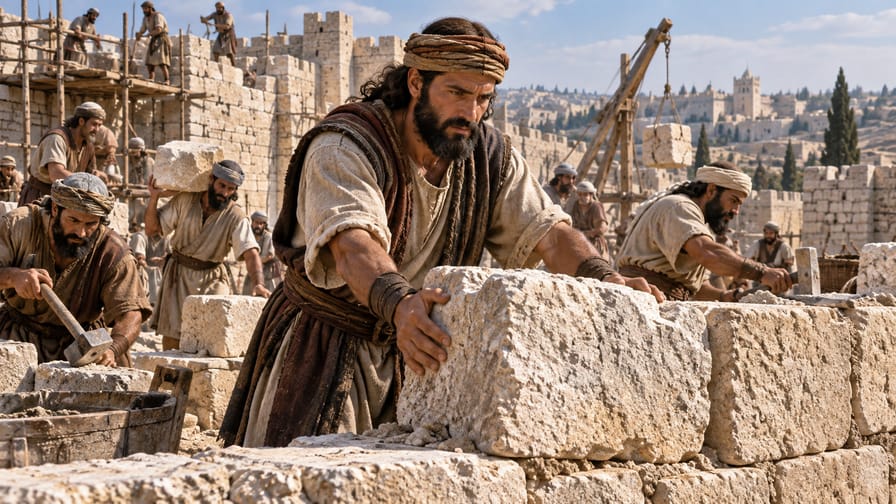
Rephaiah, the son of Hur, is one of the many names in the list of workers who rebuilt the walls of Jerusalem under Nehemiah. He appears in a single verse, Nehemiah 3:9, which calls him “ruler of half the district of Jerusalem” and records that he repaired a section of the wall.
Scripture tells us almost nothing else about him. We do not know his age, his family story beyond his father’s name, or what became of him after the wall was finished. Yet his brief appearance is not empty. It shows a civic official of the restored community who did not stay at a distance from the work but took his own place on the wall, at a time when the returned exiles were weak, threatened and discouraged.
Studying Rephaiah means reading one short line carefully and letting it speak within the larger story of Nehemiah, where God restores his people and gathers leaders and craftsmen, priests and ordinary families, into one shared task.
1. Etymology and meaning of the name
The Hebrew name Rephaiah (רְפָיָה, Rephayah) is formed from the verb rapha’, “to heal, to restore,” joined to Yah, a short form of the divine name YHWH. Its most widely accepted meaning is “the LORD has healed” or “the LORD heals.” The same root appears in God’s self-description at Marah: “I am the LORD, your healer” (Exodus 15:26).
Names of this kind were common in Israel and expressed the faith of the parents. We do not know why Hur gave his son this name, and it would be speculation to read Rephaiah’s personal story into it. Still, it is fitting that a man called “the LORD heals” appears in a chapter about repairing the ruins of Jerusalem, a city the prophets had described as wounded and in need of healing (Jeremiah 30:17; Jeremiah 33:6).
Several other men in the Old Testament bear the same name, which is why the text identifies this Rephaiah by his father and by his office.
2. Historical context and biblical narrative
2.1 Family origin and genealogy
The only family information given is that Rephaiah was “the son of Hur.” Nothing more is said about this Hur. The name appears elsewhere in Scripture, for example in the companion of Moses and Aaron (Exodus 17:10-12) and in a leading figure of the clans of Judah (1 Chronicles 2:19-20, 50; 1 Chronicles 4:1, 4). Some have suggested that Rephaiah belonged to a Judahite family descended from that clan, but this is only a hypothesis: the text does not make the connection, and Hur was not a rare name.
Rephaiah must not be confused with other men of the same name: a descendant of David after the exile (1 Chronicles 3:21), a Simeonite leader in the days of Hezekiah (1 Chronicles 4:42), a descendant of Issachar (1 Chronicles 7:2) and a descendant of Saul (1 Chronicles 9:43). None of them is the official of Nehemiah 3.
2.2 Main events
The setting is the middle of the fifth century before Christ. Around 445 BC, in the twentieth year of King Artaxerxes, Nehemiah heard that the wall of Jerusalem was broken down and its gates burned (Nehemiah 1:3; Nehemiah 2:1). With the king’s permission he traveled to the city, inspected the ruins by night and called the people to rise up and build (Nehemiah 2:11-18).
Chapter 3 records how the work was organized. The wall was divided into sections, each assigned to a family, a guild, a group of priests or the people of a town. Rephaiah’s section came right after the work of a goldsmith and a perfumer, who “restored Jerusalem as far as the Broad Wall” (Nehemiah 3:8), and before the section of a man who repaired opposite his own house (Nehemiah 3:10). Scholars usually place this stretch on the western or northwestern side of the city, but the exact topography of the chapter is debated.
The title given to Rephaiah is significant. The Hebrew speaks of the sar (ruler, official) of half the pelek of Jerusalem, a term generally understood as an administrative district of the Persian province of Judah. The chapter mentions other district rulers who also worked: Shallum, ruler of the other half of the district of Jerusalem, who built together with his daughters (Nehemiah 3:12), and the rulers of other districts of Judah (Nehemiah 3:14-18). Rephaiah was therefore part of the local leadership that stood beside Nehemiah.
The rebuilding met ridicule, threats and internal injustice (Nehemiah 4; Nehemiah 5:1-13), but the wall was finished in fifty-two days, and even the enemies perceived that the work had been done with the help of God (Nehemiah 6:15-16). Rephaiah’s name does not reappear in these events, but his section was part of that completed wall.
3. Character and role in the biblical narrative
Because the text says so little, any portrait of Rephaiah must be modest. What the verse does show is a man with public authority who put his hand to the work. This stands out in a chapter that also records a sad exception: the nobles of Tekoa refused to bend their necks to the service of their Lord (Nehemiah 3:5). Rephaiah, by contrast, is listed among those who built.
His role was also representative. As ruler of half the district, his participation brought the weight of his office to the project, although the text does not say who worked with him. Nehemiah’s list does not rank the workers by prestige: priests, goldsmiths, perfumers, officials, merchants and ordinary residents appear side by side (Nehemiah 3:1, 8, 12, 32). Rephaiah’s place in the list is simply a place among others.
We should not attribute to him virtues, words or feelings the text does not describe. It is enough to say what Scripture shows: when the moment came, he was found working, and his name was kept in the record of God’s people.
4. Theological significance
4.1 God remembers faithful service
Nehemiah 3 can look like a dry list, but it expresses a theological conviction: God sees and remembers those who serve in the restoration of his people. Nehemiah himself prays again and again, “Remember me, O my God” (Nehemiah 5:19; Nehemiah 13:14, 31). The inclusion of names such as Rephaiah’s shows that no faithful work is anonymous before God, who “is not unjust so as to overlook your work” (Hebrews 6:10).
4.2 Authority as service
Rephaiah’s example fits the biblical picture of authority exercised for the good of the community. Jesus taught that greatness in his kingdom is measured by service, and that he himself came not to be served but to serve (Mark 10:42-45). Rephaiah is not a type of Christ, and the text does not present him that way, but his readiness to work alongside the people illustrates a principle that finds its fullness in the Lord who took the form of a servant (Philippians 2:5-8).
4.3 The Lord who heals and rebuilds
The rebuilding of the wall was an act of restoration after judgment. The exile had been the consequence of Judah’s unfaithfulness, and the return was the fruit of God’s mercy according to his promises (Jeremiah 29:10-14; Ezra 1:1). The name Rephaiah, “the LORD heals,” sums up well what God was doing in that generation. In the New Testament the church is described as a building raised on the foundation of the apostles and prophets, with Christ Jesus himself as the cornerstone (Ephesians 2:19-22; 1 Peter 2:4-5). The walls of Jerusalem were temporary; the work of Christ in building his people is eternal.
5. Legacy and canonical references
Rephaiah the son of Hur appears only in Nehemiah 3:9. No other passage of Scripture mentions him with this identification, and any attempt to link him with another Rephaiah is speculative. The other bearers of the name (1 Chronicles 3:21; 4:42; 7:2; 9:43) belong to different families and periods.
His legacy is therefore a single line of Scripture. Even so, that line belongs to the inspired account of how God restored Jerusalem, and generations of believers have read it as a reminder that the Lord records the names of those who serve him, even when the world forgets them.
6. Application for today
First, Rephaiah reminds us that position does not exempt anyone from service. Pastors, leaders, parents and all who hold some authority are called to take part in the work, not only to direct it from a distance. The Christian way of leading is to be found with the people, carrying part of the load.
Second, his place in a long list teaches that the kingdom of God is built by many hands. Most of us will be remembered, if at all, as one name among many. That is not a small thing when the list is kept by God. Jesus told his disciples to rejoice not in visible success but that their names are written in heaven (Luke 10:20).
Third, his name points beyond himself to the Lord who heals. Our lives, families and churches often look like the broken walls of Jerusalem. The healing we need comes from Christ, by whose wounds we have been healed (1 Peter 2:24), and who now calls us to serve in the restoration he is bringing about.
Finally, Rephaiah invites a simple question: which section of the wall has God placed in front of you? It may be small and unnoticed, but it matters. Whatever you do, work heartily, as for the Lord and not for men (Colossians 3:23).