


Rehoboam
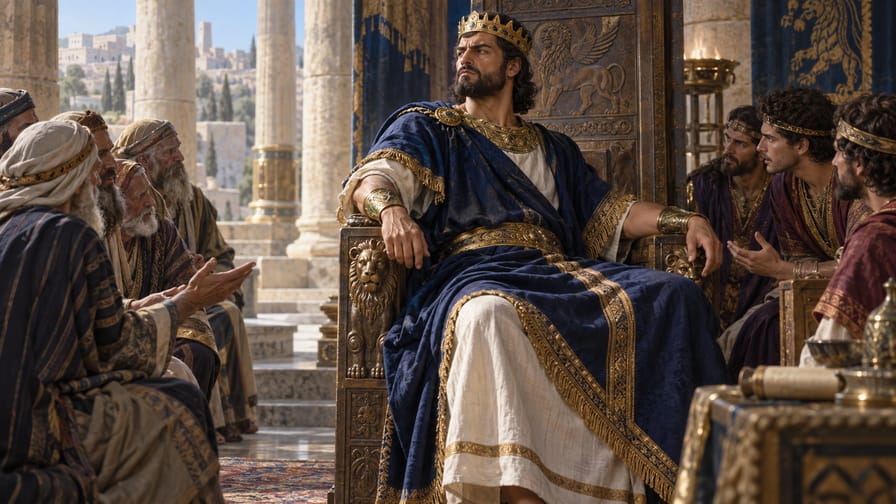
The figure of Rehoboam (Hebrew: רְחַבְעָם, Reḥav‘am), son and successor of King Solomon, is central to understanding the division of the United Kingdom of Israel. His story, detailed primarily in the books of 1 Kings and 2 Chronicles, serves as a case study on the consequences of arrogance and lack of wisdom in leadership.
From an evangelical Protestant perspective, the narrative of Rehoboam is not just a historical record, but a powerful lesson on God's sovereignty, covenant faithfulness, and the ramifications of disobedience. He represents a turning point in the history of Israel, marking the beginning of an era of division and decline.
1. Etymology and meaning of the name
1.1 Original name and linguistic derivation
The name Rehoboam derives from the Hebrew רְחַבְעָם (Reḥav‘am). The most common transliteration is Rehoboam in English, and Roboão in Portuguese. This name is composed of two distinct Hebrew parts which, together, form a deep meaning that is, ironically, in contrast with the king's own life.
The first part, רְחַב (reḥav), comes from the root רחב (raḥav), which means "to widen," "to expand," or "to make spacious." This root is often associated with concepts of breadth, freedom, and prosperity, as in Psalm 18:19: "He brought me out into a spacious place he rescued me because he delighted in me."
The second part of the name is עָם (‘am), which means "people" or "nation." This term is common in theophoric names and in references to the community of Israel, indicating an intrinsic link to the collective identity of God's people.
1.2 Literal and symbolic meaning of the name
Combining the two parts, the name Rehoboam (Reḥav‘am) literally means "the people are enlarged," "he enlarges the people," or "one who enlarges the people." In a broader sense, it can be interpreted as "one who increases the people" or "the people multiply."
This meaning is deeply ironic when contrasted with the history of Rehoboam. Instead of enlarging or increasing the people of Israel, his disastrous leadership resulted in the division of the kingdom, drastically diminishing his sphere of influence and power. The name, which promised expansion, became a symbol of contraction and fragmentation.
1.3 Theological significance of the name in the biblical context
The discrepancy between the meaning of Rehoboam's name and his actions serves as a theological reminder of human fallibility and divine sovereignty. Although his name suggested a blessing of growth and prosperity for the people, his sinful choices led to disunity.
This underscores the truth that an individual's character and actions are more determinative than their name. The irony of Rehoboam's name can also be seen as an implicit judgment, demonstrating how divine expectations for the Davidic lineage were frustrated by human disobedience, paving the way for God's sovereign intervention in salvation history.
2. Historical context and biblical narrative
2.1 Historical period and context
Rehoboam ascended to the throne of Israel around 931-930 BC, after the death of his father, King Solomon. This period marked the end of the "Golden Age" of the United Kingdom of Israel, characterized by wealth, wisdom, and territorial expansion under Solomon's reign (1 Kings 11:42-43).
However, Solomon's reign had also been marked by policies that generated great discontent among the people. His massive building projects, numerous harem, and demands for forced labor and heavy taxes created significant social and economic tensions, especially in the northern tribes (1 Kings 11:26-40).
2.2 Genealogy and family origin
Rehoboam was the son of Solomon and Naamah, an Ammonite. His mother was one of Solomon's many foreign wives, whose influence led the king to turn away from the exclusive worship of Yahweh and to build altars for pagan gods (1 Kings 11:1-8). This mixed ancestry of Rehoboam is a significant detail, as it reflects Solomon's failure to maintain the purity of faith and the royal lineage, according to Mosaic law (Deuteronomy 17:17).
His Davidic lineage, however, was unquestionable, as he was the direct heir to the throne, established by God's promise to David (2 Samuel 7:12-16). The expectation was that he would continue the Davidic dynasty, but his ineptitude would reveal the fragility of human succession.
2.3 Key life events and biblical passages
The narrative of Rehoboam begins with his journey to Shechem to be crowned king, a place that historically symbolized the aspirations of the northern tribes (1 Kings 12:1 2 Chronicles 10:1). There, Jeroboam, who had returned from exile in Egypt (1 Kings 11:40), and the representatives of the tribes presented a petition to lighten the heavy yoke imposed by Solomon.
Rehoboam sought counsel from two sources: the elders who had served his father and the young men who had grown up with him (1 Kings 12:6-8 2 Chronicles 10:6-8). The elders advised moderation and service to the people, promising loyalty in return. The young men, on the other hand, urged Rehoboam to be even more severe, declaring: "My father scourged you with whips, but I will scourge you with scorpions" (1 Kings 12:11 2 Chronicles 10:11).
Ignoring the wisdom of the elders, Rehoboam followed the advice of the young men, a decision that sealed the fate of the kingdom. This foolish choice was, in fact, a fulfillment of the word of the Lord, which had been spoken to Solomon through the prophet Ahijah, announcing the division of the kingdom due to his idolatry (1 Kings 11:29-39 1 Kings 12:15 2 Chronicles 10:15).
The ten northern tribes revolted, proclaiming Jeroboam as their king, forming the Northern Kingdom of Israel. Only the tribes of Judah and Benjamin remained loyal to Rehoboam, forming the Southern Kingdom of Judah (1 Kings 12:16-20 2 Chronicles 10:16-19). Rehoboam attempted to suppress the rebellion militarily, but was dissuaded by the prophet Shemaiah, who declared the division to be the work of God (1 Kings 12:21-24 2 Chronicles 11:1-4).
During his seventeen-year reign in Jerusalem (1 Kings 14:21 2 Chronicles 12:13), Rehoboam and the people of Judah fell into great apostasy, building high places, sacred pillars, and Asherah poles, and practicing cultic prostitution (1 Kings 14:22-24). As a result, God allowed Shishak, king of Egypt, to invade Judah, plundering Jerusalem and the treasures of the temple and the royal palace (1 Kings 14:25-26 2 Chronicles 12:1-9).
Although Rehoboam and the princes of Israel humbled themselves before God after the invasion (2 Chronicles 12:6), the humiliation was temporary and did not result in lasting repentance. The books record that "he did evil because he did not set his heart to seek the Lord" (2 Chronicles 12:14). There was continuous war between Rehoboam and Jeroboam throughout his reign (1 Kings 14:30 2 Chronicles 12:15).
2.4 Geography and relationships with other characters
The story of Rehoboam is intrinsically linked to the geography of Israel and Judah. Shechem, in the territory of Ephraim, was the site of the split. Jerusalem remained the capital of the Southern Kingdom, under Rehoboam's rule. Relations with Jeroboam I, king of the Northern Kingdom, were marked by constant hostility, military conflicts, and religious divisions.
Besides Jeroboam, Rehoboam's interaction with the prophet Shemaiah (1 Kings 12:22-24 2 Chronicles 11:2-4 2 Chronicles 12:5-8) and King Shishak of Egypt (1 Kings 14:25-26 2 Chronicles 12:2-9) demonstrates divine intervention and the consequences of political and spiritual alliances.
3. Character and role in the biblical narrative
3.1 Analysis of character as revealed in the Scriptures
Rehoboam's character is portrayed in the Scriptures in a predominantly negative way, serving as an example of a bad ruler. His main flaw was a lack of wisdom and discernment, especially evident in his refusal to listen to the advice of the elders (1 Kings 12:6-8).
He demonstrated arrogance and immaturity, preferring flattery and the counsel of his young peers, who incited him to be oppressive. This attitude reveals an inability to understand the needs and feelings of his people, a fatal trait for a king (1 Kings 12:13-14).
3.2 Documented sins, weaknesses, and moral failures
Rehoboam's sins are multifaceted. Firstly, his stubbornness and arrogance culminated in the division of the kingdom, a political and spiritual catastrophe for Israel. He not only imposed a heavy yoke but did so with provocative and humiliating rhetoric.
Secondly, under his reign, Judah fell into deep apostasy and idolatry. The biblical text states that "Judah did what was evil in the eyes of the Lord," building pagan altars and practicing cultic prostitution, an abomination that had been swept away by previous reforms (1 Kings 14:22-24). Although there was a brief moment of humiliation after the Egyptian invasion, Rehoboam did not demonstrate genuine and lasting repentance, as indicated in 2 Chronicles 12:14.
3.3 Vocation, calling, or specific function
Rehoboam's vocation was to be the legitimate king of the United Kingdom of Israel, heir to the Davidic promise. His role was to govern God's people with justice and wisdom, maintaining faithfulness to the covenant. However, he failed dramatically in his function, causing the rupture of the kingdom.
His life serves as a negative counterpoint to the ideal figure of the messianic king. He should have been a shepherd to his people, but he proved to be an oppressor, resulting in the loss of ten of the twelve tribes.
3.4 Significant actions and key decisions
Rehoboam's most significant decision was to follow the advice of the young men, which led to the division of the kingdom. This choice was a turning point in Israel's history, with lasting consequences for the nation.
Another notable action was his initial attempt to reunite the kingdom by force, which was prevented by the prophetic intervention of Shemaiah (1 Kings 12:21-24). This obedience to the prophetic voice, though temporary, demonstrates that he was not entirely insensitive to the word of God, but his adherence to his father's idolatry and his own obscured any potential for a just reign.
4. Theological significance and typology
4.1 Role in redemptive history and progressive revelation
The story of Rehoboam is crucial to redemptive history, as it demonstrates the progressive revelation of God's plan, even through human failure. The division of the kingdom, though a judgment on Solomon's idolatry and Rehoboam's arrogance, also served to preserve the Davidic lineage in Judah, through which the Messiah would come (Genesis 49:10 2 Samuel 7:16).
The division illustrates God's faithfulness to his covenant with David, ensuring that a descendant of David would always reign over Judah (1 Kings 11:36), even as the larger kingdom of Israel fragmented. This foreshadows God's sovereignty over human history, using even sin to accomplish his purposes.
4.2 Prefiguration or Christocentric typology
Rehoboam is not a typological figure of Christ in a positive sense. On the contrary, his figure serves as an antitype, a striking contrast to the true messianic King. While Rehoboam was arrogant, oppressive, and caused the division of his people, Jesus Christ is the humble, servant King, who unites his people into one body (Philippians 2:5-8 Ephesians 2:14-16).
Rehoboam's failure to reign with wisdom and justice highlights the need for a perfect king, who would come not from human lineage by his own merit, but by divine intervention. He points to the need for a King who would bring true peace and unity, not division and conflict (Isaiah 9:6-7).
4.3 Related covenants, promises, and prophecies
The story of Rehoboam is intrinsically linked to the Davidic Covenant (2 Samuel 7). The promise that David's house and kingdom would be established forever is reaffirmed, even with the division of the kingdom, for God promised David that his dynasty would continue, despite the sins of his descendants (Psalm 89:30-37).
Ahijah's prophecy to Jeroboam, announcing the division of the kingdom (1 Kings 11:29-39), and Shemaiah's subsequent confirmation to Rehoboam (1 Kings 12:22-24), demonstrate prophetic intervention in Rehoboam's history, revealing God's sovereignty over political events and human responsibility.
4.4 Connection with central theological themes
The narrative of Rehoboam connects with several central theological themes from an evangelical Protestant perspective. Firstly, God's sovereignty: the division of the kingdom, though a result of Rehoboam's poor decision, was an act foretold and orchestrated by God to fulfill his purposes (1 Kings 12:15).
Secondly, human responsibility: Rehoboam was fully responsible for his choices, which resulted in judgment. His disobedience and arrogance led to disgrace. Thirdly, the importance of wisdom: Rehoboam's story is a case study on foolishness and lack of wisdom in contrast to divine wisdom, so highly praised in Proverbs.
Finally, God's faithfulness to the covenant: despite the failures of Rehoboam and Israel, God kept his promise to David, preserving the royal lineage through which the Messiah would come. This reinforces the doctrine of grace and divine election, which does not depend on human merit.
5. Biblical-theological legacy and canonical references
5.1 Mentions of the character in other biblical books
The story of Rehoboam is primarily found in 1 Kings 12-14 and 2 Chronicles 10-12. These two accounts, though with some differences in emphasis (1 Kings focuses more on the Northern Kingdom, 2 Chronicles on the Southern Kingdom), provide the basis for understanding his reign.
He is briefly mentioned in the genealogy of Jesus in Matthew 1:7, as one of Christ's ancestors: "Solomon the father of Rehoboam, and Rehoboam the father of Abijah, and Abijah the father of Asa...". This mention is crucial, as it confirms his position in the Davidic lineage, through which the messianic promise would be fulfilled, despite his personal failures.
5.2 Influence on biblical theology
The story of Rehoboam has a significant influence on biblical theology, especially in the theology of monarchy and covenant. It vividly illustrates the consequences of disobedience and foolish leadership, serving as a counterpoint to the ideals of a just and God-fearing king.
The division of the kingdom under Rehoboam is a foundational event that shaped the subsequent history of Israel and Judah, leading to centuries of conflict and, eventually, to exile. This underscores the seriousness of sin and God's justice in judging the apostasy of his people.
5.3 Presence in Jewish and Christian interpretive tradition
In Jewish tradition, Rehoboam is generally seen as a flawed king, whose arrogance and inexperience led to the great schism. His story is an example of how a lack of wisdom and insensitivity to the needs of the people can have catastrophic consequences. Rabbis frequently debate the extent of his guilt versus divine will.
In Christian tradition, especially in Reformed and evangelical theology, Rehoboam is often cited as an example of the fallibility of human leadership and the need to seek divine wisdom. His story reinforces the doctrine of God's sovereignty, who uses even human errors to fulfill his redemptive purposes.
5.4 Treatment of the character in Reformed and evangelical theology
Reformed and evangelical theology emphasizes the story of Rehoboam to illustrate several doctrinal points. Firstly, the doctrine of divine providence: the division of the kingdom was not a mere accident, but part of God's sovereign plan, foretold and executed (Acts 4:27-28).
Secondly, the corruption of the human heart: Rehoboam's arrogance and stubbornness are seen as manifestations of man's inherent depravity, incapable of governing with justice and wisdom without divine grace. Thirdly, the importance of obedience to the Word of God: Rehoboam's disobedience to wise counsel and, ultimately, to the law of God, resulted in judgment.
5.5 Importance of the character for understanding the canon
The figure of Rehoboam is vital for understanding the biblical canon, as his reign marks the transition from the United Kingdom to the divided kingdoms of Israel and Judah. This division is a crucial reference point for all subsequent prophetic and historical narratives of the Old Testament.
Without understanding Rehoboam's role in the division, the complexity of relations between the kingdoms, the prophecies of judgment and restoration, and the progression of the messianic lineage would be incomplete. He serves as a tragic, yet essential link in the chain of salvation history that culminates in Christ.