


Achsah
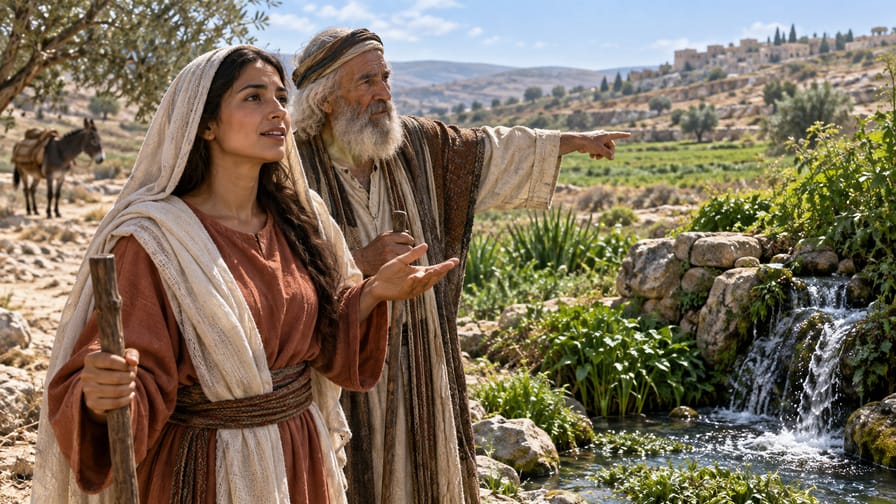
The figure of Achsah (עַכְסָה, ‘Aḵsāh) emerges in the narratives of the conquest of the land of Canaan as a notable example of feminine astuteness and proactivity. Although her story is concise, recorded in only two nearly identical Old Testament passages, it offers rich theological and practical insights. Her relevance transcends the brevity of her mention, serving as a microcosm of the larger themes of inheritance, divine provision, and human agency in the pursuit of God's blessings.
Under the evangelical Protestant perspective, the analysis of Achsah underscores the authority of the Scriptures, the historical accuracy of events, and the application of eternal principles. Her narrative, though not central to the history of redemption in terms of great covenants or direct messianic prophecies, illustrates God's faithfulness to His people and the way He empowers individuals to actively participate in His purposes. The figure of Achsah, therefore, is a testament to divine providence and the importance of practical faith and discernment in the life of the believer.
1. Etymology and meaning of the name
The name Achsah, in Hebrew עַכְסָה (*‘Aḵsāh*), is of uncertain origin, but several etymological proposals have been presented by scholars of biblical languages. The Greek transliteration in the Septuagint (LXX) is Αχσα (*Akhsa*). Although the exact meaning remains somewhat ambiguous, the most common interpretations point to connotations of value, beauty, or action.
One of the most accepted derivations connects *‘Aḵsāh* to the Hebrew root meaning "anklet" or "ankle ornament" (cf. Isaiah 3:18, where the word *‘akāsîm*, "anklets," is used). In this sense, the name could symbolize beauty, adornment, or something of value. In an ancient culture, jewelry and ornaments were often indicators of social status and wealth, bestowing upon the wearer a certain dignity and esteem.
Another possible etymological root suggested is that of "to break" or "to burst forth." If this interpretation is correct, the name Achsah could foreshadow her bold and decisive action of "breaking" social expectations by making a direct and significant request to her father. This connotation of "bursting forth" can also be seen in her quest for water sources, which "burst forth" from the ground to give life and fertility.
There are no other prominent biblical characters named Achsah, making her a unique figure in the Scriptures. The singularity of her name, whatever its precise origin, contributes to the memorability of her brief but impactful narrative. In contrast to more common names, Achsah stands out, as does her action in biblical history.
The theological significance of the name, if interpreted as "ornament" or "anklet," may reside in the idea that Achsah was considered a treasure by her father, Caleb. Her value was not only intrinsic but also functional, as she became part of a strategic transaction for the conquest of the land. If the meaning is "to break" or "to burst forth," this highlights her determined personality and her ability to act with initiative, a trait valued in the context of faith and obedience to God.
In both cases, the name Achsah, in its biblical context, suggests a woman of intrinsic worth and a remarkable capacity for action. She is not a passive figure but one who actively seeks blessing and provision, echoing a recurring theme in evangelical theology that genuine faith manifests in works and in a diligent pursuit of God's will and promises.
2. Historical Context and Biblical Narrative
The story of Achsah is set during the period of the conquest and division of the land of Canaan, a crucial moment in Israel's history. This period, led by Joshua after the death of Moses, is traditionally dated around 1400-1375 BC, according to a chronology that places the Exodus in the 15th century BC. It is a time of transition from a nomadic nation to a people established in their own land, fulfilling the divine promises made to Abraham, Isaac, and Jacob.
The political and social context of the time was one of war and settlement. The tribes of Israel were in the process of expelling the Canaanite inhabitants and establishing their own borders and inheritances. The possession of the land was of extreme importance, not only for subsistence but as a tangible sign of God's faithfulness to His covenant with Israel. Society was patriarchal, with inheritance and leadership predominantly male, but with recognition of the importance of women in the family and social context.
2.1 Family Origin and Genealogy
Achsah is identified as the daughter of Caleb, the Kenizzite, son of Jephunneh (Joshua 15:16 Judges 1:12). Caleb is a prominent figure in Israel's history, one of the two spies who brought a favorable report of the promised land (Numbers 13:30 Numbers 14:6-9) and a man of unwavering faith. His faithfulness earned him the promise that he and his descendants would inherit the land he had trodden (Numbers 14:24 Deuteronomy 1:36).
Achsah's genealogy directly connects her to a lineage of faith and courage, influencing her own personality. She is also the wife of Othniel, her cousin, who would later become the first judge of Israel (Judges 3:9-11). This family connection places her at the heart of the leadership and initial formation of the Israelite nation in the Promised Land.
2.2 Main Events of Her Life
The narrative of Achsah is recounted in two nearly identical passages: Joshua 15:16-19 and Judges 1:12-15. Both accounts describe the same crucial events of her life:
- Caleb's Promise: Caleb, in his quest to conquer the territory promised to him, offers his daughter Achsah in marriage to the man who would conquer Kiriath-Sepher (also known as Debir). This city was an important fortress in the territory of Judah.
- Othniel Conquers Debir: Othniel, son of Kenaz and Caleb's younger brother (or his nephew, depending on the interpretation of Judges 1:13), accepts the challenge and conquers the city. As a result, Caleb fulfills his promise and gives Achsah to Othniel as his wife.
- Achsah's Request: After the marriage, Achsah is described as "urging" or "instigating" her husband to ask her father for a field. The narrative in Judges says that she herself "dismounted from the donkey" when her father approached her, indicating a direct and determined action.
- Caleb's Provision: When asked what she desired, Achsah expresses her request for "springs of water," because the land given to her, the Negeb, was dry. Caleb, in response to her insightful request, grants her not only the upper springs but also the lower springs, demonstrating his generosity and recognition of his daughter's need.
The geography related to Achsah includes Kiriath-Sepher (Debir), the city conquered by Othniel, and the Negeb, the arid region where Caleb had granted lands. The "upper springs and lower springs" (*gullōt ‘ilyōt* and *gullōt taḥtîyōt*) are crucial for the fruitfulness of the land, and their acquisition ensures the viability of Achsah and Othniel's inheritance.
Her relationships with Caleb and Othniel are central to her story. Caleb, her father, is the hero of faith who grants the land. Othniel, her husband and cousin, is the warrior who conquers the city and later becomes one of Israel's first leaders. The story of Achsah, therefore, is intrinsically linked to the distribution of the land inheritance and the formation of Israel's leadership.
3. Character and Role in the Biblical Narrative
Although Achsah's presence in the Scriptures is limited to a brief episode, an analysis of her character reveals a woman of remarkable qualities. Her role in the biblical narrative, especially in Joshua 15:16-19 and Judges 1:12-15, portrays her as a proactive, astute, and determined figure who plays a significant part in securing the prosperity of her family's inheritance.
One of Achsah's most evident virtues is her proactivity and initiative. In a patriarchal society where women generally did not take the lead in matters of inheritance and property, Achsah breaks with this norm. The narrative of Judges 1:14, which states that she "urged" her husband to ask for a field, or that she herself "dismounted from the donkey" to make the request to her father, underscores her agency. She does not passively wait, but acts to secure what is needed.
Her wisdom and prudence are also noteworthy. Achsah's request is not for luxury or whim, but for a practical and vital need: springs of water. She recognizes that the land received in the Negeb, an arid region, would be of little value without adequate irrigation. Her request demonstrates keen discernment about the land's conditions and what would be necessary to make it productive and sustainable. She understands that an inheritance without the resources to cultivate it is an incomplete blessing.
Achsah's boldness and courage are equally impressive. Making a direct and substantial request to Caleb, a respected leader and warrior, required great daring. Her action is a testament to her strength of character and her trust in her father's love and generosity. She does not fear to express her needs and aspirations, a trait that distinguishes her in the gallery of biblical characters.
There are no sins, weaknesses, or moral failures documented in Achsah's brief narrative. On the contrary, her figure is presented positively, as an example of someone who seeks the fullness of God's blessing through her father's provision. Her integrity and discernment are the dominant traits of her character.
Achsah's role in the biblical narrative, though not that of a prophetess, priestess, or queen, is fundamental to the theme of inheritance and possession of the land. She functions as a catalyst for obtaining essential resources. Her primary vocation is that of a daughter and wife, but within these roles, she demonstrates a remarkable ability to positively influence the destiny of her family and her inheritance.
Achsah's significant actions focus on her request for the springs of water. This key decision not only ensures the fertility of her property but also illustrates the importance of not being content with the minimum, but seeking the fullness of promised blessings. She demonstrates that active faith and diligent pursuit are rewarded, a central theological principle in the evangelical tradition.
The development of Achsah's character, given the brevity of her mention, is limited. However, the episode of her request reveals an already formed and mature character, capable of discernment and action. She emerges in the narrative as a woman already endowed with wisdom and courage, whose actions have a lasting impact on the prosperity of her family in the Promised Land. Her story is a snapshot of an exemplary character.
4. Theological Significance and Typology
Despite being a secondary figure, the story of Achsah holds a theological significance that aligns with the grand themes of redemptive history and progressive revelation. Her narrative, set in the context of the conquest of the Promised Land, serves as a microcosm of divine providence, the importance of inheritance, and active faith in the life of God's people. The evangelical Protestant perspective seeks to extract eternal principles from these passages and, where possible, typological connections with Christ.
Achsah's role in redemptive history is intrinsically linked to the realization of God's promise to Abraham concerning the possession of the land (Genesis 12:7 Genesis 15:18-21). Her story takes place at the moment Israel is establishing its inheritance, and she, through her initiative, ensures that this inheritance is full and fruitful. She participates in God's work of blessing His people in the land flowing with milk and honey, but which also requires effort and wisdom to be cultivated.
Regarding Christocentric prefiguration or typology, Achsah is not a direct or obvious type of Christ. However, her story can be interpreted as an illustration of spiritual principles that point to greater realities in Christ and in the life of the believer. One of the most notable aspects is her request for "springs of water" (*gullōt mayim*).
Springs of water in the Old Testament frequently symbolize life, blessing, and God's provision (Psalm 36:9 Jeremiah 2:13). In the New Testament, Jesus presents Himself as "living water" (John 4:10-14), and the Holy Spirit is compared to "rivers of living water" (John 7:37-39). Thus, Achsah's desire for springs to make her land productive can be seen as a type of the believer's desire for the fullness of the Holy Spirit and the spiritual blessings that make Christian life fruitful.
Achsah's boldness in asking her father Caleb can be a prefiguration of how believers are encouraged to boldly ask God, our heavenly Father, for our needs and for the fullness of His blessings (Matthew 7:7-11 Philippians 4:6). Caleb, as the generous father who grants more than was requested (upper and lower springs), can be seen as a type of God's generosity, who is able to do "immeasurably more than all we ask or imagine" (Ephesians 3:20).
Although Achsah is not directly cited in the New Testament, her narrative resonates with central theological themes. Her story illustrates the faith that manifests in action, obedience to the principles of inheritance established by God, and Caleb's grace in granting the request. It reminds us of the importance of seeking God with discernment and of not being content with an incomplete or unproductive spiritual inheritance.
The connection with the theme of inheritance is profound. The inheritance of the land for Israel prefigured the spiritual inheritance of believers in Christ, which includes salvation, eternal life, and heavenly blessings (Ephesians 1:11-14 Colossians 1:12). Achsah, by ensuring that her earthly inheritance was fully viable, teaches us to seek the fullness of our spiritual inheritance in Christ, who is the source of all life and fertility. The possession of the land was a prophetic fulfillment for Israel, and Achsah's story is an integral part of that fulfillment.
Doctrinally, the story of Achsah reinforces the belief in God's providence, which operates through the actions and decisions of individuals. It also highlights the importance of female agency in biblical history, showing that God uses both men and women for His purposes. It teaches that practical wisdom and active faith are rewarded, and that the generosity of an earthly father reflects the incomparable generosity of our heavenly Father.
5. Biblical-Theological Legacy and Canonical References
Achsah's legacy, though not manifested in volumes of writings or an extensive genealogy, is significant for understanding certain aspects of biblical theology and Israel's history. Her canonical references are direct and limited to Joshua 15:16-19 and Judges 1:12-15, with both passages being nearly identical. This duplication underscores the story's importance to the editors of the canon, indicating that Achsah's narrative contained valuable lessons for the people of Israel and for future generations.
There are no mentions of Achsah in other biblical books beyond Joshua and Judges, nor is she credited with any literary contributions. Her influence, therefore, does not come through authorship, but through the example of her life and actions. Her story, however, demonstrates God's faithfulness in fulfilling His promises of land and prosperity for His people, and the importance of human initiative in seeking these blessings.
In Old Testament biblical theology, Achsah serves as an example of how the possession of the promised land was a process that involved not only war and tribal distribution but also individual intelligence and proactivity. She contributes to the understanding that divine inheritance, although guaranteed by God, often requires the active and discerning participation of human beings to be fully enjoyed. Her quest for the "springs of water" is a vivid reminder of the need for resources to make the inheritance fruitful, both literally and metaphorically.
In the Jewish interpretive tradition, Achsah is often seen as a model of a wise and discerning woman, whose insight ensured her family's well-being. Her story is used to illustrate the importance of making considered petitions and the generosity of a father. In the Christian tradition, especially in evangelical theology, Achsah is praised for her practical faith and her boldness. Commentators like Matthew Henry and John Gill highlight her astuteness and Caleb's generosity as a reflection of divine providence.
Reformed and evangelical theology sees in Achsah a positive example of a believer who is not content with a partial blessing but seeks the fullness of God's provision. Her story is frequently used in sermons and biblical studies to encourage believers to pray boldly and to seek God for all their needs, trusting in His generosity. The typology of the "springs of water" is a common point of application, connecting the need for water for the land to the need for the Holy Spirit for spiritual life.
Achsah's importance for understanding the canon lies in her contribution to the panorama of Israel's conquest and settlement. She is one of many voices and actions that, together, paint a picture of God's faithfulness and human response to that faithfulness. Her story, though brief, is a reminder that God acts through ordinary individuals, including women, to fulfill His grand purposes.
In summary, Achsah is a testament to God's providence, the importance of initiative and wisdom in the life of the believer, and the divine generosity that exceeds human expectations. Her narrative, though concise, remains a point of reference for evangelical theology, inspiring believers to seek the fullness of the inheritance given to them in Christ, through active faith and bold, discerning prayer.