


Jephunneh
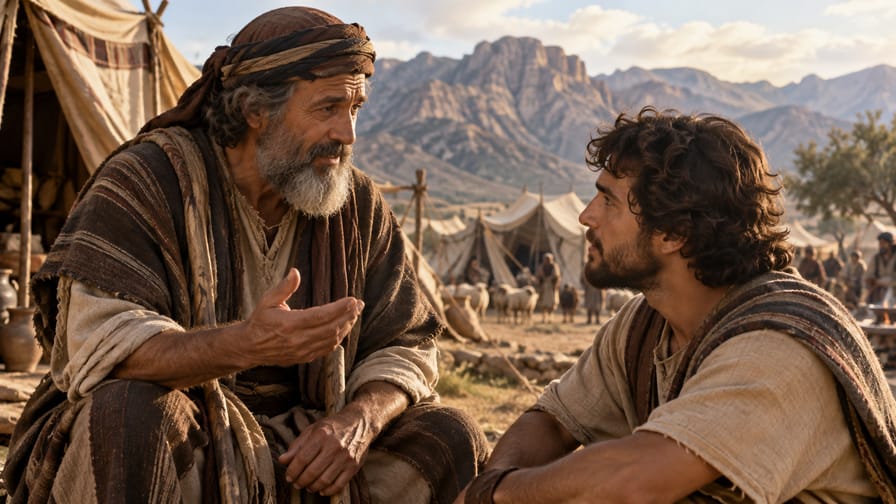
The figure of Jephunneh, although not a central protagonist in biblical narratives, assumes significant importance as the father of Caleb, one of Israel's most prominent and faithful spies. His relevance derives primarily from his lineage and the constancy with which his name is associated with his son's, indicating a lineage of faith and obedience to God amidst a generation marked by unbelief. This analysis will explore the etymology, historical context, inferred character, theological significance, and legacy of Jephunneh from a Protestant evangelical perspective, emphasizing biblical authority and Christocentric typology.
The repeated mention of "Caleb, son of Jephunneh" (Numbers 13:6, Numbers 14:6, Deuteronomy 1:36, Joshua 14:6) is not merely a genealogical identification, but a testimony to the importance of lineage and the way an individual's identity was intrinsically linked to their family. Caleb's faithfulness, a man who "followed the LORD wholeheartedly" (Numbers 32:12), reflects, albeit indirectly, the heritage and family environment from which he came, where the principles of faith and obedience to Yahweh must have been instilled.
This study seeks to present an in-depth exegetical and theological analysis, considering the historical and doctrinal implications that the brief but persistent presence of Jephunneh in the Scriptures offers. Understanding his role, though secondary, contributes to a richer appreciation of God's redemptive plan and the faithfulness He requires from His people, manifested through the generations.
1. Etymology and meaning of the name
1.1 Original Hebrew name and linguistic derivation
The name Jephunneh (in Hebrew: יְפֻנֶּה, Yepunneh) is found predominantly in the Old Testament, associated exclusively with the figure of Caleb's father. The etymology of this name is subject to some scholarly discussion, but most agree that it derives from the Hebrew root פָּנָה (panah), which means "to turn," "to turn oneself," "to direct oneself," "to prepare," or "to open a way."
The verbal form Yepunneh is an imperfect future of the root panah, which can be interpreted in various ways. The most common translations suggest meanings such as "he will be turned/faced" (towards God, for a purpose), "he will be prepared/made ready," or "he will be given a way." Some theologians, like Gesenius, point to the idea of "he will open a way" or "he will turn himself."
1.2 Literal and symbolic meaning of the name
Literally, "he will be turned" or "he will be prepared" can have important symbolic implications in the context of Jephunneh's story and, more significantly, that of his son Caleb. If the name suggests being "turned" towards God or a divine purpose, it may prefigure the posture of faith and obedience that Caleb would demonstrate throughout his life, "turning" to follow the LORD completely (Numbers 32:12).
The idea of being "prepared" or "having a way opened" also resonates with the journey of the people of Israel in the wilderness and the promise of the Promised Land. Caleb, son of Jephunneh, was one of the few of that generation who was "prepared" and had his "way opened" to enter and inherit the land, in contrast to the majority who perished due to unbelief (Numbers 14:30).
1.3 Theological significance of the name in the biblical context
Although there is no explicit explanation in the Scriptures about the theological meaning of the name Jephunneh, its etymology can be seen as providential, especially when we consider his son's exemplary faith. The name can be interpreted as a foreshadowing or a declaration about God's readiness to "turn" to those who seek Him and to "prepare" a way for the faithful, even amidst adversity.
For Reformed theology, God's sovereignty extends even to the choice of names, which often carry a prophetic or descriptive meaning. Thus, Jephunneh can be seen as a name that, in a subtle way, points to the divine grace that enables and guides His servants, preparing them to fulfill His will and inherit His promises, as seen in the life of Caleb.
2. Historical context and biblical narrative
2.1 Historical period and family origin
Jephunneh lived during the Exodus period, likely being born in Egypt and part of the generation that departed from slavery under Moses' leadership. His son Caleb was forty years old when he was sent as a spy to Canaan (Joshua 14:7), which places Jephunneh as a man who witnessed God's miracles and judgment in the wilderness. This period is crucial for the formation of Israel's identity as a theocratic nation.
Jephunneh's family origin is a point of particular interest and debate. The Bible consistently identifies him as the father of Caleb, the Kenizzite (Numbers 32:12, Joshua 14:6). The Kenizzites (in Hebrew: קְנִזִּי, Qĕnizzî) were a clan or people mentioned in Genesis 15:19 as one of the tribes that inhabited Canaan before the arrival of the Israelites. This has led to speculations that Jephunneh, and consequently Caleb, was not an Israelite by birth, but a proselyte or someone of foreign origin who was assimilated into the tribe of Judah.
However, 1 Chronicles 4:15 lists Caleb as a descendant of Judah, suggesting that the Kenizzites may have been a clan within the tribe of Judah, perhaps incorporated through marriage or adoption. The most accepted view among evangelical commentators, such as John Calvin and Matthew Henry, is that Jephunneh was indeed a non-Israelite or of mixed lineage who was fully integrated into Israel, which highlights the inclusivity of God's covenant and Jephunneh's faith in joining the people of Yahweh.
2.2 Key events and biblical passages
Jephunneh's life is not narrated in detail, and he performs no direct actions recorded in the Scriptures. His presence is always in reference to his son Caleb. The key biblical passages where Jephunneh is mentioned are:
- Numbers 13:6: Caleb is introduced as "Caleb, son of Jephunneh, of the tribe of Judah," one of the twelve spies sent by Moses.
- Numbers 14:6: Caleb, again identified by his father, and Joshua tear their garments in protest against the people's unbelief.
- Numbers 14:30: God decrees that, except for Joshua, son of Nun, and Caleb, son of Jephunneh, none of those who left Egypt would enter the Promised Land.
- Numbers 26:65: Reaffirms the divine decree, highlighting the exception of Joshua and Caleb, son of Jephunneh.
- Numbers 32:12: Moses praises Caleb, son of Jephunneh, saying that he "followed the LORD wholeheartedly."
- Deuteronomy 1:36: Moses reiterates the promise that Caleb, son of Jephunneh, would see the land and inherit it for having followed the LORD completely.
- Joshua 14:6-15: Caleb, son of Jephunneh, claims his inheritance in Hebron, recalling the promise made to him by Moses.
- Joshua 15:13: The inheritance of Caleb, son of Jephunneh, is formally established in Hebron.
- Judges 1:12: Caleb, son of Jephunneh, offers his daughter Achsah in marriage to whoever conquers Kiriath-Sepher.
- 1 Chronicles 4:15: Lists Caleb as the son of Jephunneh in the genealogy of Judah.
The constant repetition of Jephunneh's name alongside Caleb's serves to solidify the identity and lineage of the faithful spy. Although Jephunneh does not play an active role in the narrative, his fatherhood is essential to identify Caleb and authenticate the divine promises made to him.
3. Character and role in the biblical narrative
3.1 Character analysis as revealed in the Scriptures
The Bible offers no direct descriptions of Jephunneh's character. Any analysis must be inferential, based primarily on the figure of his son Caleb. Caleb's unwavering faith and his loyalty to Yahweh are consistently praised in the Scriptures. It is reasonable to assume that such a character did not arise from a vacuum, but was nurtured in a family environment that valued faith and obedience.
Caleb's perseverance in following the LORD wholeheartedly (Numbers 14:24) suggests that the principles of faithfulness to God were part of his family's inheritance. While we cannot directly attribute Caleb's qualities to Jephunneh, the absence of any rebuke or fault associated with Jephunneh in the Bible, combined with his son's faith, allows us to infer that he was a man who, at the very least, did not oppose faith in Yahweh and probably practiced it actively.
3.2 Role played and significant actions
Jephunneh's primary role in the biblical narrative is that of Caleb's father. This function is fundamental for Caleb's identity and for the validation of the divine promises made to him. In the context of ancient culture, genealogy was of paramount importance, and the mention of the father was essential to establish the social, tribal, and, in many cases, the dignity of an individual.
Jephunneh's only recorded "action" is that of having fathered Caleb. However, this fatherhood carries significant weight. He was the progenitor of one of the two men of that generation who demonstrated exemplary faith and obedience to God, and who was rewarded with entry into the Promised Land. In this sense, Jephunneh indirectly contributed to the continuity of the lineage of faith and to the fulfillment of God's promises to Israel.
Jephunneh's possible Kenizzite origin, if interpreted as the integration of a non-Israelite into the covenant community, highlights his decision to associate with the people of God. This choice, which may have been made by him or his ancestors, reflects a faith that transcended ethnic and cultural barriers, a recurring theme in biblical theology about inclusion by faith. The theologian John Gill, for example, comments on the possible Kenizzite origin as a sign of God's grace extending beyond the borders of Israel.
4. Theological significance and typology
4.1 Role in redemptive history and progressive revelation
Jephunneh, as Caleb's father, occupies a place in redemptive history indirectly, but significantly. He is part of the lineage that traversed the wilderness, witnessed God's judgments on Egypt and Israel's unbelief. His greatest contribution is having fathered and, presumably, influenced a son whose faith was a beacon in a time of spiritual darkness.
Caleb's faithfulness, whether encouraged by Jephunneh or not, is a crucial link in the chain of progressive revelation, demonstrating that even in a rebellious generation, God preserves a faithful remnant. The story of Caleb, and by extension that of Jephunneh, illustrates the importance of covenant obedience and the reward of faith in the midst of adversity, preparing the ground for entry into the Promised Land, which is a type of heavenly inheritance in Christ.
4.2 Connection to central theological themes
The figure of Jephunneh, through Caleb, connects to several central theological themes from an evangelical perspective:
- Faith and Obedience: Caleb's faith in following the LORD completely (Numbers 14:24) is the most prominent point. Jephunneh, as his father, represents the lineage from which this faith emerged, emphasizing that genuine faith and obedience are rewarded by God.
- God's Faithfulness to His Promises: The promise of inheritance made to Caleb by Moses, and confirmed by God, is faithfully fulfilled many years later (Joshua 14:9-14). This reflects the immutability of God's character and His loyalty to those who honor Him.
- Inclusion by Faith: If Jephunneh was indeed a Kenizzite, his integration into the tribe of Judah and the prominence of his son Caleb serve as an early example of the inclusion of Gentiles into God's covenant people through faith. This foreshadows the broad inclusion of all nations in Christ, as taught in the New Testament (Galatians 3:28).
- Spiritual Inheritance: The conquest and inheritance of the Promised Land by Caleb, son of Jephunneh, typify the spiritual inheritance believers receive in Christ. The land is not conquered by human strength alone, but by faith and obedience, a principle that applies to our "imperishable, undefiled, and unfading inheritance" reserved in heaven (1 Peter 1:4).
4.3 Prefiguration or Christocentric typology
Although Jephunneh is not a direct typological figure of Christ, the story of his son Caleb, whom he fathered, can be seen as a prefiguration of certain aspects of Christ's work and the Christian life. Caleb, as the faithful one who enters the land and claims his inheritance, represents those who, by faith in Christ, receive the inheritance of eternal life and enter into God's "rest" (Hebrews 4:9-11).
Caleb's readiness to follow God completely, even in the face of opposition and the unbelief of the majority, echoes the radical faithfulness required of Christ's followers. Caleb's reward – a portion of land in Hebron – points to the "inheritance of the nations" that is given to Christ and, through Him, to those who are His (Psalm 2:8, Romans 8:17).
5. Biblical-theological legacy and canonical references
5.1 Mentions of the character in other biblical books
Mentions of Jephunneh are restricted to the Old Testament, always in association with Caleb. He appears in the books of Numbers, Deuteronomy, Joshua, and 1 Chronicles. This recurrence in different books, which span the law, history, and genealogies, underscores the importance of his identification as Caleb's father and the constancy of Caleb's lineage.
The repetition of the full name "Caleb, son of Jephunneh" serves as a marker of authenticity and a reminder of the divine promise. In a context where orality and memorization were crucial, the constant association of the father's name with the son reinforced the identity and credibility of the narratives.
5.2 Influence on biblical theology and interpretive tradition
Jephunneh's influence on biblical theology is mediated by his son Caleb. Caleb's story is a powerful testimony to obedience, faith, and divine reward. Jephunneh's fatherhood is the starting point for this exemplary narrative. In Jewish and Christian interpretive tradition, Caleb is often exalted as a model of faith, and Jephunneh is recognized as his ancestor.
Jephunneh's possible Kenizzite origin has been a point of reflection on the universality of God's grace and the inclusion of Gentiles in the plan of salvation. Evangelical commentators like F.B. Meyer and Charles Spurgeon, when discussing Caleb's life, frequently touch upon his origin and the implication that faith is not restricted to one ethnicity, but is accessible to all who believe. This resonates with Reformed theology that emphasizes divine sovereignty in election and the universality of the gospel call.
5.3 Treatment of the character in Reformed and evangelical theology
In Reformed and evangelical theology, Jephunneh is generally treated as a secondary figure, whose main importance lies in being Caleb's father. However, his consistent mention serves to reinforce the doctrine of the perseverance of the saints, exemplified in Caleb, and God's faithfulness in fulfilling His promises to those who demonstrate genuine faith.
Caleb's life, with Jephunneh as his progenitor, is frequently used in sermons and biblical studies to illustrate the importance of unwavering faith in the face of opposition, the necessity of "following the LORD wholeheartedly," and the reward of obedience. The lineage of Jephunneh and Caleb demonstrates that faith can be transmitted and that God honors those who commit to Him, even in environments of unbelief.
The inclusion of Jephunneh, possibly a Kenizzite, in the genealogy of Judah and the prominence of his son Caleb, is seen as a precursor to the inclusion of Gentiles in the church, a theme dear to evangelical theology. This inclusion demonstrates that God's covenant is not exclusive to one race or nation, but extends to all who respond with faith, a central principle of the gospel of Christ (Ephesians 2:11-22).
In summary, Jephunneh, although not a character who performs great deeds, plays a crucial role in fathering and naming Caleb, one of the most faithful and exemplary men of faith in the Old Testament. His presence in the Scriptures, though discreet, underscores the importance of lineage, family faith, and God's sovereignty in using individuals from diverse backgrounds to fulfill His redemptive purposes.