


Caleb
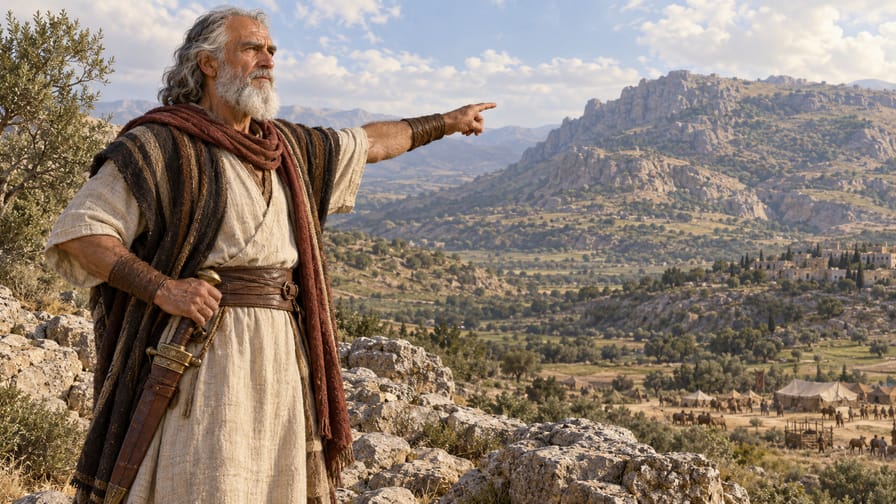
The figure of Caleb, whose name resonates with unwavering loyalty and fervor, emerges in the narratives of the Pentateuch and the historical books of the Old Testament as one of the most prominent examples of faith and obedience to God. His journey, from the exodus from Egypt to the conquest of Canaan, is marked by a singular devotion to the Lord, contrasting sharply with the unbelief and rebellion of his generation.
This analysis aims to explore the life and legacy of Caleb from a conservative evangelical Protestant perspective, examining his onomastic meaning, the historical context in which he lived, the virtues that shaped his character, and the profound theological relevance of his story for understanding faith, obedience, and the fulfillment of divine promises.
As one of the few of the Exodus generation who inherited the Promised Land, Caleb's narrative serves as a beacon of hope and a challenge to faithfulness, illustrating the reward of perseverance and the certainty of God's Word.
1. Etymology and meaning of the name
The name Caleb, in Hebrew, is Kalev (כָּלֵב). The etymology of this name is a subject of some discussion among scholars, but the most widely accepted interpretations converge on meanings that resonate with the character of the biblical figure. The most commonly associated root is kelev (כֶּלֶב), which means "dog."
At first glance, the association with "dog" might seem pejorative, but in the cultural and linguistic context of the Ancient Near East, the dog was often seen as a symbol of loyalty, devotion, and faithfulness. A "watchdog" was a vigilant protector, and the image of a dog that follows its master unconditionally can have positive connotations.
Another possible etymological derivation suggests that Kalev might be a contraction of kol-lev (כָּל-לֵב), which means "whole heart" or "full of heart." This interpretation, though not the most direct linguistically, harmonizes perfectly with the biblical description of Caleb as one who followed the Lord "completely" or "with his whole heart" (Deuteronomy 1:36 Numbers 14:24).
The theologian John Gill, in his Exposition of the Old and New Testaments, observes that, although the etymology of "dog" is the most probable, the contextual meaning of loyalty and devotion is what prevails in the interpretation of Caleb's name. He represents unconditional faithfulness, a characteristic that defines his life and legacy.
There are no significant variations of the name Caleb in biblical languages that substantially alter its meaning. The Greek transliteration in the Septuagint is Chaleb (Χάλεβ), retaining the Hebrew sound and sense.
There are no other prominent biblical figures with the same name who possess such extensive narratives or a theological meaning as central as Caleb son of Jephunneh. This confers a uniqueness to his story and the impact of his name.
The theological significance of Caleb's name, regardless of the exact etymology, lies in its profound resonance with the man's character. Whether as "loyal as a dog" or "with his whole heart," the name prefigures and describes Caleb's unrestrained devotion to Yahweh, becoming a symbol of unwavering faith and complete obedience in the context of the covenant.
2. Historical context and biblical narrative
2.1 Family origin and genealogy
Caleb is identified as the son of Jephunneh, the Kenizzite (Numbers 13:6 Numbers 32:12 Joshua 14:6). The designation "the Kenizzite" suggests that his family was not of pure Israelite origin but was assimilated into the tribe of Judah. The Kenizzites were a people who inhabited Canaan before the arrival of the Israelites and were mentioned in the Abrahamic covenant (Genesis 15:19).
This non-Israelite, yet integrated, ancestry is notable and may highlight the inclusion of Gentiles in the covenant community, a theme that resonates in Reformed theology regarding the universality of God's grace and the future inclusion of the nations in the church.
2.2 Major life events
Caleb's life spans a crucial period in Israel's history, from the Exodus from Egypt (circa 1446 BC, according to traditional conservative evangelical Protestant chronology) to the conquest and division of the Promised Land (circa 1406 BC). He was a central figure during the forty years of wandering in the wilderness and the early years of possessing Canaan.
The first major event in Caleb's life is his participation as one of the twelve spies sent by Moses to investigate the land of Canaan (Numbers 13:1-2). He represented the tribe of Judah, a position of honor and responsibility.
After forty days of exploration, the spies returned with a report. Ten of them brought a discouraging description of the land, focusing on the giants and fortified cities, instilling fear and discouragement in the people (Numbers 13:28-33).
In contrast, Caleb and Joshua presented a positive report, emphasizing the land's fertility and God's faithfulness to grant Israel victory (Numbers 13:30 Numbers 14:6-9). They tore their clothes as a sign of mourning and indignation at the people's unbelief.
Despite the faithful testimony of Caleb and Joshua, the Israelite congregation rebelled, wishing to return to Egypt and stone them (Numbers 14:10). As a result of this unbelief, God sentenced that generation to die in the wilderness, with the exception of Caleb and Joshua, who were rewarded for their faith (Numbers 14:28-30).
God made a specific promise to Caleb: he would enter the Promised Land and receive the land he had walked on, "because he followed the Lord with his whole heart" (Numbers 14:24 Deuteronomy 1:36). This promise was reiterated by Moses before his death.
Forty-five years after the spies were sent, during the division of the land under Joshua's leadership, Caleb, eighty-five years old, claimed possession of Hebron, the mountainous region inhabited by the Anakim, giants who had frightened the previous generation (Joshua 14:6-15).
Caleb expressed his strength and vigor, stating that he was as capable of warring at eighty-five years old as he was at forty, when he spied out the land (Joshua 14:10-11). He trusted in God's promise and in His ability to empower him for battle.
Joshua blessed Caleb and gave him Hebron as an inheritance (Joshua 14:13). Caleb then drove out the three sons of Anak: Sheshai, Ahiman, and Talmai (Joshua 15:14 Judges 1:20). He also offered his daughter Achsah in marriage to whoever conquered Kiriath-Sepher (Debir), which was conquered by Othniel, his nephew (Joshua 15:16-17 Judges 1:12-13).
Caleb's story is intrinsically linked to the geography of the Promised Land, especially the mountainous region of Judah, with Hebron, one of the oldest cities in Canaan, as the center of his inheritance.
His most important relationships are with Moses, his leader during the wandering, and Joshua, his companion in faith and successor to Moses, with whom he shared the honor of entering the promised land. He is also connected to Othniel, the first judge of Israel, through the marriage of his daughter.
3. Character and role in the biblical narrative
3.1 Virtues and spiritual qualities
Caleb's character is a paradigm of spiritual virtues. Scripture consistently describes him as a man of unwavering faith. His trust in God did not waver in the face of seemingly insurmountable obstacles, such as the Anakim giants or fortified cities.
He demonstrated exceptional courage by opposing the majority of the spies and the fury of the Israelite congregation (Numbers 13:30 Numbers 14:6-9). His intrepidity was grounded in the conviction of God's faithfulness and power.
Caleb's obedience was complete and unconditional. He "followed the Lord with his whole heart" (Numbers 14:24 Deuteronomy 1:36 Joshua 14:8-9). This phrase is a motto that defines his life, indicating a total and unreserved devotion to God.
His perseverance is remarkable. He waited patiently for forty-five years for the divine promise to be realized, maintaining his faith and vigor even in old age (Joshua 14:10-11). His longevity and strength were a testament to God's blessing on his life.
Caleb possessed a "different spirit" (Numbers 14:24). This Hebrew expression, ruah aḥeret (רוּחַ אַחֶרֶת), suggests a mental and spiritual attitude distinct from that of the majority. He did not conform to the unbelief and discouragement of his generation.
This "different spirit" was driven by faith and God's vision, in contrast to the carnal and fearful vision of the people. He saw challenges not as insurmountable obstacles, but as opportunities for God to demonstrate His power.
Caleb's integrity is evident in his consistency throughout his entire life. He did not change his mind or his loyalty, remaining faithful to his initial conviction that God would fulfill His promises.
3.2 Vocations and role played
Caleb's role in the biblical narrative was multifaceted. Initially, he served as a tribal leader, representing Judah as a spy. Afterward, he acted as a prophet of faith, confronting the people's unbelief and calling them to trust in God.
During the conquest, he was a valiant warrior, leading his clan in driving out the Anakim and taking possession of his inheritance. His readiness to confront the giants in Hebron, even in old age, served as an inspiration for the entire nation.
He also played a significant role in the distribution of the land, being the first to claim his portion based on the divine promise. This established a precedent for faith and obedience in possessing the inheritance.
There are no documented records of sins or moral failings in Caleb's life, which is notable for such a prominent character. His narrative is almost exclusively focused on his virtues and his unwavering faithfulness.
Caleb's significant actions include his faithful report on Canaan, his persistence in upholding God's faithfulness, his claim to the inheritance in Hebron, and his victory over the Anakim. Each of these actions demonstrates his profound faith and obedience.
Caleb's development is not so much a transformation from a sinful to a righteous state, but rather a continuous and deepening demonstration of an already godly character. He began his journey with faith and maintained it to the end, growing in trust and serving as a model of perseverance.
4. Theological significance and typology
4.1 Role in redemptive history
Caleb plays a crucial role in the redemptive history of Israel and in the progressive revelation of God's plan. He is a living testimony to God's faithfulness to His promises, even in the face of human unfaithfulness. His life illustrates that the promise of the land was not nullified by the unbelief of the majority, but was fulfilled through the faith of a few.
His story is a vital link between the Exodus generation, which failed to enter the land due to unbelief, and the conquest generation, which inherited it by faith. He represents the continuity of the covenant and the perseverance of faith in the midst of apostasy.
4.2 Prefiguration and Christocentric typology
Although Caleb is not a direct type of Christ in the sense of prefiguring specific aspects of His redemptive work, he serves as a moral and spiritual type. His faith, obedience, and "different spirit" point to the discipleship that Christ demands of His followers.
Caleb's entry into the Promised Land, after forty years of wandering, typifies the believer's entry into God's "rest" (Hebrews 4:1-11), which is found in Christ. His inheritance in Hebron, conquered by faith and battle, can be seen as a type of the spiritual inheritance that believers receive in Christ, which requires faith and struggle against the spiritual forces of evil.
Caleb's "whole heart" prefigures the complete devotion that is due to Christ, who perfectly fulfilled the law and the purpose of God. He is an example of how saving faith manifests in practical obedience, a central theme in Pauline and Jamesian theology (Romans 1:5 James 2:14-26).
4.3 Connection with central theological themes
Caleb's life is deeply connected to central theological themes. His story is a powerful testimony to faith. He believed in God's promises and acted in accordance with that belief, even when everything around him suggested otherwise (Numbers 14:6-9).
Obedience is another key doctrine. Caleb's reward (entry into the land and possession of Hebron) was directly attributed to his obedience in following the Lord "with his whole heart." This highlights the importance of obedience as the fruit of true faith.
The faithfulness of God is glorified in Caleb's life. God fulfilled His promise to Caleb forty-five years later, demonstrating that His words are worthy of all trust and that He never fails in His covenants.
God's grace is evident in the choice of Caleb and Joshua to enter the land, despite the condemnation of the entire generation. Although faith is a requirement, it is God's grace that empowers and rewards that faith.
His story also addresses the theme of divine judgment on unbelief, as seen in the forty-year wandering and the death of the unfaithful generation. Caleb and Joshua are the survivors of grace in the midst of judgment.
In the New Testament, Caleb is not explicitly named, but the author of Hebrews makes a veiled reference to the generation that could not enter God's rest because of unbelief, using them as a counterpoint to those who enter by faith (Hebrews 3:7-19 Hebrews 4:1-11). Caleb's life is the positive example of what it means to "enter" that rest.
Reformed theology emphasizes God's sovereignty and human responsibility. Caleb's life is an example of man's responsibility to exercise faith and obedience, while also being a testimony to God's sovereign grace that preserves and rewards the faithful.
5. Biblical-theological legacy and canonical references
5.1 Mentions in other biblical books
Besides the books of Numbers, Deuteronomy, and Joshua, where Caleb is a central figure, he is also mentioned in the book of Judges. In Judges 1:12-15, the narrative of Othniel, his nephew and son-in-law, conquering Kiriath-Sepher, and Achsah's request for springs of water, is retold.
This retelling in Judges serves to reinforce Caleb's lineage and inheritance, connecting him with the beginning of the period of the judges and with Othniel, the first judge of Israel, consolidating his importance in the nation's history.
In 1 Chronicles 2:18-20 and 1 Chronicles 4:15, Caleb is included in the genealogies of Judah, with mentions of his descendants and sons. These genealogical references confirm his position as an important ancestor in the tribe of Judah, from which King David and, ultimately, the Messiah would come.
5.2 Influence on biblical theology and tradition
Caleb is not the author of any biblical book, but his life and actions have a lasting influence on biblical theology. He is a timeless model of faith and obedience, and his story continues to inspire believers in all generations.
In the Jewish interpretative tradition, Caleb is revered as one of the few righteous individuals of the wilderness generation. Midrashim and rabbinic commentaries frequently highlight his courage and devotion to God as an example for the Jewish people.
In the Christian tradition, especially in Reformed and evangelical theology, Caleb is often cited as an example of the perseverance of the saints, the importance of active faith, and the reward of obedience. Commentators such as Matthew Henry and Charles Spurgeon frequently refer to him as a model believer.
His readiness to face the giants and take possession of his inheritance is interpreted as a call for believers today to confront spiritual challenges with the same faith and trust in God's power. He encourages not to be content with a passive faith, but to strive for the spiritual inheritance in Christ.
The figure of Caleb is fundamental for understanding the biblical canon by illustrating the continuity of God's promises and the importance of the human response of faith. He serves as a link between generations and a testimony to God's faithfulness throughout the centuries.
His life demonstrates that the covenant promise, though universal in scope, is experienced individually through faith and obedience. He is a reminder that genuine faith is not merely an intellectual belief, but an active trust that manifests in works and perseverance.
In summary, Caleb remains a pillar of faith and a testimony to God's faithfulness. His story, rich in onomastic and theological meaning, resonates through the centuries as a model of integral devotion to the Lord, inspiring believers to follow God "with his whole heart."