


Ishui
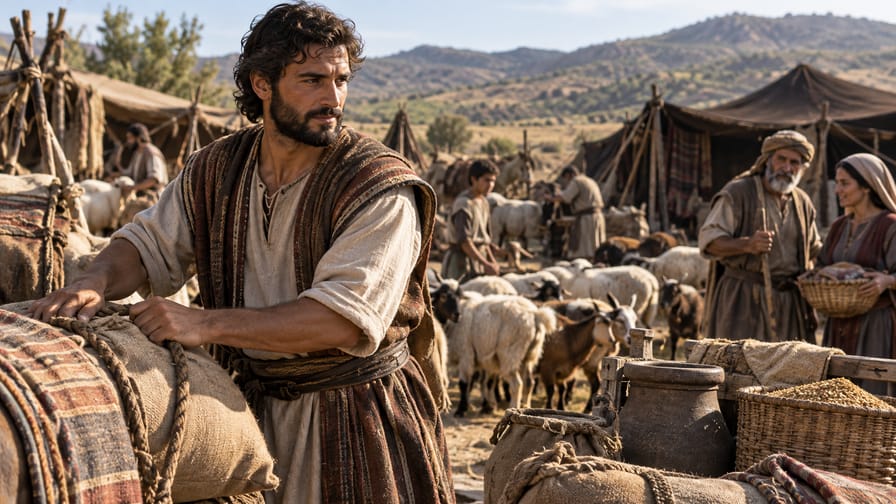
The figure of Ishvi (Hebrew: יִשְׁוִי, Yišwî), though not prominent in biblical narratives, plays a significant role within the genealogical and theological structure of the Old Testament. He is one of the sons of Asher, grandson of Jacob, and, therefore, one of the seventy descendants who accompanied Jacob to Egypt, as recorded in Genesis 46:17. His importance primarily lies in his function as the progenitor of one of the families of the tribe of Asher, contributing to the formation and organization of the people of Israel.
The analysis of Ishvi from a conservative evangelical Protestant perspective emphasizes the authority of Scripture, seeking to extract its meaning from the biblical text in its original context. Even for less prominent characters, the Bible reveals aspects of divine faithfulness, salvation history, and God's providence, which unfold through each individual listed in its sacred genealogies. Thus, the life and lineage of Ishvi, though brief in narrative detail, are an integral part of God's redemptive plan.
1. Etymology and Meaning of the Name
1.1 Original Name and Linguistic Derivation
The name Ishvi is derived from the Hebrew יִשְׁוִי (Yišwî), also transliterated as Ishvi or Ishui in some versions. This nominal form is consistent with the Hebrew practice of forming names from verbal or substantive roots that carry a specific meaning. The presence of the suffix -î indicates an adjectival or possessive form, or a gentilic, though in this case it functions as a proper name.
The etymological root of Yišwî is commonly associated with the verb יָשַׁע (yāšaʿ), which means "to save," "to deliver," but can also be linked to a root denoting "to be level," "to be equal," or "to be similar." While the connection with "salvation" is theologically rich, most lexicons and biblical commentators, such as Gesenius and Strong (H3439), point to the root of "equality" or "similarity."
1.2 Literal and Symbolic Meaning
Literally, the name Ishvi can be interpreted as "he is level," "he is equal," or "similar to me." This meaning suggests an idea of symmetry, conformity, or perhaps a position of balance. In the context of Hebrew culture, names often expressed characteristics, parental hopes or birth circumstances, or even implicit prophecies about the individual's or their lineage's future.
Symbolically, the meaning of "equality" or "similarity" can be interpreted in various ways. It could indicate that Ishvi was considered similar to someone important, or that he was seen as an individual who brought balance or justice. Although the Bible provides no narrative details to confirm such an interpretation, the name itself carries a connotation of order and proportion.
1.3 Variations and Other Characters
There are no significant variations of the name Ishvi in the biblical languages that alter its etymological essence. He is consistently presented as יִשְׁוִי (Yišwî) in the Hebrew text. This name appears to be unique to the son of Asher in the Scriptures, not being prominently attributed to other biblical characters, which makes it a distinctive name in its limited usage.
1.4 Theological Significance of the Name
The theological significance of the name Ishvi, though not explicit in the biblical narrative, can be inferred from its genealogical context. As one of the seventy who descended to Egypt, his name, even if it means "similar" or "equal," places him within the lineage of the promise. Each name in the biblical genealogies serves to trace God's providence in the preservation of Abraham's descendants and, ultimately, the messianic lineage.
In a broader perspective, the idea of "equality" or "similarity" can resonate with concepts of justice and equity, divine attributes. Although not directly attributed to Ishvi, the name recalls the character of God, who is just and impartial in His ways. The inclusion of his name in the canon underscores the importance of each individual in the divine plan, even those without recorded heroic deeds.
2. Historical Context and Biblical Narrative
2.1 Historical Period and Context
Ishvi lived during the patriarchal period, specifically at the end of the era of the patriarchs and the beginning of the formation of the people of Israel as a nation. He was born in the land of Canaan, before the migration of Jacob and his family to Egypt, an event dated approximately between 1876 and 1870 BC, according to the chronology traditionally accepted by many evangelical scholars. His life spanned the transition of Jacob's family from a nomadic clan to a growing community in Egypt.
The political, social, and religious context of Ishvi's time was marked by tribal and family life. Jacob's family was a semi-nomadic entity, living under patriarchal authority. The worship of God, the Lord (YHWH), was central, though syncretism and Canaanite influences were constant challenges. The Abrahamic promise of a great nation and the possession of the land of Canaan was the backbone of their faith and identity.
2.2 Genealogy and Family Origin
Ishvi is explicitly identified as the third son of Asher, the eighth son of Jacob (Genesis 46:17). His mother was Zilpah, Leah's servant, who bore Asher to Jacob (Genesis 30:12-13). His brothers were Imnah, Ishvah, and Beriah, and he had a sister named Serah. This genealogy inserts him directly into the lineage of the twelve tribes of Israel, which would become the foundation of God's chosen nation.
Ishvi's family, as part of Jacob's household, went to Egypt to escape the famine, a providential event orchestrated by God through Joseph (Genesis 45:7-8). He is listed among the seventy descendants of Jacob who entered Egypt, marking a crucial point in redemptive history, where the family would multiply and become a great nation, according to the promises made to Abraham, Isaac, and Jacob (Genesis 12:2 26:4 35:11).
2.3 Main Events and Biblical Passages
The Bible records no specific narrative events or actions of Ishvi. His mention is limited to genealogical lists, which are, nevertheless, of profound theological importance. The key passages where he appears are:
- Genesis 46:17: Where he is listed as one of the sons of Asher who went down to Egypt with Jacob. This passage is crucial for establishing the foundation of the twelve tribes and God's providence in preserving their lineage.
- Numbers 26:44: Where he is mentioned as the progenitor of the family of the Ishvites (or Ishuites), one of the clans of the tribe of Asher, during the census conducted by Moses in the wilderness. This record demonstrates the continuity of his lineage and the formation of Israel's tribal units.
- 1 Chronicles 7:30: Where his descendants are again confirmed in the genealogy of Asher. The Chronicles frequently revisit and reaffirm the genealogies, underlining the importance of lineage and tribal identity for the people of Israel.
2.4 Geography and Relationships with Other Characters
The primary geography associated with Ishvi is the land of Canaan, where he was born, and subsequently Egypt, in the region of Goshen, where Jacob's family settled. He would have lived in Egypt during the initial period of Israel's sojourn, before the oppression and the Exodus. His life was intrinsically linked to that of his father, Asher, and his immediate family.
His relationships with other characters are, therefore, familial: his father Asher, his grandfather Jacob, and his uncles and cousins who comprised the house of Israel. Although he had no direct recorded interactions with figures like Joseph, Moses, or Aaron, his existence and descendants are part of the same historical fabric that paved the way for the nation of Israel and its divinely appointed leaders.
3. Character and Role in Biblical Narrative
3.1 Character Analysis According to Scripture
Due to the absence of detailed narratives about Ishvi, the analysis of his character must be inferred and contextualized within the general biblical principles applicable to the sons of Israel. Scripture records no specific acts of virtue or failure for Ishvi, which means we cannot attribute personal qualities to him beyond what is implicitly expected of a member of the patriarchal family.
We assume that Ishvi, as part of Jacob's family who went down to Egypt, was a participant in the Abrahamic covenant by lineage. He would have grown up under the influence of his ancestors' faith, learning about the God of Abraham, Isaac, and Jacob. The absence of any reprimand or negative note concerning him in the genealogies suggests that he did not notably deviate from the ways of Israel, at least not in a manner significant enough to be recorded.
3.2 Virtues and Spiritual Qualities
Although there are no explicit mentions of virtues concerning Ishvi, his inclusion in the genealogies suggests a life in conformity with the expectations of the covenant community. We can infer a virtue of faithfulness in his ability to father descendants who formed a clan in Israel (the Ishvites, Numbers 26:44). This genealogical continuity is, in itself, a testament to obedience to the divine command to "be fruitful and multiply" (Genesis 1:28).
Participation in a family that maintained faith in the God of Israel, even in a foreign land, points to an implicit adherence to the religious principles of his time. He was part of God's promise to make Israel a great nation, and his life, even if silent in the narrative, contributed to the fulfillment of that promise.
3.3 Sins, Weaknesses, and Moral Failures
Similarly, the Bible does not document specific sins, weaknesses, or moral failures of Ishvi. This does not mean he was without sin, for the Scriptures affirm the universality of sin (Romans 3:23). However, his lack of recorded transgressions places him in contrast with figures like Reuben or Simeon and Levi, whose failures are explicitly mentioned (Genesis 35:22 49:5-7).
The absence of mention of moral failures for Ishvi suggests that his life was not marked by acts of disobedience that had significant impact or merited recording in salvation history. He appears to have been an ordinary and unproblematic member of Jacob's family, contributing to the stability and growth of his lineage.
3.4 Vocation, Calling, and Role Played
Ishvi's primary vocation, as revealed by the Scriptures, was to be a progenitor. His main role in the biblical narrative is to be a link in the genealogical chain, ensuring the continuity of the lineage of Asher and, by extension, of the twelve tribes of Israel. He is one of the "heads of families" (Numbers 26:44) who contributed to the formation of the nation.
Although he had no prophetic, priestly, or royal role, his existence was fundamental for the fulfillment of divine promises. The meticulousness of biblical genealogies, which include figures like Ishvi, demonstrates the precision of God's providence in every detail of His redemptive plan, from the patriarchs to the coming of Christ.
4. Theological Significance and Typology
4.1 Role in Redemptive History and Progressive Revelation
Ishvi's role in God's redemptive history, though discreet, is undeniable. His inclusion in the genealogies of Genesis and Numbers underscores God's faithfulness in fulfilling His promises of multiplication and the formation of a nation from Abraham (Genesis 12:2). He represents the continuity of the covenant lineage, a vital link in the chain that would lead to the coming of the Messiah.
Ishvi's life, as part of Jacob's household, participated in God's progressive revelation, which manifested through the formation of a chosen people. He witnessed the divine providence that led his family to Egypt and protected them, preparing the ground for the Exodus and the giving of the Law at Sinai. His existence is evidence of God's sovereignty over human history.
4.2 Prefiguration or Christocentric Typology
It is difficult to establish a direct and explicit typology of Ishvi for Christ, given the scarcity of narrative details about his life. However, in a broader sense, his inclusion in the messianic genealogy, which culminates in Jesus Christ (Matthew 1:1-17 Luke 3:23-38), makes him an indirect participant in the grand narrative of redemption. Each individual in this lineage, by their mere existence and procreation, points to God's ultimate goal of sending the Savior.
The formation of the twelve tribes, of which Ishvi was a progenitor of a clan, prefigures the universality of God's people, both Israel and the Church, which is composed of all tribes, tongues, peoples, and nations (Revelation 7:9). The meticulousness with which God preserves each lineage serves to demonstrate divine care in preparing the stage for the incarnation of Christ.
4.3 Connection with Central Theological Themes
The figure of Ishvi connects with several central theological themes from a conservative evangelical Protestant perspective:
- Sovereignty of God: The inclusion of Ishvi and other less prominent figures in the genealogies demonstrates God's sovereignty over history and individuals, using each one for His purposes.
- Covenant Faithfulness: The existence and descendants of Ishvi are a testament to God's faithfulness to His covenant promises with Abraham, Isaac, and Jacob, ensuring the multiplication of their offspring.
- Divine Election: As part of the chosen nation of Israel, Ishvi participates in God's election, who chose a people for Himself to be a channel of blessing to all nations (Genesis 12:3).
- Continuity of Redemption: His life, though without great deeds, is a link in the continuity of the history of redemption, which moves progressively towards its final fulfillment in Christ.
4.4 Associated Doctrine and Teachings
The main doctrine associated with Ishvi and similar figures in the genealogies is that of divine providence. God not only governs the great events of history but also the most intimate details of individual lives, including procreation and the formation of families. The inclusion of Ishvi in the Scriptures teaches that no life is insignificant in God's plan.
Furthermore, the emphasis on genealogies reinforces the doctrine of the historicity of the Christian faith. Salvation is not based on myths, but on real events and historical persons, whose lives were divinely orchestrated to fulfill a greater purpose. Ishvi is a piece, however small, in this intricate and true historical-redemptive mosaic.
5. Biblical-Theological Legacy and Canonical References
5.1 Mentions of the Character in Other Biblical Books
The mentions of Ishvi are restricted to the books of Genesis, Numbers, and 1 Chronicles. In Genesis 46:17, he is listed among the seventy who went down to Egypt. In Numbers 26:44, he is identified as the progenitor of one of the clans of Asher, the Ishvites. In 1 Chronicles 7:30, he reappears in the genealogy of Asher, confirming his lineage.
The consistency of these mentions across different books and contexts (patriarchal narrative, desert census, post-exilic genealogies) underscores the importance of preserving lineages for the identity and theology of Israel. Although he is not an active character, his genealogical presence is canonically established and significant.
5.2 Literary Contributions and Influence on Biblical Theology
Ishvi is not the author of any biblical book, psalm, or epistle. His literary contribution is indirect, through his inclusion in the canon, which serves to reinforce the importance of genealogies as a vital literary and theological genre in the Scriptures. Genealogies are more than mere lists they are concise narratives of God's faithfulness and the preparation for the coming of the Messiah.
Ishvi's influence on biblical theology lies in the validation of the truth that every individual, even the seemingly insignificant, is part of God's plan. He contributes to the understanding of Israel's formation as a nation from families and clans, a process that was divinely supervised and recorded with historical and theological precision.
5.3 Presence in Jewish and Christian Interpretive Tradition
In the Jewish interpretive tradition, genealogies are seen as crucial for tribal identity and land inheritance. Ishvi is recognized as one of the founders of a clan of Asher, and his descendants are important for understanding tribal distribution in Canaan. Genealogical accuracy was vital for land claims and for priestly purity.
In the Christian tradition, especially in Reformed and evangelical theology, the inclusion of Ishvi and others in the genealogies is often interpreted in light of redemptive history. Commentators like John Calvin and Matthew Henry, though not dedicating extensive sections to Ishvi, emphasize the divine purpose behind each name in the genealogies, pointing to God's providence in the messianic lineage. They see each name as proof of the historicity of faith and God's faithfulness to His covenant.
5.4 Treatment in Reformed and Evangelical Theology
Reformed and conservative evangelical theology values the inerrancy and sufficiency of Scripture, which means that every part of the text, including the genealogies, has a purpose. Ishvi, in this context, is seen as a silent witness to God's meticulous work in building Israel. His existence reinforces the doctrine of election and divine sovereignty, which chooses and preserves a people for Himself.
His inclusion also serves as a reminder of the importance of "common history" – the lives of ordinary people who, together, form God's grand plan. The evangelical perspective emphasizes that biblical history is not just about heroes, but about all who were divinely chosen and used, even in discreet ways, for the advancement of God's kingdom.
5.5 Importance of the Character for Understanding the Canon
The importance of Ishvi for understanding the biblical canon lies in the fact that he validates the integrity and historicity of the genealogies. These lists are fundamental for establishing the legitimacy of the tribes, the possession of the land, and, crucially, the lineage that culminates in Jesus Christ. Without the careful preservation of these genealogies, the connection between the promises of the Old Testament and the fulfillment in the New Testament would be weakened.
Thus, Ishvi, as one of the many names listed, contributes to confidence in the accuracy of the biblical record and the comprehensiveness of God's redemptive plan, which includes every individual and every generation in preparation for the coming of the Savior. He is a testament to God's faithfulness in every detail of His revelation and His salvation history.