


Abida
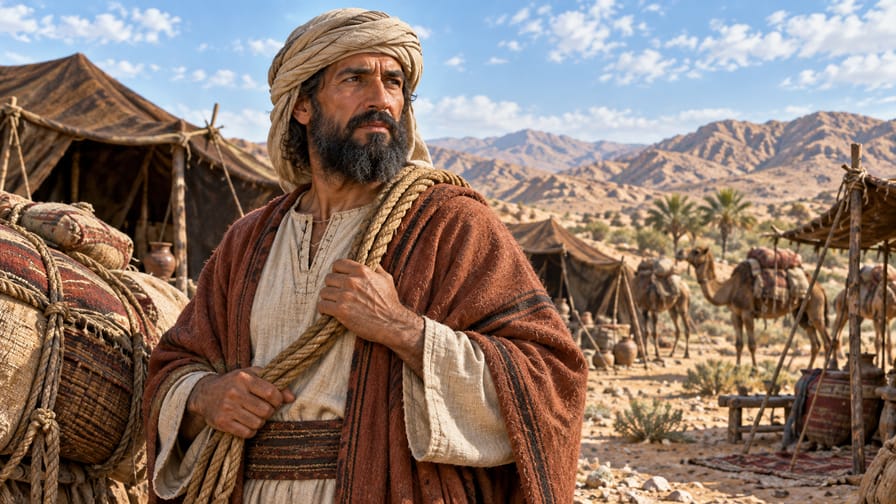
The figure of Abida, though briefly mentioned in the Scriptures, offers a starting point for a biblical and theological analysis that transcends mere genealogical listing. His inclusion in the canon, though concise, underlines divine meticulousness in preserving the history of salvation and demonstrating God's sovereignty over all nations and lineages. From an evangelical Protestant perspective, the analysis of Abida is not limited to his historical existence but extends to his significance in the broader panorama of progressive revelation and Christocentric typology.
This study will delve into the few references to Abida, extrapolating his meaning from the patriarchal context and the theology of the covenants. The implications of his lineage, his relationship with the patriarch Abraham, and the role of his descendants in the history of Israel will be explored. Although Abida is not a character with a developed narrative, his presence in biblical records contributes to understanding the extent of Abraham's offspring and the complex interactions between the peoples who emerged from his seeds.
The approach will be scholarly and encyclopedic, seeking to extract theological teachings and spiritual principles even from seemingly peripheral figures. Exegetical precision and commitment to biblical authority will guide the interpretation, emphasizing the relevance of every detail of the Word of God. Ultimately, the analysis of Abida will reveal how even the most concise mentions serve the divine purpose of revealing God's glory and the redemptive plan.
1. Etymology and meaning of the name
The name Abida (in Hebrew: עֲבִידָע, ʿĂḇîḏāʿ) is found in the Hebrew Scriptures as one of the sons of Midian, who in turn was a son of Abraham with Keturah (Genesis 25:4 1 Chronicles 1:33). The etymological analysis of biblical names is crucial for unraveling layers of meaning that often transcend simple identification, providing insights into expected character, cultural context, or even an implicit theological statement.
The etymological root of Abida is generally associated with two parts. The first part, עַב (ʿaḇ), is an abbreviated form of אָב (ʾāḇ), which means "father" or "my father." The second part, יָדַע (yāḏaʿ), is a common Hebrew verb meaning "to know," "to be acquainted with," "to have knowledge," or "to perceive." The combination of these roots suggests meanings such as "My father knows," "Father of knowledge," or "The father has known."
The meaning "My father knows" can be interpreted in several ways. It could be an expression of trust in paternal wisdom and knowledge, whether the earthly father (Midian or Abraham) or, more profoundly, the heavenly Father. In the context of a patriarchal culture, the father's wisdom and knowledge were highly valued and served as a guide for the family and tribe. This interpretation reflects a dependence on paternal authority and providence.
Alternatively, "Father of knowledge" or "The father has known" could be a reference to the very nature of God, who is omniscient and possesses all knowledge. Even if Abida is not a character with an extensive narrative, his name may carry a theological truth about God's sovereignty and knowledge over all things, including the formation of lineages and nations. In a broader sense, the naming of children in the Ancient Near East often carried spiritual aspirations or acknowledgments.
There are no significant variations of the name Abida in biblical languages that alter its etymological essence. It appears consistently as עֲבִידָע (ʿĂḇîḏāʿ) in Old Testament passages. Furthermore, there are no other prominent biblical characters who share this name, which makes it distinctive, though associated with a less prominent figure in the narrative.
From a theological perspective, the meaning of the name Abida, "My father knows," resonates with the doctrine of God's omniscience. God, as the supreme Father, knows the end from the beginning and sovereignly rules over human history (Isaiah 46:10). Even lineages not in the direct line of the messianic promise are under divine knowledge and providence, fulfilling greater purposes within the redemptive plan. This reminds us that God's sovereignty extends to all families of the earth, not only to those directly involved in the history of Israel.
2. Historical Context and Biblical Narrative
Abida appears in the Scriptures during the patriarchal period, specifically in the final phase of Abraham's life, after Sarah's death and the patriarch's marriage to Keturah. This period, estimated to be in the mid-second millennium BC (circa 2000-1800 BC), is characterized by the formation of various tribes and peoples who would inhabit the Ancient Near East region, many of whom would have significant interactions with the descendants of Isaac, the lineage of the promise.
The political, social, and religious context of the time was one of nomadic and semi-nomadic tribes, with strong family and clan structures. Religion was predominantly polytheistic, with cults to various local and ancestral deities. Abraham, however, stood out for his monotheistic faith in the one true God, Yahweh, who called him to be the father of many nations and to whom the Lord made unconditional promises (Genesis 12:1-3).
Abida is explicitly identified in the genealogy as a son of Midian, who was one of the six sons Abraham had with his second wife, Keturah (Genesis 25:1-2). The complete genealogy is presented in Genesis 25:4: "The sons of Midian were Ephah, Epher, Hanoch, Abida, and Elda. All these were descendants of Keturah." This list is reiterated in 1 Chronicles 1:33, demonstrating the importance of maintaining genealogical records in the biblical canon, even for lineages that are not the main focus of the redemptive narrative.
The mention of Abida and his brothers occurs after the narrative of Sarah's death and before Abraham's death. Abraham, before he died, "gave all he had to Isaac. But to the sons of the concubines he had, Abraham gave gifts and, while he was still living, sent them away from his son Isaac, to the land of the East" (Genesis 25:5-6). This action of Abraham is crucial for understanding the role of Abida and his brothers. Although they received possessions, they were separated from Isaac, the heir of the covenant promise.
The geography associated with Abida and his brothers is the "land of the East." This region is generally identified with the Arabian Peninsula, particularly the areas east and southeast of Canaan. The descendants of Midian, the Midianites, became a nomadic and commercially active people, frequently interacting with Israel at various points in its history. This geographical and genealogical separation established the distinction between the lineage of the promise (Isaac) and the other Abrahamic lineages.
Abida's relations with other biblical characters are indirect but significant. He is a grandson of Abraham, the father of faith, and of Keturah. His father, Midian, is the progenitor of the Midianites, a people who would later have notable encounters with Israel. For example, the Midianites were involved in the sale of Joseph to Egypt (Genesis 37:28, 36) and later became adversaries of Israel in the time of Moses (Numbers 25) and Gideon (Judges 6-8). The existence of Abida, therefore, is a genealogical link to a nation that would play a considerable role in the history of Israel.
3. Character and Role in the Biblical Narrative
The Bible offers no details about Abida's personal character, nor does it record any actions or decisions he made. His presence in the Scriptures is strictly genealogical, serving to document the extent of Abraham's descendants through Keturah. This brevity, however, does not negate his contextual and theological importance but redefines it within the greater purpose of biblical genealogies.
Abida's primary role in the biblical narrative is that of a link in the genealogical chain connecting Abraham to the Midianites. He is a progenitor, and his existence, even without biographical details, is essential for tracing the origin of one of the peoples that emerged from Abraham's seed. Genealogies in the Old Testament are not mere records of kinship they serve theological purposes, demonstrating God's faithfulness to His promises and the progression of salvation history.
Although we cannot attribute specific virtues or flaws to Abida, his inclusion in the genealogies of Genesis and Chronicles reflects the careful preservation of Abraham's family history. For the readers of Israel, these lists confirmed the origin of neighboring peoples and established the basis for future interactions and conflicts. The absence of a personal narrative for Abida allows his significance to be derived from his family context and the destiny of his descendants.
Abida's function, therefore, is that of an ancestor. He does not exercise a prophetic, priestly, royal, or apostolic role. His contribution is to be part of the "seed" of Abraham that expanded beyond the line of the messianic promise that would pass through Isaac. This distinction is fundamental to biblical theology, which always separates the covenant lineage (Isaac, Jacob, David, Christ) from the other Abrahamic lineages.
Significant actions and key decisions are not attributed to Abida. His life is presumably that of an ordinary man of the patriarchal era, involved in the activities of his nomadic tribe. Character development is nonexistent in the biblical narrative, which directs attention to the meaning of his existence as part of a greater plan, rather than to his individual achievements.
Abida's importance lies, therefore, in what he represents: the vast progeny of Abraham, which was not restricted solely to the nation of Israel. The Scriptures precisely record these other lines to show that God is the Lord of all history and all peoples, and that His blessing, though special and concentrated in Israel, also manifests in more general ways.
4. Theological Significance and Typology
The figure of Abida, despite his concise mention, holds significant theological meaning within the evangelical Protestant perspective, especially when contextualized within the history of redemption and progressive revelation. His inclusion in the Scriptures, even without a personal narrative, serves several doctrinal purposes, highlighting themes such as God's sovereignty, election, covenant, and the comprehensiveness of divine grace.
Abida's role in redemptive history is indirect but significant. He is part of Abraham's "seed" who, though not the lineage of the messianic promise through Isaac, nonetheless receives God's general blessings. God promised Abraham that He would make him "a father of many nations" (Genesis 17:4). The existence of Abida and his brothers demonstrates the fulfillment of this promise in a broad sense, showing that Abraham truly became the progenitor of diverse peoples, including the Midianites.
There is no direct Christocentric typology associated with Abida. He does not explicitly prefigure Christ. However, his existence and that of his Midianite brothers can be seen as a contrast that highlights the uniqueness of Isaac's lineage and, consequently, of Jesus Christ. The clear separation between Isaac's lineage (the line of the covenant and salvation) and Keturah's lineage (the line of general blessings) underlines the doctrine of election and God's sovereign grace (Romans 9:6-13).
The distinction between the lineages of Isaac and Keturah (including Abida) illustrates the difference between the covenant of grace, which culminates in Christ and salvation, and God's providential blessings extended to all humanity. Abraham sent the sons of Keturah to the East with gifts, but the inheritance of the promise went to Isaac (Genesis 25:5-6). This symbolizes the theological truth that, although God blesses everyone in various ways (common grace), there is a special and saving blessing reserved for those who are in the lineage of faith and the covenant, which is faith in Christ Jesus (Galatians 3:29).
There are no citations or references to Abida in the New Testament, nor direct prophecies concerning him. His theological relevance is drawn from a broader understanding of biblical genealogies and covenant theology. The inclusion of Abida in the biblical canon highlights the importance of historical and genealogical precision for understanding God's plan, even when individual details are scarce. Genealogies are more than lists they are theological affirmations of God's faithfulness and preparation for the coming of the Messiah.
Abida's connection with central theological themes, such as God's sovereignty, is evident. The existence of the Midianites, descendants of Abida, reveals that God has a plan for all nations, even those not directly involved in the history of Israel's redemption. God used the Midianites at specific times to discipline Israel and to fulfill His purposes, as seen in the books of Numbers and Judges. This demonstrates that God rules over all peoples and that His providence extends to all creation (Psalm 24:1).
In summary, the figure of Abida, though silent, serves as a reminder of the vast and complex tapestry of redemption history, where every thread, even those that seem less prominent, is woven by the sovereign hand of God. He reinforces the doctrine of election and the distinction between special (saving) grace and common (providential) grace, fundamental to Reformed and evangelical theology.
5. Biblical-Theological Legacy and Canonical References
Abida's legacy in the biblical canon is primarily genealogical and contextual, yet no less significant for understanding biblical theology in its entirety. His mentions are concise, restricted to Genesis 25:4 and 1 Chronicles 1:33. These passages, though brief, are crucial for establishing the origin of one of the most prominent peoples of the Ancient Near East, the Midianites, and for outlining the scope of Abraham's descendants.
There are no literary contributions attributed to Abida, such as the authorship of books, psalms, or epistles. His influence on biblical theology does not derive from his direct actions or teachings, but from his position within the vast genealogical tapestry that paves the way for the history of Israel and, ultimately, for the coming of Christ. He serves as a reminder that the Word of God is detailed and precise, recording even lineages that are not the main focus of the redemptive narrative.
In Jewish and Christian interpretive tradition, Abida is generally seen as part of Abraham's expanded genealogy. Jewish scholars frequently use these lists to trace the origins of neighboring peoples and to understand Israel's historical and ethnic relations. In the Christian tradition, especially the Reformed and evangelical, the inclusion of Abida reinforces the doctrine of God's sovereignty over all nations and the distinction between the seed of promise (Isaac) and the seeds that received general blessings.
Reformed and evangelical theology emphasizes the importance of genealogies for demonstrating God's faithfulness to His promises, even when details of an individual's life are scarce. The presence of Abida in the genealogies of Genesis and Chronicles serves to: 1) affirm the historicity of the biblical narrative 2) illustrate the extent of the fulfillment of God's promise to Abraham that he would be a father of many nations (Genesis 17:4) and 3) contextualize Israel's future interactions with peoples such as the Midianites.
Abida's importance for understanding the canon lies in his contribution to the completeness of the biblical record. He helps us understand that Israel's history does not occur in a vacuum, but amidst a complex network of peoples and cultures that also have their origins in divine providence. The careful documentation of these secondary lineages underscores the authority and inspiration of the Scriptures, which neglect no detail relevant to God's plan.
Although Abida is not a central character, his existence teaches us about divine meticulousness in preserving history and the breadth of God's governance. He reminds us that all Scripture is divinely inspired and useful for teaching, rebuking, correcting, and training in righteousness (2 Timothy 3:16), and that even the briefest mentions can contain profound theological truths about God's character and His redemptive plan for humanity.