


Phinehas
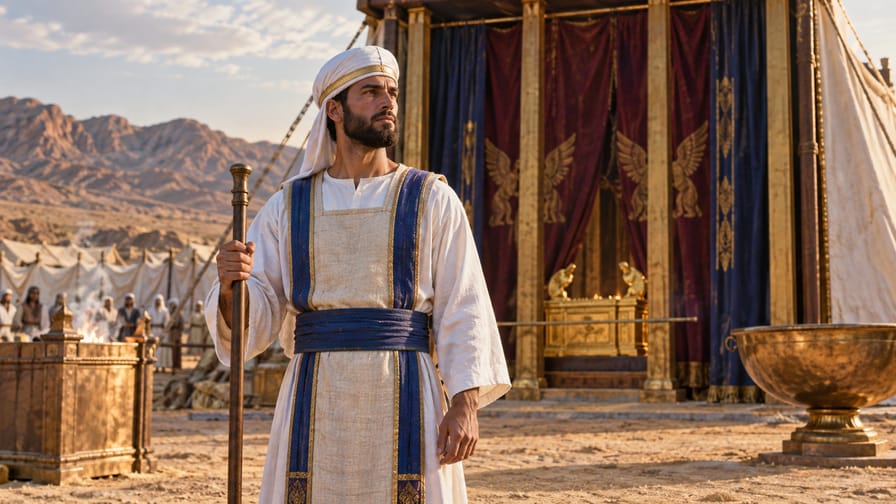
The figure of **Phinehas** (Hebrew: פִּינְחָס, Pîneḥās) emerges in the Old Testament as a character of profound theological relevance, notably for his zeal for the holiness of God and the purity of Israel. Grandson of Aaron and son of Eleazar, he played a crucial priestly role at decisive moments in Israel's history, serving as a zealous guardian of the Mosaic covenant. His story, though punctuated by an act of extreme violence, is interpreted from an evangelical Protestant perspective as a testimony to the seriousness of sin, the necessity of divine judgment, and the promise of a perpetual priesthood.
This study aims to explore the life and legacy of **Phinehas**, examining his onomastic meaning, the historical context of his actions, the complexity of his character, the depth of his theological significance, and his enduring importance for understanding the biblical canon. The analysis will be conducted from a conservative evangelical Protestant perspective, emphasizing the authority of Scripture, historical accuracy, and Christocentric typology, suitable for a biblical-theological dictionary.
1. Etymology and meaning of the name
The name **Phinehas**, in Hebrew פִּינְחָס (Pîneḥās), is of uncertain etymology, which has generated various proposals among scholars. The difficulty lies in the fact that the name does not seem to have a clear Semitic root. Many commentators suggest an Egyptian origin, given Egypt's strong cultural and linguistic influence over Israel during the Exodus period and the priestly ancestry of **Phinehas**, which dates back to Aaron, a contemporary of Moses and Egypt.
One of the most accepted proposals is that Pîneḥās derives from the Egyptian Pa-nehesy, meaning "the Nubian" or "the Ethiopian." This interpretation suggests a connotation of "dark-skinned man" or "the dark one." If this derivation is correct, **Phinehas**'s name may have been a nickname or a descriptive name, perhaps indicating some physical characteristic or non-Israelite ancestry in his maternal line, although his paternal line was unequivocally priestly.
Other etymological suggestions, less accepted or more speculative, include "mouth of bronze" or "mouth of serpent," based on possible Hebrew or Aramaic roots, although these lack robust linguistic evidence. However, the etymological uncertainty does not diminish the significance of the character, but, paradoxically, highlights how his actions and divine favor defined him much more than the origin of his name.
There are no other prominent biblical characters with the same name requiring distinction, making **Phinehas**, grandson of Aaron, the only significant bearer of this name in the canon. The theological significance of the name, therefore, does not lie in its intrinsic literal meaning, but in the way God himself consecrated him through a covenant of peace and a perpetual priesthood, transforming a name of obscure origin into a symbol of zeal and divine justice.
**Phinehas**'s name, regardless of its etymology, has become synonymous with a fervent zeal for the honor of God and the purity of his people. Although the literal meaning is not directly prophetic or symbolic of his actions, his life and the divine promises associated with him have given the name a theological weight that transcends its linguistic origin, making it a reminder of the importance of holiness and radical obedience to God.
2. Historical context and biblical narrative
2.1 Family origin and genealogy
**Phinehas** was the son of Eleazar and the grandson of Aaron, the first High Priest of Israel. His genealogy is clearly established in Exodus 6:25, which identifies him as the son of Eleazar, and in Numbers 20:28, where Aaron transfers his priestly garments to Eleazar, his son, before his death, solidifying the priestly line of which **Phinehas** was the next direct heir. This lineage placed him at the heart of Israel's religious leadership, predestined for a position of great responsibility and authority.
He belonged to the tribe of Levi, being a direct descendant of Aaron, which qualified him for the priesthood. His family was, therefore, the guardian of the Law, of rituals, and of the holiness of the people of Israel. The expectation for **Phinehas** was, from his birth, that of a spiritual leader, a mediator between God and the people, and a zealous defender of divine ordinances.
2.2 Main life events and biblical passages
The life of **Phinehas** is marked by three main events in the Old Testament, which reveal his character and theological importance:
1. The incident at Shittim (Numbers 25:1-18): This is the most significant and defining event in **Phinehas**'s life. Israel was encamped at Shittim, in the plains of Moab, on the brink of the Promised Land. The people began to engage in sexual immorality with Moabite and Midianite women and to participate in the worship of Baal-Peor, a pagan god. This provoked the Lord's anger, who sent a plague that had already killed twenty-four thousand people (Numbers 25:9).
In the midst of this crisis, an Israelite named Zimri publicly brought a Midianite woman, Cozbi, into his tent, openly defying God's holiness and Moses' authority. Seeing this, **Phinehas**, moved by divine zeal, took a spear and thrust it through both of them, the man and the woman, in their bed. His immediate and drastic action stopped the plague that was afflicting Israel (Numbers 25:7-8). God recognized and rewarded **Phinehas**'s zeal, making a "covenant of peace" with him, promising him and his descendants a "perpetual priesthood" (Numbers 25:12-13).
2. The war against Midian (Numbers 31:1-12): After the incident at Shittim, God commanded Moses that Israel should take vengeance on the Midianites, for they had seduced the people of Israel. **Phinehas** was sent to battle as the leader of the military expedition, carrying with him the sacred articles and the trumpets for the war cry (Numbers 31:6). His participation in this war underscores his role not only as a priest but also as an executor of divine justice against those who led Israel into sin.
3. The matter of the altar in Transjordan (Joshua 22:10-34): After the conquest of Canaan, the tribes of Reuben, Gad, and the half-tribe of Manasseh, who had received their inheritance in Transjordan, built an imposing altar near the Jordan. The other tribes of Israel interpreted this as an act of apostasy and rebellion against the Lord and His only altar in Shiloh. Fearing divine wrath, they prepared for war.
However, before acting precipitately, they sent a delegation led by **Phinehas**, along with ten princes from the other tribes, to confront their brothers. **Phinehas** acted with wisdom and diplomacy, inquiring about their intentions. He discovered that the altar was not for sacrifice, but a memorial so that their future generations would not be excluded from worshipping the Lord. **Phinehas**'s intervention averted a civil war and restored unity among the tribes (Joshua 22:30-32).
**Phinehas** is also mentioned in Joshua 24:33 as Eleazar's successor in the high priesthood, and his tomb is located in the hills of Ephraim. He continued to serve as High Priest during the period of the Judges, being consulted by Israel before going into battle against Benjamin (Judges 20:28).
The geography associated with **Phinehas** primarily includes Shittim, the plains of Moab, the Jordan River, and the regions of Transjordan, as well as Shiloh, where the Tabernacle and the main altar were located. He interacts directly with Moses and Joshua, the two greatest leaders of Israel, and represents priestly authority in times of crisis and transition.
3. Character and role in the biblical narrative
**Phinehas**'s character is multifaceted, revealing qualities of zeal, courage, discernment, and unwavering faithfulness to God. His figure is a paradigmatic example of a priest who does not hesitate to defend divine holiness, even if it requires unpopular or dangerous actions.
**Phinehas**'s most prominent virtue is his zeal (Hebrew: qinnâ'). In Numbers 25:11, God Himself testifies: "Phinehas, son of Eleazar, son of Aaron the priest, turned my wrath away from the Israelites when he was as zealous as I am for my honor among them, so that I did not put an end to them in my zeal." This zeal was not an uncontrolled passion, but a deep commitment to God's honor and the purity of His covenant people. He acted not out of personal vengeance, but out of a holy indignation against the sin that was defiling Israel and provoking divine wrath.
His courage is undeniable. Intervening in a public act of idolatry and immorality, confronting a tribal leader (Zimri was a prince of a father's house among the Simeonites, Numbers 25:14), required extraordinary bravery. **Phinehas** did not fear personal consequences or the crowd's reaction, but acted decisively to stop the advance of the plague and restore divine order.
Beyond zeal and courage, **Phinehas** demonstrates discernment and wisdom, especially in the incident of the altar in Joshua 22. Instead of joining the outcry for war, he led a delegation to investigate the situation, seeking to understand the intentions of the Transjordanian tribes. His diplomatic approach and his ability to listen and dialogue averted a fratricidal conflict, demonstrating that his zeal was tempered by prudence and a desire for unity around the truth.
**Phinehas**'s role is primarily priestly. As the grandson of Aaron and son of Eleazar, he was in the line of succession for the High Priesthood. His action at Shittim cemented his position and that of his descendants as perpetual priests, according to the divine promise in Numbers 25:13. He was the guardian of the Law, the minister of the Tabernacle, and responsible for maintaining the holiness of the people before God.
His actions are significant because he not only fulfilled rituals but actively intervened to defend the moral and spiritual integrity of the nation. He represented the voice of God in a time of crisis, a judge who executed divine will. Later, he became the High Priest, leading Israel in spiritual and moral matters, as seen in Judges 20:28, where he consults the Lord on behalf of the people.
Although his action in Numbers 25 is violent, it is presented in Scripture as a divinely approved act of justice, not as a moral failing. The biblical text does not record specific sins or weaknesses of **Phinehas**, but consistently portrays him as a faithful and zealous servant of the Lord. His character development shows a transition from an impulsive executor of justice (though divinely inspired) to a more mature and diplomatic leader, capable of mediating complex conflicts.
4. Theological significance and typology
The figure of **Phinehas** holds profound theological significance, revealing aspects of the divine nature, God's relationship with His people, and prefiguring truths about Christ and the history of redemption. He is an agent in redemptive history, whose singular act preserved the covenant and the holiness of Israel, allowing for the continuation of the divine plan of salvation.
4.1 Divine zeal and judgment
**Phinehas**'s act at Shittim is a reflection of divine zeal itself against sin. God is a holy God who does not tolerate idolatry and immorality among His people (Deuteronomy 6:15). The plague in Numbers 25 was a manifestation of God's righteous wrath. **Phinehas**'s zeal was an extension of God's zeal, acting as an instrument to turn away divine wrath and demonstrate the seriousness of the consequences of sin. Psalm 106:30-31 explicitly praises his action, stating: "Then Phinehas stood up and intervened, and the plague was stopped. And this was credited to him as righteousness for endless generations to come."
This passage is crucial, as it shows that **Phinehas**'s action was considered righteousness by God. It was not a righteousness based on the ceremonial Law, but a righteousness of faith and radical obedience, which manifested itself in an action that saved the nation. This resonates with the doctrine of justification by faith, where true faith manifests itself in works of obedience and commitment to divine holiness (James 2:17-26).
4.2 The covenant of peace and the perpetual priesthood
God's promise to **Phinehas** of a "covenant of peace" and a "perpetual priesthood" (Numbers 25:12-13) is a central point of his theological significance. This covenant is a testament to God's faithfulness in rewarding obedience and zeal. The Levitical priesthood, though temporary in its sacrificial nature, was guaranteed to **Phinehas**'s lineage for generations, reflecting the importance of continuous priestly mediation.
The "covenant of peace" (Hebrew: berît shalom) is a concept that points to reconciliation and the restoration of fellowship. In **Phinehas**'s context, it represented the end of divine wrath upon Israel and the restoration of peace between God and His people, mediated by the act of a man. This covenant is a type that prefigures the New Covenant in Christ, which is the true and eternal covenant of peace, established by the blood of Jesus, the perfect High Priest, who brought definitive peace between God and humanity (Ephesians 2:14-18).
4.3 Christocentric typology
As a priest, **Phinehas** is an imperfect type that points to Jesus Christ, the great High Priest (Hebrews 4:14). While **Phinehas** acted with zeal to purify the people through judgment, Christ, with infinitely greater zeal for the Father's glory and the salvation of His people, purified us through His own perfect sacrifice. Christ's zeal for His Father's house (John 2:17, quoting Psalm 69:9) finds an echo in **Phinehas**'s zeal, but the method and outcome are radically different and superior in Christ.
**Phinehas**'s perpetual priesthood prefigures the eternal and unchangeable priesthood of Christ, which is not "according to a legal requirement concerning bodily descent but by the power of an indestructible life" (Hebrews 7:16). Christ, unlike **Phinehas** and all the Levitical priests, did not need to offer sacrifices for Himself, but offered Himself once for all, obtaining eternal redemption (Hebrews 7:27 9:12). The purification from sin that **Phinehas** accomplished through the death of two sinners is surpassed by the purification that Christ accomplished through His own atoning death, which not only stops the plague of sin but removes it completely.
**Phinehas**'s action also illustrates the principle of substitutionary judgment. His intervention, though not an atoning sacrifice, acted as an deed that turned away divine wrath from the rest of Israel. This, in a limited way, points to Christ, who in His substitutionary judgment on the cross, took upon Himself God's wrath due to sin, so that those who believe might be saved. **Phinehas**'s zeal for God's holiness is, therefore, a glimpse of Christ's perfect zeal in fulfilling God's righteousness and redeeming His people.
5. Biblical-theological legacy and canonical references
**Phinehas**'s legacy transcends the few chapters in which he is explicitly mentioned, influencing biblical theology and interpretive tradition throughout the centuries. His importance is underlined by mentions in other biblical books, which confirm his continuous relevance in the history of Israel and in the understanding of divine justice and mercy.
5.1 Mentions in other biblical books
In addition to Numbers and Joshua, **Phinehas** is remembered in the book of Psalms and in Chronicles. Psalm 106:30-31 is one of the most significant references, where his action at Shittim is praised as an act of justice that stopped the plague and was "credited to him as righteousness for endless generations to come." This passage is fundamental for Reformed and evangelical theology, as it connects **Phinehas**'s action with the concept of imputed righteousness, prefiguring justification by faith.
In Judges 20:28, **Phinehas** is again mentioned as High Priest, consulting the Lord on behalf of the Israelites during the war against the tribe of Benjamin. This demonstrates his continuing authority and his role as a divine mediator during the period of the Judges, a time of great turmoil and turning away from God in Israel.
The genealogies in 1 Chronicles 6:4-15 and 9:20, as well as in Ezra 7:5, list **Phinehas** as a prominent ancestor in the priestly line. The inclusion of his name in these genealogical lists is not merely a historical record it underlines the importance of his lineage for the priesthood of Israel and, by extension, for the continuity of worship and the Law, up to the post-exilic period, when Ezra, a priest of his lineage, led the restoration in Jerusalem.
5.2 Influence on biblical theology and tradition
**Phinehas**'s influence on biblical theology lies primarily in his personification of zeal for the holiness of God. He set a precedent for the necessity of reacting vigorously against sin that threatens the covenant community. His story serves as a reminder of the seriousness with which God views idolatry and immorality, and the grave consequences that arise from such transgressions.
In Jewish tradition, **Phinehas** is revered as a hero, a model of zeal and faithfulness to the Torah. His act is seen as an example of mesirat nefesh (self-sacrifice) for the honor of God. He is often associated with the prophet Elijah, another zealous defender of monotheistic faith in Israel.
In Christian theology, and particularly from an evangelical Protestant perspective, **Phinehas** is studied with nuances. While his zeal is admired, the violent nature of his action is contextualized within the Law and judgment of the Old Testament, which differs from the ethics of the New Testament, which emphasizes love, grace, and personal non-retaliation (Matthew 5:38-48). Nevertheless, the principle that sin demands judgment and that God's holiness must be defended remains a central truth.
The "covenant of peace" with **Phinehas** is seen as a precursor to the New Covenant in Christ, emphasizing the continuity of God's faithfulness in establishing a priesthood that mediates peace. The promise of a perpetual priesthood is definitively fulfilled in Christ, the eternal High Priest, who not only stops the plague of sin but offers complete healing and redemption. **Phinehas**'s zeal points to Christ's zeal in purifying His temple and His church, not with a spear, but with the authority of His word and the power of His atoning sacrifice.
In summary, **Phinehas** is a complex and crucial figure for understanding themes such as the holiness of God, zeal against sin, divine justice, the nature of the priesthood, and the promise of the covenant. His life serves as a mirror for the church, calling believers to genuine zeal for the glory of God, tempered by the wisdom and love of Christ, and to a deep understanding of the seriousness of sin and the magnitude of redemptive grace.