


Zeruiah
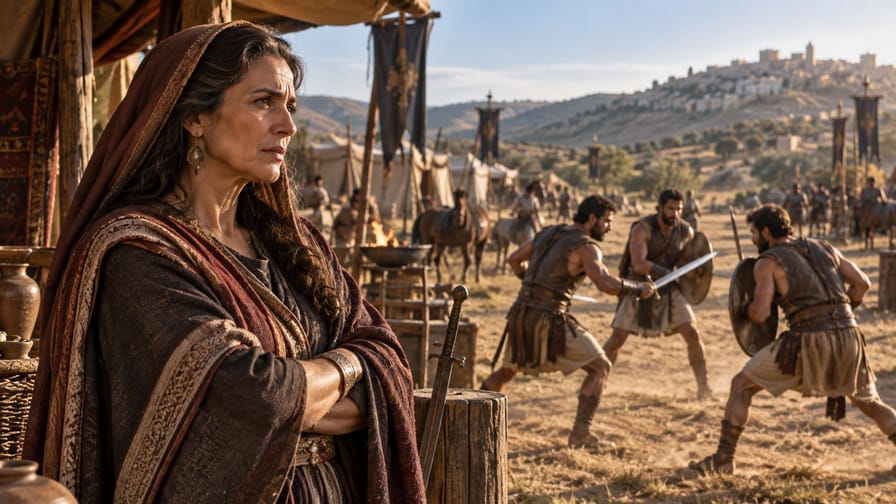
The figure of Zeruiah (also spelled Seruiah in some translations) emerges in biblical narratives as a secondary character, yet of undeniable importance for understanding David's court and the dynamics of power that permeated the early monarchy in Israel. Although not a protagonist of direct events, her identity as David's sister and, crucially, mother of three of the king's most prominent and controversial warriors – Joab, Abishai, and Asahel – confers upon her a genealogical and theological significance that resonates through the books of Samuel, Kings, and Chronicles.
Her presence is felt through the actions of her sons, who were military pillars of the Davidic kingdom, exercising fierce loyalty, but also brutality and insubordination at crucial moments. The analysis of Zeruiah, therefore, requires an approach that transcends her scarce direct mention, focusing on her indirect influence and the role of her lineage in salvation history, from the perspective of conservative evangelical Protestant theology.
This biblical-theological dictionary entry aims to explore the etymology of her name, the historical and narrative context in which she lived, the character and role that, though peripheral, were fundamental, and the theological significance and legacy her family left for understanding divine sovereignty amidst human complexities.
1. Etymology and meaning of the name
The name Zeruiah, in Hebrew, is צְרוּיָה (Tseruyah or Ṣerūyāh). The exact etymology of this name has been subject to some discussion among scholars of the Hebrew language. One of the most accepted derivations connects the name to the Hebrew root צָרָה (tsarah), which means "balsam," "ointment," or "pain" / "distress" / "affliction."
If the derivation is from "balsam," the name could suggest a connotation of healing, relief, or even a type of anointing, although there are no textual indications that directly support this interpretation for the character. It is more probable that the name refers to a personal quality or characteristic not explored in the biblical narrative.
Alternatively, and perhaps with more contextual resonance, the name may be linked to "pain" or "affliction," which could be a prefiguration of the tribulations her brother David would face, and in which her sons, in various ways, would be deeply involved. This interpretation, however, is speculative and lacks direct exegetical support.
Another possibility is that Zeruiah is an abbreviated form of a theophoric name, although the divine portion (such as Yah or El) is not immediately evident in the most common form. However, feminine names in biblical Hebrew often lack explicit theophoric components or are of uncertain origin.
There are no other prominent biblical characters with the same name, making Zeruiah a unique figure in onomastic terms in the Bible. The absence of a clear etymological meaning directly applicable to her narrative reinforces the idea that the biblical focus is not on her person, but on her lineage and her connection to the house of David.
From a theological point of view, the meaning of Zeruiah's name does not possess explicit doctrinal relevance. Her importance lies more in her genealogical function and in the role of her sons in the history of Israel's monarchy. The name primarily serves as an identifier for the maternal lineage of Joab, Abishai, and Asahel, who are central figures in the Davidic narrative.
The mention of her name, though rare, is always accompanied by the identification of her sons, as in 2 Samuel 2:18: "And the three sons of Zeruiah were there: Joab, Abishai, and Asahel." This demonstrates that her identity is intrinsically linked to her motherhood and her family connection to David, establishing the prominence of her offspring.
2. Historical context and biblical narrative
Zeruiah lived during a crucial period in Israel's history, the late 11th and early 10th centuries B.C., encompassing the reign of Saul, the rise of David, and the consolidation of his monarchy. This was a time of transition from a tribal confederation to a centralized monarchical state, marked by internal and external conflicts.
The political context was one of almost constant war, first against the Philistines and then in the civil war between the house of Saul and the house of David, and later, internal rebellions against David himself. Society was patriarchal and militarized, and family loyalty played a vital role in the structure of power and support.
Zeruiah is introduced in the Scriptures as one of David's sisters, son of Jesse, from Bethlehem, in the tribe of Judah. Her genealogy is mentioned in 1 Chronicles 2:16, where it reads: "And their brothers were Abishai, Joab, and Asahel, the three sons of Zeruiah." This verse, along with 2 Samuel 2:18, is one of the main sources of information about her.
She is the mother of Joab, who became the commander of David's army Abishai, another valiant warrior and military leader and Asahel, a swift runner who was killed by Abner early in David's reign (2 Samuel 2:18-23). Zeruiah's relationship with David is that of a sister, which makes her Solomon's aunt and an ancestor of the royal lineage of Judah.
Key biblical passages where Zeruiah is mentioned or where her sons are identified as "sons of Zeruiah" include 2 Samuel 2:13, 18 3:39 8:16 14:1 16:9-10 18:2 19:21-22 21:17 23:18, 37, besides 1 Kings 1:7 2:5 and 1 Chronicles 2:16 11:6, 39 18:12 19:11. These references solidify her family's position in the military and political hierarchy of Israel.
The geography related to Zeruiah and her family is primarily the region of Judah, especially Bethlehem, her hometown, and Hebron, where David established his first reign (2 Samuel 2:1-4). Subsequently, Jerusalem became the center of their activities, after David's conquest of the city (2 Samuel 5:6-9).
The sons of Zeruiah were at the epicenter of the events that shaped David's reign. Joab, in particular, was an instrumental figure in several military campaigns and political intrigues, from the war against Ish-bosheth (2 Samuel 2-3) to the rebellions of Absalom (2 Samuel 18) and Sheba (2 Samuel 20), and the issue of David's succession (1 Kings 1-2).
Their relationship with David was complex. Although they were close relatives and Joab was David's chief general, there were moments of great tension and disobedience. David often expressed frustration with the independence and cruelty of the "sons of Zeruiah," as in 2 Samuel 3:39, where he laments: "I am this day weak, though anointed king, and these men, the sons of Zeruiah, are too hard for me."
3. Character and role in the biblical narrative
The character of Zeruiah, as an individual person, is not explicitly delineated in the Scriptures. She never speaks, nor are her actions recorded. Her presence is purely genealogical, serving as the maternal link connecting Joab, Abishai, and Asahel to the house of David. However, it is possible to infer aspects of her "role" through the reputation and actions of her sons.
The constant mention of her sons as "the sons of Zeruiah" (bĕnê Ṣerûyāh) suggests a strong family identification, perhaps indicating a respected matriarch or a family with a cohesive identity, driven by fierce loyalty to their clan and, by extension, to David. They were known for their courage, but also for their relentless determination and, at times, cruelty.
There are no virtues or spiritual qualities directly attributed to Zeruiah. Likewise, there are no documented sins, weaknesses, or moral failures for her. The Bible presents her neutrally, as a genealogical fact, which is common for many female figures who do not play an active role in the narrative.
Her specific vocation or function, though not formal, was that of a matriarch who bore and, presumably, raised sons who would become prominent military figures. Her role, therefore, is that of a progenitor, whose offspring had a significant impact on the history of Israel.
The sons of Zeruiah, especially Joab, were instrumental in the rise and maintenance of David's reign. They were the "strong hand" of the king, executing his military orders and, at times, acting on their own behalf in defense of David's interests or their own family, such as the vengeance for Asahel (2 Samuel 3:27).
Significant actions and key decisions in the narrative are all attributed to her sons. For example, Abishai's unwavering loyalty to David, even when others abandoned him (2 Samuel 16:9-11 19:21-22), reflects an aspect of Zeruiah's family. Joab's military shrewdness and his ability to lead armies are unquestionable (2 Samuel 8:16 10:7-14).
However, the actions of Zeruiah's sons often exceeded the bounds of royal authority or morality, resulting in condemnation from David. Joab murdered Abner (2 Samuel 3:27) and Amasa (2 Samuel 20:10), both out of revenge or political calculation, which David considered a grave affront and an shedding of innocent blood.
David expressed his powerlessness before the strength and determination of the sons of Zeruiah, referring to them as "men too hard for me" (2 Samuel 3:39). This phrase reveals the tension between David's royal authority and the power and influence of his military family, highlighting a constant challenge to his rule.
There is no evidence of character development for Zeruiah throughout the narrative, as she remains a static figure. Her significance is fixed in her genealogical identity and the prominence of her offspring, who served as a crucial, though at times problematic, military arm for David's kingdom.
4. Theological meaning and typology
Although Zeruiah is a background figure, her family plays a significant role in redemptive history, especially in the establishment and maintenance of the Davidic monarchy, which is central to the progressive revelation of God's plan. David's dynasty is the lineage through which the Messiah would come, and the sons of Zeruiah were instrumental in its consolidation.
The presence and actions of Zeruiah's sons illustrate the complexity of the interaction between divine sovereignty and human agency. God chose David and promised to establish his throne forever (2 Samuel 7:12-16), but the execution of this plan involved imperfect men, with their virtues and their vices.
There is no direct Christocentric prefiguration or typology associated with Zeruiah or her sons. Nevertheless, her family's role in stabilizing David's kingdom, despite their flaws, points indirectly to the need for a perfect king. The imperfections and conflicts generated by the "sons of Zeruiah" in David's court underscore the fragility of human kingdoms and the need for an eternal and just kingdom, governed by Christ.
The loyalty, though imperfect, of the sons of Zeruiah to David, God's anointed king, can serve as a theological counterpoint. It highlights the importance of submission to divinely established authority, even when that submission is stained by human motives or questionable methods. God's sovereignty prevails, utilizing even the mixed intentions of His servants.
Reformed and evangelical theology emphasizes God's providence, which operates in and through all events of history, including the actions of individuals like the sons of Zeruiah. They were used by God to fulfill His purposes for David and for Israel, even when their actions were sinful or contrary to David's expressed will.
David's rebuke of the sons of Zeruiah (2 Samuel 3:39 19:22) illustrates the tension between divine justice and human failure. David, as king-priest, sought justice, but was hindered by the strength of his own relatives. This prefigures the need for a king who not only seeks justice, but who embodies it and executes it perfectly, which is only possible in Christ.
Central theological themes that emerge from the narrative involving the sons of Zeruiah include God's sovereignty over history, the reality of human sin even among God's servants, the consequences of violence and revenge, and the need for divine grace and judgment. Joab's actions, for example, are a vivid reminder of the corruption of the human heart and the need for a Redeemer.
Ultimately, the story of Zeruiah and her offspring fits into the grand narrative of salvation history, serving as a backdrop for the Davidic lineage and, consequently, for the coming of the Messiah. The struggles and victories of David's kingdom, enabled by the military strength of Zeruiah's sons, pave the way for the promise of an eternal kingdom in Christ.
Prophetic fulfillment, in this context, does not come directly through Zeruiah, but through the kingdom her sons helped establish and maintain. David's kingdom, with its glories and its tragedies, is an imperfect type of the kingdom of God that would come in Jesus Christ, the true Son of David, who will rule with eternal justice and peace.
5. Biblical-theological legacy and canonical references
The mentions of Zeruiah and, more frequently, of "the sons of Zeruiah," are dispersed throughout several books of the Old Testament, primarily in 2 Samuel, 1 Kings, and 1 Chronicles. These references are crucial for understanding the history of the united monarchy of Israel under David and Solomon.
In 2 Samuel, Zeruiah's family is central to the military and political narrative. In 2 Samuel 2:18, Asahel, Abishai, and Joab are presented as the "sons of Zeruiah" in the context of the battle of Gibeon. In 2 Samuel 3:39, David laments the cruelty of the "sons of Zeruiah" after Abner's murder. Their presence is a constant in David's life.
The book of 1 Kings also mentions them, notably in 1 Kings 2:5-6, where David, on his deathbed, instructs Solomon on how to deal with Joab, the son of Zeruiah, because of his acts of bloodshed. This underscores the lasting impact of his family's actions on royal politics.
In 1 Chronicles, Zeruiah is mentioned in genealogical contexts, as in 1 Chronicles 2:16, where she is listed as David's sister and mother of his valiant warriors. This book also details the military exploits of Joab, Abishai, and Asahel, reinforcing their importance to David's army (1 Chronicles 11:6, 39 18:12).
There are no literary contributions attributed to Zeruiah or mentions of her in the New Testament. Her influence in biblical theology lies in the fact that her lineage was a vital component in divine providence for establishing and sustaining David's kingdom, which is the foundation for the Messianic promise.
In Jewish and Christian interpretive tradition, Zeruiah is generally seen as the matriarch of a family of fierce warriors, whose loyalty to David was unquestionable, but whose methods were often brutal and problematic. Joab, in particular, is an ambivalent figure, admired for his military prowess, but condemned for his cruelty and insubordination.
Reformed and evangelical theology, when analyzing Zeruiah's family, often emphasizes God's sovereignty in using imperfect instruments to fulfill His redemptive purposes. The presence of men like the sons of Zeruiah in David's court serves as a reminder of the persistence of sin and the need for divine grace to operate amidst human failure.
Zeruiah's importance for understanding the biblical canon lies in how she contextualizes David's rise and reign. Without the military strength and, at times, relentless loyalty of her sons, David's kingdom could have collapsed on several occasions. They were the "strong hand" David needed, even if he often disapproved of their methods.
The story of Zeruiah and her family, therefore, is a testament to God's complex providence. It demonstrates that God operates not only through perfect saints, but also through flawed and ambiguous individuals, weaving their actions into the larger tapestry of His redemptive plan to bring the Messiah and establish His eternal kingdom.
Thus, Zeruiah, though an almost silent figure, is a name that resonates with the strength, complexity, and challenges inherent in the founding of the Davidic royal lineage, essential for understanding salvation history and the coming of Jesus Christ.