


Abishai
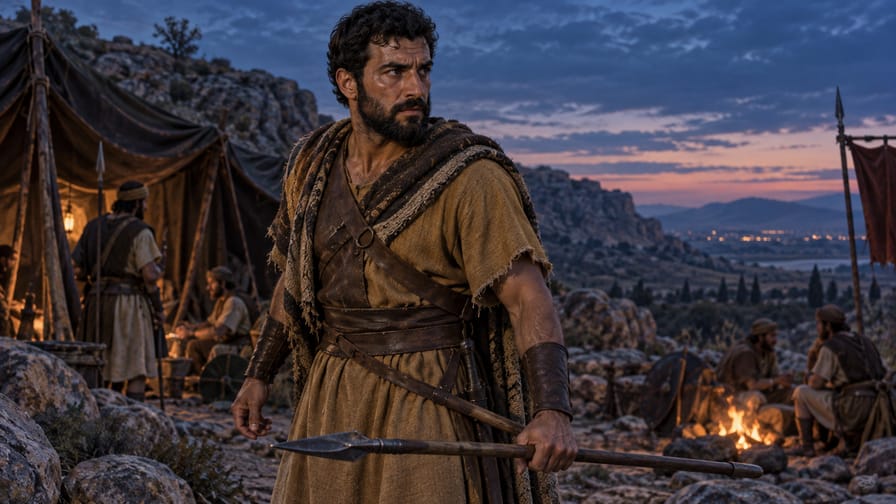
The figure of Abishai (also spelled Abisai, Abishai, or Abishai) is one of the most prominent and complex personalities in King David's inner circle in the Old Testament. His story, intrinsically linked to the rise and consolidation of the Davidic kingdom, offers rich opportunities for biblical and theological analysis.
As David's nephew and one of his "mighty men," Abishai personifies fierce loyalty and military prowess, but also reveals traits of impetuosity and vengefulness that challenge the king's patience. His life and actions illuminate important themes about leadership, justice, mercy, and human nature under divine sovereignty.
1. Etymology and meaning of the name
The name Abishai derives from the Hebrew ’Avishay (אֲבִישַׁי). It is a compound name that is generally interpreted as "My father is a gift" or "Father of a gift." The first part, ’av (אָב), means "father," while the second part, shay (שַׁי), means "gift" or "present."
This etymology suggests a possible connection with the idea that Abishai's father considered him a gift, or that he himself was a gift from God to his family. In a broader context, it may reflect the belief in divine providence over the birth of a child.
There are no significant variations of the name Abishai in biblical languages that alter its fundamental meaning. It is consistently transliterated and understood with the same etymological root.
There are no other notable biblical characters with the exact same name. The uniqueness of the name reinforces Abishai's identity as a distinct and memorable figure in the Davidic narrative, without confusion with other personalities.
From a theological point of view, the meaning of the name "My father is a gift" can be seen in retrospect as ironic or prophetic, given Abishai's character and actions. Although he was a "gift" of strength and loyalty to David, his impetuous nature also presented significant challenges for the king.
The name, therefore, can symbolize the duality of the human experience: the blessing of having a "father" (or protector, like David for him) and the complexity of being a "gift" that requires wisdom to be managed. It points to the sovereignty of God who uses even imperfect instruments to fulfill His purposes.
2. Historical context and biblical narrative
2.1 Family origin and genealogy
Abishai appears in the biblical narrative during the period of the monarchy in Israel, specifically during the reigns of Saul and, more prominently, David. This period, approximately between 1050 B.C. and 970 B.C., was marked by the transition from a tribal confederation to a consolidated monarchy, with intense internal and external conflicts.
Abishai was the son of Zeruiah, who was David's sister (1 Chronicles 2:16). This made him King David's direct nephew. He had two brothers: Joab, the future commander of David's army, and Asahel, a swift and fearless warrior who was killed by Abner (2 Samuel 2:18-23).
This family origin is crucial, as it positions Abishai and his brothers at the heart of David's military and political elite. They were part of David's clan, of the tribe of Judah, and their loyalty was expected and rewarded, although their influence could also be a source of tension for the king.
2.2 Main events of his life
Abishai's life is recorded mainly in the books of 1 Samuel and 2 Samuel, with additional mentions in 1 Chronicles. He is introduced as one of David's mighty men and a prominent warrior from the early days of David's flight from Saul.
One of the first notable episodes occurs when David and Abishai infiltrate Saul's camp at night. Abishai proposes to kill Saul while he sleeps, but David prevents him, reaffirming his respect for the Lord's anointed (1 Samuel 26:6-12).
During the civil war between the house of David and the house of Saul, after Saul's death, Abishai and his brothers play crucial roles. The death of his brother Asahel by Abner motivates relentless vengeance on the part of Joab and Abishai (2 Samuel 2:18-23 3:27-30).
Abishai is consistently listed among David's "thirty mighty men," and his military prowess is highlighted. He is credited with having killed three hundred men with his spear and for having been the chief of the "Three Mighty Men" or "Thirty" (2 Samuel 23:18-19 1 Chronicles 11:20-21), although it is said that he did not attain the stature of the "three chief" (Joab, Eleazar, Shammah).
He is also remembered for having rescued David from a Philistine giant, Ishbi-Benob, in battle, saving the king's life (2 Samuel 21:15-17). This action led David's men to swear that he would no longer go out to battle, lest he quench the "lamp of Israel."
During Absalom's rebellion, Abishai remains faithful to David. He again proposes to kill the curse-utterer Shimei, who was casting curses on David, but is restrained by the king, who demonstrates patience and trust in God's justice (2 Samuel 16:9-12).
Later, when David is fleeing from Absalom and meets Ahithophel, Abishai is again one of the first to offer to protect the king. He leads a portion of David's troops in the battle against Absalom's forces in the forest of Ephraim (2 Samuel 18:2).
His loyalty is again demonstrated in the suppression of the revolt of Sheba, son of Bichri (2 Samuel 20:6-7). David, distrustful of Joab, instructs Abishai to pursue Sheba, showing the king's trust in his nephew, despite his violent tendencies.
Geographically, the events involving Abishai unfold throughout the land of Israel, reflecting David's movements. From the southern deserts, where they fled from Saul, passing through Hebron (David's initial capital), to Jerusalem and the regions of Gilead and Ephraim during the rebellions.
His relationship with David is the most prominent. He is a protector, a military advisor, and an executor of orders, though he often needs to be restrained by David. His relationship with Joab, his brother, is one of deep camaraderie and mutual loyalty, often culminating in joint actions.
3. Character and role in the biblical narrative
3.1 Analysis of character as revealed in the Scriptures
Abishai's character is multifaceted, marked by a combination of virtues and flaws that make him a complex and realistically human figure in the Scriptures. He is presented as a courageous and loyal warrior, but also as an impetuous man prone to violence.
His loyalty to David is unquestionable. On several occasions, Abishai puts himself at risk to protect the king, such as when he saved him from the giant Ishbi-Benob (2 Samuel 21:15-17) or when he offered to kill Saul (1 Samuel 26:6-8) and Shimei (2 Samuel 16:9-11).
This loyalty, however, is often accompanied by excessive zeal and a thirst for justice that borders on personal vengeance. He does not hesitate to propose drastic and violent solutions to David's problems, often clashing with the king's more moderate and patient stance.
3.2 Virtues and spiritual qualities evidenced
Among Abishai's virtues, courage and bravery stand out. He is a fearless warrior, capable of facing powerful enemies and performing heroic deeds on the battlefield (2 Samuel 23:18-19).
His unwavering loyalty to David is a remarkable quality. He remains by the king's side in times of persecution by Saul, during the civil war, and, crucially, during Absalom's rebellion, when many others deserted (2 Samuel 16:9).
Abishai demonstrates initiative and readiness to act in defense of David and his interests. He is not a passive follower, but an active leader on the battlefield and in the king's war council.
3.3 Documented sins, weaknesses, and moral failings
Abishai's primary flaw is his impetuosity and his tendency to resolve problems with immediate violence. His eagerness to kill Saul (1 Samuel 26:8) and Shimei (2 Samuel 16:9) reveals a spirit of vengeance that contrasts with David's mercy and trust in divine justice.
He demonstrates a lack of spiritual discernment regarding God's will, preferring immediate human action over patience and waiting for the Lord's timing. David, on the other hand, recognizes God's sovereignty even over his enemies (1 Samuel 26:10 2 Samuel 16:11).
Although his loyalty is a virtue, it is often a blind and zealous loyalty that does not ponder the moral or theological implications of his actions. This leads him to proposals that David, with his spiritual sensibility, rejects.
3.4 Role played and character development
Abishai's role in the narrative is predominantly that of a military commander and David's personal bodyguard. He is an enforcer, a man of action who protects the king and defends his interests with the sword.
He does not exercise a prophetic or priestly role, but rather a military and leadership role within David's army. His function is vital for the king's survival and success in a period of constant conflict.
Regarding character development, Abishai seems to maintain his essential characteristics throughout the narrative. Although David reprimands and restrains him repeatedly, Abishai's tendency towards impetuosity and violence persists, evidencing the difficulty of changing ingrained aspects of human character.
His significant actions and key decisions, such as assassination attempts and acts of bravery, serve to highlight Abishai's personality and, by contrast, David's wisdom and patience. He is an important counterpoint to the figure of the king.
4. Theological significance and typology
4.1 Role in redemptive history and progressive revelation
Abishai, as a secondary figure in redemptive history, plays an indirect but significant role in the progressive revelation of God's plan. His life illustrates the complexity of the human condition and the need for a king who transcends the limitations and failures of earthly leaders.
He represents human strength and loyalty, which, though valuable, are always imperfect and tainted by sin. His actions highlight the tension between human justice, often impetuous and vengeful, and divine justice, which is patient, merciful, and sovereign.
4.2 Prefiguration or Christocentric typology
Directly, Abishai is not a typological figure of Christ. On the contrary, he serves as a contrast that highlights the perfection of the Messiah. Abishai's flaws, especially his impetuosity and thirst for vengeance, underscore the need for a King who does not act out of impulse or personal vengeance, but out of perfect justice and sacrificial love.
David's restraint of Abishai (1 Samuel 26:9-11 2 Samuel 16:9-12) can be seen as a type of anticipation of Christ's patience and mercy. David, as a king after God's own heart, demonstrates a wisdom and control that transcend human impulsiveness, pointing to the greater King who was to come.
Abishai's loyalty to David, though imperfect, can be seen as a distant echo of the loyalty that followers of Christ are called to have toward their Lord. However, Christ's loyalty is perfect and redemptive, unlike human loyalty which always carries with it the marks of sin.
4.3 Connection with central theological themes
Abishai's story connects to several central theological themes. The theme of **divine sovereignty** is evident in how God uses even Abishai's impetuosity for His purposes, while David is guided to restrain his nephew to fulfill a greater justice.
The theme of **grace** and **mercy** is contrasted with Abishai's thirst for vengeance. David's refusal to allow the deaths of Saul and Shimei, trusting in God's judgment, is a testament to divine mercy that forgives and restores.
Abishai's life also illustrates the reality of human **sin**, even among the most loyal and courageous. No one, except Christ, is perfect. This reinforces the doctrine of total depravity and the need for a Savior.
It also touches on the theme of **leadership**. David, in dealing with Abishai, demonstrates the wisdom of a leader who needs to balance the loyalty of his subordinates with divine ethics and patience. This reflects the nature of God's kingdom, which is not established by human violence, but by divine will.
In the New Testament, there are no direct references to Abishai. However, the principles of restraining vengeance and trusting in divine justice, exemplified by David in contrast to Abishai, are widely echoed in the teachings of Jesus and the apostles (Romans 12:19 1 Peter 2:23).
The doctrine associated with Abishai lies in the demonstration that human strength and loyalty, however admirable, must be submitted to God's will and His perfect justice. He reminds us that true justice and the establishment of the kingdom come from God, not from the impetuous action of man.
5. Biblical-theological legacy and canonical references
5.1 Mentions of the character in other biblical books
Abishai is mentioned in 1 Samuel (chapter 26), 2 Samuel (chapters 2, 3, 10, 16, 18, 19, 20, 21, 23) and 1 Chronicles (chapters 2, 11, 18). These passages cover most of his active life alongside David, from the days of fleeing from Saul until the consolidation of the kingdom.
The mentions in 1 Chronicles, especially in the list of David's mighty men (1 Chronicles 11:20-21), confirm his military importance and his prominent position among the king's warriors. These references complement the more detailed accounts in 2 Samuel, which focus on his interaction with David.
5.2 Influence on biblical theology and interpretive tradition
Although Abishai is not a biblical author or a central figure of systematic theology, his story offers valuable contributions to biblical theology, especially in the Old Testament. He serves as a case study on the nature of human loyalty, the ethics of war, and wisdom in leadership.
In Jewish and Christian interpretive tradition, Abishai is frequently discussed in commentaries on David. He is seen as an example of zeal, but also of a propensity for violence that David, as an imperfect messianic figure, needed to restrain.
The rabbis and early church fathers often used David's interactions with Abishai to illustrate the virtue of patience, mercy, and trust in God, in contrast to human vengeance.
5.3 Treatment of the character in Reformed and Evangelical theology
In Reformed and Evangelical theology, the figure of Abishai is generally analyzed under the light of **God's sovereignty** and **human depravity**. He exemplifies how God can use flawed individuals to fulfill His purposes, but also how divine grace operates to restrain and guide sinful nature.
Evangelical commentators like John Gill, Matthew Henry, and Charles Spurgeon often highlight David's patience and faith in dealing with Abishai's impulsivity, seeing in this a reflection of God's patience towards His imperfect people. Reformed theology emphasizes that God's justice is perfect and does not depend on the impetuous execution of men.
Abishai's story is used to illustrate the importance of submission to divinely instituted authority (David, as the Lord's anointed) and the need for spiritual discernment to act according to God's will, and not merely human emotion.
5.4 Importance of the character for understanding the canon
Abishai's importance for understanding the canon lies in his contribution to the narrative of David's reign, which is central to the development of covenant theology and the messianic promise. He helps paint a realistic picture of the challenges and complexities of establishing God's kingdom on earth.
His presence in the books of Samuel and Chronicles reinforces the historicity and depth of the biblical accounts. He is a reminder that the Scriptures do not present idealized characters, but real individuals, with virtues and flaws, through whom God carries out His redemptive plans.
Ultimately, Abishai contributes to the revelation of the need for a perfect Messiah, a King who will not have impetuous counselors to restrain, but who will rule with perfect justice and mercy, establishing an eternal kingdom that will not be stained by human imperfection (Isaiah 9:6-7).