


Ish-Bosheth
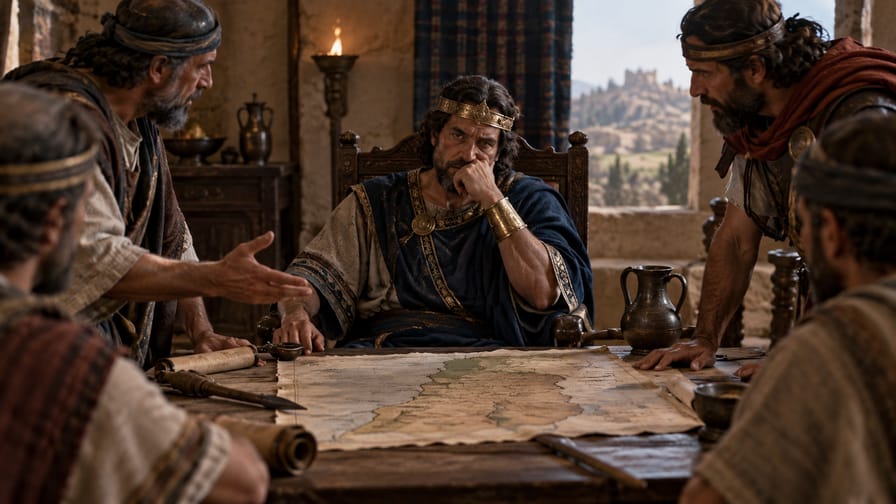
The figure of Ish-bosheth, also known as Ish-baal or Merib-Baal, emerges in the Hebrew Scriptures as a character of strategic relevance, though of little personal prominence, during the period of transition of the monarchy in Israel. His brief reign and tragic fate serve as a crucial marker in the consolidation of David's kingdom, delineating divine sovereignty and the consequences of human disobedience.
His story, recorded primarily in the book of 2 Samuel, offers insights into the nature of power, the fragility of leadership without divine backing, and the inevitability of God's plans, even amidst political conflicts and intrigues. An analysis of his life, character, and the context in which he lived is fundamental to understanding the rise of the Davidic dynasty and the progression of redemption history.
From a Protestant evangelical perspective, the narrative of Ish-bosheth not only illuminates historical events but also highlights perennial theological principles. It underscores the importance of biblical authority, the historical accuracy of the accounts, and the way God orchestrates events to fulfill His promises, culminating in the figure of Christ.
This study therefore seeks to explore the life and significance of Ish-bosheth comprehensively, from his etymology to his theological legacy, contributing to a deeper understanding of the biblical canon and the evangelical message.
1. Etymology and meaning of the name
The name Ish-bosheth is a transliteration of the Hebrew ’Ish-boshet (אִישׁ בֹּשֶׁת), which literally means "man of shame" or "man of ignominy." This form of the name is predominant in the book of 2 Samuel, where his story is detailed (e.g., 2 Samuel 2:8, 2 Samuel 3:15).
The etymological root of boshet (בֹּשֶׁת) is associated with the idea of "shame," "disgrace," or "confusion." The use of this word in the name of Saul's son is often interpreted as a euphemism. This is because his original name, or a variation of it, was likely ’Ish-ba‘al (אִישׁ בַּעַל), which means "man of Baal" or "man of the lord."
This variation is found in 1 Chronicles 8:33 and 1 Chronicles 9:39, where he is called Merib-Baal (מְרִיב בַּעַל), or simply Ba‘al in some genealogies, although more commonly ’Ish-ba‘al. The substitution of Ba‘al for Boshet reflects a common practice among Jewish scribes, especially after the exile, to avoid the pronunciation or writing of "Baal," a term associated with pagan Canaanite deities.
The substitution aimed to dissociate names of biblical figures from any idolatrous connotation, transforming a name that could mean "my lord is Baal" or "man of Baal" into "man of shame." This onomastic change has a profound symbolic meaning, as the fate of Ish-bosheth, marked by weakness and defeat, indeed culminated in shame and an ignominious end.
Although there are no other prominent biblical figures with the same name Ish-bosheth, the practice of using "Baal" in personal names was common before the intensification of the struggle against idolatry. The case of Ish-bosheth is a notable example of linguistic "damnatio memoriae," where the very form of the name reflects an implicit judgment on the association with paganism or the individual's fate.
The theological significance of the name, therefore, lies in its double layer: the original, which perhaps linked the royal family of Israel to a terminology that would later become anathema, and the revised form, which prophetically describes the dishonorable end of his life and reign. The name change underscores the biblical aversion to idolatry and the way God judges and discredits those who associate with false gods, even if indirectly.
2. Historical context and biblical narrative
The life of Ish-bosheth unfolds in a period of great turmoil and transition in the history of Israel, approximately between 1010 and 1003 B.C. This was a crucial time, marked by the death of the first king of Israel, Saul, and the rise of David, the king chosen by God.
The political, social, and religious context of the time was one of fragmentation. The nation of Israel was divided, with the northern tribes still loyal to the house of Saul, while the tribe of Judah had already anointed David as their king in Hebron (2 Samuel 2:4).
2.1 Family origin and genealogy
Ish-bosheth was the son of Saul, the first king of Israel, and Ahinoam. He was, therefore, part of the Benjamite lineage, a tribe that had been prominent at the beginning of the monarchy. His genealogy is mentioned in 1 Chronicles 8:33 and 9:39, where he is identified as Merib-Baal, son of Saul, alongside Jonathan, Malchishua, and Abinadab.
Despite being Saul's son, Ish-bosheth was not among the sons who died with his father in the Battle of Gilboa against the Philistines (1 Samuel 31:1-6). He was Saul's only surviving son with any claim to the throne, although he was apparently neither the oldest nor the most suitable to rule.
2.2 Main events of his life
The narrative of Ish-bosheth's life is concentrated mainly in 2 Samuel 2-4. After the death of Saul and his sons in the Battle of Gilboa, Abner, the commander of Saul's army and his cousin, took Ish-bosheth and brought him to Mahanaim, in the Transjordan (2 Samuel 2:8).
There, Abner anointed him king over Israel, Gilead, the Ashurites, Jezreel, Ephraim, and Benjamin, that is, over all the tribes of Israel except Judah (2 Samuel 2:9-10). This reign lasted two years, although some commentators interpret the "two years" as the period of his effective rule before events that undermined his authority, or as a period of nominal reign. During this time, David reigned in Hebron over Judah for seven years and six months (2 Samuel 2:11).
The reign of Ish-bosheth was marked by a prolonged civil war between the house of Saul and the house of David (2 Samuel 3:1). The first significant confrontation occurred in Gibeon, where Abner's men and Joab's, commander of David's army, clashed in a brutal combat that resulted in the defeat of Ish-bosheth's forces (2 Samuel 2:12-17).
Ish-bosheth's authority was, in fact, a facade for Abner's power. When Ish-bosheth rebuked Abner for taking Saul's concubine, Rizpah, daughter of Aiah, Abner became enraged and swore to transfer the kingdom to David (2 Samuel 3:7-10). This incident demonstrates Ish-bosheth's weakness and his incapacity to control his own commander.
Abner then made a pact with David to bring all Israel under his dominion (2 Samuel 3:12). However, Abner was assassinated by Joab, in retaliation for the death of his brother Asahel in Gibeon (2 Samuel 3:27). Abner's death was a devastating blow to Ish-bosheth, who "lost heart, and all Israel was dismayed" (2 Samuel 4:1).
Without his protector and the true power behind the throne, Ish-bosheth became even more vulnerable. He was assassinated by two of his own captains, Baanah and Rechab, from the city of Beeroth. They found him sleeping at noon, killed him, and cut off his head, taking it to David in Hebron, expecting a reward (2 Samuel 4:5-7).
However, David, instead of rewarding them, executed them for having killed a righteous man in his own house (2 Samuel 4:9-12). Ish-bosheth's head was buried in Abner's tomb in Hebron, an end that highlights the contrast between the legitimacy of the king anointed by God and the illegitimacy of a reign based on human ambition and manipulation.
3. Character and role in the biblical narrative
An analysis of Ish-bosheth's character, as revealed in the Scriptures, portrays him as a weak, passive, and easily manipulated figure. He is consistently described as a "puppet king," whose authority was merely nominal and completely dependent on his military commander, Abner.
There is no evidence of notable virtues or spiritual qualities that distinguished him. On the contrary, his story is a testament to his failures and weaknesses. His lack of initiative and his inability to lead are evident from the moment Abner established him as king in Mahanaim.
His main sin, or weakness, was the absence of leadership and the inability to discern God's will for the kingdom. He allowed Abner to exercise the true power, and when he tried to assert his authority by questioning Abner about Rizpah, he did so in such an ineffective way that he only provoked the wrath of his general, sealing his own fate (2 Samuel 3:7-8).
Ish-bosheth does not demonstrate a divine calling to the throne, nor the anointing that David possessed. His vocation was imposed by Abner, who sought to maintain the influence of Saul's house and his own position of power. He was not a prophet, priest, or notable warrior his role was purely royal, but without the substance of a true monarch.
The role played by Ish-bosheth in the biblical narrative is, therefore, that of a counterpoint to David's rise. He represents the human attempt to sustain a dynasty that God had already rejected (1 Samuel 15:23). His existence and brief reign serve to illustrate resistance to divine will and the futility of opposing God's plan.
His significant actions are few and, for the most part, reactive. He is the central figure in a civil war, but not its driving force. His key decisions are absent he is more an object of the actions of others than an active agent. The development of his character is, in fact, a regression, from a nominal king to a defenseless victim of others' ambition, culminating in his lamentable death.
In summary, Ish-bosheth's character is defined by his passivity and weakness, making him a symbol of the transitoriness of human power without God's backing. He is not an example to be followed, but rather a tragic figure who underscores the importance of divinely instituted leadership.
4. Theological significance and typology
The story of Ish-bosheth, though brief and seemingly peripheral, possesses deep theological significance in the redemptive history of Israel and in the progressive revelation of God's plan. He emerges as an obstacle, albeit a weak one, to the fulfillment of the Davidic covenant and, therefore, to the messianic lineage.
His existence and reign represent the last attempt to keep Saul's lineage on the throne, contrary to God's divine choice of David. The narrative demonstrates God's sovereignty in establishing His anointed king, David, despite human resistance and machinations (2 Samuel 3:18).
From the perspective of Christocentric typology, Ish-bosheth does not serve as a positive prefigurement of Christ. On the contrary, he can be seen as a negative type, an "antitype" or a contrast. He is the "false king" or the "usurper king" who lacks divine anointing, in opposition to David, the true king, who prefigures the Messiah.
The reign of Ish-bosheth is characterized by division, weakness, and eventual collapse, reflecting Saul's disobedience and God's rejection of his house. This contrasts sharply with the kingdom of David, which, despite its flaws, was established by God and became the prototype of the eternal kingdom of the Messiah (2 Samuel 7:12-16).
The story of Ish-bosheth connects to central theological themes such as divine sovereignty, election, judgment, and grace. The fall of the house of Saul and the rise of David illustrate the principle that God removes kings and establishes kings (Daniel 2:21), and that His choice will prevail over human ambitions.
His life is a testament to the consequences of disobedience and lack of faith, which not only affected Saul but also his descendants. The ascent of Ish-bosheth, driven by Abner, is an act of rebellion against the revealed will of God, who had already anointed David (1 Samuel 16:12-13).
There are no direct citations of Ish-bosheth in the New Testament, nor is he the object of specific prophecies. However, his story contributes to the backdrop of the messianic promise, by demonstrating the need for a divinely chosen and powerful king who would unify and rule with justice, a role that David began to fulfill and that Christ fully accomplished.
The doctrine associated with Ish-bosheth is that of the transitoriness of human power not aligned with God's will. His violent death and David's refusal to accept the reward for it (2 Samuel 4:9-12) underscore the importance of justice, even amidst the consolidation of power, and divine reprobation on betrayal and opportunistic violence.
5. Biblical-theological legacy and canonical references
The figure of Ish-bosheth, though not an author or a prophet, leaves a significant biblical-theological legacy, mainly through his mention in the books of 2 Samuel and 1 Chronicles. His story is an integral part of the transition of the monarchy in Israel and the consolidation of David's reign, which is central to biblical theology.
The mentions of Ish-bosheth in 2 Samuel 2-4 are the most detailed, narrating his brief and troubled reign, his dependence on Abner, and his death. In 1 Chronicles 8:33 and 9:39, he is identified as Merib-Baal in Saul's genealogies, confirming his identity and lineage.
His influence on biblical theology resides primarily in his function as a catalyst for David's rise and the reaffirmation of the Davidic promise. His story demonstrates that God's will will prevail, even in the face of human resistance and attempts to frustrate His plans. The fall of the house of Saul, symbolized by Ish-bosheth, paved the way for the dynasty that would culminate in Jesus Christ.
In Jewish and Christian interpretive tradition, Ish-bosheth is often seen as a tragic figure, a pawn in the hands of Abner and political circumstances. He serves as an example of weak leadership and how power can be exercised illegitimately, in contrast to the legitimacy and divine anointing of David.
There are no direct references to Ish-bosheth in intertestamental literature, but the period of monarchical transition, which his life represents, is fundamental to the development of messianic expectation, which intensified during this time. The need for a strong and righteous king, a descendant of David, was a living hope among the Jews.
In Reformed and evangelical theology, the story of Ish-bosheth is treated as an illustrative case of God's sovereignty over human history. He is seen as a passive instrument in divine providence, whose ephemeral reign served to highlight the legitimacy and divine choice of David. His weakness and ignominious end reinforce the idea that human power, devoid of God's blessing and direction, is transient and doomed to failure.
The importance of Ish-bosheth for understanding the biblical canon lies in how his narrative contributes to the broader theme of redemption history. He is a link in the chain of events leading to the consolidation of the Davidic monarchy, essential for the messianic lineage and, ultimately, for the revelation of Christ as the King of kings and Lord of lords. His life, marked by shame and defeat, serves as a powerful reminder of God's faithfulness in fulfilling His promises, regardless of human failures and resistance.