


Jotham
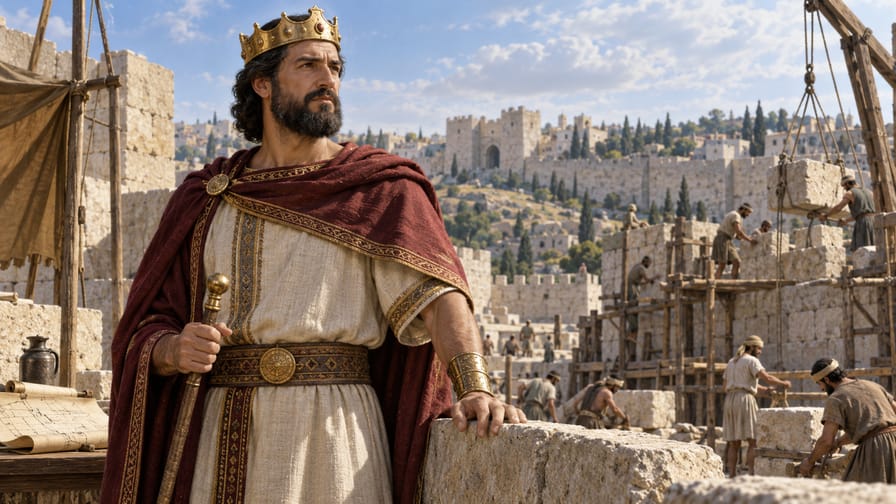
The figure of Jotham (in Hebrew, Yotham, יוֹתָם), king of Judah, emerges in the Hebrew Scriptures as a monarch who, for the most part, walked in the ways of the Lord. His history, though concise, offers valuable insights into divine faithfulness, royal responsibility, and the persistence of popular idolatry, even under a righteous government.
This study proposes an in-depth exegetical and theological analysis of Jotham, exploring his onomastic meaning, the historical context of his reign, the evaluation of his character and actions, his theological relevance, and his legacy in the biblical canon. The adopted perspective will be conservative evangelical Protestant, emphasizing the authority of Scripture and the sovereignty of God in the history of redemption.
1. Etymology and meaning of the name
The name Jotham, in Hebrew Yotham (יוֹתָם), is a theophoric name, a compound name that incorporates the name of God. It is derived from two Hebrew roots: the abbreviated form of the divine tetragrammaton, Yah (יה), and the root tamam (תָּמַם), which means "to be complete," "to be perfect," "to be upright," or "to be righteous."
Thus, the literal meaning of the name Jotham is often interpreted as "Yahweh is perfect," "Yahweh is upright," or "Yahweh is complete." This meaning carries a profound theological connotation, which may reflect the parents' hope or declaration of faith in the immutable character of God, manifested in perfection and righteousness.
Although there are no significant variations of the name in biblical languages, its form is consistent throughout the Old Testament. It is interesting to note that the name Yotham is also used for a son of Gideon in Judges 9:5, who is the sole survivor of Abimelech's massacre and pronounces a notable prophetic parable against him.
The theological significance of the name, "Yahweh is perfect," resonates with the biblical description of Jotham himself, who "did what was right in the eyes of the Lord" (2 Kings 15:34 2 Chronicles 27:2). This can be seen as a congruence between the name and the character, although God's perfection is infinitely superior to human righteousness, which is always limited and flawed.
The name serves as a constant reminder of Yahweh's sovereignty and impeccability, even amidst the imperfections and challenges of human reign. It points to the ultimate source of all righteousness and justice, which is the God of Israel Himself.
2. Historical context and biblical narrative
2.1 Family origin and genealogy
Jotham was the son of King Uzziah (also known as Azariah) and Jerusha, daughter of Zadok (2 Kings 15:33 2 Chronicles 27:1). His genealogy places him directly in the Davidic line, to which God had promised an eternal throne (2 Samuel 7:12-16). This connection is vital for understanding his role in the history of Israel and in the redemptive narrative.
His father, Uzziah, was one of the most successful and long-reigning kings of Judah, reigning for 52 years (2 Kings 15:2). However, Uzziah's reign ended tragically when he, in his pride, attempted to offer incense in the temple, an act reserved for priests, being struck with leprosy by the Lord (2 Chronicles 26:16-21). This condition made him unclean and prevented him from fully exercising his royal duties.
2.2 Historical period and regency
The reign of Jotham is dated approximately between 750 and 735 BC, a period of transition and increasing instability in the ancient Near East region. He began to reign as co-regent with his father, Uzziah, when the latter was afflicted with leprosy, as recorded in 2 Kings 15:5 and 2 Chronicles 26:21. This regency lasted for several years, likely over a decade.
After Uzziah's death, Jotham ascended the throne as full king, reigning for sixteen years (2 Kings 15:33 2 Chronicles 27:1). His reign occurred during the period of the prophets Isaiah, Hosea, and Micah, who denounced idolatry and social injustice in Judah and Israel, setting the stage for the rise of the Assyrian Empire.
2.3 Main events and actions
The biblical narrative describes Jotham as a king who "did what was right in the eyes of the Lord, just as his father Uzziah had done" (2 Kings 15:34 2 Chronicles 27:2). However, there is an important caveat: "Nevertheless, the high places were not removed the people still sacrificed and burned incense on them" (2 Kings 15:35).
One of his notable achievements was construction and fortification in Jerusalem and other cities of Judah. He "built the Upper Gate of the house of the Lord" and "did much building on the wall of Ophel" (2 Chronicles 27:3). In addition, he built cities in the hill country of Judah and fortresses and towers in the forests (2 Chronicles 27:4).
In terms of foreign policy, Jotham waged war against the Ammonites. The Bible reports that he subjugated them, and the Ammonites paid him tribute for three years: "one hundred talents of silver, ten thousand cors of wheat, and ten thousand of barley" (2 Chronicles 27:5). This victory demonstrates his military strength and God's blessing on his reign.
Despite his personal righteousness and success, the persistence of the "high places" indicates a failure to completely eradicate idolatry and syncretistic practices among the people. This observation is crucial for understanding the limitations of royal power and the depth of spiritual corruption in Judah.
2.4 Relationships with other characters
Jotham maintained important relationships with his father, Uzziah, taking over the regency due to his leprosy. He was the father of Ahaz, his successor, who would become one of Judah's most wicked kings (2 Kings 16:1-4). This transition from a righteous king to a wicked one is a turning point in Judah's history.
His life intertwines with the ministry of prophets such as Isaiah, Micah, and Hosea, who were active during his time or soon after. Although the Bible does not record direct interactions of Jotham with these prophets, their message of repentance and justice was certainly relevant to Judah's spiritual climate during his reign.
3. Character and role in the biblical narrative
3.1 Analysis of character and virtues
Jotham's character is predominantly positive in the Scriptures. He is praised for "doing what was right in the eyes of the Lord" (2 Kings 15:34 2 Chronicles 27:2), an assessment that places him in contrast with many kings of Israel and Judah. His righteousness is compared to that of his father Uzziah, who was also a generally good king until his final transgression.
A notable virtue of Jotham is his diligence and prudence. He not only maintained the stability of the kingdom inherited from his father, but also strengthened it through construction and fortification projects (2 Chronicles 27:3-4). This demonstrates active leadership and concern for the security and infrastructure of Judah.
His victory over the Ammonites (2 Chronicles 27:5) suggests military and strategic competence, as well as a dependence on God, for Scripture attributes his success to the fact that he "ordered his ways before the Lord his God" (2 Chronicles 27:6). This phrase underlines his faith and submission to the divine will.
3.2 Limitations and failures
Despite his personal righteousness, the biblical narrative points out a significant limitation in his reign: "Nevertheless, the high places were not removed the people still sacrificed and burned incense on them" (2 Kings 15:35). This indicates that, although Jotham was personally righteous, he could not or would not eradicate popular idolatry.
This failure to completely reform the people's religious worship can be interpreted in several ways. It may have been a limitation of his royal power, a reluctance to confront deeply rooted traditions, or perhaps an incomplete understanding of the purity required by Mosaic law. In any case, the permanence of the high places would be a continuous source of apostasy for Judah.
3.3 Role in the narrative and development
Jotham's role in the biblical narrative is that of a king who maintained the continuity of the Davidic line and the stability of the kingdom of Judah during a turbulent period. He served as a link between the long and prosperous reign of Uzziah and the disastrous reign of his son Ahaz, which would lead Judah into a profound crisis and dependence on Assyria.
His development as a character is limited by the few details provided, but the transition from regent to full king, dealing with external (Ammon) and internal (the high places) challenges, shows a monarch who assumed his responsibilities. His life is an example of a leader who sought God, but whose actions did not result in a complete spiritual reform of the people.
4. Theological significance and typology
4.1 Role in redemptive history
Jotham's reign, though brief compared to his father's, is an integral part of Israel's redemptive history. He represents the continuity of the Davidic covenant (2 Samuel 7), by which God promised that a descendant of David would always sit on the throne. The stability of his reign, even with the people's failures, demonstrates God's faithfulness to His promise.
His personal righteousness, even if limited, serves as a reminder of the ideal of a righteous king, a recurring theme in Old Testament theology that points to a greater fulfillment. Jotham's ability to keep Judah strong and prosperous for a time is a testament to divine blessing on those who walk in righteousness, even imperfectly.
4.2 Prefiguration or Christocentric typology
As part of the Davidic line, Jotham, like all righteous kings of Judah, can be seen as a type of Christ, albeit in a generic way. He ruled with righteousness, brought stability, and vanquished enemies, prefiguring the perfect and eternal rule of the Messiah, who is the true righteous and victorious King (Isaiah 9:6-7 Jeremiah 23:5-6).
His inability to remove the high places and completely purify the people's worship highlights the limitation of any human king. This points to the need for a greater King and Priest, Jesus Christ, who not only rules with perfect justice but also purifies His people from all sin, removing all idolatry from the heart (Hebrews 7:26-27 Hebrews 9:11-14).
4.3 Connection with theological themes
Jotham's reign illustrates the tension between the monarch's individual obedience and the persistence of the people's collective disobedience. This is a central theme in biblical theology: individual responsibility before God and the responsibility of the community. His story highlights that the righteousness of a leader, by itself, does not guarantee the holiness of the entire nation.
The phrase "Yahweh is perfect" in Jotham's name is an echo of God's sovereignty and perfection, which is manifested even when His servants are imperfect and the people stray. The victory over Ammon and the prosperity of Judah under Jotham are evidence of God's grace, which blesses obedience and upholds His covenant.
5. Biblical-theological legacy and canonical references
5.1 Mentions in other biblical books
In addition to the accounts in 2 Kings 15 and 2 Chronicles 27, Jotham is notably mentioned in the genealogy of Jesus Christ in the Gospel of Matthew. In Matthew 1:9, he appears as one of Jesus' ancestors: "Uzziah begat Jotham Jotham begat Ahaz Ahaz begat Hezekiah."
This mention in the New Testament is of immense theological importance. It not only confirms his historicity but also inserts him directly into the Messianic lineage, underlining God's faithfulness in fulfilling His Davidic promises through a sequence of kings, both good and bad, until the coming of the Messiah.
5.2 Influence on biblical theology
Jotham's story contributes to biblical theology by reinforcing the concept of God's covenant faithfulness, even in the face of human fallibility. His reign, characterized by personal righteousness and prosperity, but also by the persistence of popular idolatry, illustrates the complexity of Israel's history and the need for a more radical divine intervention for true redemption.
He serves as another link in the chain of salvation history, demonstrating God's patience with His people and His continued preparation for the advent of the Messiah. Jotham's era also marks the period when Judah, under the influence of prophets such as Isaiah, was being warned about the impending Assyrian judgment, which adds a prophetic backdrop to his reign.
5.3 Treatment in Reformed and Evangelical theology
In Reformed and Evangelical theology, Jotham is typically seen as an example of a king who, though righteous in his personal ways, failed to bring about comprehensive spiritual reform in his kingdom. This is often used to illustrate the doctrine of total depravity and the need for divine regeneration for genuine heart change, which goes beyond mere external obedience or pious leadership.
Commentators such as Matthew Henry and John Gill, for example, highlight divine approval of Jotham for his righteousness, but also lament the people's inability to turn away from idolatry, even under a good king. The mention of Jotham in Matthew's genealogy is always emphasized as proof of the continuity of God's covenant and divine sovereignty over human history, leading to Christ.
5.4 Importance for understanding the canon
The inclusion of Jotham in the biblical canon is vital for understanding the continuous narrative of Israel's history and the preparation for the Messiah. He represents a phase of relative stability and righteousness in Judah, a brief respite before the more wicked reigns that would follow and lead to exile.
His story reaffirms the message that God is actively involved in the history of His people, raising up and bringing down kings, and that obedience brings blessings, while persistent disobedience, especially idolatry, brings severe consequences. Jotham's life is a testament to God's faithfulness in preserving the Davidic line, culminating in Jesus Christ, the perfect and eternal King.