


Joshua
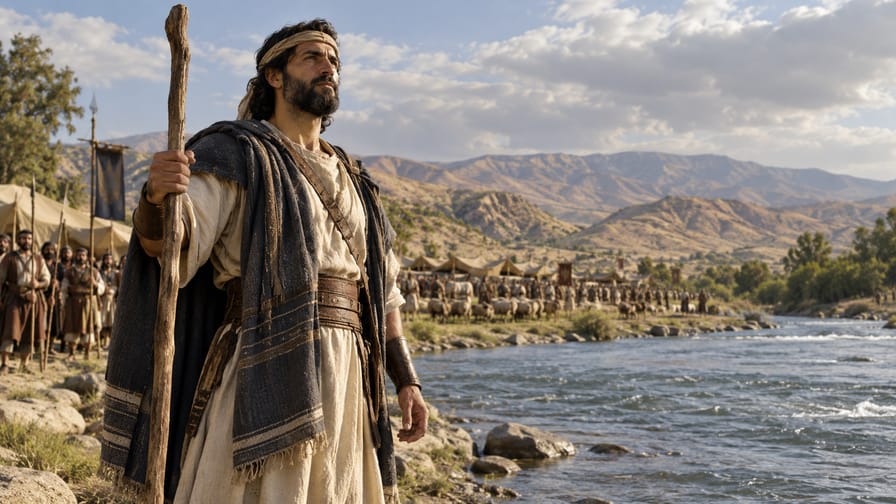
The figure of Joshua (in Hebrew, יְהוֹשֻׁעַ, Yehoshua), successor to Moses, is one of the most prominent and theologically rich in the Old Testament. His leadership marked Israel's transition from a nomadic nation to a nation established in the Promised Land, fulfilling God's divine promises to Abraham. His life and ministry are a testament to God's faithfulness and the importance of obedience.
From an evangelical Protestant perspective, Joshua is not merely a military leader but a divinely chosen instrument for the history of redemption. He is a model of faith, courage, and devotion to the Law of God, and his story offers profound lessons on divine sovereignty, spiritual warfare, and entering into God's "rest." The analysis of his life is crucial for understanding the progression of biblical revelation and Christocentric typology.
1. Etymology and meaning of the name
The name Joshua derives from the Hebrew Yehoshua (יְהוֹשֻׁעַ), which is a contracted form of Yehoshua (יְהוֹשֻׁעַ) or Hoshea (הוֹשֵׁעַ), his original name as recorded in Numbers 13:8. The name Hoshea means "salvation" or "he saves."
Moses, however, changed his name to Yehoshua (יְהוֹשֻׁעַ), which means "Yahweh is salvation" or "Yahweh saves." This change was not merely nominal but carried a profound theological significance, anticipating Joshua's role as God's instrument to bring salvation and possession of the land to the people of Israel.
The central etymological root is yasha (יָשַׁע), which means "to save," "to deliver," or "to rescue." The addition of the theophoric prefix Yeho or Yah (an abbreviation of Yahweh, God's covenant name) emphasizes that salvation would not come from Joshua's human capability, but from God Himself through him.
In the Greek Septuagint and the New Testament, the name Yehoshua is transliterated as Iesous (Ἰησοῦς). This is the same Greek form of the name of Jesus Christ. This linguistic connection is not accidental and establishes a significant typological bridge, which will be explored further.
Although Joshua, son of Nun, is the most well-known, the Bible mentions others with similar names, such as Joshua, the high priest in the book of Zechariah (*Zechariah 3:1*), who also holds a prefigurative messianic role. However, the central figure is unquestionably the successor to Moses.
The theological significance of the name "Yahweh is salvation" resonates deeply in the biblical context. It points to the fundamental truth that all salvation, whether physical (such as deliverance from slavery or the conquest of the land) or spiritual, comes exclusively from God. Joshua was the human channel for this divine salvation.
2. Historical context and biblical narrative
The life of Joshua unfolds at the end of the Late Bronze Age, a period approximately between 1400 and 1200 B.C., according to the traditional chronology that dates the Exodus around 1446 B.C. This period was marked by the transition from Egypt to the Levant, with the decline of Egyptian power and the rise of new regional powers, although Canaan was in a state of political fragmentation.
The social and religious context of Canaan was polytheistic and syncretistic, with the worship of gods like Baal and Asherah, characterized by cultic practices that included child sacrifice and cultic prostitution (*Deuteronomy 12:29-31*). Joshua's conquest represented divine judgment upon these nations and the purification of the land for the people of Israel.
Joshua was the son of Nun, from the tribe of Ephraim (*Numbers 13:8*). His genealogy is not extensive, but his tribe, Ephraim, was one of the most numerous and influential, descended from Joseph. He emerges in the biblical narrative as a young assistant to Moses, a faithful "servant."
2.1 Key life events
The chronology of Joshua's life begins to be detailed in Exodus. He is first mentioned as Israel's military commander in the battle against the Amalekites at Rephidim (*Exodus 17:8-16*), demonstrating his aptitude for leadership and combat from an early age. He also accompanied Moses to Mount Sinai, waiting for him at the base while Moses received the Law (*Exodus 24:13*).
His faithfulness and devotion are again evident when he, along with Caleb, was one of the twelve spies sent to explore the land of Canaan. While the other ten spies brought a disheartening report, Joshua and Caleb urged the people to trust God and move forward, even in the face of giants (*Numbers 13:30-14:9*).
Due to their faith, Joshua and Caleb were the only ones of that generation, twenty years old or more, who survived the forty-year wilderness wandering and were permitted to enter the Promised Land (*Numbers 14:30*). This event sealed his destiny as the future leader of Israel.
After the death of Moses, Joshua was formally commissioned by God and invested with authority before all Israel (*Deuteronomy 31:7-8, 23 Joshua 1:1-9*). The narrative of the book of Joshua details the conquest of Canaan, beginning with the miraculous crossing of the Jordan River (*Joshua 3*), which echoed the parting of the Red Sea.
Key events include the fall of Jericho (*Joshua 6*), the defeat at Ai due to Achan's sin and the subsequent victory (*Joshua 7-8*), the military campaigns against the coalitions of Canaanite kings in the south (*Joshua 10*) and in the north (*Joshua 11*). After the conquest, Joshua oversaw the division of the land among the tribes of Israel (*Joshua 13-21*).
The geography of Joshua's narrative spans from the Sinai wilderness to the lands of Canaan, with iconic locations such as the Jordan River, Jericho, Ai, Gibeon, Hazor, and the cities of refuge. He interacted with figures such as the high priest Eleazar and his son Phinehas, as well as Caleb, his companion in faith.
The life of Joshua culminates with his farewell speeches in Shechem (*Joshua 23-24*), where he called Israel to renew their covenant with God and to serve Him alone, before his death at 110 years old (*Joshua 24:29*).
3. Character and role in the biblical narrative
The character of Joshua is portrayed in the Scriptures as exemplary, marked by unwavering faith, courage, and devotion to the Law of God. He is consistently presented as a God-fearing leader, whose obedience was the key to Israel's success.
Among his virtues, his **faith** in God stands out, demonstrated in the spies' report (*Numbers 14:6-9*) and in his readiness to cross the Jordan and attack Jericho. His **obedience** to the Word of God was meticulous, following divine instructions for the conquest and distribution of the land (*Joshua 11:15*).
Joshua's **courage** is evident in his willingness to face powerful enemies and in his firm stance against the people's discouragement. God repeatedly exhorted him to be strong and courageous (*Joshua 1:6-9*), indicating that these qualities were essential for his calling.
He also demonstrated **humility** and **loyalty** as a servant of Moses, learning and serving faithfully before assuming leadership. His **zeal** for God's holiness and Israel's purity is seen in his reaction to Achan's sin (*Joshua 7*) and in his final exhortations to the people.
Although Joshua is a model of virtues, the Bible also records a notable failure: the covenant with the Gibeonites (*Joshua 9*). In this episode, Joshua and the leaders of Israel were deceived by the Gibeonites and made a pact without consulting God (*Joshua 9:14*). This failure highlights the importance of continuous dependence on God, even for the most godly leaders.
His calling and function were multifaceted: he was the **successor to Moses**, the **military commander** of Israel, the **spiritual leader** who ensured the observance of the Law, and the **administrator** who oversaw the division of the land. He combined the authority of a prophet (receiving direct instructions from God) with the leadership of an early judge/king.
Joshua's significant actions include leading the crossing of the Jordan, the strategy and execution of the conquest of Jericho and Ai, and the decisive victories over the Canaanite coalitions. His key decisions, such as the renewal of the covenant at Shechem (*Joshua 24*), shaped the identity and future of Israel.
The development of Joshua's character is notable. He begins as a faithful assistant to Moses, an apprentice. Under Moses' tutelage, he matures and is prepared to take on the mantle of leadership. After Moses' death, he emerges as a strong and independent leader, demonstrating wisdom and courage in his own authority, always depending on God.
4. Theological significance and typology
The figure of Joshua is of immense importance in Israel's redemptive history and in God's progressive revelation. He is the instrument chosen by God to fulfill the promise of the land made to Abraham (*Genesis 12:7*), a crucial step in establishing Israel as a theocratic nation.
His life and ministry are rich in **prefigurations and Christocentric typology**, pointing in various ways to Jesus Christ. The most evident connection lies in the name itself: Joshua (*Yehoshua*) and Jesus (*Iesous*) are the same name in Hebrew and Greek, respectively. Both mean "Yahweh is salvation."
Just as Joshua led God's people out of the wilderness and into the Promised Land, a place of rest and inheritance, Jesus Christ leads His people out of the wilderness of sin and into the true "promised land" – spiritual and eternal rest in God. The author of Hebrews makes this connection explicit, stating that "if Joshua had given them rest, God would not have spoken later about another day" (*Hebrews 4:8*), indicating that the rest brought by Joshua was merely a type of the superior rest offered by Christ.
Both Joshua and Jesus are divinely chosen and commissioned leaders. Joshua was full of the spirit of wisdom (*Deuteronomy 34:9*), and Jesus was anointed by the Holy Spirit without measure (*John 3:34*). Both faced and overcame enemies to secure their people's inheritance, Joshua against the Canaanites, Jesus against sin, death, and Satan.
Joshua's conquest of Canaan, though a physical war, is also a type of the spiritual warfare that believers wage under the leadership of Christ. The walls of Jericho falling prefigure Christ's power to tear down spiritual strongholds. Joshua's obedience to the Law of God is an echo of Christ's perfect obedience.
The covenant and promises are central to Joshua's narrative. He fulfilled the promises of the Abrahamic and Mosaic covenants, particularly the possession of the land. In Joshua 21:43-45, it is declared that "the Lord gave Israel all the land he had sworn to give their ancestors... Not one of all the Lord's good promises to the house of Israel failed every one was fulfilled."
In the New Testament, Joshua is referenced in Acts 7:45, where Stephen mentions that "**Joshua, with our ancestors, brought it [the tent of testimony] in when they took possession of the land of the nations God drove out before them." The most significant reference, as mentioned, is in Hebrews 4:8, which uses the Greek name Iesous for Joshua, to contrast the earthly rest he provided with the spiritual and eternal rest that only Christ can offer.
The connection of Joshua with central theological themes is profound: **salvation** (by name and function), **faith** (exemplified in his life), **obedience** (a requirement for blessing), **judgment** (upon the Canaanites), and **grace** (God giving the land not by Israel's merit). He is a testament to God's faithfulness to His covenant and the importance of human response in faith and obedience.
5. Biblical-theological legacy and canonical references
Joshua's legacy is indelible in biblical theology. He is one of the main links between the era of Moses and the period of the Judges, consolidating the nation of Israel in the promised land. The book of Joshua, traditionally attributed to him, is a foundational document that narrates God's faithfulness in fulfilling His promises.
Besides the book bearing his name, Joshua is mentioned in other biblical books, such as Exodus, Numbers, and Deuteronomy, where his preparation and commissioning are detailed. In the New Testament, his mentions in Acts and Hebrews reinforce his importance as a historical and typological figure. The book of Judges, which follows Joshua, begins its narrative with Joshua's death, demonstrating the transition from unified leadership to a more fragmented period.
Joshua's influence on biblical theology is vast. He exemplifies the doctrine of **holy war** (or herem), where God commands the eradication of peoples as judgment for their wickedness and to preserve Israel's purity. This raises complex questions, but the conservative evangelical perspective understands that such actions were acts of sovereign divine judgment in a unique context of redemptive history.
In the Jewish interpretive tradition, Joshua is revered as one of Israel's greatest leaders, a man of war and wisdom, who brought the people into their inheritance. In the Christian tradition, especially in Reformed and evangelical theology, the figure of Joshua is central to understanding **Christocentric typology**, as discussed earlier.
Commentators like John Calvin and Matthew Henry, in their works, dedicate significant attention to Joshua's life, highlighting his faith, obedience, and the fulfillment of divine promises. They emphasize God's sovereignty in the conquest and the lesson that true victory and rest come through obedience to the Word of God and trust in His power.
The relevance of Joshua for understanding the biblical canon is that he demonstrates the continuity of God's redemptive plan. He is the link that connects the patriarchal promises and the Mosaic Law with the reality of Israel's life in the Promised Land, setting the stage for the monarchy and, ultimately, for the coming of the Messiah.
His life is a powerful illustration that God is faithful to fulfill all His promises and that obedience and faith are the ways by which His people experience His salvation and blessing. Joshua's message resonates as a call to exclusive loyalty to God, a timeless truth for the church today.