


Jabal
1. Etymology and Meaning of the Name
The name Jabal is a figure mentioned briefly in the book of Genesis, specifically in Genesis 4:20. In Hebrew, the name is Yabal (יָבָל). Its etymological root comes from the Hebrew verb y-b-l (י-ב-ל), which means "to carry," "to bring," "to lead," or "to produce." This root is associated with the idea of movement, flow, and, by extension, the production of something.
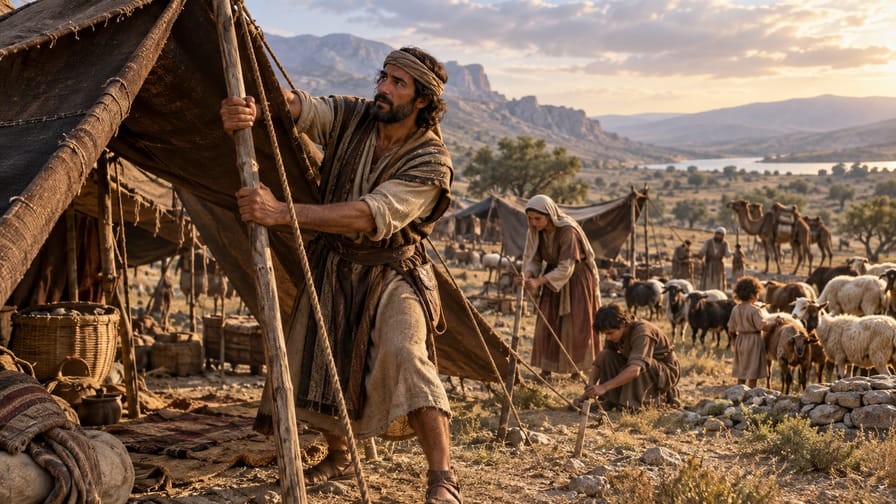
Literally, Jabal can be interpreted as "one who carries," "one who leads," or "one who produces." This meaning is particularly pertinent to his role in the biblical narrative, where he is identified as "the father of those who dwell in tents and have livestock" (Genesis 4:20). He is, therefore, a "leader" or "initiator" of a specific way of life and a form of economic production.
There are no significant variations of the name Jabal in biblical languages, nor are there other prominent biblical figures with the same name. His uniqueness in Scripture grants him a clear identity, although his mention is concise. The form Yabal is consistently used in Hebrew versions of the Old Testament.
The theological significance of the name lies in its connection to culture and human development post-Fall. The name suggests an active role in the formation of civilization, even within the lineage of Cain, which is marked by rebellion and distance from God. Jabal "leads" humanity into a new stage of social and economic organization, reflecting humanity's capacity for innovation, even within a context of sin.
From the perspective of Reformed theology, the capacity to "produce" and "lead" manifested by Jabal, even as a descendant of Cain, can be seen as an expression of God's common grace. Humanity, though fallen, still retains aspects of the divine image (imago Dei), including creativity and the capacity to exercise dominion over creation (Genesis 1:28), even if distorted by sin.
2. Historical Context and Biblical Narrative
2.1 Family Origin and Genealogy
Jabal is introduced within the context of the genealogy of Cain's lineage, in the antediluvian period, as recorded in Genesis 4. He is the son of Lamech and Adah, and brother of Jubal. His half-brother, by his father's side, is Tubal-Cain, son of Lamech and Zillah, and his half-sister is Naamah (Genesis 4:19-22). This genealogy is crucial for understanding the culture and environment in which Jabal lived.
Cain's lineage is characterized by rapid cultural and technological development, but also by increasing impiety and violence, culminating in Lamech's declaration in Genesis 4:23-24, which exceeds Cain's vengeance. Jabal emerges in this scenario of human progress dissociated from communion with God.
The historical period in which Jabal lived is the time before the Flood, an obscure period of human history that the Bible describes with few details, but with great emphasis on the proliferation of sin and violence (Genesis 6:5-7). There are no precise dates for this period, but it precedes the narrative of Noah and the universal Flood.
2.2 Main Events and Biblical Passages
The biblical narrative mentions Jabal in a single key passage: Genesis 4:20. This passage declares: "And Adah bore Jabal he was the father of those who dwell in tents and have livestock." This brief statement is the totality of the direct information about him in the Scriptures, but it is dense in meaning.
His identification as "the father" ('av, אָב) of a category of people is a title of great honor and recognition in Semitic culture. It means that he was not only the first, but the originator and the model for a way of life that became fundamental to many ancient societies, especially in the Near East.
The social and economic context of the time was one of expanding humanity, probably moving away from Eden and developing different forms of subsistence. Before Jabal, life was predominantly agricultural (like Cain and Abel) or hunter-gatherer. The introduction of nomadic pastoralism by Jabal marks a significant economic and social diversification.
The geography related to Jabal and his lineage is undefined, but presumably situated in the land of Nod (Genesis 4:16) or its vicinity, east of Eden. The nomadic way of life he initiated implies constant movement through different regions in search of pastures, not settling in a single city or territory.
Jabal's relationships with other biblical figures are primarily familial. He is the brother of Jubal, who is the father of musicians, and half-brother of Tubal-Cain, the father of metalworkers. This triad of siblings, along with their sister Naamah, represents the foundations of antediluvian culture: animal husbandry, music, and metallurgy.
This division of labor and cultural specialization in Cain's lineage, though not spiritually approved, demonstrates human ingenuity and the capacity to develop civilization. The Bible does not explicitly condemn these inventions, but presents them in the context of an increasingly corrupt society, contrasting with the godly line of Seth.
3. Character and Role in the Biblical Narrative
3.1 Character and Qualities
Scripture does not offer an explicit analysis of Jabal's personal character. Unlike figures such as Abraham or David, there are no dialogues, monologues, or descriptions of his virtues or moral failings. His identity is defined exclusively by his vocation and the innovation he introduced into human society.
Nevertheless, we can infer some qualities from his designation as "the father of those who dwell in tents and have livestock." This suggests that Jabal was an individual of great initiative, practical intelligence, and organizational capacity. He must have been a visionary leader, capable of observing the environment, developing new techniques, and organizing people around a new way of life.
The domestication of animals and nomadic pastoralism require patience, diligence, knowledge of animal behavior and seasons, and management skills. These are qualities that Jabal, as the progenitor of this practice, must have possessed in a high degree. He was, without a doubt, an innovator and a pioneer.
3.2 Vocation and Specific Function
Jabal's role in the biblical narrative is singular: he is the founder of nomadic pastoralism and tent-dwelling. Before him, life was more sedentary, focused on agriculture or, perhaps, hunting. His innovation allowed communities to move with their flocks, exploring new lands and resources, which was a significant advance for human subsistence.
He is not portrayed as a prophet, priest, king, or warrior. His role is cultural and economic. He is an architect of civilization, contributing to the diversification of human activities and the formation of different social structures. The nomadic life, made possible by Jabal, became a pillar of many ancient cultures, including that of the patriarchs of Israel, who were nomadic shepherds (Genesis 12:8 13:3).
Jabal's significant actions are not dramatic events, but the introduction of a new paradigm of life. The decision to domesticate animals on a large scale for sustenance and to develop tents as mobile dwellings represents a break from previous practices and an important step in the development of human culture.
The Bible does not document specific moral failings or sins of Jabal. However, he is part of the lineage of Cain, which is intrinsically linked to rebellion against God and the progressive corruption of humanity before the Flood. Although his inventions were culturally significant, the silence about his faith or piety is notable, especially in contrast to the line of Seth, where it is said that "people began to call upon the name of the Lord" (Genesis 4:26).
From an evangelical perspective, the absence of any mention of faith in God in Cain's lineage, including Jabal, is a crucial theological point. His contributions, though important for culture, are presented as part of a civilization that develops outside the covenant and communion with the Creator, pointing to the need for redemption that would affect all spheres of human life.
4. Theological Significance and Typology
4.1 Role in Redemptive History and Progressive Revelation
Jabal's role in redemptive history is not direct, like that of Abraham or Moses. He is not an agent of salvation or a bearer of divine promises. His importance lies in the progressive revelation about the nature of humanity post-Fall and the development of culture. The narrative of Jabal illustrates how humanity, even corrupted by sin, still exercises the creative and dominion-exercising capacity granted to it at creation (Genesis 1:28).
The "culture of Cain," of which Jabal is a part, demonstrates that sin does not completely annihilate the image of God in man, but distorts it. Humanity continues to build, innovate, and organize, but often autonomously, separated from God's guidance and glory. The inventions of Jabal and his brothers are presented without explicit moral judgment, but in the context of a lineage that does not call upon the name of the Lord.
This section of Genesis 4 serves as a backdrop for the growing depravity that leads to the Flood. Cultural innovations, though useful, do not bring redemption or spiritual restoration. They are part of the development of human civilization in its autonomy from the Creator, an autonomy that ultimately leads to ruin and judgment.
4.2 Prefiguration or Christocentric Typology
It is difficult to establish a direct Christocentric typology for Jabal. He does not prefigure Christ explicitly or implicitly. His figure does not fit the classic typological patterns of prophet, priest, king, or sacrifice. However, we can draw broader theological lessons that, indirectly, point to the necessity of Christ.
Jabal's contribution to the development of human civilization, devoid of any mention of faith or God, serves as a contrast. He represents humanity's capacity to create culture and progress technologically without an explicit connection to the divine. This underscores the truth that redemption in Christ is not just for the individual soul, but aims to redeem all spheres of life, including culture and civilization.
The Reformed view holds that God's sovereignty extends over all things, including culture. Even the inventions of Cain's lineage, made by faithless men, are under God's providential control and, ultimately, can be used for His purposes. Christ, as the redeemer of all things (Colossians 1:15-20), offers the possibility that human culture and inventions be redeemed and directed towards the glory of God, something not seen in the lineage of Jabal.
4.3 Connection to Central Theological Themes
The figure of Jabal connects with central theological themes such as common grace, the Fall of man, culture, and divine sovereignty. His existence and his innovations are a testament to common grace, by which God sustains and enables humanity, even those outside the covenant, to develop and flourish in certain aspects, despite the Fall (Matthew 5:45 Acts 14:17).
At the same time, Jabal illustrates the consequences of the Fall in culture. Human ingenuity, though a divine gift, can be exercised autonomously, leading to a civilization that, despite its achievements, is spiritually empty and destined for judgment. The absence of faith and the increasing violence in Cain's lineage (Genesis 4:23-24) demonstrate that material progress without spiritual progress is insufficient and dangerous.
God's sovereignty is evident, as He permits and, in His providence, uses even the culture of Cain's lineage for His broader purposes, setting the stage for the history of redemption. The inventions of Jabal, Jubal, and Tubal-Cain form the basis of essential skills that, later, would be employed in godly contexts, such as the construction of the Tabernacle (Exodus 35:30-35) or music for worship (Psalm 150).
5. Biblical-Theological Legacy and Canonical References
5.1 Mentions in Other Biblical Books and Influence on Theology
Jabal is mentioned only in Genesis 4:20. There are no other direct references to him in any other book of the biblical canon, neither in the Old nor in the New Testament. His contribution is recorded punctually as a landmark in early human history, but he does not become a reference figure or a character with continuous development in the biblical narrative.
Despite the absence of later mentions, Jabal's legacy is indirectly significant. He represents the beginning of a way of life – nomadic pastoralism – that would be central to the history of Israel. The patriarchs Abraham, Isaac, and Jacob were shepherds who lived in tents and owned vast flocks, following the model that Jabal had established (Genesis 13:2-7 26:14 30:43).
This indirect connection is important for biblical theology. It demonstrates how elements of human culture, even when originating in ungodly contexts, can be integrated and transformed to serve God's purposes within the covenant. Jabal's pastoral lifestyle became the backdrop for the great promises of the covenant with Abraham.
5.2 Presence in Interpretive Tradition and Evangelical Theology
In Jewish and Christian interpretive tradition, Jabal is generally seen as a symbol of human ingenuity and cultural progress. Rabbinic commentators and church fathers frequently included him in discussions about the development of civilization and the origins of arts and crafts. He is recognized as a pioneer, even though his lineage is that of Cain.
In Reformed and evangelical theology, the treatment of Jabal fits into the broader discussion about the "culture of Cain" versus the "culture of Seth." Theologians like John Calvin, in their commentaries on Genesis, note the irony that Cain's lineage, which departed from God, was the one that developed the arts and inventions of civilization. Calvin observes that, although these advancements are useful, they do not lead to godliness by themselves.
Modern evangelical commentators, such as Derek Kidner and Gordon Wenham, emphasize that Jabal and his brothers represent humanity's capacity to create culture, a capacity derived from the image of God, but which is exercised autonomously and, ultimately, sinfully in Cain's lineage. They highlight the contrast between the building of cities and the cultural development of Cain's lineage and the emphasis on calling upon the name of the Lord in Seth's lineage (Genesis 4:26).
Jabal's importance for understanding the canon lies in his contribution to the narrative of early humanity and the revelation of the Fall's impact on culture. He helps to contextualize the development of human civilization before the Flood, showing that human ability to innovate and create is not, in itself, a sign of spiritual righteousness.
In summary, Jabal, despite his brief mention, offers a window into understanding God's common grace, human creative capacity, and the complexity of cultural development in a fallen world. His story is a reminder that, although God permits and uses human ingenuity, the true restoration and purpose of culture can only be found in Christ and in submission to God's will.