


Saul
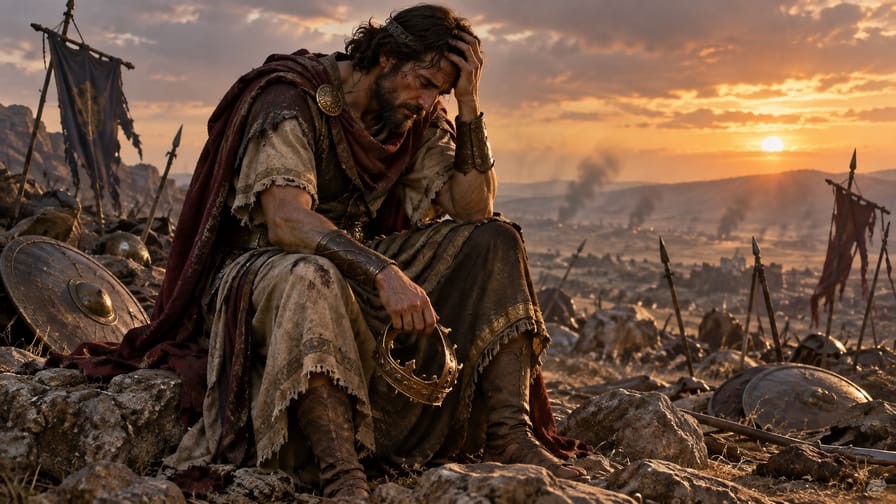
The figure of Saul, the first king of Israel, emerges in the Scriptures as a complex and multifaceted character whose trajectory reflects the tensions between human will and divine sovereignty. His story, recorded primarily in the books of 1 and 2 Samuel, is a profound study on leadership, obedience, and the consequences of disobedience to God.
From a Protestant evangelical perspective, the analysis of Saul is not limited to a mere historical account but delves into its theological significance, examining how his life and reign prefigure or contrast with the pattern of kingship that would culminate in Jesus Christ. This entry aims to offer a comprehensive analysis, focusing on his etymology, context, character, theological significance, and canonical legacy.
1. Etymology and meaning of the name
The name Saul, in Hebrew שָׁאוּל (Sha’ul), derives from the Hebrew verb שָׁאַל (sha’al), which means "to ask," "to inquire," "to request," or "to borrow." Thus, the literal meaning of the name Saul is "asked for," "requested," or "lent." This meaning is profoundly ironic and theologically charged in the context of his ascent to the throne.
The biblical narrative in 1 Samuel 8 describes the people of Israel asking for a king "like all the other nations" (1 Samuel 8:5), rejecting God's direct rule through the judges. The name Saul, therefore, symbolizes the origin of his kingship: it was not primarily an unconditional divine initiative, but a concession from God to a human request, even though God already had a plan for the monarchy.
Although there are other biblical characters with the same name, such as a king of Edom (Genesis 36:37) and a son of Simeon (Genesis 46:10), King Saul of Israel is, without a doubt, the most prominent. His designation through a "request" resonates with the theology of divine sovereignty, which, at times, allows human choice, but always subordinates it to His greater purposes.
The best-known variation of the name occurs in the New Testament, where the apostle Paul was originally named Saul of Tarsus (Acts 9:1-2). Although there is no direct genealogical connection, the meaning "requested" could allude to his former life of Pharisaic zeal, before being "requested" by Christ to become an apostle to the Gentiles, but this is a later inference and not a direct link to the king.
Theologically, Saul's name serves as a reminder that a leader chosen by human desire, even with divine permission, can deviate from God's purpose if he does not maintain continuous dependence and obedience. God's provision for a king "asked for" by the people, in contrast to the king "after His own heart" (1 Samuel 13:14) who would come later, is a central theme in Israel's history.
2. Historical context and biblical narrative
Saul's reign occurred at the end of the 11th century B.C., approximately between 1050 and 1010 B.C., marking a crucial transitional period in Israel's history. Before Saul, Israel was a tribal confederacy governed by judges, charismatic leaders raised by God to deliver the people from oppressors and administer justice, as described in the book of Judges.
The political, social, and religious context of the time was one of great instability. Internally, the tribes often fought among themselves and lacked centralized unity. Externally, Israel faced the constant threat of the Philistines, a well-organized and militarily superior people, who had subjugated much of the land and even captured the Ark of the Covenant (1 Samuel 4:1-11).
It was in the face of this external pressure and the desire for more stable and visible leadership that the people of Israel demanded a king from Samuel, the last of the judges and a prophet of God (1 Samuel 8:4-5). God, though reluctant, instructed Samuel to anoint a king for them, warning them about the burdens of monarchy (1 Samuel 8:7-18). Thus, Saul, son of Kish, from the tribe of Benjamin, was chosen.
2.1 Family origin and genealogy
Saul was the son of Kish, a wealthy and influential man from the tribe of Benjamin (1 Samuel 9:1). Although the tribe of Benjamin was the smallest in Israel (1 Samuel 9:21), Saul was described as an imposing man, "taller than any of the people from his shoulders upward" (1 Samuel 9:2). His genealogy is briefly mentioned in 1 Chronicles 8:33 and 9:39, which connects him to Jeiel and Maacah.
His family, though from Benjamin, did not belong to a prominent royal or priestly lineage, which initially made him modest and reluctant to accept kingship (1 Samuel 10:22). This humble origin, however, did not prevent divine anointing, but his lack of an established leadership background may have contributed to his later insecurities and failures.
2.2 Key life events
Saul's life is a series of dramatic events that culminate in his tragic fall:
- Anointing and Confirmation: Saul was secretly anointed by Samuel (1 Samuel 10:1) and, subsequently, confirmed as king by lot at Mizpah (1 Samuel 10:17-24). His leadership was publicly validated by a decisive victory over the Ammonites at Jabesh-Gilead (1 Samuel 11:1-15).
- First Disobedience and Partial Rejection: In the context of a battle against the Philistines at Michmash, Saul, impatient with Samuel's delay, offered a sacrifice himself, usurping a priestly function. For this disobedience, Samuel prophesied that his kingdom would not endure and that God would seek a man "after His own heart" (1 Samuel 13:8-14).
- Second Disobedience and Total Rejection: God commanded Saul to utterly destroy the Amalekites, including all their livestock (1 Samuel 15:1-3). Saul, however, spared King Agag and the best of the flock, claiming it was to sacrifice to the Lord. Samuel confronted him, declaring that "to obey is better than sacrifice" (1 Samuel 15:22) and that God had rejected him as king (1 Samuel 15:23).
- The Rise of David and the Fall of Saul: With divine rejection, the Spirit of the Lord departed from Saul, and an evil spirit tormented him (1 Samuel 16:14). David, secretly anointed by Samuel (1 Samuel 16:13), was brought to Saul's court to soothe him with his harp. David's victory over Goliath (1 Samuel 17) marked the beginning of his popularity and Saul's growing envy and paranoia.
- Persecution of David: Driven by jealousy and fear, Saul repeatedly tried to kill David (1 Samuel 18:10-11 19:9-10) and relentlessly pursued him for years (1 Samuel 23-26).
- Consultation with the Medium of En-dor: In his despair, before a final battle against the Philistines, Saul consulted a medium at En-dor, seeking guidance from Samuel's spirit (1 Samuel 28:7-25), an act strictly forbidden by the Law (Deuteronomy 18:10-12).
- Death: Saul and his sons, including Jonathan, died in battle on Mount Gilboa against the Philistines (1 Samuel 31:1-6), a tragic end for the first king of Israel.
Key biblical passages about Saul are in 1 Samuel 8-31 and 2 Samuel 1 (David's lament). The geography of his reign includes his capital, Gibeah, the regions of Ramah (where Samuel resided), Gilgal (place of sacrifices and disobedience), Michmash (battle against Philistines), En-dor (consultation with the medium), and Mount Gilboa (place of his death).
His relationships with other characters were fundamental: Samuel, the prophet who anointed and rebuked him Jonathan, his loyal son and intimate friend of David David, his successor and main target of his wrath and Abner, his army commander.
3. Character and role in the biblical narrative
Saul's character is one of the most complex and tragic in the Bible, exhibiting a downward curve from a promising beginning to a desolate end. Initially, the Scriptures describe him as a good-looking, imposing man (1 Samuel 9:2), and endowed with initial modesty, as he hid when he was to be presented as king (1 Samuel 10:22).
At the beginning of his reign, Saul demonstrated qualities of leadership and courage. His response to the Ammonite threat at Jabesh-Gilead was swift and effective, uniting the tribes of Israel and demonstrating military bravery (1 Samuel 11:6-11). He was anointed with the Spirit of the Lord (1 Samuel 10:6, 10), which endowed him with the ability to prophesy and lead with authority.
However, these qualities were gradually overshadowed by a series of weaknesses and moral failures. The primary one was disobedience to the word of God, as conveyed by Samuel. His impatience at Gilgal, leading him to offer a sacrifice that was not his to make (1 Samuel 13:8-12), revealed a failure to fully trust in God and to submit to prophetic authority.
The disobedience regarding the Amalekites (1 Samuel 15:1-9), sparing King Agag and the best of the livestock, was even more serious. It demonstrated an explicit rebellion against divine command and an attempt to justify his actions, blaming the people (1 Samuel 15:15, 21). This attitude led Samuel to declare: "Because you have rejected the word of the Lord, He has rejected you from being king over Israel" (1 Samuel 15:23).
After this rejection, Saul's character rapidly deteriorated. He lost the Spirit of the Lord and was tormented by an evil spirit (1 Samuel 16:14). Envy and jealousy of David became a morbid obsession, leading him to relentless persecutions and assassination attempts (1 Samuel 18:8-11 19:9-10). His paranoia isolated him, alienating even his own son, Jonathan.
Saul's role in the biblical narrative is that of being the first king of Israel, establishing the monarchy as a form of government. However, his reign also served as a dark example of what happens when a leader fails to maintain obedience and dependence on God. He was a king "after the people's own heart," but not "after God's own heart."
His key actions and decisions – the disobedience at Gilgal and against the Amalekites – sealed his fate and paved the way for David's rise. The development of Saul's character is a tragic parable about the corruption of power, the fragility of human nature, and the spiritual consequences of persistent disobedience, culminating in despair and a violent end on the battlefield (1 Samuel 31:4-6).
4. Theological significance and typology
Saul's theological significance is profound and multifaceted, serving as a crucial landmark in Israel's redemptive history and in the progressive revelation of God's plan. His reign marks the beginning of monarchy in Israel, a divinely ordained institution, but one that began with a king who failed to meet the divine prerequisites for leadership.
Saul's story is a powerful demonstration of God's sovereignty, even in the face of human disobedience. Although Saul was "asked for" by the people and rejected by God, the divine plan for a king "after God's own heart" (1 Samuel 13:14) was not thwarted, but rather accelerated, paving the way for the Davidic dynasty and, by extension, for the promised Messiah.
A central theme of Saul's narrative is the primacy of obedience over sacrifice and external religiosity. Samuel's declaration to Saul: "Behold, to obey is better than sacrifice, and to listen than the fat of rams" (1 Samuel 15:22), is a fundamental theological truth. Saul's disobedience, seen as rebellion and witchcraft, led to his rejection (1 Samuel 15:23).
From the perspective of Christocentric typology, Saul serves as an anti-type or a striking contrast to Jesus Christ, the true King of Israel. While Saul was chosen by human criteria (appearance, height) and popular demand, Christ is the divinely chosen King, whose kingship is established by God the Father from eternity (Psalm 2:6-7).
Saul's kingship was flawed, characterized by disobedience, insecurity, and a temporary reign. In contrast, Christ is the perfect King, who fulfilled all the will of God (Hebrews 10:7), whose kingdom is eternal (Luke 1:33), and who exercises just and gracious sovereignty. The departure of the Spirit of the Lord from Saul (1 Samuel 16:14) contrasts with the fullness of the Spirit that rests upon Jesus (John 3:34).
Saul's story also illustrates the consequence of sin and the seriousness of rejecting God's word. His fall serves as a warning for all leaders and for every individual about the importance of faithfulness and humility before divine authority. Despite his initial calling, the lack of a truly submissive heart to God resulted in his ruin.
In the New Testament, although there are no direct typological references to Saul, the context of messianic expectation is profoundly shaped by the history of Israel's monarchy. The need for a righteous king, who would rule with uprightness and obey God, was established by the failures of kings like Saul and the promise of an eternal Davidic king (2 Samuel 7:12-16), which was fulfilled in Christ.
Themes such as grace and judgment are evident. God's judgment upon Saul for his disobedience is clear, but God's grace is manifested in the provision of David as the successor, ensuring the continuity of the messianic lineage. The figure of Saul, therefore, is essential for understanding the theology of kingship, the nature of godly leadership, and the preparation for the coming of the Messiah.
5. Biblical-theological legacy and canonical references
Saul's legacy in biblical theology is indelible, shaping the understanding of kingship and leadership in Israel and pointing to the need for a different kind of king. His story is told primarily in 1 Samuel, but his actions and the impact of his reign reverberate in other canonical books.
One of the most poetic and significant references to Saul outside of 1 Samuel is David's lament for Saul and Jonathan in 2 Samuel 1:17-27. In this song, David expresses his deep sorrow and reverence for the Lord's anointed, despite the relentless persecution he suffered. This reveals the complexity of the relationship and the importance of Saul as the first king, even in his failure.
In the books of Chronicles, Saul is mentioned in genealogies (1 Chronicles 8:33 9:39), but his story is told more concisely, with a greater emphasis on the legitimacy of the Davidic dynasty. The narrative in Chronicles tends to focus more on obedience and temple worship, meaning Saul's failed reign is less detailed, serving as a prelude to the glory of David and Solomon.
Saul's influence on biblical theology lies primarily in his role as an example of failed leadership. He set the negative standard against which subsequent kings would be measured and highlighted the need for a king who was "after God's own heart" (1 Samuel 13:14). His story serves as a backdrop for David's exaltation and the promise of the Davidic covenant (2 Samuel 7), which is fundamental to messianic expectation.
In Jewish and Christian interpretive tradition, Saul is often portrayed as a tragic figure. His fall is seen as a result of his own disobedience, pride, and lack of trust in God. Evangelical commentators, such as John Calvin and Matthew Henry, emphasize the seriousness of Saul's disobedience and God's sovereignty in removing a failed king to accomplish His purposes.
Reformed and conservative evangelical theology often uses Saul's story to illustrate principles such as total depravity, demonstrating that even a chosen and anointed man can succumb to sin if he does not depend on God's grace. Saul's story also underscores the doctrine of sovereign election, for God, in His wisdom, permitted Saul's reign, but already had the true king, David, in mind.
Saul's importance for understanding the canon is that he provides the essential link between the period of the judges and the establishment of the Davidic monarchy. Without Saul's story, the narrative of David's rise and the development of the theology of the Davidic covenant would lose much of their context and significance. He is the bridge between direct theocracy and the theocratic monarchy that would culminate in Christ.
In sum, Saul is more than a mere historical character he is a theological case study on the nature of kingship, the centrality of obedience, the consequences of disobedience, and God's unwavering faithfulness in carrying forward His redemptive plan, even through human failures. His life, though tragic, serves as a powerful precursor to the need for the perfect King, Jesus Christ.