


Agag
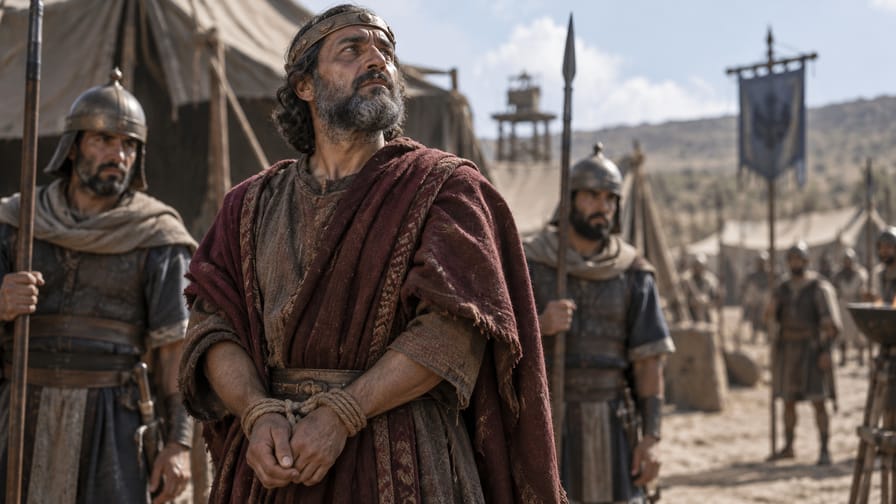
The figure of Agag, king of the Amalekites, is one of the most intriguing and theologically charged in the Old Testament, though his appearance is brief yet crucial. His story, recorded primarily in 1 Samuel 15, serves as a watershed moment in the narrative of the Israelite monarchy, exposing Saul's failure and reaffirming God's sovereignty and justice. From an evangelical Protestant perspective, Agag is not merely an enemy of Israel, but a symbol of the persistence of evil and the divine demand for radical obedience, with implications that reverberate throughout redemptive history.
An analysis of Agag requires a deep understanding of the Old Testament context, the nature of holy war (ḥerem), and the typology that points to spiritual battle and the eradication of sin. His narrative is a forceful reminder of the consequences of disobedience and the seriousness of God's commandments, serving as a fundamental case study in biblical theology concerning divine sovereignty and human responsibility.
1. Etymology and Meaning of the Name
The name Agag, in Hebrew, is ’Agag (אֲגַג). Its etymology is uncertain and has been the subject of various conjectures among scholars. Some proposals suggest that the root may be linked to terms meaning "flaming," "violent," or "superior," although none of these derivations are conclusively accepted.
It is more probable that Agag is not a personal name but rather a dynastic title, similar to "Pharaoh" for Egyptian kings or "Caesar" for Roman emperors. This interpretation is reinforced by the mention of an "Agag" in Numbers 24:7, centuries before the Agag of 1 Samuel, in Balaam's prophecy that exalts Israel above Amalek.
If it is a title, it would symbolize the royalty and, possibly, the fierceness or prominence of the Amalekite kings. This suggests a continuity in Amalekite leadership and their enmity against Israel, perpetuating a legacy of antagonism from generation to generation. The name, therefore, carries the weight of the identity and mission of a people hostile to God and Israel.
There are no significant variations of the name in biblical languages, being consistently transliterated as Agag. The absence of other biblical characters with this name, apart from the Amalekite kings, reinforces the idea that it is a title or a distinctive name of their royal lineage.
The theological significance of the name, if it is a title, lies in its representation of the persistent and institutionalized enmity of the Amalekite people against Israel. It embodies resistance to God's plan and opposition to His chosen people, becoming a symbol of evil to be eradicated according to the divine will. The name itself evokes the continuous threat that Amalek represented.
2. Historical Context and Biblical Narrative
2.1. The Amalekite People and Their Origin
The story of Agag is intrinsically linked to the history of the Amalekite people. The Amalekites were descendants of Amalek, a grandson of Esau, through Eliphaz and his concubine Timna, as recorded in Genesis 36:12. They settled in the desert region of the Negeb, south of Canaan, and were known for their nomadic and warlike nature.
From the earliest days of Israel's journey from Egypt, the Amalekites demonstrated relentless hostility. They attacked the Israelites in the rear, targeting the weak and the weary, shortly after the liberation from Egypt, at Rephidim (Exodus 17:8-16). This cowardly and unprovoked attack was an act of great malice, marking the beginning of an enduring enmity.
God, through Moses, pronounced a severe judgment against Amalek, promising "war against Amalek from generation to generation" (Exodus 17:16). This divine condemnation was reiterated in Deuteronomy 25:17-19, where Israel is commanded to "blot out the memory of Amalek from under heaven" when they had peace in their land. This instruction formed the basis for the future holy war against them.
2.2. The Divine Command and Saul's Failure
The central historical period for the figure of Agag is the beginning of the Israelite monarchy, around the end of the 11th century BC, during Saul's reign. God, through the prophet Samuel, gave Saul an explicit and irrevocable command to execute divine vengeance against Amalek (1 Samuel 15:1-3).
The instruction was clear: "Now go and strike Amalek and devote to destruction all that they have. Do not spare them, but kill both man and woman, child and infant, ox and sheep, camel and donkey" (1 Samuel 15:3). This was a command of ḥerem, or holy war, where everything captured was to be dedicated to God, usually by total destruction, to prevent the assimilation of pagan practices and to demonstrate God's holiness and the seriousness of His judgment.
Saul assembled an army and attacked the Amalekites, defeating them from Havilah to Shur, which is on the border of Egypt (1 Samuel 15:7). He managed to capture Agag, the Amalekite king, and destroyed the rest of the people. However, Saul failed to carry out the divine command completely and radically.
Instead of destroying everything, Saul and his people spared Agag and the best of the sheep, oxen, fatlings, lambs, and everything else that was good (1 Samuel 15:9). Saul's justification, presented to Samuel, was that they had spared the livestock to offer them as sacrifices to the Lord in Gilgal (1 Samuel 15:15, 21). This partial disobedience, based on human logic and superficial piety, was a direct affront to the will of God.
2.3. Samuel's Judgment on Agag
Saul's disobedience provoked the Lord's anger, who regretted that He had made Saul king (1 Samuel 15:10-11). Samuel confronted Saul, exposing his failure and proclaiming God's judgment: the kingdom would be torn from him (1 Samuel 15:23, 28).
In a dramatic and emphatic act, Samuel demanded that Agag be brought before him. The Bible describes Agag coming "cheerfully" or "delicately," perhaps believing that the danger had passed and that he would be spared (1 Samuel 15:32). His attitude might indicate arrogance or a complete lack of understanding of the gravity of the situation and the seriousness of divine justice.
Samuel then pronounced the final judgment upon Agag: "As your sword has made women childless, so shall your mother be childless among women" (1 Samuel 15:33). With his own hands, or by direct and immediate command, Samuel "hacked Agag to pieces before the Lord in Gilgal" (1 Samuel 15:33). This brutal, yet divinely ordered, act sealed Agag's destiny and symbolized the complete execution of God's will, despite Saul's failure.
3. Character and Role in the Biblical Narrative
3.1. Agag's Character: A Ruthless Enemy
Agag's personal character is not explored in detail in the Scriptures, as he serves more as a representative of his people and a focal point for the drama of Saul's obedience. However, the little that is revealed about him and his people portrays him as a ruthless and arrogant enemy. The mention that he came "cheerfully" or "delicately" (1 Samuel 15:32) to Samuel can be interpreted as a sign of his presumption or his disconnection from the reality of divine justice. He shows no repentance or supplication, but rather an expectation of clemency.
Samuel's statement preceding Agag's execution – "As your sword has made women childless, so shall your mother be childless among women" (1 Samuel 15:33) – reveals the cruelty inherent in Agag and his people. This declaration is not merely a sentence but a reflection of Amalekite brutality, which justified God's judgment and the ḥerem command. Agag, therefore, embodies the wickedness and violence that characterized the enemies of Israel and of God.
3.2. Role as a Test of Obedience
Agag's primary role in the biblical narrative is that of a catalyst for the test of Saul's obedience. The divine command to utterly destroy Amalek, including its king, was a test of Saul's faithfulness to God. Saul's failure to execute this command without reservations is the central point of the story.
By sparing Agag and the best of the livestock, Saul demonstrated partial and selective obedience, preferring his own will and the spoils of war over God's express word (1 Samuel 15:9). This decision was not a trivial error but a rebellion that cost Saul his kingdom, for "to obey is better than sacrifice" (1 Samuel 15:22).
The presence of Agag, alive and captive after the battle, served as visible proof of Saul's disobedience. His spared life was a testimony to the king of Israel's failure to fully carry out the divine commission. Thus, Agag became a symbol of the temptation to compromise God's will in favor of personal interests or a supposed "better" strategy.
3.3. Representation of Evil to Be Eradicated
Beyond being a test for Saul, Agag represents the persistent and irreducible evil that God had commanded to be completely eradicated. The ḥerem command against Amalek was not an act of arbitrary cruelty but a righteous judgment against a people who had demonstrated continuous and profound enmity against God and His people since the exodus. Agag's life, if spared, would signify the permanence of that threat.
The execution of Agag by Samuel, an act that transcended his normal role as prophet and judge to an act of executing divine justice, underscores the seriousness of God's command. Agag's death in Gilgal, a place of covenant renewal and judgment (Joshua 5:9-10), symbolizes that God's holiness demands the complete eradication of evil that opposes Him and His will. The narrative of Agag is, therefore, a lesson on the necessity of radical and unreserved obedience in the face of evil.
4. Theological Significance and Typology
4.1. The Holy War and Divine Justice
The story of Agag is a primary example of the doctrine of holy war (ḥerem) in the Old Testament. The command to destroy Amalek was not a license for indiscriminate violence but an act of divine judgment against a people who persistently opposed God and His redemptive plan. Amalek represented a continuous barrier to Israel's holiness and its mission as the chosen nation.
The execution of Agag by Samuel reaffirms God's uncompromising justice. While it may seem brutal to modern sensibilities, Samuel's action is viewed theologically as a fulfillment of the divine will and a demonstration of the seriousness with which God treats sin and disobedience. Agag's life could not be spared without compromising God's holiness and the integrity of His word.
4.2. Obedience Versus Disobedience
The contrast between the divine command and Saul's action, mediated by the figure of Agag, is one of the most prominent theological themes. Saul's failure to destroy Agag and the best of the livestock was not merely a tactical error but an act of direct disobedience. Samuel emphasizes that "to obey is better than to sacrifice" (1 Samuel 15:22), showing that radical obedience to God's word is superior to any ritual or sacrifice made with impure or partial motivations.
Saul's disobedience, centered on his decision to spare Agag, led to his rejection as king (1 Samuel 15:23). This serves as a severe warning about the consequences of incomplete or selective obedience. For evangelical theology, this narrative underscores the importance of obedience as evidence of genuine faith and submission to God's sovereignty, a principle that echoes in the New Testament (John 14:15, Romans 6:16).
4.3. Christocentric Typology and the Spiritual Battle
From a typological and Christocentric point of view, the narrative of Agag can be interpreted on several levels. Agag, as the enemy whom God commanded to be completely eradicated, can prefigure the evil and sin that must be completely overcome in the life of the believer and in the history of redemption. Saul, by sparing him, typifies human failure to deal radically with sin.
Christ, on the other hand, is the King who perfectly obeys the Father and who completely triumphs over sin, death, and Satan (Colossians 2:15, Hebrews 2:14-15). He not only overcomes the enemy but definitively annihilates him. The execution of Agag by Samuel can be seen as a type of the final eradication of evil that will be consummated by Christ at His second coming, when all evil will be judged and removed.
Furthermore, the struggle against Amalek, personified in Agag, is often seen as an allegory of the spiritual battle that the believer faces against the flesh (Romans 7:18-25, Galatians 5:17) and against the spiritual forces of evil (Ephesians 6:12). Just as Israel was commanded not to spare Amalek, the believer is called not to give quarter to sin and their sinful nature, but to mortify it by the power of the Holy Spirit (Romans 8:13, Colossians 3:5).
4.4. The Persistence of Evil and God's Plan
The story of Agag also illustrates the persistence of evil and the need for continuous vigilance. Saul's failure to completely eradicate the Amalekites had far-reaching consequences, as evidenced by the emergence of Haman, the Agagite, in the book of Esther (Esther 3:1). Haman, a descendant of Agag, attempted to annihilate the entire Jewish people, demonstrating that uneradicated evil can resurface with renewed strength.
This connection with Haman reinforces the theological importance of God's original command and the seriousness of Saul's disobedience. It shows that God's plan for the eradication of evil is precise and that human disobedience can prolong and intensify the struggle against the forces of evil, though it can never frustrate God's ultimate purpose in the history of redemption.
5. Biblical-Theological Legacy and Canonical References
5.1. Mentions in Other Biblical Books
The figure of Agag, though central to 1 Samuel 15, is also referenced in other parts of the biblical canon, solidifying his theological legacy. Balaam's prophecy in Numbers 24:7, which exalts Israel above the nations and declares that "his king shall be higher than Agag," suggests that "Agag" was a title or name for Amalekite kings of great prominence, centuries before Saul.
The most significant mention after Samuel's narrative is found in the book of Esther. Haman, the arch-enemy of the Jews in Persia, is identified as an "Agagite" (Esther 3:1, 10 8:3, 5 9:24). This designation is crucial, as it connects Haman directly to the lineage of Agag and, by extension, to the ancestral enmity of the Amalekites against Israel.
This connection in Esther demonstrates the persistence of the seed of evil that Saul failed to eradicate completely. Haman's genocidal attempt against the Jews is seen as the final manifestation of the Amalekite curse, which was only thwarted by divine providence and the courage of Esther and Mordecai. Agag's legacy, therefore, transcends his own death, symbolizing the continuous threat of evil.
5.2. Influence on Biblical and Reformed Theology
The story of Agag and Saul's disobedience exert a profound influence on biblical theology and on Reformed and evangelical theology. It serves as a paradigmatic case for the doctrine of God's sovereignty, which demands unconditional obedience, and for the consequences of human disobedience.
Reformed theologians, such as John Calvin, emphasized the gravity of Saul's sin, which was not a mere error in judgment but a rebellion against God's authority. The narrative is often used to illustrate that obedience is not a matter of personal choice or convenience but a response of faith to God's revealed will. The "war against Amalek" is metaphorically seen as the holy war against sin in the life of the believer.
Conservative evangelical theology frequently uses the story of Agag to teach about the necessity of a "mortification of the flesh" (Romans 8:13, Colossians 3:5). Just as Agag needed to be utterly destroyed, the believer is called to eradicate sin in their life, not sparing "the best" of their sinful inclinations, but radically submitting to the lordship of Christ.
5.3. Jewish and Christian Interpretive Tradition
In Jewish tradition, the figure of Agag and the Amalekites is of great importance. The command to "remember what Amalek did to you" (Deuteronomy 25:17) is taken seriously, and the story of Agag and Haman is central to the festival of Purim. The commandment to destroy Amalek is interpreted as a struggle against evil and idolatry, and the figure of the Agagite represents the archetypal enemy of Israel.
In Christian tradition, especially in evangelical interpretation, the story transcends the historical-political context to become a powerful moral and spiritual lesson. It is not just a narrative about an ancient war, but a teaching about the nature of sin, the holiness of God, the importance of obedience, and the continuous battle against evil, both external and internal. The execution of Agag by Samuel is seen as an act of radical obedience, contrasting with Saul's failure.
Agag's relevance, therefore, lies in his ability to illustrate fundamental theological principles: the seriousness of disobedience, divine justice, the need to eradicate evil completely, and God's faithfulness in fulfilling His promises, even when human leaders fail. He remains a key figure for understanding the conflict between good and evil in the history of redemption.