


Bilga
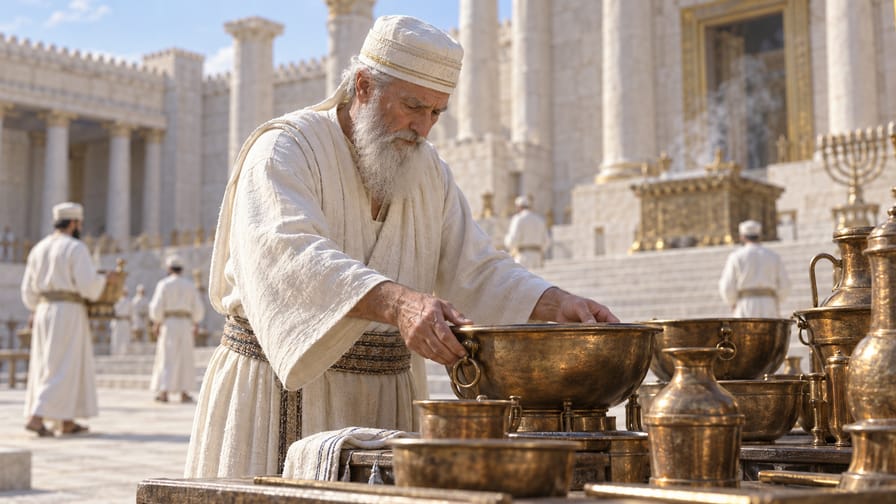
The figure of Bilga, though not a central character in the biblical narrative, emerges from the Scriptures as an exponent of faithfulness and order in the Levitical priesthood. His name is associated with a priestly lineage that served God in different periods of Israel's history, from the organization of worship in David's time to the restructuring of the post-exilic community. The analysis of Bilga, therefore, does not focus on a detailed biography, but on the significance of his office and the continuity of his house in divine service, offering rich theological implications for understanding worship, the covenant, and the sovereignty of God in the history of redemption, from an evangelical Protestant perspective.
This study seeks to explore the etymology of the name, the historical context in which the house of Bilga appears, the role it played, its theological significance, and the legacy its mention in the Scriptures provides. The absence of a detailed personal narrative for Bilga requires an approach that extends beyond the individual to the collective, examining the function and symbolism of the Levitical priesthood as a whole, and how it points to the consummation in Christ Jesus, the eternal high priest.
1. Etymology and meaning of the name
The name Bilga (Hebrew: בִּלְגָה, Bilgāh) appears in the Hebrew Scriptures in contexts related to the priesthood. The exact etymology of the name is debated among scholars, but the most accepted interpretations connect it to roots suggesting "joy," "serenity," or "emptying" / "pouring out." One of the most probable derivations is from a root implying "joy" or "contentment," possibly linked to the idea of "flowing" or "overflowing."
If the meaning is linked to "joy" or "serenity," the name may have been an omen or an aspiration for the life and service of its bearer and his lineage. In the priestly context, such a meaning would be deeply symbolic, as priests were those who interceded and offered sacrifices, restoring communion between God and the people, an act that resulted in joy and peace for the faithful community. Joy in the service of the Lord is a recurring theme in the Scriptures (Psalm 100:2).
There are no significant variations of the name Bilga in biblical languages, although in Nehemiah 10:8 (or 9:38 in some Septuagint versions) and Nehemiah 12:18, the form Bilgai (בִּלְגַּי, Bilgay) may be a variant or an abbreviated form, referring to the same priestly family or an individual of the same lineage. This small variation does not alter the core of the onomastic meaning but reflects the flexibility of transliteration and vocalization of proper names in Hebrew.
It is important to note that there are two distinct mentions of Bilga in the Scriptures, though they likely refer to the same priestly lineage in different periods. The first mention is in 1 Chronicles 24:14, where Bilga is listed as the head of the fifteenth of the twenty-four priestly divisions established by David. The second mention occurs in the books of Nehemiah (Nehemiah 10:8, 12:5, 12:18), referring to a priestly family that returned from the Babylonian exile and participated in the reconstruction and renewal of the covenant.
The theological significance of a name like Bilga, if interpreted as "joy" or "contentment," lies in the nature of priestly service. Priests were called to minister with joy before the Lord, representing God's holiness and benevolence to the people. Service in the Temple was not merely an obligation but an opportunity to experience the divine presence and facilitate worship, generating a sense of satisfaction and purpose that transcends mere ritualism.
Thus, the name Bilga, even in its simplicity, carries an echo of the theology of worship and service to God. It reminds us that ministry in the house of the Lord, whether in the Old Covenant or the New, should be characterized by a spirit of joy and gratitude, reflecting the nature of the God they serve and the hope they offer to the people (Philippians 4:4).
2. Historical context and biblical narrative
The first appearance of Bilga occurs in the context of the organization of the priesthood during the reign of David (c. 1010-970 BC). The book of 1 Chronicles dedicates entire chapters to the meticulous organization of Levitical and priestly service, reflecting David's zeal in establishing an orderly and continuous worship for the Lord. This period was marked by the consolidation of the kingdom of Israel, the conquest of Jerusalem, and the planning for the construction of the Temple, which would be built by Solomon (1 Chronicles 22:6-19).
David, assisted by Zadok and Ahimelech (or Abiathar, depending on the exact period), organized the priests descended from Aaron into twenty-four courses or divisions (1 Chronicles 24:1-19). The purpose was to ensure that service in the Temple was continuous, with each division ministering for a specific period. This organization was crucial for maintaining order and holiness in worship, ensuring that offerings, sacrifices, and prayers were performed according to the Law of Moses (Leviticus 1-7).
It is in this context that Bilga is mentioned in 1 Chronicles 24:14 as the head of the fifteenth priestly division, designated by lot. The use of lots was a common and accepted method in antiquity to determine divine will or to distribute responsibilities, as seen in other biblical passages (Acts 1:26). The choice by lot emphasized God's sovereignty in the appointment of ministers and the organization of His worship.
The lineage of Bilga, as part of the Aaronic priests, descended directly from Eleazar and Ithamar, the sons of Aaron (1 Chronicles 24:1). Its inclusion in David's lists attests to the legitimacy of his family in the priesthood and the importance of its contribution to the religious life of Israel. The main geography associated with these priests would be Jerusalem, the location of the Temple, where they would minister in their respective courses.
The second appearance of the lineage of Bilga occurs in the books of Nehemiah, in a significantly later historical context: the post-exilic period, around the 5th century BC. After the return from Babylonian exile, under the leadership of Zerubbabel, Ezra, and Nehemiah, the people of Israel undertook the reconstruction of Jerusalem and the Temple, as well as the restoration of their spiritual and social life (Ezra 1-10 Nehemiah 1-13).
During this period of renewal, a solemn covenant was established between God and the people, in which the leaders and representatives of the families signed a pact of faithfulness to the Law of the Lord. Among those who sealed this covenant were "the priests, the Levites, and the chiefs of the people" (Nehemiah 10:1). In Nehemiah 10:8, Bilgai (a form of the name Bilga) is listed among the priests who signed the pact, representing his family.
Furthermore, in Nehemiah 12:5 and 12:18, the family of Bilga is mentioned again in the lists of priests who returned with Zerubbabel and Jeshua, and later, in the days of Joiakim, the high priest. These mentions reiterate the continuity and importance of the house of Bilga in maintaining priestly service and reaffirming Israel's identity as a covenant people, even after the trauma of exile and the need for reconstruction.
The presence of the family of Bilga in these lists demonstrates the persistence of their lineage in the priesthood and their commitment to the worship of Yahweh. They were witnesses and active participants in crucial moments of Israel's history: the organization of worship under David and the restoration of religious life after the exile. Their relationships extended to central figures such as David, Ezra, and Nehemiah, underscoring the integration of their house into the religious and social structure of the nation.
3. Character and role in the biblical narrative
The absence of a detailed personal narrative about Bilga in the Scriptures requires that his character and role be inferred from his context and function. As head of one of the twenty-four priestly divisions established by David, and as a representative of a priestly family that signed the post-exilic covenant, the character of Bilga and his lineage must be understood in light of the responsibilities and expectations of their office.
The primary virtue associated with the house of Bilga is **faithfulness**. Inclusion in genealogical and service lists for centuries (from David to Nehemiah) demonstrates a continuous dedication to God's covenant and to the service of the Temple. The priests were guardians of the Law and mediators between God and the people, and their faithfulness was essential for the holiness of the nation (Malachi 2:7).
Another notable quality is **obedience**. David's organization of the priestly divisions was a divinely inspired initiative, and the participation of Bilga and his house reflects submission to royal authority and the established order for worship. In the post-exilic period, the signing of the covenant in Nehemiah underscores the family's commitment to the Law of God, demonstrating obedience to Mosaic precepts and a desire to renew the covenant with Yahweh (Nehemiah 9:38).
Bilga's calling was priestly, a function of immense responsibility and holiness in Israel. Priests were entrusted with offering sacrifices, burning incense, keeping the lamp lit, blessing the people, and teaching the Law (Numbers 6:22-27 Deuteronomy 33:10). As head of a division, Bilga would have the responsibility of overseeing and ensuring that rituals were performed correctly and that the priests under his leadership maintained the required purity.
The role played by the house of Bilga was fundamental for the maintenance of Israel's religious and social life. They ensured the continuity of worship and the remembrance of God's covenants with His people. Their participation in the organization of the priesthood under David and in the renewal of the covenant under Nehemiah were not mere administrative acts, but key actions that sustained Israel's theocratic identity.
There are no documented records of sins, weaknesses, or moral failures for Bilga or his lineage in the Scriptures, which, for a secondary character, generally means that they fulfilled their duties acceptably. The absence of criticism, unlike other priests who failed (e.g., Hophni and Phinehas in 1 Samuel 2:12-36), suggests a service that, at minimum, was upright and in conformity with divine requirements.
Character development, in the sense of psychological or moral progression, is not applicable to Bilga. However, the persistence of his lineage in the priesthood for centuries, from the monarchy to the post-exilic period, can be seen as a testimony to **perseverance** and generational commitment to the service of God. This continuity demonstrates the importance of inheritance and the transmission of faith and office through generations in Israel.
In summary, the figure of Bilga, though discreet, embodies the virtues of faithfulness, obedience, and perseverance expected of a Levitical priest. His house played a vital role in Israel's worship structure, contributing to the order and holiness of worship, and to the reaffirmation of the covenant with God at crucial moments in salvation history.
4. Theological significance and typology
The mention of Bilga and his lineage, though brief, offers important theological perspectives within the evangelical Protestant perspective, especially concerning the Levitical priesthood and its relation to redemptive history. The Old Testament priesthood, in which the house of Bilga was embedded, was a divinely ordained institution to mediate between a holy God and a sinful people (Hebrews 8:1-6).
The role of Bilga as head of a priestly division and his family in signing the post-exilic covenant underscores the importance of **order in worship**. God is a God of order, not of confusion (1 Corinthians 14:33), and David's organization of the priestly divisions reflects this principle. Worship of God should be intentional, reverent, and structured, aiming for God's glory and the edification of His people.
The Levitical priesthood, generally speaking, is a rich **Christocentric typology**. The priests of the Old Covenant, with their offerings and sacrifices, prefigured the work of Christ. They pointed to the need for a perfect mediator and a definitive sacrifice for the remission of sins (Hebrews 9:11-14). The imperfection and temporality of the Levitical priesthood (priests died, sacrifices needed to be repeated) evidenced the need for a superior High Priest.
Jesus Christ is the final and perfect fulfillment of the priesthood. He is the High Priest "according to the order of Melchizedek," not according to the Levitical order, whose priesthood is eternal and whose sacrificial work is complete and effective forever (Hebrews 7:23-28). The house of Bilga, by serving faithfully in its course, participated in a system that, though temporary, was essential to prepare the way for the fullness of revelation in Christ.
The connection of the family of Bilga with the renewal of the covenant in Nehemiah highlights the theme of **covenant faithfulness**. Nehemiah's pact was an act of repentance and reaffirmation of Israel's commitment to the Law of God, demonstrating the importance of obedience and spiritual renewal for the life of God's people (Nehemiah 9:38-10:29). This prefigures the New Covenant in Christ, where the law is written on hearts and faithfulness is guaranteed by the Holy Spirit (Jeremiah 31:31-34 Hebrews 8:7-13).
The Levitical priests, including the lineage of Bilga, administered the promises of the Mosaic Covenant, which included blessings for obedience and curses for disobedience. They were the guardians of holiness and ritual purity, teaching the people to distinguish between the holy and the profane (Leviticus 10:10). Their existence and service were a constant reminder of the separation between God and sinful humanity, and of divine provision for reconciliation.
In the New Testament, although there are no direct mentions of Bilga, the epistle to the Hebrews extensively explores the superiority of Christ's priesthood over the Levitical one. The understanding that the rituals and priesthood of the Old Covenant were shadows of future realities in Christ is fundamental to evangelical theology (Colossians 2:16-17). The faithfulness of priests like those of the house of Bilga illustrates the seriousness of service to God and the importance of divine mediation.
Doctrinally, the figure of Bilga, by representation, reinforces the doctrine of **atonement** and **intercession**. Priests made atonement for the sins of the people and interceded on their behalf. In Christ, we have perfect atonement and an intercessor who lives forever to intercede for us (Hebrews 7:25). The transition from the Levitical priesthood to the priesthood of Christ is a central point in biblical theology, demonstrating the progression of God's revelation.
5. Biblical-theological legacy and canonical references
The legacy of Bilga, though not a character with an extensive narrative, lies in the representation of a faithful priestly lineage and its contribution to the structure and continuity of worship to God in Israel. The mentions of Bilga in 1 Chronicles 24:14 and of the family of Bilga/Bilgai in Nehemiah 10:8, 12:5, and 12:18 are the direct canonical references. These mentions, though concise, are significant for understanding the history and theology of Israel.
The inclusion of the house of Bilga in the priestly lists contributes to the **historical authenticity** of the biblical canon. They demonstrate the meticulousness of the biblical authors in recording social and religious structures, reinforcing the reliability of the Scriptures as a divinely inspired historical record. These lists were not mere appendices but an integral part of the narrative of God's covenant with His people, detailing how worship was organized and maintained.
In biblical theology, the persistence of the lineage of Bilga for centuries, from David's time to the post-exile, is a testimony to **God's faithfulness to His promises** and the **perseverance of His people**. Even after the Babylonian exile, which could have disintegrated Israel's identity, priestly families like that of Bilga returned and resumed their functions, ensuring the continuity of worship and national identity based on the covenant.
Jewish and Christian interpretive tradition recognizes the importance of genealogical and priestly lists. For Judaism, they were essential for the legitimation of the priesthood and for maintaining the purity of the lineages. For Christianity, these lists provide the necessary historical and theological context to understand the transition from the Old to the New Covenant and the superiority of Christ's priesthood.
Although there are no literary contributions attributed to Bilga nor mentions in intertestamental literature, his presence in the Scriptures serves as a reminder of the importance of each "piece" in the grand mosaic of redemption history. Every priest, every division, every act of obedience contributed to the scenario in which Christ would come to fulfill all prophecies and prefigurations.
In Reformed and evangelical theology, the figure of Bilga and the Levitical priesthood are often used to illustrate the **priesthood of all believers** (1 Peter 2:9 Revelation 1:6). Although the Levitical priesthood was exclusive and mediating, it points to Christ, who opened direct access to God for us, making every believer a priest with the ability to approach the throne of grace and offer spiritual sacrifices of praise and service (Hebrews 4:16 Romans 12:1-2).
Understanding the function of the house of Bilga helps to appreciate order and structure in the church, as well as the importance of dedicated spiritual leadership. David's meticulousness in organizing the priesthood, and the readiness of the family of Bilga to sign the covenant in Nehemiah, highlight the seriousness with which service to God should be approached, both in the Old Testament and in the contemporary church.
The importance of Bilga for understanding the canon lies in his representation of institutional faithfulness and the continuity of God's promise. His mention reinforces the idea that God acts through people and structures to fulfill His purposes, and that every role, however small, has its place in the divine plan of salvation. The life and service of figures like Bilga, even if discreet, are an integral part of the tapestry of God's revelation, pointing to the magnificence of Christ, the Eternal and perfect High Priest.