


Ithiel
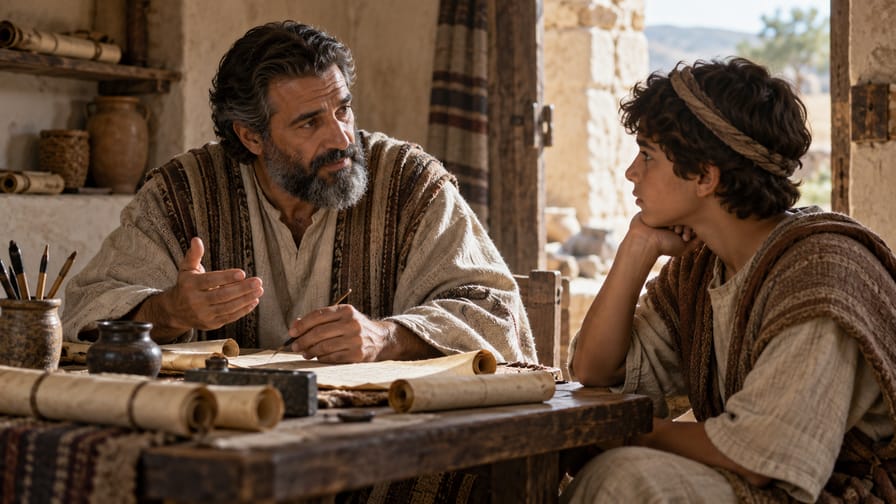
The biblical figure of Itiel, though mentioned concisely in the Scriptures, offers profound points of theological and exegetical reflection. The name Itiel appears in two distinct passages, in different contexts within the Hebrew canon: once in a genealogical record of the Old Testament and another as one of the recipients of "the words of Agur" in the book of Proverbs. This scarcity of direct biographical details does not diminish its relevance for a biblical-theological analysis, but rather directs it towards a more in-depth exploration of the onomastic meaning and the literary and historical context in which the name emerges.
The conservative evangelical Protestant perspective values every detail of God's Word as divinely inspired and useful (2 Timothy 3:16). Thus, even brief mentions of individuals like Itiel are considered significant, not only for their historical existence but for what their names and the contexts in which they appear reveal about God's sovereignty, His providence, and His redemptive purposes. Through careful analysis, we can discern theological and spiritual principles that transcend the particularity of the character.
This study will seek to uncover what the Scriptures allow us to infer about Itiel, focusing on its etymology, the historical environment of its mentions, the implications of its limited role, and the broader theological significance that its figure, or the absence of further details about it, may offer to the Christian faith. We will delve into the Hebrew roots of the name and connect its meaning to central themes of Reformed theology, such as the presence of God, divine wisdom, and covenant faithfulness.
1. Etymology and Meaning of the Name
The name Itiel, in Hebrew, is transliterated as ʼItyʼēl (אִיתִיאֵל). Its etymological composition is quite clear and deeply theological, consisting of two main parts. The first part, ʼît (אִית), is a preposition or particle that can mean "with", "together with", "near", or indicate "existence" or "substance". The second part is ʼĒl (אֵל), a common term for "God" in biblical Hebrew, frequently used to refer to the God of Israel.
The combination of these two parts results in a primary and powerful meaning: "God is with me" or "God is my companion". Other possible interpretations include "God exists" or "I am with God", although "God is with me" is the most widely accepted and theologically resonant. This meaning reflects a profound confession of faith and a declaration of the experience of divine presence in the life of the individual or their family.
The practice of incorporating the name of God (ʼĒl, Yah, Yahweh) into personal names was common in ancient Israel, serving as a form of recognition of divine sovereignty and the covenant relationship. Names like Israel ("he who struggles with God"), Emmanuel ("God with us"), Samuel ("heard by God"), and Daniel ("God is my judge") are examples of this rich onomastic tradition that infused personal identity with theological truths.
In the case of Itiel, the name expresses a fundamental conviction of biblical faith: the active and sustaining presence of God in the life of His people. In a context where names were often prophetic or descriptive, the name Itiel would have served as a constant reminder of divine immanence and faithfulness, both for the bearer and for their community. There are no other prominent biblical characters with the same name that require distinction, making each mention of Itiel unique in its context.
The theological significance of the name Itiel is, therefore, immense. It encapsulates the doctrine of the presence of God, a recurrent theme throughout Scripture, from the patriarchal promises (Genesis 28:15) to Christ's Great Commission (Matthew 28:20). The choice of such a name for a child was an act of faith, a testimony to the belief in God's proximity and providential care amidst life's vicissitudes.
2. Historical Context and Biblical Narrative
The two mentions of Itiel in the biblical canon occur in distinct historical and literary periods, requiring an individualized contextual analysis for each. Although there is no evidence that they are the same person, the meaning of the name resonates in both contexts, offering a theological bridge.
2.1. Itiel in Nehemiah 11:7
The first mention of Itiel is found in Nehemiah 11:7, within a genealogical and settlement list after the return from the Babylonian exile. The passage says: "These are the sons of Benjamin: Sallu the son of Meshullam, son of Joed, son of Pedaiah, son of Kolaiah, son of Maaseiah, son of Itiel, son of Jeshaiah."
The precise historical period is the post-exilic era, around 445 B.C., during the time of Nehemiah and Ezra, when the Jews returned from Babylon to rebuild Jerusalem and restore religious and social life. The political and social context was one of great challenge, with the need to repopulate the holy city and strengthen its defense against external enemies (Nehemiah 4:7-9).
Genealogies played a crucial role in this period, as they ensured tribal identity, priestly purity, and land inheritance (Nehemiah 7:5-6). The inclusion of Itiel in this list of descendants of Benjamin, who settled in Jerusalem, underscores his connection to the families committed to the restoration and renewal of the community of faith. His lineage connects him directly to the history of the people of Israel and the continuity of divine promises.
The geography related to this Itiel is Jerusalem and the region of Judah, the center of the religious and political life of the returning Jews. His presence in the genealogy of Benjamin, one of the two tribes that formed the nucleus of the kingdom of Judah after the division, is a testimony to God's faithfulness in preserving His people and their lineages, even after the severe judgment of the exile.
2.2. Itiel in Proverbs 30:1
The second mention of Itiel is in Proverbs 30:1: "The words of Agur son of Jakeh an oracle. The man declares to Itiel, to Itiel and Ucal." This verse serves as an introduction to a specific section of wisdom, attributed to Agur. The literary context is that of the Old Testament wisdom literature, which seeks to transmit divine truth and practical wisdom for life.
The exact period of the compilation of Agur's proverbs is uncertain, but wisdom literature generally reflects traditions that may date back to the time of Solomon (10th century B.C.) or later collections. The book of Proverbs, as a whole, is a compilation of various sources of wisdom (Proverbs 25:1).
The role of Itiel here is that of a recipient of Agur's words. The repetition of the name ("to Itiel, to Itiel and Ucal") has been the subject of academic debate. Some suggest that the repetition may be for emphasis, others see it as a way to indicate a primary recipient or even a textual corruption. However, the consensus is that Itiel and Ucal are real individuals to whom Agur addressed his instruction.
In this context, Itiel is not defined by his genealogy or geographical location, but by his relationship to wisdom. He is a receiver of divine revelation and sapiential instruction, which places him in a position of a learner or disciple. The absence of details about his life reinforces the idea that the focus is on the message of wisdom, and not on the biography of the recipient.
3. Character and Role in the Biblical Narrative
Given the nature of the mentions of Itiel, the analysis of his character and role must be done by inference and contextualization, rather than a direct description of his actions or qualities. The Scriptures do not provide biographical details that allow for tracing a complete psychological or spiritual profile of the character.
3.1. The Itiel of the genealogy in Nehemiah
The Itiel mentioned in Nehemiah 11:7 is part of a lineage, which means he existed and contributed to the continuity of his family and tribe. His inclusion in the list of inhabitants of Jerusalem after the exile suggests, at the very least, that he or his immediate ancestors participated in the return and the effort to rebuild the city. This denotes a commitment to the restored community of Israel and to obedience to God's call to repopulate the promised land.
Although no specific virtues or qualities are attributed to him, the mere fact that his family returned to Jerusalem and was registered among those who settled there may indicate a spirit of faith and resilience. In a period of difficulties and opposition (Nehemiah 4:1-6), the decision to live in Jerusalem required courage and a deep conviction in God's providence. The name "God is with me" would have been an appropriate motto for such a time.
His role is that of a link in the generational chain that preserved the tribal identity of Benjamin and the Jewish presence in Jerusalem. He represents God's faithfulness in maintaining His covenant with His people, even in times of fragmentation and exile. There is no record of moral failures or sins associated with him, maintaining his figure as a simple, yet significant, element in the genealogical tapestry.
3.2. The Itiel recipient of wisdom in Proverbs
The Itiel of Proverbs 30:1 assumes a different, yet equally significant, role. As one of the recipients of "the words of Agur," he is implicitly a learner or an individual interested in acquiring divine wisdom. This position suggests a receptive mind and a heart inclined to instruction and discernment.
Biblical wisdom is not merely intellectual, but involves a moral and spiritual character that fears God (Proverbs 1:7). Therefore, Itiel's association with the reception of such wisdom may indicate that he was someone who valued divine instruction and sought to live according to God's principles. His name, "God is with me," harmonizes perfectly with the idea that true wisdom comes from the presence and revelation of God.
His role is that of a model for all who seek wisdom. He represents the ideal student, one who is willing to listen and internalize God's truths. The "words of Agur" are profound and, at times, enigmatic, requiring an attentive and discerning listener. Itiel, in this sense, personifies the quest for understanding and the fear of the Lord that are central to sapiential literature.
In both cases, the absence of detailed narrative development for Itiel emphasizes the theocentric nature of Scripture. The focus falls on God's action in history (in Nehemiah) and on the provision of divine wisdom (in Proverbs), and not on the individual's personal achievements. Itiel serves as a reminder that every person, even those with brief mentions, has a place in God's greater plan.
4. Theological Significance and Typology
The theological significance of Itiel lies more in the echo of his name and the context of his appearances than in a detailed biography. The conservative evangelical Protestant perspective views the Bible as a progressive revelation that culminates in Christ, and therefore seeks Christocentric and doctrinal connections in all parts of Scripture.
4.1. The Presence of God as a Central Theme
The meaning of the name Itiel, "God is with me," is a central and recurrent theme in redemptive history. This truth is the foundation of God's covenant with His people, promising to be with them in all circumstances. God promised Moses: "I will be with you" (Exodus 3:12) Joshua: "As I was with Moses, so I will be with you" (Joshua 1:5) and David: "I will be with you wherever you go" (2 Samuel 7:9).
In the New Testament, this promise reaches its climax in Jesus Christ, whose name Emmanuel means "God with us" (Isaiah 7:14, Matthew 1:23). The presence of God in Christ is the guarantee of salvation and the restoration of fellowship. Jesus' final promise to His disciples is: "And behold, I am with you always, to the end of the age" (Matthew 28:20). Thus, the name Itiel prefigures, in a conceptual sense, the incarnation and the continuous presence of Christ.
In Nehemiah, the presence of God ("God is with me") is the driving force for the restoration of Jerusalem. It is the conviction that God is with them that enables the exiles to overcome adversity and rebuild. In Proverbs, the presence of God is the source of all true wisdom (Proverbs 1:7). Wisdom is not an isolated human achievement, but a gift that comes from fellowship and the fear of the Lord, who is "with" His children.
4.2. Divine Wisdom and Revelation
The appearance of Itiel in Proverbs 30:1, as a recipient of Agur's words, intrinsically connects him to the theme of wisdom. Evangelical theology emphasizes that all true wisdom emanates from God and is revealed through His Word (James 1:5). Agur, in addressing his words to Itiel, is engaged in the divine process of transmitting wisdom, which is essential for a godly life and for understanding the nature of God.
Agur's words in Proverbs 30 are notable for their humility and recognition of the limits of human knowledge, contrasting it with divine omniscience (Proverbs 30:2-4). Itiel, as a listener, is invited to embrace this perspective, recognizing that true wisdom begins with dependence on God. The repetition of his name may even suggest the importance of clinging firmly to this truth.
4.3. Covenant Faithfulness and Continuity of Salvation History
The Itiel of Nehemiah, as part of a genealogy, points to God's faithfulness in fulfilling His covenant promises. Genealogies in the Old Testament are not mere lists, but theological documents that demonstrate the continuity of Abraham's seed and the preparation for the coming of the Messiah (Genesis 12:1-3, Matthew 1:1-17). The inclusion of Itiel in the lineage of Benjamin is a testimony to divine providence in preserving the remnant and in maintaining the tribal structure of Israel, even after the exile.
Although Itiel is not a direct typological figure of Christ in the sense of prefiguring specific events or aspects of His life, the meaning of his name is deeply Christocentric. "God is with me" is the essence of who Christ is and what He accomplishes for His people. He is the ultimate fulfillment of the promise of God's presence, the embodiment of divine wisdom, and the guarantor of the eternal covenant (Hebrews 8:6-13).
5. Biblical-Theological Legacy and Canonical References
The legacy of Itiel in biblical theology does not lie in great deeds or extensive narratives, but in the profundity of his name and the meaning it lends to the contexts in which it is mentioned. His presence, even if brief, is proof of the inspiration and usefulness of every word of Scripture (2 Timothy 3:16).
The scarcity of mentions of Itiel implies that there are no direct literary contributions attributed to him (such as authorship of books or psalms). He is not cited in the New Testament, nor is he a prominent figure in intertestamental literature or older Jewish and Christian interpretive traditions, in contrast to characters like David, Moses, or Abraham.
Nevertheless, the name Itiel and the contexts in which it appears contribute to biblical theology in subtle, yet significant ways. It reinforces the doctrine of God's immanence, His active and constant presence in the history of His people. In a world that frequently questions God's relevance, the name Itiel serves as a reminder that God is present, whether in the restoration of a nation (Nehemiah) or in the transmission of wisdom (Proverbs).
In Reformed and evangelical theology, the sovereignty of God is a fundamental pillar. The existence of Itiel, even in his obscurity, demonstrates that God uses people, great and small, to fulfill His purposes. Every name in a genealogy, every recipient of a word of wisdom, is under God's care and providence. The brevity of Itiel's mention can even be seen as a reminder of the humility and dependence that all believers should have before God.
The importance of Itiel for understanding the canon lies in how he illustrates that every element of Scripture has its purpose. The genealogies in Nehemiah are not just dry lists, but testimonies to God's faithfulness to His covenant and the preservation of His people. Agur's proverbs are not just moral advice, but expressions of divine wisdom that God offers to those who fear Him.
In summary, Itiel, though a minor figure in terms of visibility, is a name that resonates with one of the most fundamental truths of faith: the presence of God. Its analysis, from an evangelical Protestant perspective, invites us to seek theological meaning in every part of Scripture, recognizing that the totality of God's Word points to His glory and His redemptive plan in Christ Jesus.