


Maaseiah
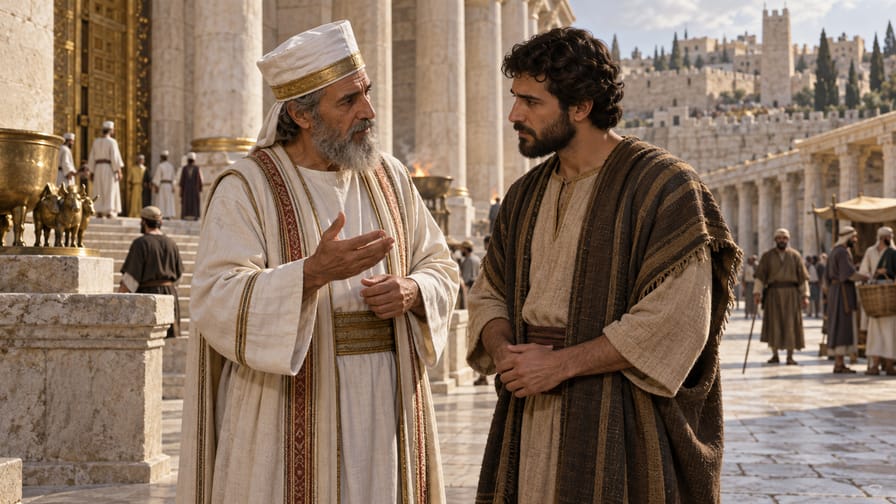
Maaseiah belonged to a priestly family of Judah in the last years before the Babylonian exile. He is known only as the father of Zephaniah, a priest who held a position of responsibility in the temple during the reign of Zedekiah and who served several times as a messenger between the king and the prophet Jeremiah (Jeremiah 21:1; 29:25; 37:3).
Scripture records no word or deed of Maaseiah himself. His name appears three times, always in the formula Zephaniah the son of Maaseiah, which identified his son among the leaders of Jerusalem. Because the priesthood was hereditary, the fact that his son was a priest implies that Maaseiah belonged to a family descended from Aaron, although the text never gives his genealogy or describes any service of his.
The name Maaseiah is one of the most common in the Old Testament, borne by many different men, so care is needed. This article speaks only of the father of the priest Zephaniah in the book of Jeremiah and, as far as the text allows, of the setting in which his family lived.
1. Etymology and meaning of the name
The Hebrew name Maʿaśeyah (מַעֲשֵׂיָה), which also occurs in the longer form Maʿaśeyahu (מַעֲשֵׂיָהוּ), is composed of maʿaśeh, work or deed, and the short form of the divine name, Yah. Its most accepted meaning is work of the Lord. Like many names formed with the divine name, it expresses a confession of faith: the child is seen as the work of God's hands, or the family acknowledges what the Lord has done.
The frequency of the name among Levites, priests and officials (1 Chronicles 15:18; 2 Chronicles 23:1; Ezra 10:18; Nehemiah 8:4) shows that it was popular in circles connected with the temple and the court. That popularity is also the reason why the name alone never allows us to identify a particular Maaseiah; the context must decide.
2. Historical context and biblical narrative
2.1 Family origin and genealogy
The Bible does not give the ancestry of Maaseiah, nor the name of his wife or of any other children. All it says is that he was the father of Zephaniah, who is called the priest (Jeremiah 21:1; 37:3). In Jeremiah 29:25 the phrase Zephaniah the son of Maaseiah the priest is grammatically ambiguous, since the title could refer to the father or to the son; the next verse, which addresses Zephaniah as the one the Lord made priest in place of Jehoiada (Jeremiah 29:26), shows that the title belongs above all to the son. Even so, in Israel only descendants of Aaron could serve as priests (Numbers 3:10), so it is reasonable to conclude that Maaseiah belonged to a priestly family.
His son Zephaniah is very probably the same man called the second priest, next in rank to Seraiah the chief priest, when Jerusalem fell (2 Kings 25:18; Jeremiah 52:24). Those passages do not name his father, but the identification is widely accepted because of the name, the period and the rank. If it is correct, Maaseiah's son was among the leaders whom Nebuchadnezzar put to death at Riblah (2 Kings 25:18-21; Jeremiah 52:24-27).
Some scholars have proposed that this Maaseiah is the same as Maaseiah the son of Shallum, keeper of the threshold, whose chamber in the temple is mentioned in Jeremiah 35:4. The hypothesis is attractive, because a keeper of the threshold held a temple office and Zephaniah later appears as second priest, but the text never makes the connection. Since Maaseiah was a very common name, it is safer to treat them as distinct unless further evidence appears.
2.2 Main events
Maaseiah is not an actor in any event. What the Bible narrates are episodes involving his son, in which the father's name serves as identification. They show the environment in which Maaseiah's household lived during the final crisis of the kingdom of Judah.
The first is the embassy of Jeremiah 21:1-2. When Nebuchadnezzar king of Babylon was making war against Judah, King Zedekiah sent Pashhur the son of Malchiah and Zephaniah the priest, the son of Maaseiah, to ask Jeremiah to inquire of the Lord, hoping that the Lord would perform a wonder as in the past and make the enemy withdraw. The answer was severe: the Lord himself would fight against the city, and whoever surrendered to the Chaldeans would live (Jeremiah 21:3-10).
The second is recorded in Jeremiah 29:24-32. Shemaiah of Nehelam, one of the exiles in Babylon, sent letters in his own name to Zephaniah the son of Maaseiah and to all the priests, rebuking Zephaniah for not restraining Jeremiah, whom he treated as a madman who prophesied, because Jeremiah had written to the exiles that the captivity would be long. Zephaniah read the letter in the hearing of Jeremiah (Jeremiah 29:29), and the Lord answered with a word of judgment against Shemaiah.
The third appears in Jeremiah 37:3. Zedekiah sent Jehucal the son of Shelemiah and Zephaniah the priest, the son of Maaseiah, to Jeremiah with the request: Please pray for us to the Lord our God. The siege had been lifted for a time because Pharaoh's army was approaching, but the Lord declared through Jeremiah that the Chaldeans would return and burn the city (Jeremiah 37:5-10).
3. Character and role in the biblical narrative
Since the Bible says nothing about the words or actions of Maaseiah, nothing can be affirmed about his character without inventing it. We do not know whether he was still alive in the days of Zedekiah, what function he exercised, or what he thought of the preaching of Jeremiah. His role in the text is that of a family name: in a society where men were known by their fathers, to say son of Maaseiah placed Zephaniah within a specific priestly household.
What can be observed is the conduct of his son, which the text records with nuance. Zephaniah was sent twice by the king to seek a word from the prophet. When he received Shemaiah's letter urging him to put Jeremiah in the stocks, he read it to Jeremiah instead of acting against him (Jeremiah 29:26-29). The text does not explain his motives, and it would be excessive to make him a hero, since he belonged to a leadership that did not lead the nation to repentance. But these episodes show a priest who, at least, did not silence the prophet.
4. Theological significance
4.1 A name that confesses the work of God
The name Maaseiah, work of the Lord, stands in contrast with the situation of Jerusalem in the days of his son. Priests who bore names confessing the Lord's work served in a temple about to be destroyed because of the people's unfaithfulness (Jeremiah 7:1-15). A godly name did not guarantee a faithful life, neither for the nation nor for individuals. The Lord does not want his name invoked as a guarantee, as if repeating the temple of the Lord were enough (Jeremiah 7:4); he wants obedience to his word.
4.2 The priesthood in crisis
The family of Maaseiah belonged to the priesthood appointed to teach the Law and to intercede for the people (Deuteronomy 33:10; Malachi 2:7). In Jeremiah's time, however, many priests had turned away (Jeremiah 2:8; 5:31; 23:11). The requests of Zedekiah that passed through Zephaniah show a king who wanted the prophet's prayers without obeying the prophet's message. The priesthood of Aaron, weakened and finally carried into exile, points to the need for a better priest, one who does not need to offer sacrifices for his own sins and who always lives to intercede (Hebrews 7:23-28).
4.3 Faithfulness across generations
Identifications like son of Maaseiah remind us that faith, or its absence, is passed on within families. Scripture does not tell us what Maaseiah taught his son, and we must not fill that silence. It is enough to note that the Bible remembers the name of this father because of the role his son played at a decisive moment in the history of God's people.
5. Legacy and canonical references
Maaseiah, father of the priest Zephaniah, is named in only three verses: Jeremiah 21:1, 29:25 and 37:3. His son is very probably also the second priest mentioned in 2 Kings 25:18 and Jeremiah 52:24, where the father is not named, and Jeremiah 29:29 refers to Zephaniah without mentioning his father.
He should not be confused with the many other men of the same name, among them Maaseiah the son of Adaiah, one of the commanders who helped Jehoiada in the coronation of Joash (2 Chronicles 23:1); Maaseiah the son of Shallum, keeper of the threshold (Jeremiah 35:4), whose possible identification is discussed above; Maaseiah the father of the false prophet Zedekiah (Jeremiah 29:21); and Maaseiah who stood beside Ezra at the reading of the Law (Nehemiah 8:4).
6. Application for today
Maaseiah reminds us that most of God's people live and die without their deeds being recorded. The Bible preserves only his name, as father of a priest who served in difficult days. Many believers today will also be remembered, if at all, through their children or through others who continued their work. God does not measure faithfulness by visibility, and no labor in the Lord is in vain (1 Corinthians 15:58).
His name also invites us to confess what it proclaims: our life is the work of the Lord. Paul writes that we are his workmanship, created in Christ Jesus for good works (Ephesians 2:10). Salvation is not our work presented to God, but God's work in us.
Finally, the episodes involving his son warn against a religion that seeks God's help without submitting to his word. Zedekiah wanted prayer, not repentance. The way of life, as Jeremiah announced, was to hear the word of the Lord and obey it. In Jesus Christ, the faithful High Priest and the eternal Word, that invitation remains open to all who come to him.