


Baanah
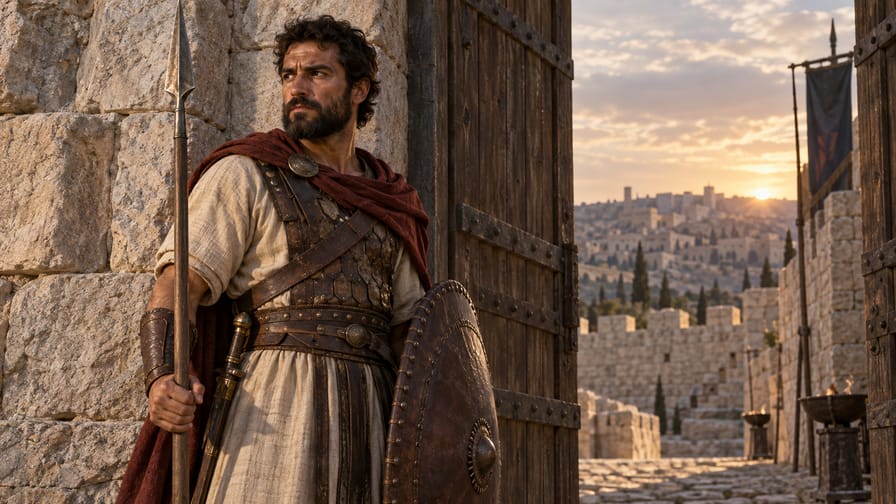
1. Etymology and Meaning of the Name
The name Baaná (Hebrew: בַּעֲנָא, Baaná) is found in several passages of the Old Testament, being borne by various individuals in different historical and social contexts. Its etymology is the subject of some discussion among Hebraists, but the most common interpretations point to meanings that may have symbolic relevance, though not always directly linked to the character of its bearers.
The root of the name Baaná can be derived from a combination of Hebrew elements. One possibility is the joining of בַּעַל (Ba'al), meaning "lord" or "master", with עָנָה ('anah), which can mean "to answer", "to afflict", or "to humble". Thus, one interpretation would be "in answer" or "in affliction/oppression". Another derivation suggests "son of affliction" or "son of misery", which resonates with the idea of oppression.
Some scholars also propose a connection with the root בָּנָה (banah), "to build", or with the idea of "son of Ana" (if 'anah is interpreted as the proper name Ana/Hannah). However, the most accepted interpretation in the general context of Semitic names tends towards the idea of "to answer" or "to afflict", implying a relationship with some form of divine intervention or life circumstance.
It is crucial to note that, although the etymological meaning of a name can carry a symbolic weight, it does not always directly reflect the destiny or character of the individual in the biblical narrative. In many cases, names were given based on circumstances of birth or parental hopes, and not as an infallible omen of the future.
1.1 Variations and Other Characters Named Baaná
The name Baaná appears in at least four distinct contexts in the Hebrew Scriptures, indicating that it was a relatively common name in Israel. The precise identification of the character under analysis is fundamental for a correct interpretation of his story and theological significance.
- Baaná, son of Rimmon, the Beerothite: This is the most prominent and the one on whom this analysis will focus. He and his brother Rechab were the assassins of Ish-Bosheth, son of Saul, as recorded in 2 Samuel 4:2-12. His story is one of treachery and divine judgment.
- Baaná, the Netophathite: One of David's mighty men, mentioned in 2 Samuel 23:29 and 1 Chronicles 11:30. This Baaná is celebrated for his loyalty and bravery in the service of King David, contrasting sharply with the previous Baaná.
- Baaná, father of Zadok: Mentioned in Nehemiah 3:4 as the father of Zadok, who was involved in the rebuilding of the wall of Jerusalem during the post-exilic period. This Baaná seems to have been a respected figure, whose son contributed to a sacred work.
- Baaná, one of the chiefs of the people who returned from exile with Zerubbabel: Recorded in Ezra 2:2 and Nehemiah 7:7. He is also listed among those who sealed the covenant with Nehemiah in Nehemiah 10:27. This Baaná was a figure of leadership in the restored community of Israel.
For the purposes of this in-depth analysis, the main focus will be on Baaná, son of Rimmon, given the prominence and theological impact of his narrative in the history of Israel and in David's ascension to the throne. References to the other Baanás serve to contextualize the recurrence of the name, but will not be the core of the detailed exploration of character and theological significance.
1.2 Theological Significance of the Name in the Biblical Context
In the case of Baaná, son of Rimmon, the etymological meaning of "in affliction" or "son of oppression" can be seen ironically or prophetically, considering the act of oppression and affliction that he perpetrated against Ish-Bosheth. Although the name itself is not a condemnation, the story of Baaná serves as a reminder that human actions have consequences, and that divine justice eventually prevails.
The repetition of the name Baaná in different contexts reminds us of the diversity of individuals whom God uses in His salvation history, some to illustrate justice and others to demonstrate faithfulness. The figure of Ish-Bosheth's assassin, though not a positive example, is crucial for the unfolding of the narrative of the Davidic monarchy.
2. Historical Context and Biblical Narrative
The figure of Baaná, son of Rimmon, the Beerothite, is embedded in a critical and turbulent period of Israel's history: the transition from Saul's monarchy to David's. This period, approximately between 1010 and 1003 B.C., was marked by internal conflicts and political instability after the death of Saul and his sons in the Battle of Gilboa (1 Samuel 31).
After Saul's death, David was anointed king over Judah in Hebron (2 Samuel 2:4). However, Abner, the commander of Saul's army, anointed Ish-Bosheth, Saul's surviving son, as king over Israel, establishing his kingdom in Mahanaim, in Transjordan (2 Samuel 2:8-10). This initiated a prolonged civil war between the house of Saul and the house of David, which lasted about seven and a half years.
2.1 Family Origin and Genealogy
Baaná and his brother Rechab are identified as sons of Rimmon, the Beerothite (2 Samuel 4:2). The city of Beeroth was one of the four Hivite cities that deceived Joshua into making a covenant (Joshua 9:17). Subsequently, Beeroth was assigned to the tribe of Benjamin (Joshua 18:25), but its original inhabitants, the Hivites, seem to have maintained a distinct identity or, at the very least, a certain autonomy that completely differentiated them from the loyal Israelites.
The passage in 2 Samuel 4:3 notes that the Beerothites fled to Gittaim and remained there as sojourners. This note may suggest a certain detachment on their part from the Israelite tribal structure and loyalty to the house of Saul or David, making them mercenaries or opportunists in a civil war scenario.
2.2 Main Events in the Life of Baaná, Son of Rimmon
The biblical narrative focuses exclusively on the role of Baaná and his brother Rechab in the assassination of Ish-Bosheth, the son of Saul who reigned over Israel. This event is crucial for the unification of the kingdom under David and is detailed in 2 Samuel 4:1-12.
With the death of Abner, Ish-Bosheth's main military support, the house of Saul was severely weakened, and Ish-Bosheth himself was discouraged and without leadership (2 Samuel 4:1). It was in this vacuum of power and morale that Baaná and Rechab saw an opportunity for their own benefit.
They entered Ish-Bosheth's house in Mahanaim, while he was sleeping at noon, a common time for rest in the region (2 Samuel 4:5). Without hesitation, they murdered him in his bed and cut off his head. Then, they took Ish-Bosheth's head to David in Hebron, hoping to be rewarded for having removed his rival to the throne (2 Samuel 4:6-8).
The expectation of Baaná and Rechab was that David would generously reward them for having eliminated his adversary, believing that they were rendering a great service to the new king. They presented Ish-Bosheth's head to David, proclaiming: "Here is the head of Ish-Bosheth, the son of Saul, your enemy, who sought your life thus the Lord has avenged my lord the king this day on Saul and his descendants" (2 Samuel 4:8).
2.3 Relationships with Other Biblical Characters
Baaná's most significant relationship is with Ish-Bosheth, his victim, and with David, whom he hoped to please. His act of murder reveals a profound betrayal of the one he should have served and protected, Ish-Bosheth. At the same time, the expectation of reward from David demonstrates a deep misunderstanding of the king's character and the principles of justice that David sought to follow.
David's reaction is fundamental to understanding Baaná's role in the narrative. David, a man who refused to touch the Lord's anointed, even Saul, his persecutor (1 Samuel 24:6 26:9), could not tolerate such an act of treachery and violence against a king, even if he was his rival.
David reminded Baaná and Rechab of the fate of the Amalekite who falsely claimed to have killed Saul and was executed by David for having stretched out his hand against the Lord's anointed (2 Samuel 1:1-16). With this, David established a clear precedent for the punishment of Baaná and Rechab.
David's response was swift and decisive: "Then David commanded his young men, and they put them to death and cut off their hands and feet and hanged them beside the pool in Hebron. But they took the head of Ish-Bosheth and buried it in the tomb of Abner in Hebron" (2 Samuel 4:12). This act of justice demonstrates the seriousness with which David regarded the shedding of innocent blood, especially against a king.
3. Character and Role in the Biblical Narrative
The character of Baaná, son of Rimmon, is unequivocally and negatively revealed through his actions in 2 Samuel 4. He is presented as an individual driven by calculating opportunism and shocking cruelty, devoid of loyalty and ethics.
3.1 Documented Sins, Weaknesses, and Moral Failings
The main moral failings of Baaná and his brother Rechab include:
- Betrayal: They betrayed the trust of Ish-Bosheth, whom they should have served and protected. Loyalty was a fundamental value in ancient society, especially in relation to a king.
- Murder: They committed cold-blooded murder against a defenseless and sleeping man. This is a serious sin against the Sixth Commandment (Exodus 20:13).
- Selfish Ambition: Their actions were motivated by the hope of a personal reward and social or financial advancement, without considering justice or the will of God.
- Deceit and Cowardice: They took advantage of Ish-Bosheth's vulnerability and a moment of carelessness to commit their crime, which demonstrates a lack of courage and a propensity for deceit.
- False Piety: By presenting Ish-Bosheth's head to David, they tried to justify their act as "the Lord's vengeance" (2 Samuel 4:8), a clear distortion of the divine will to legitimize their crime.
The attitude of Baaná and Rechab contrasts sharply with that of David, who, even having the opportunity to rid himself of his enemies lawfully or in battle, always refused to raise his hand against the Lord's anointed or to support acts of unjustified violence.
3.2 Role Played and Significant Actions
Baaná's role in the biblical narrative is that of an agent of evil who, paradoxically, contributes to the fulfillment of divine purposes, but through a sinful act. Although God uses even human wickedness to accomplish His plans (Proverbs 16:4), this never absolves individuals of their moral responsibility.
The action of Baaná and Rechab marked the definitive end of the house of Saul as a political force in Israel. The death of Ish-Bosheth opened the way for the unification of all the tribes of Israel under David's leadership, thus consolidating the Davidic monarchy, which is central to the Messianic line.
David's decision to execute Baaná and Rechab was a public demonstration of his integrity and his commitment to divine justice. This established his moral and political authority, showing that he was not an opportunist who would benefit from murder, but a king who pursued righteousness.
This action also served to purify David's image, who could be wrongly associated with such acts of violence. By punishing the assassins, David reaffirmed that his ascension to the throne was not based on intrigue and the shedding of innocent blood, but on the sovereign will of God.
4. Theological Significance and Typology
The story of Baaná, son of Rimmon, offers profound theological insights, even if he himself is not a figure of virtue. His narrative is a microcosm of larger themes in redemptive history, addressing the sovereignty of God, divine justice, the nature of sin, and the integrity of divinely instituted leadership.
4.1 Role in Redemptive History and Progressive Revelation
Despite the sinful nature of his actions, Baaná played an unwilling role in the advancement of God's redemptive plan. The assassination of Ish-Bosheth removed the last significant obstacle to the unification of Israel under David, the king chosen by God and ancestor of the Messiah.
This event illustrates the doctrine of God's sovereignty, who can use even the evil choices of men to fulfill His purposes (Genesis 50:20). However, as Reformed theology emphasizes, divine sovereignty does not negate human moral responsibility. Baaná and Rechab were fully responsible for their crime and suffered the consequences.
The progressive revelation of God's justice is evident in David's response. David's refusal to accept injustice and his application of capital punishment to Ish-Bosheth's assassins demonstrate a standard of righteousness that points to the perfect justice of God Himself.
4.2 Connection to Central Theological Themes
The narrative of Baaná highlights several crucial theological themes:
- Divine and Human Justice: The swift and severe punishment of Baaná and Rechab by David reflects God's justice. David acted as an instrument of divine justice, establishing a standard for righteous governance (Romans 13:4). Impunity for evil would undermine social order and trust in God's governance.
- God's Sovereignty and Human Responsibility: God had promised the kingdom to David (1 Samuel 16:1), and Ish-Bosheth's death was a necessary step for this fulfillment. However, God did not command the murder, nor did He approve of it. Baaná acted by his own sinful will, and was held responsible for it, demonstrating the tension between divine sovereignty and human agency.
- Integrity of Anointed Leadership: David's attitude towards the Lord's anointed (Saul and Ish-Bosheth) is a testament to his reverence for divinely instituted authority. He did not allow personal ambition to justify violence against those who, in some way, were under divine anointing, even if they were no longer God's chosen for the future.
- Consequences of Sin: The brutal death of Baaná and Rechab serves as a vivid reminder of the consequences of sin, especially the shedding of innocent blood. Scripture is clear about the seriousness of this type of transgression (Genesis 9:6).
4.3 Christocentric Prefiguration or Typology
Although Baaná, as an individual, is not a typological figure that points directly to Christ, the narrative in which he is embedded has indirect Christocentric implications. David's conduct on the occasion, his refusal to benefit from evil and his imposition of justice, prefigures the perfect righteousness and justice of Christ, the true King and Messiah.
Christ is the King anointed by God, whose throne is established in justice and righteousness (Psalm 45:6-7 Hebrews 1:8-9). Any attempt to usurp or harm His kingdom by unjust means will be judged by Him. God's sovereignty revealed in David's ascension to the throne, even through tumultuous events, anticipates Christ's sovereignty over all things and the final fulfillment of the plan of salvation.
The story of Baaná can also be seen as a contrast to the coming of the Kingdom of God through Christ. While Baaná attempted to establish power through violence and treachery, the Kingdom of Christ is established through sacrifice, love, and divine justice, and not by sinful human means.
5. Biblical-Theological Legacy and Canonical References
The legacy of Baaná, son of Rimmon, is primarily one of warning and an illustration of divine justice and the integrity of David. His story, though brief, is a crucial turning point in the narrative of the formation of the Davidic monarchy and, by extension, in salvation history.
5.1 Mentions of the Character in Other Biblical Books
The main narrative of Baaná, son of Rimmon, and his brother Rechab is confined to 2 Samuel 4. There are no other explicit mentions of this Baaná in other books of the biblical canon, nor in the New Testament. His importance lies solely in the role he played in the end of the house of Saul and the consolidation of David's kingdom.
It is important to reiterate that the other individuals with the name Baaná (the Netophathite, the father of Zadok, the one who returned from exile) are distinct characters, and their mentions in 2 Samuel 23:29, 1 Chronicles 11:30, Nehemiah 3:4, Ezra 2:2, Nehemiah 7:7 and Nehemiah 10:27 refer to completely different contexts and legacies, generally positive and of service to Israel.
5.2 Influence on Biblical Theology and Interpretive Tradition
The story of Baaná has a significant influence on biblical theology by reinforcing the doctrine of divine sovereignty. As John Gill observes in his Exposition of the Old and New Testaments, "God rules in the kingdoms of men and gives them to whom He will, and even by wicked instruments and unjust means, though He is not the author of sin." This underscores God's ability to use evil for His own ends, without being complicit in evil.
In Reformed and evangelical theology, the narrative of Baaná is often cited to illustrate the distinction between the foreknowledge and decree of God and the moral responsibility of man. Baaná's action was a sinful act that God permitted and used, but for which Baaná was justly punished.
Commentators such as Matthew Henry, in his Commentary on the Whole Bible, highlight David's justice and his reverence for the Lord's anointed, even if he was his enemy. David's condemnation of Baaná and Rechab is seen as proof of his integrity and that he was not a usurper of the throne, but one who waited for God's time and way.
The Christian interpretive tradition, especially evangelical Protestantism, sees in this passage a clear example of how obedience to God and the pursuit of justice must prevail over personal ambition and illicit means. The story of Baaná is a testament that the end does not justify the means, and that God will judge those who commit acts of violence and treachery.
5.3 Importance of the Character for Understanding the Canon
The story of Baaná, though brief and focused on an act of wickedness, is indispensable for understanding the biblical canon for several reasons:
- Confirmation of the Davidic Monarchy: His action and David's subsequent reaction are crucial for the legitimation of the Davidic monarchy. Without the end of the house of Saul, the unification of Israel under David would have been more complex and prolonged.
- David's Character: David's response solidifies his image as a righteous king, a man after God's own heart, who refuses to tolerate wickedness and the shedding of innocent blood, even when this could benefit him politically. This is vital for understanding David as a messianic figure.
- Teaching on Justice and Sovereignty: The narrative serves as a powerful lesson on God's justice and His sovereignty over human history, even in the face of sin. It is a reminder that God is in control, and that He will bring judgment upon the wicked.
- Context for Messianic Promises: By consolidating the Davidic line, the story of Baaná contributes to the scenario in which the Messianic promises, which culminate in Jesus Christ, can unfold. The stability of David's throne is a prerequisite for the hope of the Messiah who would come from his lineage.
In summary, Baaná is a minor character, but his actions and the judgment that followed are an essential component of the biblical narrative, contributing to the revelation of God's character, David's integrity, and the advancement of the redemptive plan that culminates in the Messiah, Jesus Christ. His story is a perennial reminder of the consequences of wickedness and the inevitability of divine justice.