


Binui
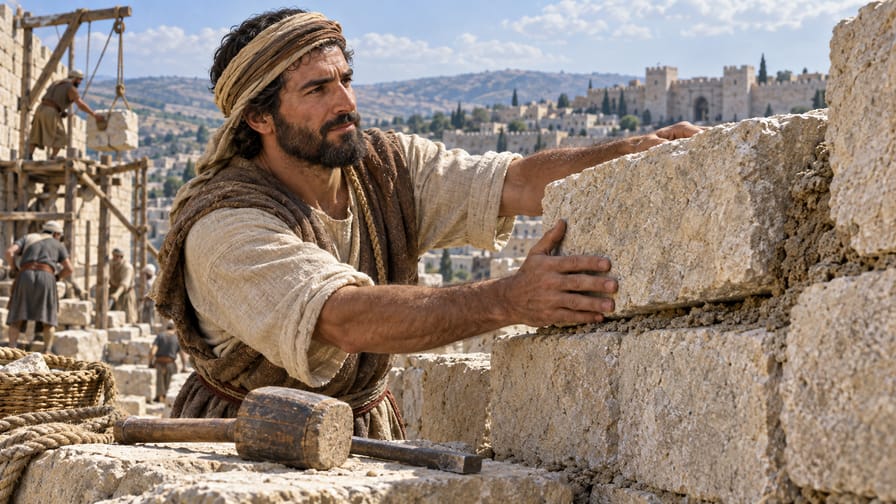
The figure of Binui, though not among the most prominent in the biblical narrative, emerges in a crucial period of Israel's history: the return from Babylonian exile and the subsequent reconstruction of Jerusalem and the Temple. Multiple individuals with this name are mentioned in the books of Ezra and Nehemiah, each contributing, in some way, to the complex and challenging process of restoring the Jewish nation. The analysis of Binui offers a window into the common life and spiritual engagement of the post-exilic Israelites, revealing themes of obedience, repentance, community service, and God's continued faithfulness to His people.
From an evangelical Protestant perspective, the understanding of Binui is not limited merely to his historical role. His name and his actions, even if brief, resonate with fundamental theological principles such as divine sovereignty in restoration, the importance of the covenant, the holiness of God's people, and, typologically, the building up of the Church of Christ. This in-depth study seeks to explore the diverse facets of this biblical character, contextualizing him historically, analyzing his character, and extracting his theological significance for the sacred canon.
1. Etymology and Meaning of the Name
The name Binui (Hebrew: בִּנּוּי, Binnuy) is of Hebrew origin and is intimately linked to the verb banah (בָּנָה), which means "to build," "to erect," or "to rebuild." The form Binnuy is a passive participle, and can be interpreted as "built," "erected," or "my building/construction." This meaning is deeply resonant with the historical period in which the characters bearing this name lived, a time marked by the physical and spiritual reconstruction of Israel after the Babylonian exile.
The root banah is fundamental in biblical theology, appearing in significant contexts such as the building of Noah's ark (Genesis 6:14), the Tower of Babel (Genesis 11:4), the Tabernacle (Exodus 25:9), and, notably, Solomon's Temple (1 Kings 6:1-2). The meaning of "to build" also extends metaphorically to the building up of a family (Genesis 16:2) or a nation (Jeremiah 24:6, 42:10). Thus, the name Binui carries with it the idea of something that is built up, whether a physical structure or a community.
There are no significant variations of the name Binui in biblical languages, being consistently transliterated from Hebrew. However, it is important to note that there are other theophoric names or names related to the same root that express similar ideas, such as Benaiah (בְּנָיָה), which means "Yahweh has built" or "Yahweh has established," demonstrating the centrality of divine action in building.
Several individuals with the name Binui are mentioned in the books of Ezra and Nehemiah, suggesting that it was a relatively common name in the post-exilic period. This multiplicity of homonymous characters requires attention to distinguish their respective contributions and contexts. The theological significance of the name lies in its connection to the theme of restoration. In a time of rebuilding walls, houses, and, above all, the identity and faith of God's people, the name "built" or "constructed" served as a constant reminder of the work being carried out by human hands under divine providence.
The very choice of names in the Old Testament often reflected hopes, circumstances, or characteristics. For a people seeking to rise from the ruins, the name Binui could be a symbol of hope and a plea for God's intervention in the reconstruction of their nation and their lives. It highlights the idea that God's people are a people in constant building, both materially and spiritually, always dependent on the grace and direction of the Lord.
2. Historical Context and Biblical Narrative
The individuals named Binui appear in the biblical narrative during the post-exilic period, specifically in the books of Ezra and Nehemiah. This period spans approximately from the late 6th century to the mid-5th century B.C., following the decree of Cyrus, king of Persia, in 538 B.C., which permitted the return of the Jews to their homeland (Ezra 1:1-4). The political context was that of the Persian Empire, which governed vast regions, including the province of Judah, with its own governors and administrative structures.
Socially and religiously, Israel faced the monumental challenge of reconstructing its national identity and its faith. The city of Jerusalem was in ruins, the Temple needed to be rebuilt, and the community needed to be purified from pagan influences acquired during the captivity. The leaders Ezra and Nehemiah played crucial roles in this restoration, Ezra focusing on spiritual renewal and the law, and Nehemiah on the physical reconstruction of the city walls and social organization.
Several men named Binui are mentioned in the Scriptures, indicating that it was a relatively common name. It is fundamental to distinguish among them for a precise analysis:
- Binui, one of the heads of the people who returned with Zerubbabel: Mentioned in Ezra 2:10 and Nehemiah 7:15, this Binui (or his family) was among the first to return from the Babylonian exile under the leadership of Zerubbabel. His presence in the list of those who returned underscores the importance of each family and clan in the repopulation and restoration of Judah.
- Binui, son of Henadad: This Binui was a Levite who played an active role in the reconstruction of Jerusalem's walls. Nehemiah 3:24 records that he "repaired another section, from the house of Azariah to the corner and the angle." His participation demonstrates the engagement of different classes and families in Nehemiah's work.
- Binui, one of the Levites who sealed the covenant: In Nehemiah 10:9, a Binui is listed among the Levites who sealed the covenant of faithfulness to God, promising to obey the Law, not to marry foreigners, and to support the Temple. This event was a landmark in the spiritual renewal of the nation under the leadership of Nehemiah and Ezra.
- Binui, among those with foreign wives: Ezra 10:30 and 10:38 mention two individuals named Binui (one of the sons of Pahath-Moab and another of the sons of Bani) who had taken foreign wives. This was a serious problem that Ezra faced, as it threatened Israel's identity and religious purity. The list of names, including Binui, indicates that they confessed their sin and pledged to separate from their wives, as required by Ezra 10:19.
The primary geography for these individuals is Jerusalem and the province of Judah. They were involved in the life of the capital and in the reconstruction efforts occurring there. Their relationships with other important characters include Zerubbabel, Ezra, and Nehemiah, the leaders whom God raised up to guide His people in this critical period. The presence of multiple individuals with the same name highlights the importance of a careful study of the references to avoid confusion and to appreciate the distinct contributions of each one to the history of Israel's restoration.
3. Character and Role in the Biblical Narrative
The analysis of Binui's character and role in the biblical narrative requires us to consider the different individuals who bear this name, as their actions and contexts vary. Nevertheless, in a collective sense, they represent crucial aspects of the post-exilic community of Israel: the spirit of service, leadership, the struggle for purity, and commitment to the covenant.
The Binui who returned with Zerubbabel (Ezra 2:10 Nehemiah 7:15) demonstrates the virtue of perseverance and faith in a restored future. He was part of the first wave of repatriates, men and women who, moved by divine promise and Cyrus's decree, left the security of exile to face the challenges of a desolate land. His inclusion in the genealogical lists underscores his importance as one of the founders of the new Jewish community in Judah.
The Binui, son of Henadad, who helped repair the walls of Jerusalem (Nehemiah 3:24), exemplifies the spirit of service and community dedication. As a Levite, he did not limit himself to religious tasks but engaged in the manual labor essential for the city's security. His participation, alongside priests, princes, and common citizens, illustrates the unity and collective effort necessary for God's work, a model of collaboration that evangelical theology often exalts in the building up of the church (Ephesians 4:16).
The Binui, a Levite, who sealed the covenant (Nehemiah 10:9), manifests a deep commitment to God's Law and spiritual renewal. The signing of the covenant was a solemn act of repentance and reaffirmation of faith, a moment in which the nation committed itself to obey God's commandments, not to intermingle with neighboring peoples, and to support the service of the Temple. This Binui, as a representative of the Levites, played a vital role in the spiritual leadership of the community, reinforcing the importance of obedience to the Word of God.
On the other hand, the individuals named Binui who took foreign wives (Ezra 10:30, 38) reveal human weakness and the constant temptation to deviate from divine commandments. The issue of mixed marriages was an existential threat to Israel's identity and holiness, as warned in passages such as Deuteronomy 7:3-4. The mention of their names, however, is not just a record of failure, but also of repentance. Ezra 10:19 indicates that they pledged to separate from their wives and to offer sacrifices for their sins, demonstrating a recognition of their transgression and a willingness for obedience. This attitude of repentance is a crucial spiritual virtue, echoing the call to confession and restoration that is central to evangelical faith (1 John 1:9).
In summary, the characters named Binui, in their various manifestations, represent the range of experiences of God's people in the post-exilic period. They embody the spirit of service and leadership in reconstruction, commitment to the divine covenant, and, in some cases, the need for repentance and purification. Their lives, though briefly recorded, serve as examples of individual responsibility in the building up of the community of faith and in maintaining faithfulness to God.
4. Theological Significance and Typology
The theological significance of the figure of Binui, in his multiple appearances, is intrinsically linked to the themes of restoration, covenant, and the holiness of God's people in the post-exilic period. His very etymology, "built" or "erected," makes him a symbol of the work of reconstruction that Israel was undertaking, both physically and spiritually. This process of rebuilding points to God's faithfulness in fulfilling His promises to restore His people (Jeremiah 31:4, Amos 9:11).
The participation of a Binui in the reconstruction of Jerusalem's walls (Nehemiah 3:24) underscores the importance of human cooperation in the divine work. God uses His servants to accomplish His purposes, and every contribution, no matter how small, is valued. This is a fundamental theological lesson for the evangelical church, which emphasizes the priesthood of all believers and the role of each member in the building up of the body of Christ (Ephesians 4:12).
The presence of a Binui among the Levites who sealed the covenant (Nehemiah 10:9) highlights the renewal of the covenant as a pillar of Israel's identity. The commitment to obey God's Law, to maintain the community's purity, and to sustain worship in the Temple was vital for the spiritual survival of the nation. Theologically, this underscores the importance of obedience to God's Word and the seriousness of the covenant with Him, principles that are central to Reformed and evangelical theology.
The issue of mixed marriages, which involved other individuals named Binui (Ezra 10:30, 38), addresses the crucial theme of holiness and separation. Ezra and Nehemiah saw this practice as an existential threat to Israel's identity as God's people, chosen and separated for Him. The requirement to separate from foreign wives, though painful, aimed to preserve the theological and genetic purity of the lineage that would lead to the Messiah. This points to the doctrine of sanctification and the need for the church to remain pure from worldly influences (2 Corinthians 6:14-18).
In terms of Christocentric typology, the work of reconstruction in which Binui and his contemporaries participated foreshadows the building up of the Church of Christ. Just as Jerusalem and the Temple were rebuilt, Christ is the builder of His Church (Matthew 16:18), and believers are the "living stones" that form this spiritual temple (1 Peter 2:5). Binui's dedication to the reconstruction of the walls can be seen as a minor type of the service that believers render in the building up of the Kingdom of God, where Christ is the "cornerstone" (Ephesians 2:20).
The renewal of the covenant under Ezra and Nehemiah, with the participation of a Binui, foreshadows the New Covenant established by Christ in His blood (Hebrews 8:6-13). Obedience to the Law, though imperfect in the Old Testament, finds its consummation and perfect fulfillment in Jesus Christ, who came not to abolish the Law but to fulfill it (Matthew 5:17). The struggle for the purity of the community of Israel reflects the pursuit of holiness that the Church must have, knowing that its true purity is imputed by Christ and progressively manifested by the Holy Spirit.
Therefore, Binui, although a secondary character, embodies aspects of redemptive history that resonate with central theological themes: God's faithfulness in restoring, human responsibility in service and obedience, the need for holiness and repentance, and the foreshadowing of Christ's work in building up His Church and establishing the New Covenant.
5. Biblical-Theological Legacy and Canonical References
The figure of Binui, or rather, the multiple figures with this name, have their biblical-theological legacy firmly rooted in the books of Ezra and Nehemiah. He is not mentioned in other biblical books outside this post-exilic period, nor is there evidence that he authored any canonical writings. However, his importance is not measured by prominence, but by the representativeness of a people who, after the exile, strived to reestablish their faith and identity under divine leadership.
Binui's contribution to biblical theology lies in the exemplification of crucial themes from the history of redemption. He illustrates the need for a people dedicated to the reconstruction, both physical and spiritual, of their nation. The participation of a Binui in the reconstruction of the walls (Nehemiah 3:24) emphasizes that God's work requires the collective effort of all members of the community, regardless of their social or religious position. This principle is fundamental to evangelical ecclesiology, which values the service of every believer in the body of Christ (1 Corinthians 12:12-27).
The involvement of a Binui in the sealing of the covenant (Nehemiah 10:9) reinforces the centrality of the covenant in God's relationship with His people. The renewal of the covenant under Ezra and Nehemiah was a moment of reaffirmation of commitment to the Law and to Israel's theocratic identity. For Reformed and evangelical theology, this underscores the importance of obedience to God's Word and the seriousness of faith commitments, reflecting the covenantal nature of salvation in Christ.
The issue of mixed marriages involving other individuals named Binui (Ezra 10:30, 38) serves as a vivid reminder of the constant battle against cultural assimilation and spiritual corruption. The need for purity and separation for God's people is a recurrent theme throughout Scripture, from the laws of the Old Testament to the exhortations of the New Testament for believers not to conform to the world (Romans 12:2). The repentance of these individuals, as indicated in Ezra 10:19, points to God's grace that allows for restoration after failure.
In Jewish and Christian interpretative tradition, Binui is generally treated as a minor character, but his presence in the lists of repatriates, builders, and covenant signers contributes to the richness and historical authenticity of the books of Ezra and Nehemiah. He represents the "common man" who, in his faithfulness or in his repentance, is part of the grand narrative of divine providence and the history of salvation.
In Reformed and evangelical theology, the books of Ezra and Nehemiah are seen as fundamental for understanding God's continuous faithfulness to His promises, even amidst human unfaithfulness. The story of Binui and his contemporaries is interpreted as a testament to God's power to restore, purify, and build up His people. The relevance of these accounts for the contemporary church lies in the constant need for spiritual renewal, commitment to the Word of God, and selfless service for the building up of the Kingdom of Christ.
Ultimately, the legacy of Binui, though modest in terms of individual prominence, is significant for his collective contribution to the narrative of post-exilic restoration. He reminds us that God's great work is accomplished through many, and that faithfulness in small things is essential for the building of His kingdom. His story, therefore, serves as an encouragement for every believer to actively participate in the building up of the Church, the true temple of God, under the leadership of Christ, the cornerstone.