


Will we recognize each other in heaven?
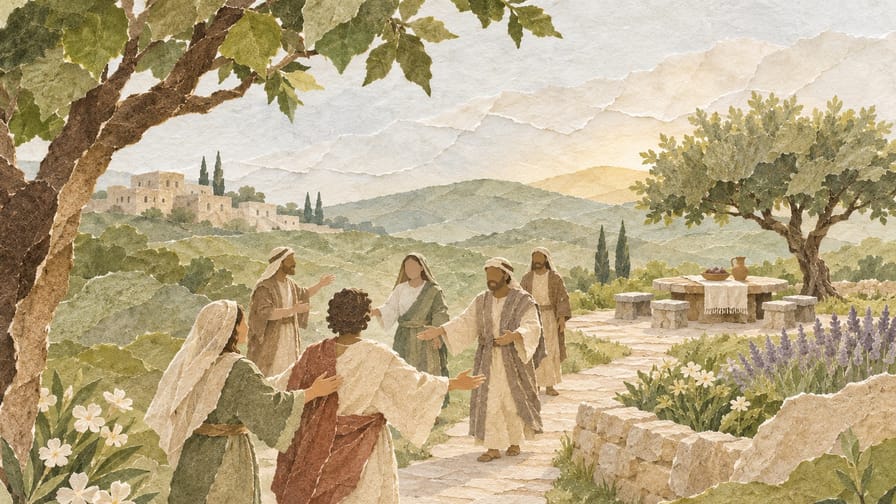
Probably yes: the Bible never states in so many words that we will recognize each other in heaven, but there are good hints, and several passages lean that way. Some scenes seem to show people identified beyond this life, Paul seems to expect to see fellow believers again before Christ, and the risen Christ, the pattern for the body we will have, ends up recognized by his followers, though not always at once. Where the text speaks, I quote it; where I move to deduction, I say so.
Moses, Elijah, and the rich man: who is identified beyond death?
At the transfiguration, Moses and Elijah appear talking with Jesus, and Peter, who had never seen either of them, offers to build three shelters, one for each of the three (Matthew 17:1-4). Luke says the two appeared in glory and spoke of Jesus' departure (exodos, ἔξοδος), which he was about to fulfill in Jerusalem (Luke 9:30-31). One of them died (Deuteronomy 34:5); the other was taken up to heaven in a whirlwind, and the text does not record his death (2 Kings 2:11). Peter calls them by name, and the text does not say how he identified them. So the scene is a hint, not a proof: it was a one-time experience, which Jesus himself called a vision (Matthew 17:9), and Luke notes that Peter did not know what he was saying (Luke 9:33).
In Luke 16:19-31, the rich man, even in torment, recognizes Abraham and Lazarus, and Abraham calls him child and tells him to remember. Interpreters debate whether Jesus is telling a parable or an actual event; if the scene describes any state, it is the intermediate one (Hades, v. 23), not the final one, and the point of the story seems to lie elsewhere (listening to Moses and the prophets, vv. 29-31). So I do not use it as proof; I only note that the story assumes identity and memory survive death.
There are smaller signals too. Jesus says many will come from east and west and sit at table with Abraham, Isaac, and Jacob in the kingdom of heaven (Matthew 8:11). The focus of that text is elsewhere, the inclusion of the Gentiles in the kingdom, and the banquet is an image; reading identifiable patriarchs into it is only inference. The statement that Abraham was gathered to his people (Genesis 25:8) is read by some as a nod to the afterlife and by others as a reference to burial; the text does not settle it.
Did Paul expect to see fellow believers again before Christ?
The text suggests so. Paul tells the Thessalonians that they are his hope, joy, and crown of boasting before Jesus at his coming (1 Thessalonians 2:19-20). Rejoicing before the Lord with people you knew and taught presupposes recognizing them. That is an inference, but a hard one to avoid.
In 1 Thessalonians 4:13-18, he comforts people grieving for fellow believers who have died in Christ: they must not grieve like those who have no hope. The dead in Christ will rise first, the living will be caught up together with them, and so we will always be with the Lord. The passage ends by telling them to encourage one another with these words. The comfort is one of reunion, and a reunion of people who did not know one another would be a strange comfort; that is deduction, since Paul does not describe how it works. Faithful Christians differ on the order of events in this passage (the rapture, the tribulation), but not on the promise of being with the Lord forever.
In 1 Corinthians 13:12, Paul contrasts seeing in a mirror now with seeing face to face, and knowing in part with knowing fully, as he himself is fully known by God. The Greek verb for the fullness, epiginōskō (ἐπιγινώσκω), is the one Luke uses when the disciples at Emmaus recognize Jesus (Luke 24:31), but the emphasis comes from the contrast with “in part,” not from the word alone. The verse speaks of full knowledge and of being fully known by God; extending that to people is inference. Still, it fits the rest, as an inference: knowing fully suggests knowledge expanded rather than erased, though Scripture does not say how much of this life we will remember.
Is the resurrected body still the same person?
The pattern is the risen Jesus, the firstfruits of those who sleep (1 Corinthians 15:20). Our body will be transformed to be like his glorious body (Philippians 3:21), and John says that when he appears we will be like him (1 John 3:2). And the risen Christ was recognized: Mary knew him when he called her by name (John 20:16), and Thomas, when Jesus showed him the marks of the wounds (John 20:27-28). Paul says this perishable body must put on imperishability (1 Corinthians 15:53): the transformation reaches this body, not another one. From that we deduce that the person stays the same. It is a conclusion drawn from the text, not a sentence in it.
There is an honest nuance: Mary took Jesus for the gardener (John 20:14-15), the two on the road to Emmaus did not recognize him until their eyes were opened (Luke 24:16; Luke 24:31), and the disciples by the lake did not at first know who was standing on the shore (John 21:4). Recognition in the glorified body seems to be partly something God grants, not only a matter of appearance. That too is a cautious inference; the Bible gives no method.
The biblical ending, by the way, is resurrection (1 Corinthians 15:20-23) and a new creation, with God dwelling with his people (Revelation 21:1-4), not faceless souls. What happens between death and resurrection is the subject of another answer; here the focus is recognition.
Does Matthew 22:30 mean we will forget our spouses?
The Sadducees asked whose wife a woman would be in the resurrection after she had married seven brothers in turn. Jesus answered that in the resurrection people neither marry nor are given in marriage, but are like angels in heaven (Matthew 22:30). He does not say we will stop recognizing our spouse, or that we will become angels. The comparison concerns marriage as an institution of this age, which does not continue; Luke adds that they can no longer die (Luke 20:34-36).
What happens to the bond between husband and wife, the Bible does not detail. The prudent inference is that the love lived here is not lost but finds a new place in God's family gathered around Christ. Jesus was answering a question asked to ridicule the resurrection, not sketching a picture of families in heaven.
What changes in grief and in how we treat the people near us
Scripture does not say how we will recognize each other or how much of this life we will remember. Nor does it explain how joy will be complete for someone thinking of a person who seemed far from God, and promising anything here would go beyond the text. What it affirms is that God will wipe away every tear and that there will be no more mourning, crying, or pain (Revelation 21:4), and that the Judge of all the earth does what is right (Genesis 18:25). Someone grieving over a person like that does not need to declare or deny that person's destiny: they can entrust that person to the just and merciful God.
And there is a point that cannot be left out. The hope in 1 Thessalonians 4:13-18 is for those who die in Christ, and the center of that hope in this text is being with the Lord forever (1 Thessalonians 4:17). If that weighs more than seeing loved ones again, it is a deduction, supported by Revelation 21:3, where the mark of the new creation is God dwelling with his people. The door is grace, through faith, not merit (Ephesians 2:8-9). Anyone who has not yet trusted in Christ can do so today.
In practice, Paul does not forbid tears; he asks that we not grieve like people without hope (1 Thessalonians 4:13). And living as people who expect to recognize each other in heaven means forgiving quickly, showing up, and giving thanks while there is time. It is living in the light of the hope Christ gives, without promising anything beyond what he promised.
Key Bible references
Matthew 17:3-4 · Luke 16:23 · 1 Corinthians 13:12 · 1 Thessalonians 4:13-18 · 1 Thessalonians 2:19-20 · Matthew 22:30 · John 20:16 · Philippians 3:21