


What Does the Bible Say About Dating?
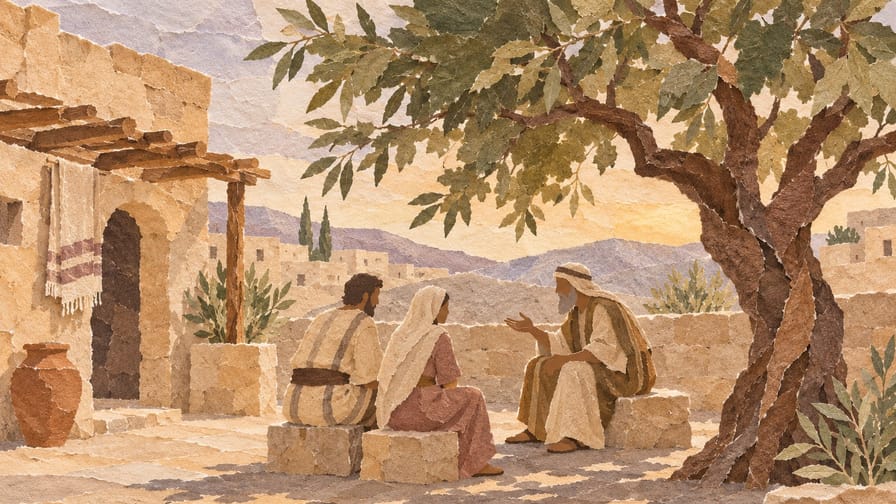
The Bible does not describe dating as we know it today: it gives no model for dating and no rule about it. What it offers are principles that apply to any relationship heading toward marriage: purity and wisdom, which the texts support, and purpose and shared faith, which are application by extension, not a commandment about dating. Admitting Scripture’s silence is honest; taking seriously what it does say is what actually guides.
How the road to marriage appears in the biblical stories
In the biblical stories, families usually play an active part in the choice. In Genesis 24, Abraham’s servant looks for a wife for Isaac, Rebekah’s family is consulted, and she herself answers that she will go (Genesis 24:57-58); in the end, Isaac loves her (Genesis 24:67). Jacob loves Rachel and works seven years for her, and the years seem to him like a few days because of that love (Genesis 29:18-20). In Ruth, Boaz acknowledges her character (Ruth 3:10-11) and settles the matter openly, before the elders, at the city gate (Ruth 4:1-10). And the Song of Solomon celebrates love and desire between a man and a woman; many interpreters read it as poetry of love that leads to marriage, but that reading is debated.
These texts describe rather than prescribe: they tell what happened without turning every custom into an order for today (the Bible records Jacob’s polygamy without presenting it as a model). What Scripture knows well is betrothal, a serious commitment recognized by the community. The Hebrew verb ʼāraś (“to betroth”) appears in Deuteronomy 20:7, and the Greek verb mnēsteúō describes Mary as “betrothed” to Joseph in Matthew 1:18. In Matthew 1:19 Joseph is still only betrothed and yet considers “divorcing her” quietly, a sign that betrothal created a serious bond. From that comes an inference, not a commandment: what the Bible calls commitment is more serious and more public than many dating relationships today.
Purity: what 1 Thessalonians 4:3-7 asks of anyone in a relationship
This is the most direct passage for anyone in a relationship. Paul says God’s will is sanctification: that believers abstain from sexual immorality (porneía), that each one know how to control his own body (skeûos) in holiness and honor, and that no one wrong or exploit a brother in this matter (prâgma); in the context of 4:3-5, the most common reading takes this matter to mean sexuality. The reason for the whole exhortation appears in 4:7: God called us to holiness, not to impurity. The Greek verb translated “control,” ktâsthai, can also mean “possess.” The word skeûos, literally “vessel,” is read by many translations as “body”; some interpreters understand “wife.” On either reading, the center is holiness and respect.
Within marriage, sex is good and honorable (Hebrews 13:4), and Scripture reserves it for the covenant between one man and one woman (Genesis 2:24). The specific question of sex before marriage has its own answer here at Midvash; for dating, the principle is what matters: whoever enters a relationship takes on responsibility for the other person. Purity is not only about the body, either. Jesus takes it to the look and the desire (Matthew 5:28), and the wise are told to guard the heart (Proverbs 4:23). Paul advises fleeing youthful passions and pursuing righteousness, faith, love, and peace together with those who call on the Lord from a pure heart (2 Timothy 2:22). And in guiding Timothy on how to treat fellow believers in the church, he asks that younger women be treated as sisters, in all purity (1 Timothy 5:2). By extension, the person you are getting to know is someone made in the image of God (Genesis 1:27) and, if a believer, a brother or sister in Christ.
Wisdom: watch character, go slowly, take counsel
Proverbs treats the choice of companions as a matter of wisdom. Whoever walks with the wise becomes wise (Proverbs 13:20), the prudent sees danger and takes cover (Proverbs 22:3), and in an abundance of counselors there is safety (Proverbs 11:14). Applied to dating, that calls for watching character over time, not only attraction. The fruit of the Spirit (Galatians 5:22-23) is a concrete list of what to cultivate in yourself and look for in the other person: love, joy, peace, patience, kindness, goodness, faithfulness, gentleness, and self-control. The application is by extension, since Paul is speaking of the fruit the Spirit produces in every believer, not of a standard for choosing someone.
As for pace, whoever hurries misses the way (Proverbs 19:2), and plans fail without counsel (Proverbs 15:22). Mature friends, parents, or leaders who know the couple can see what someone in love cannot. Some readers see something similar in the refrain of Song of Solomon 2:7, repeated in Song of Solomon 3:5 and 8:4, understood as an invitation not to stir up love before its time. Its exact sense is debated, so it stands as one possible reading, not as a rule. Discretion, by the way, is not secrecy: Boaz protects Ruth’s reputation (Ruth 3:14), yet he conducts everything openly (Ruth 4:1-10). And anyone who lacks wisdom should ask God for it (James 1:5), using their head and listening to people at the same time.
Purpose and the unequal yoke: dating for what, and with whom
Scripture presents the union of a man and a woman as marriage (Genesis 2:24); by inference, those who relate to each other in that direction should do so honestly and wisely, toward marriage. That changes the underlying question: besides “am I enjoying this?” it is worth asking “where is this relationship going?” At the same time, the Bible does not treat single life as a failure: Paul sees both marriage and singleness as gifts from God (1 Corinthians 7:7-8), and, by extension, no one needs to date in order to be complete in Christ (Colossians 2:10).
As for the “unequal yoke” of 2 Corinthians 6:14, context calls for caution: Paul writes about the church’s fellowship with idolatry and paganism, without mentioning marriage or dating, and applying it to a relationship is an extension. One of the closest texts on the subject is 1 Corinthians 7:39, “only in the Lord,” said to a widow; concluding from it that anyone thinking about marriage should look for someone who follows Christ is a prudent inference, not a verse about dating. The question has its own answer here at Midvash, in “Can a Christian marry a non-Christian?”
What is not a biblical rule, and what changes in practice
A few misunderstandings come up often.
- “The Bible forbids dating.” It neither forbids nor commands the modern practice. Where the text is silent, the way forward is wisdom, not an invented commandment.
- “There is only one biblical model: courtship, a minimum age, contact rules.” Scripture sets no age, no number of dates, no chaperone, and no rules for kissing. Church models can help as prudence, but raising them to the level of a commandment recalls the “do not handle, do not taste, do not touch” that Paul treats as human rules with no power against the flesh (Colossians 2:20-23), though the context there is different.
- “God has already chosen exactly one person for me.” The Bible shows God guiding (Genesis 24), but no text says there is a single secret name; in 1 Corinthians 7:39 the widow is free to marry whom she wishes, with the one limit of being in the Lord.
- “Dating is just fun, with no commitment.” Paul tells believers not to wrong or exploit a brother (1 Thessalonians 4:6); in the context of 4:3-5, on the most common reading, this is said about sexuality, and by extension care for the other person’s heart and hopes fits the golden rule of Jesus (Matthew 7:12).
- “Someone who failed in the past cannot start over.” There is forgiveness for those who confess (1 John 1:9; Romans 8:1), and Paul lists serious sins, sexual ones among them, and says some of the Corinthians were like that, but they were washed, sanctified, and justified (1 Corinthians 6:9-11).
In practice, what follows is prudence drawn from the principles above, not a commandment of Scripture. Look for someone who truly follows Christ, and watch character over time. Be honest about what you are seeking, by extension of the principle of speaking the truth in love (Ephesians 4:15, 25). Agree on boundaries beforehand, not in the heat of the moment, to protect the purity of both. Keep community close: mature friends, parents, or leaders. And be willing to end things with respect if the path toward marriage is not confirmed.
None of this guarantees that dating will end in marriage, and the Bible promises a spouse to no one. The calling is the same in every season: to trust the Lord with all your heart (Proverbs 3:5) and honor him with the body, which is the temple of the Holy Spirit (1 Corinthians 6:19-20).
Key Bible references
1 Thess 4:3-7 · 2 Cor 6:14 · 1 Cor 7:39 · Gen 24:67 · Prov 11:14 · Heb 13:4 · 2 Tim 2:22 · Gal 5:22-23