


Philip
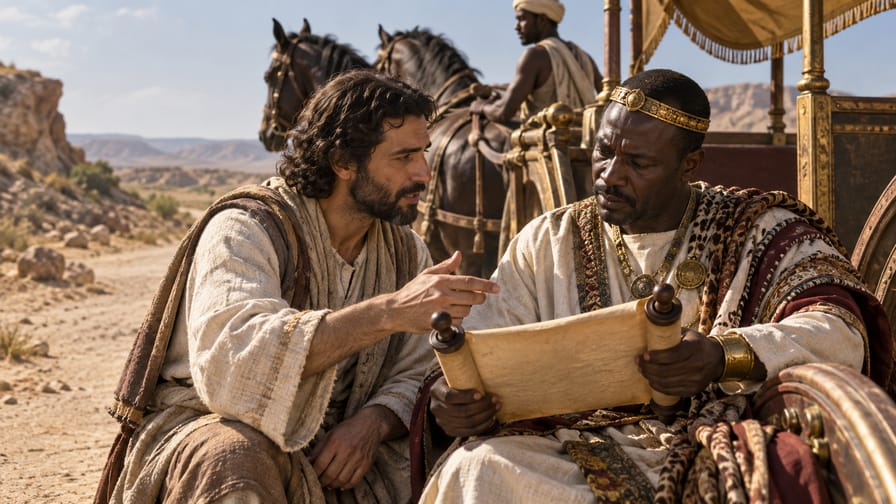
The figure of Philip in the Holy Scriptures is multifaceted, encompassing two distinct and prominent characters in the New Testament who bear the same name. Both played crucial roles in the dawn of Christianity, contributing significantly to the narrative of the Church's foundation. This biblical and theological analysis, from an evangelical Protestant perspective, will seek to discern their identities, actions, and legacies.
The onomastic meaning of the name Philip will be explored, along with the historical context and biblical narratives in which each of the Philips appears, an analysis of their characters and roles, their theological and typological significance, and, finally, the legacy they left for the Christian faith. The distinction between Philip, the Apostle, and Philip, the Evangelist/Deacon, will be kept clear throughout the text.
1. Etymology and meaning of the name
The name Philip, in its original Greek form, is Philippos (Φίλιππος). This is a name of Hellenic origin, common in the Greco-Roman world of the New Testament era, which already suggests a strong Greek cultural influence in its adoption by Jews.
The etymological root of Philippos derives from two Greek words: philos (φίλος), meaning "friend" or "lover," and hippos (ἵππος), meaning "horse." Thus, the literal meaning of the name is "friend of horses" or "lover of horses."
Although the name itself does not possess an intrinsic theological meaning like many Hebrew names (e.g., Yeshua, "Yahweh saves"), its popularity reflects the Hellenization of Jewish society. Horses were symbols of power, status, and warfare in the ancient world, and being a "friend of horses" could denote someone of prestige or with an affinity for such symbols.
There are no direct Hebrew or Aramaic variations of the name Philippos in the Scriptures, as it is of purely Greek origin. Its presence among the Jews of Palestine demonstrates the extent of Greek acculturation after the conquests of Alexander the Great.
In the Scriptures, we primarily identify two characters with this name who are crucial to the Christian narrative. The first is Philip, one of the twelve apostles of Jesus Christ, mentioned in the Synoptic Gospels and the book of Acts. The second is Philip, the evangelist, one of the seven deacons chosen by the early church, whose story is told in Acts.
Besides these two, the Bible also mentions Philip the tetrarch, son of Herod the Great (Luke 3:1), whose domain included Iturea and Trachonitis. The latter, though important for historical context, is not the focus of this theological analysis of the figure of Philip as a disciple and servant of God.
The theological significance of the name Philip, therefore, does not lie in its etymology, but in the lives and ministries of the men who bore it. Their actions and the way they were used by God are what give the name lasting relevance in the history of redemption, especially concerning the expansion of the gospel.
2. Historical context and biblical narrative
The two main Philips lived in the first century A.D., a period of intense religious, political, and social effervescence. Judea was under the rule of the Roman Empire, and Hellenistic culture permeated all aspects of life, coexisting with Second Temple Judaism. It was in this setting that Jesus Christ began His ministry and the Early Church began to form.
2.1 Philip, the Apostle
Philip, the apostle, was a native of Bethsaida, in Galilee, the same city as Andrew and Peter (John 1:44). His Galilean origin placed him in a culturally mixed region, with strong Gentile influence, which may have contributed to his openness to foreigners.
He was one of the first to be called directly by Jesus, who found him and said to him: "Follow me" (John 1:43). Immediately after his own call, Philip demonstrates his evangelistic zeal by finding Nathanael (also known as Bartholomew) and inviting him to see Jesus, stating: "We have found Him of whom Moses in the Law, and also the Prophets, wrote—Jesus of Nazareth, the son of Joseph" (John 1:45-46).
Key passages that reveal his character and interactions with Jesus include the episode of feeding the multitude. Jesus tests Philip by asking: "Where shall we buy bread, that these may eat?" (John 6:5). Philip's pragmatic response, focused on the insufficiency of financial resources (John 6:7), shows his rationality, but also perhaps an initial lack of faith in Christ's miraculous provision.
Later, in Jerusalem, Philip serves as a mediator when some Greeks wish to see Jesus. He takes the request to Andrew, and together they present it to Jesus (John 12:20-22), indicating his accessibility and role as a link between cultures. His question to Jesus at the Last Supper, "Lord, show us the Father, and it is sufficient for us" (John 14:8), prompted one of Jesus' most profound revelations about His unity with the Father: "He who has seen Me has seen the Father" (John 14:9).
After Jesus' ascension, Philip is listed among the apostles who remained in Jerusalem (Acts 1:13), awaiting the outpouring of the Holy Spirit at Pentecost. His presence in the group of the Twelve attests to his position of authority and eyewitness testimony of Christ's ministry.
2.2 Philip, the Evangelist/Deacon
Philip, the evangelist, first appears in the book of Acts of the Apostles. He is one of the seven men "full of the Spirit and wisdom" chosen by the community to serve tables and care for the needs of Hellenistic orphans and widows, relieving the apostles to devote themselves to prayer and the ministry of the Word (Acts 6:1-6).
Although his family origin is not detailed, his Greek name and his role among the Hellenists suggest that he himself was a Greek-speaking Jew. After the persecution that followed the martyrdom of Stephen, Philip stands out as a powerful evangelist.
He went down to Samaria and proclaimed Christ, performing signs and miracles that resulted in great joy and many conversions and baptisms (Acts 8:5-8). There, he confronted and converted Simon the Sorcerer, who previously deluded the populace (Acts 8:9-13), although Simon's faith was later questioned (Acts 8:18-24).
The Holy Spirit then directed him from Samaria to the desert road that goes down from Jerusalem to Gaza, where he met an Ethiopian eunuch, a high official of Queen Candace (Acts 8:26-29). Philip explained the Scriptures to the eunuch, specifically the passage from Isaiah 53, and led him to believe in Jesus and be baptized (Acts 8:30-38).
After the baptism of the eunuch, Philip was caught away by the Spirit of the Lord and found at Azotus, from where he continued evangelizing all the cities until he came to Caesarea (Acts 8:39-40). Years later, he still resided in Caesarea, where he hosted the apostle Paul and his companions, being described as "one of the seven" and the father of four virgin daughters who prophesied (Acts 21:8-9).
The geography of his ministry encompassed Samaria, the road to Gaza, Azotus, and Caesarea, showing his mobility and the geographical reach of the early church's mission. His relationships include the apostles, Stephen, Simon the Sorcerer, the Ethiopian eunuch, and Paul, demonstrating his centrality in the expansion of the gospel.
3. Character and role in the biblical narrative
The two Philips, though distinct, exhibit characteristics of faith, obedience, and service that make them important models in the biblical narrative. Their lives illustrate different aspects of Christian discipleship and ministry.
3.1 Character of Philip, the Apostle
Philip, the apostle, is portrayed in the Gospels as a practical man, perhaps somewhat pragmatic or skeptical in certain situations. His response to Jesus about feeding the multitude in John 6:7 reveals a mind that calculates material resources before considering divine power. However, this characteristic does not diminish his faith, but perhaps shows a need to see to believe, or a more rational basis for belief.
His qualities include loyalty to Jesus and a desire to share the good news, evidenced when he invites Nathanael (John 1:45-46). He also demonstrates an open mind by acting as a bridge for the Greeks who wished to see Jesus (John 12:20-22), indicating a willingness to interact with people from different backgrounds.
Philip's question to Jesus in John 14:8, "Show us the Father," while it might seem like a failure of understanding, actually reveals a deep longing for a more intimate experience with God. This search for a clearer revelation of the Father is a virtue that prompted Jesus to utter one of His most important Christological declarations.
His primary role was that of one of the Twelve, an eyewitness to the ministry, death, and resurrection of Jesus. He was part of Jesus' inner circle, receiving direct teachings and being prepared for the leadership of the early church. His life, though less detailed than that of Peter or John, is an example of faithful discipleship.
3.2 Character of Philip, the Evangelist
Philip, the evangelist, is described with notable spiritual qualities from his first mention. He is chosen as a deacon for being a man "full of the Spirit and wisdom" (Acts 6:3). These are essential characteristics for service and for the effective proclamation of the gospel.
His character is marked by boldness and obedience to the Holy Spirit. Amid persecution, he does not hesitate to preach the gospel in Samaria (Acts 8:5), a region hostile to Jews. His faith is evidenced by the miracles and signs that accompany him (Acts 8:6-7), confirming the message he preached.
Philip's obedience to the Spirit is exemplified in his journey to the desert road to Gaza (Acts 8:26) and his readiness to approach the Ethiopian eunuch (Acts 8:29). He demonstrates humility and skill in explaining the Scriptures, guiding the eunuch to faith in Christ and to baptism (Acts 8:30-38).
His role goes beyond diaconal service he becomes a powerful evangelist, paving the way for the gospel in Samaria and, crucially, for the Gentiles through the Ethiopian eunuch. He represents the missionary expansion of the Church beyond Jewish borders, under the sovereign direction of the Holy Spirit.
Philip's hospitality is also notable, evidenced by his home in Caesarea, which served as a refuge for Paul and his companions (Acts 21:8). The presence of his four prophesying daughters (Acts 21:9) suggests a home where spiritual gifts were cultivated and ministry was valued, demonstrating a family legacy of service to God.
4. Theological significance and typology
The lives and ministries of both Philips hold deep theological significance, contributing to the understanding of the history of redemption and the nature of the Church, especially from an evangelical Protestant perspective.
4.1 Theological significance of Philip, the Apostle
The apostle Philip plays an important role in the progressive revelation of the person of Christ. His question in John 14:8, "Lord, show us the Father," elicits one of Jesus' most explicit declarations about His divinity and unity with the Father. Jesus' response, "He who has seen Me has seen the Father" (John 14:9), is a pillar of Christological and Trinitarian doctrine, emphasizing the full revelation of God in Christ.
Although Philip is not a typological figure in the classic sense of foreshadowing Christ, his role as a "bridge" for the Greeks in John 12:20-22 symbolizes the universality of Christ's message. He anticipates the inclusion of Gentiles in the plan of salvation, a central theme in New Testament theology.
His interactions with Jesus also address central theological themes such as divine provision (John 6:5-7), faith in Christ as sufficient for salvation, and the revelation of God. His life is a reminder that even Jesus' closest disciples had their doubts and limitations, yet were powerfully used by God.
4.2 Theological significance of Philip, the Evangelist
Philip, the evangelist, is a theologically monumental figure in the narrative of Acts. His ministry marks a turning point in redemptive history, being fundamental to the expansion of the gospel beyond Jewish and Samaritan borders, fulfilling Jesus' Great Commission (Acts 1:8 Matthew 28:19-20).
His preaching in Samaria (Acts 8:5) demonstrates the breaking down of ethnic and religious barriers, showing that the gospel is for everyone, including those traditionally despised by the Jews. The conversion of the Samaritans is a crucial step for understanding the inclusion of Gentiles in the Church.
The encounter with the Ethiopian eunuch (Acts 8:26-39) is even more significant. This eunuch, a Gentile (though a proselyte or "God-fearer"), represents the "ends of the earth" mentioned in Acts 1:8. Philip, under the direction of the Holy Spirit, explains Isaiah 53, a key messianic text, and the eunuch is baptized, symbolizing the entry of all nations into the kingdom of God, according to Old Testament prophecies (e.g., Isaiah 56:3-7).
This event is a precursor to Paul's Gentile mission and establishes a model for transcultural evangelism. The story of Philip and the Ethiopian eunuch is a powerful example of God's sovereignty in election and salvation, the importance of expository preaching of the Scriptures, and the indispensable role of the Holy Spirit in evangelism, who guides the preacher and opens the heart of the listener (Acts 8:29).
Philip, the evangelist, is, therefore, a type of the Spirit-guided missionary and evangelist, demonstrating that salvation is through faith in Christ, accessible to all who believe, regardless of their ethnicity, social status, or physical limitations (like the eunuch). He embodies the doctrine of God's grace that reaches even the most distant.
5. Biblical-theological legacy and canonical references
The legacy of both Philips is deeply rooted in the canonical Scriptures and has been the subject of reflection in Christian interpretive tradition, shaping Reformed and evangelical theology.
5.1 Legacy of Philip, the Apostle
Philip, the apostle, is mentioned in the Synoptic Gospels in the lists of the twelve apostles (Matthew 10:3 Mark 3:18 Luke 6:14) and most prominently in the Gospel of John (John 1:43-48 John 6:5-7 John 12:20-22 John 14:8-9). He is also listed among the apostles who prayed in the Upper Room after Jesus' ascension (Acts 1:13).
His influence in biblical theology resides primarily in his interaction with Jesus in John 14. Christ's response to his question, "He who has seen Me has seen the Father" (John 14:9), is one of the clearest affirmations of Jesus' divinity and His essential unity with God the Father. This passage is fundamental for Christology and for the doctrine of the Trinity.
Although later tradition associates him with preaching in Phrygia and Scythia and a martyrdom by crucifixion, this information is not canonical. In Reformed and evangelical theology, Philip is seen as an example of a disciple who, despite his limitations and questions, sincerely seeks God and is used by Christ to reveal profound truths and connect people to Him.
5.2 Legacy of Philip, the Evangelist
Philip, the evangelist, is a central figure in the book of Acts of the Apostles (Acts 6:5 Acts 8:5-40 Acts 21:8-9). His contributions are immeasurable for understanding the mission of the Church and the role of the Holy Spirit.
His ministry in Acts 8 is a key text for various evangelical doctrines. The conversion of the Samaritans and the Ethiopian eunuch is a powerful testimony to the universality of the gospel and the inclusion of all ethnicities into the body of Christ, a central theme in Pauline theology and the Great Commission.
The story with the Ethiopian eunuch is frequently cited in discussions about believers' baptism, the need for expository preaching of the Scriptures (Acts 8:30-35), and God's sovereignty in evangelism, where the Spirit guides the evangelist to a specific individual for salvation. The eunuch, being a "eunuch," was excluded from the assembly of Israel by the Law (Deuteronomy 23:1), but is included by the grace of Christ, fulfilling Isaiah 56:3-7.
The presence of his prophesying daughters in Acts 21:9 demonstrates the continuity of spiritual gifts in the early church and the participation of women in prophetic ministry, a relevant point of study in contemporary theology on gender roles in the church.
In Reformed and evangelical theology, Philip, the evangelist, is acclaimed as a model of service (deacon), dynamic evangelism, and unquestioning obedience to the Holy Spirit. His life and ministry are a testimony to the effectiveness of the gospel when proclaimed with power and guided by God, being an archetype of the Christian missionary who crosses cultural and geographical boundaries to carry the message of salvation.