


Eliezer
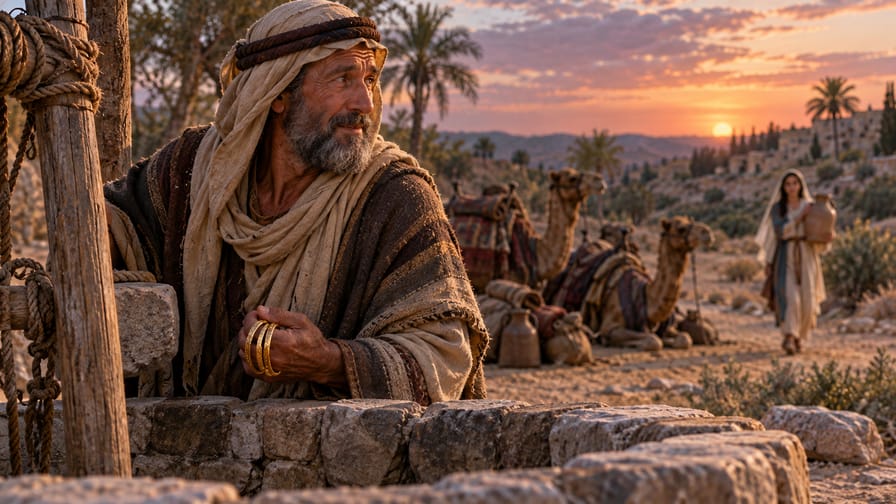
The biblical figure of Eliezer, although not among the most prominent in terms of narrative protagonism, plays a crucial role in decisive moments of patriarchal history, especially in Abraham's life. His most significant and detailed mention occurs in the book of Genesis, where he is presented as Abraham's steward, a faithful and trusted servant. The analysis of Eliezer from an evangelical Protestant perspective reveals important lessons about faith, obedience, divine providence, and typology.
This in-depth study proposes to examine Eliezer in his multiple dimensions, from the meaning of his name to his theological legacy, seeking to extract the perennial truths that his story offers for contemporary Christian faith. The servant's faithfulness, his dependence on God, and his role in the continuity of the Abrahamic promise are fundamental aspects that deserve detailed attention. The narrative of Eliezer serves as a microcosm of God's work in guiding and providing for His people, using human instruments to fulfill His sovereign purposes.
Beyond the best-known Eliezer of Damascus, the Bible records other individuals with the same name, each contributing to the richness of its onomastic meaning. The repetition of the name in different biblical contexts underlines the intrinsic message of "God is help," a truth that resonates throughout all Scripture. The exegetical and theological analysis of this character, therefore, not only illuminates his own story but also enriches our understanding of the nature of God and His relationship with humanity.
1. Etymology and meaning of the name
The name Eliezer (in Hebrew: אֱלִיעֶזֶר, 'Elî'ezer) is composed of two parts: 'El (אֵל), meaning "God," and 'ezer (עֶזֶר), meaning "help" or "succor." Thus, the literal and most accepted meaning of the name is "My God is help" or "God is help." This composition is common in Hebrew theophoric names, which incorporate one of God's names to express a truth about Him or a prayer.
The etymological root of 'ezer (עֶזֶר) is found in various biblical passages, describing the succor that God provides to His people. For example, in Deuteronomy 33:7, Judah is described as needing the "help" of the Lord, and in Psalm 121:2, the psalmist declares that his "help" comes from the Lord. The name, therefore, carries deep theological significance, pointing to God's helping and providing nature.
There are no significant variations of the name Eliezer in the original biblical languages, maintaining its consistent Hebrew form. However, transliteration may vary slightly in different modern languages. The meaning of the name is a confession of faith and a constant reminder of human dependence on divine intervention, a central theme in evangelical Protestant theology.
Besides Eliezer of Damascus, Abraham's steward, the Bible mentions other individuals with the same name. Among them, the following stand out: the second son of Moses and Zipporah, whose name was given in recognition of God's help (Exodus 18:4) a chief of the tribe of Reuben (1 Chronicles 27:16) a Levitical priest in David's time (1 Chronicles 15:24) and several men in the books of Ezra and Nehemiah who returned from the Babylonian exile or were involved in religious reforms (Ezra 8:16 10:18, 23, 31).
The recurrence of the name "God is help" in different eras and contexts underlines the perennial truth that divine providence and succor are constant in the history of God's people. For evangelical Protestantism, this reinforces the doctrine of God's sovereignty and His faithfulness in helping His children in all circumstances, whether in deliverance from dangers, in the provision of needs, or in the guidance of their paths.
The theological meaning of the name Eliezer is intrinsic to the biblical narrative, serving as a reminder that God is the true Helper and Provider. The life of each Eliezer in Scripture, in some way, reflects this truth, whether through deliverance (Moses' son) or faithfulness in service (Abraham's steward). The name itself is a small theology, a declaration of trust in God's goodness and power.
2. Historical context and biblical narrative
The most prominent Eliezer in the Bible is Abraham's steward, mentioned in Genesis 15:2 and, implicitly, in Genesis 24. His story is set in the patriarchal period, which extends approximately from 2100 to 1800 BC, according to traditional biblical chronology. This was a time of nomadic and semi-nomadic societies in the Fertile Crescent, with dominant family and tribal structures.
The political and social context of the time was marked by the existence of city-states in Mesopotamia and Canaan, with trade caravans and migrations of peoples. Religion was predominantly polytheistic, with cults to various local and regional deities. Abraham, however, was called by God to a monotheistic faith, in a covenant that would distinguish him from the nations around him (Genesis 12:1-3).
Eliezer's genealogy is not explicitly provided in the Bible, but he is identified as "Eliezer of Damascus" (Genesis 15:2), suggesting his geographical origin. His position as "the oldest servant of his house, who ruled over all that Abraham had" (Genesis 24:2) indicates his high position and trust within Abraham's clan, comparable to that of an administrator or property manager.
The main events of Eliezer's life are intrinsically linked to Abraham's story. First, he is mentioned in Genesis 15:2-3, where Abraham expresses his concern about the lack of a direct heir. In this passage, Abraham declares to God: "Sovereign LORD, what can you give me since I remain childless and the one who will inherit my estate is Eliezer of Damascus?"
This declaration reveals that, in the absence of a biological son, Eliezer was Abraham's legal heir, according to the customs of the time, as attested by documents from Nuzi and Mari. This underlines the depth of Abraham's faith crisis and the magnitude of God's promise of a biological heir (Isaac), who would be the father of a great nation.
Eliezer's most significant role is detailed in Genesis 24, a chapter almost entirely dedicated to his mission to find a wife for Isaac. Abraham, already old, entrusted Eliezer with going to his homeland, Haran, in Mesopotamia, to seek a bride for Isaac among his relatives, preventing Isaac from marrying Canaanite women (Genesis 24:3-4).
The geography related to Eliezer includes Damascus (his probable hometown), the land of Canaan (where he served Abraham), and Haran/Nahor (the region of Paddan-Aram, in Mesopotamia), where he traveled to find Rebekah. This journey of hundreds of kilometers demonstrates the extent of Abraham's trust and Eliezer's diligence.
His relationships with other biblical characters are central: with Abraham, as his faithful servant and confidant with Isaac, as the agent who secured the promised wife for him and with Rebekah and her family, with whom he negotiated the marriage. The narrative in Genesis 24 is a vivid testimony to divine providence and human obedience in action, crucial aspects for evangelical theology.
3. Character and role in the biblical narrative
Eliezer's character, though not explored with the same depth as figures like Abraham or Jacob, is consistently portrayed in Scripture in an exemplary manner. He emerges as a model of faithfulness, prudence, and devotion, essential qualities for a servant of God. His conduct in Genesis 24 is particularly revealing of his integrity and commitment.
One of his most striking qualities is faithfulness. Abraham entrusts Eliezer with the most important task of his life after the promise of an heir: finding a wife for Isaac. This mission involved a long and perilous journey, great riches, and the continuity of the promised lineage. Abraham's trust in Eliezer is a testament to his irreproachable character (Genesis 24:2-4).
Obedience is another central virtue. Eliezer accepts the mission without questioning, despite the difficulties and risks. He swears to Abraham that he will fulfill his will, demonstrating submission to his master's authority. His obedience is not blind, but informed by faith and the desire to honor Abraham and, consequently, God.
Eliezer's prudence and wisdom are evident in his approach to the mission. Upon arriving at the city of Nahor, he does not act impulsively but seeks divine guidance through prayer. His prayer in Genesis 24:12-14 is an example of dependence on God, asking for a clear sign to identify the woman chosen by God. This shows his spiritual discernment and his belief in divine providence.
Perseverance and diligence also characterize Eliezer. He does not give up in the face of such a great challenge. Upon meeting Rebekah, he acts with courtesy and generosity, offering gifts and explaining his mission with clarity and respect to her family. He neither ate nor drank until he had presented his case (Genesis 24:33), demonstrating focus and determination.
Regarding sins, weaknesses, or moral failures, the Bible documents none for Eliezer. He is presented as an ideal servant, whose conduct is worthy of imitation. His absence of explicit flaws in the biblical narrative serves to highlight his exemplary nature in service to God and to men.
Eliezer's role in the biblical narrative is that of an agent of divine providence. He is the instrument chosen by God to ensure the continuity of the promised lineage through Isaac. His function is not that of a prophet, priest, or king, but of a faithful servant who executes his master's will, which in turn, is aligned with God's will.
His significant actions include the administration of Abraham's household, his readiness to be an heir in Isaac's absence, and above all, his successful mission to find Rebekah. Eliezer's key decision to rely on prayer and divine guidance at the well (Genesis 24:12-14) is the central point that demonstrates his faith and character.
There is no extensive development of Eliezer's character throughout the narrative, as he appears primarily in two specific moments. However, his trajectory from being a potential heir to a servant who secures the true heir of the promise, and who seeks the wife for that heir, shows his unwavering dedication to God's plan for Abraham's family.
4. Theological significance and typology
The theological significance of Eliezer in the biblical narrative is multifaceted and profound, especially from the evangelical Protestant perspective, which values progressive revelation and Christocentric typology. He plays a crucial role in redemptive history, being an instrument of divine providence in the continuity of the Abrahamic covenant.
Firstly, the mention of Eliezer in Genesis 15:2-3 serves to accentuate Abraham's faith and God's faithfulness. Abraham's concern with Eliezer as his legal heir, before Isaac's birth, highlights the apparent impossibility of the fulfillment of the divine promise of numerous offspring. God's intervention, promising a biological son, exalts divine sovereignty over human logic and the customs of the time.
The figure of Eliezer is widely interpreted as a prefigurement or type of the Holy Spirit. This is one of the richest theological connections associated with him. Just as Eliezer was sent by Abraham (the Father) to find a bride for Isaac (the Son), bringing her from her homeland to meet the heir, the Holy Spirit is sent by the Father to seek the Church (the Bride of Christ) and lead her to Jesus Christ (the Son).
The parallels are notable:
- The Father (Abraham) sends the servant (Eliezer), just as the Father sends the Holy Spirit (John 14:26).
- The servant does not speak of himself but exalts his master and his son (Genesis 24:34-36), just as the Holy Spirit does not speak of himself but glorifies Christ (John 16:13-14).
- The servant brings gifts for the bride (Genesis 24:22, 53), just as the Holy Spirit bestows spiritual gifts upon the Church (1 Corinthians 12:4-11).
- The servant convinces the bride to leave her home and go to a new life with the son (Genesis 24:58), just as the Holy Spirit convicts the world of sin, righteousness, and judgment, and calls believers to Christ (John 16:8).
- The servant leads the bride to the son, who awaits her (Genesis 24:62-67), just as the Holy Spirit guides believers to Christ, who awaits them (Romans 8:14).
This typology is fundamental for evangelical theology, as it illustrates God's redemptive plan in action and the vital role of the Holy Spirit in the application of salvation. Eliezer, as a type, not only points to the future but also demonstrates the consistency of God's character in using means to fulfill His purposes.
Eliezer's story also connects with central theological themes such as faith and obedience. His faith that God would guide his steps and his obedience to Abraham's mission are practical examples for believers. Eliezer's prayer in Genesis 24:12-14 is a powerful testimony to dependence on divine providence and the effectiveness of prayer.
He represents God's providence in action, showing how God works through His faithful servants to fulfill His promises. Rebekah's choice was not accidental but divinely orchestrated, as Eliezer recognizes: "The Lord has sent His angel before you" (Genesis 24:40). This is an affirmation of God's sovereignty over the details of human life.
Although Eliezer is not directly cited in the New Testament, the principles of his story – faithfulness in service, dependence on God, seeking the bride for the son – resonate deeply in teachings about discipleship and the work of the Holy Spirit. The doctrine of grace and election is also illustrated, as Rebekah's choice was not based on her merits, but on God's sovereignty.
In summary, Eliezer is not just a secondary character, but a vehicle of profound theological truths. His story is a testimony to God's faithfulness to His covenant, to the importance of prayer and obedience, and a rich typology of the work of the Holy Spirit in the history of redemption. He teaches us about the greatness of serving a divine purpose with integrity and faith.
5. Biblical-theological legacy and canonical references
Eliezer's legacy, although it does not translate into authorship of biblical books or great theological movements initiated by him, is significant for his exemplary nature and for his typological function in the history of redemption. He is a character who, by his faithfulness and crucial role, left an indelible mark on the patriarchal narrative, influencing the understanding of themes such as divine providence and the work of the Holy Spirit.
Beyond the passages in Genesis, Eliezer of Damascus is not explicitly mentioned in other canonical books of the Old or New Testament. However, the principle of his actions – the search for a bride for the master's son – resonates throughout all Scripture, especially in the New Testament theology concerning the Church as the Bride of Christ. The absence of direct mentions does not diminish his importance in biblical theology.
His influence on biblical theology resides primarily in the illustration of God's faithfulness and sovereignty in fulfilling His promises. Eliezer's narrative in Genesis 24 is one of the richest in demonstrations of divine providence, where every step of the servant is guided by God for a specific purpose. This story serves as a powerful testimony to divine intervention in human affairs.
In the Jewish interpretive tradition, Eliezer is often praised for his wisdom and faithfulness. Midrashim and rabbinic commentaries sometimes expand upon his figure, attributing to him great erudition and piety, and even identifying him with other anonymous wise men mentioned in the Torah. He is seen as an example of an ideal servant, whose loyalty to Abraham was unquestionable.
In the Christian tradition, especially in Reformed and evangelical theology, Eliezer is widely recognized for his typology of the Holy Spirit. Theologians like John Calvin, though not explicitly detailing this typology in all his works, emphasized divine providence in the narrative. Modern evangelical commentators, such as John Walton and Kenneth Mathews, frequently point to Eliezer as a model of faithful service and a precursor of the Spirit's role in redemption.
Eliezer's importance for understanding the canon lies in his contribution to the covenant narrative. He is a vital link in the chain that connects God's promise to Abraham with its fulfillment in Isaac and, subsequently, in the messianic lineage. Without Eliezer's successful mission, the continuity of the promise would be at risk, and the history of salvation would take a different course.
Eliezer's story reinforces the evangelical doctrine of God's sovereignty and the effectiveness of prayer. His detailed prayer and the subsequent divine response demonstrate that God is not distant, but actively involved in the details of His servants' lives and in the realization of His plans. He is an example of how human faith and obedience intertwine with divine action.
The treatment of Eliezer in Reformed and evangelical theology accentuates the dignity of humble service and the importance of practical faith. He reminds us that one does not need to be a great patriarch or prophet to be a powerful instrument in God's hands. Faithfulness in small things and dependence on God are the true marks of a servant. He is a testimony to the truth that "God is help," not only in name but in action.
Therefore, Eliezer remains a figure who, even in the background, illuminates fundamental truths of the Christian faith: God's loving providence, the value of obedience and prayer, and the ongoing work of the Holy Spirit in preparing the Bride for the Bridegroom. His story is an essential link in the tapestry of redemptive history, pointing to God's faithfulness in every generation.