


Asaph
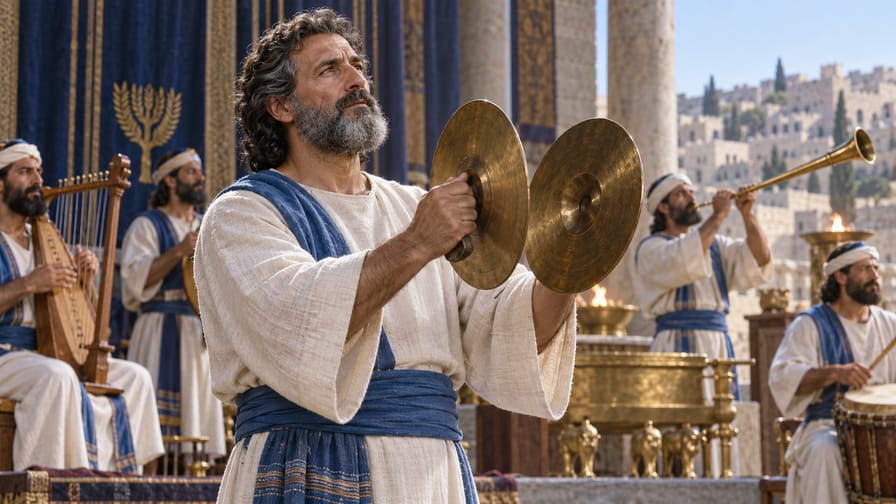
The figure of Asaph (Hebrew: אָסָף, ʼĀsāph) emerges in the Hebrew Scriptures as one of the most prominent worship leaders and composers of the Davidic and Solomonic periods. His relevance transcends mere musical function, positioning him as a prophetic and theological voice within the Old Testament canon.
An analysis of his life and work, particularly through the Psalms attributed to him, offers a rich tapestry of faith, struggle, and deep reflection on God's justice and sovereignty. From an evangelical Protestant perspective, Asaph represents a model of sincere worship and theological engagement with the complexities of life.
His legacy is not only musical but also doctrinal, contributing significantly to the theology of suffering, divine justice, and true worship—themes that resonate throughout all of Scripture and find their culmination in Christ Jesus.
1. Etymology and Meaning of the Name
The name Asaph, in Hebrew אָסָף (ʼĀsāph), derives from the verbal root אָסַף (ʼāsap̄), which means "to gather," "to collect," "to assemble," or "to take away." Thus, the literal meaning of the name is often interpreted as "Collector," "Assembler," or "He gathered."
This meaning holds profound symbolic resonance in the context of Asaph's vocation. As a worship leader and composer, he "gathered" the people in worship, "collected" expressions of faith and lament, and "assembled" the heart of the congregation before God.
Although there are no significant variations of the name in biblical languages, its etymology suggests an active role in mediating between the divine and the human through music and poetry. The name points to a function of gathering, be it of people, thoughts, or praises.
It is important to note that there are other individuals named Asaph in the Scriptures. For example, Asaph, the keeper of the royal park during the time of Nehemiah (Nehemiah 2:8), and a Levite gatekeeper mentioned in 1 Chronicles 26:1.
However, the most prominent and theologically significant Asaph is the son of Berechiah, a Levite from the family of Gershon, who was one of the chief musicians appointed by David. It is to this Asaph that tradition and textual criticism attribute the authorship of twelve Psalms in the Psalter.
The theological significance of the name, therefore, can be seen in the idea of God "gathering" or "collecting" the praise of His people through His servants, such as Asaph. He was an instrument in God's hand to gather hearts in worship and spiritual instruction, a true assembler of souls and songs.
This reflects the congregational nature of Israelite faith and, subsequently, of the church, where worship is a collective act mediated by anointed leaders, who "gather" the community around divine truth. The name itself already prefigures his function as a catalyst for worship.
2. Historical Context and Biblical Narrative
2.1. Period and Politico-Religious Context
Asaph lived and ministered during a crucial period in Israel's history, spanning the reigns of King David and his son Solomon, approximately in the 10th century B.C. This was a time of consolidation for the kingdom of Israel, with political and religious centralization in Jerusalem.
David, a man after God's own heart and a talented musician, dedicated himself to organizing the worship of the Lord in a more elaborate and worthy manner, after the installation of the Ark of the Covenant in Jerusalem (2 Samuel 6). It was in this context that Asaph and other Levites were commissioned.
The period is characterized by the transition from more itinerant worship to a more fixed and organized structure, preparing the way for the construction of Solomon's Temple. Music and praise played a central role in this new phase of Israel's spiritual life.
2.2. Genealogy and Family Origin
Asaph is identified in the Scriptures as the son of Berechiah (1 Chronicles 6:39) and belonged to the Levitical lineage of Gershon, one of Levi's sons (1 Chronicles 6:16-21). His Levitical heritage qualified him for service in the Tabernacle and, later, in the Temple.
The detailed genealogy in 1 Chronicles 6 establishes his position within the priestly and musical structure of the Levites, highlighting his authority and legitimacy to lead worship. He was among the three principal worship leaders, alongside Heman and Jeduthun (1 Chronicles 25:1).
2.3. Key Events and Biblical Passages
The first significant mention of Asaph occurs when David organizes the transport of the Ark of the Covenant to Jerusalem. He is named one of the chiefs of the singers, playing bronze cymbals (1 Chronicles 15:16-19).
Subsequently, David designates him to minister continually before the Ark, with his brothers, to make remembrance, to praise, and to give thanks to the Lord (1 Chronicles 16:4-5). This passage underscores his leadership role in public worship.
In 1 Chronicles 25:1-8, David and the commanders of the army set apart the sons of Asaph, Heman, and Jeduthun for the service of prophesying with harps, lyres, and cymbals. This indicates that Asaph was not merely a musician, but also a "prophet" or "seer" (ḥōzeh, חֹזֶה), whose words were inspired by God.
The "sons of Asaph" continued to serve in the Temple in subsequent generations, including during the dedication of Solomon's Temple (2 Chronicles 5:12), during Hezekiah's reform (2 Chronicles 29:13, 30), and at the return from Babylonian exile (Ezra 2:41 Nehemiah 7:44, 11:22).
The persistence of Asaph's lineage in Temple service over centuries attests to the importance and lasting impact of his foundation in Israelite worship. He established a legacy of musical worship that endured for generations.
2.4. Geography and Relationships with Other Characters
Asaph's activity was intrinsically linked to the city of Jerusalem, the political and religious center of the kingdom of David and Solomon. It was there that he led worship before the Ark and, later, in the Temple.
His most important relationships were with King David, who appointed and commissioned him, and with Heman and Jeduthun, the other two chief Levite musicians, with whom he collaborated in organizing the musical service of the Temple (1 Chronicles 25:1).
He was also in contact with the Levitical priesthood and with the other Levites who served in the Temple, being a central figure in orchestrating praise and worship to the Lord during the golden age of the Israelite monarchy.
3. Character and Role in the Biblical Narrative
3.1. Analysis of Character and Spiritual Virtues
Asaph's character is most richly revealed in the Psalms that bear his name, particularly in Psalms 73-83. These Psalms portray him as a man of deep faith, but also of brutal honesty in his spiritual struggles.
His primary virtue is unwavering devotion to God, even in the face of doubts and perplexities. He demonstrates a rare ability to express his innermost anxieties before the Lord, without pretense or hypocrisy, which is a model of sincere prayer.
Asaph also stands out for his spiritual leadership, musical ability, and prophetic insight. He was a "seer" (ḥōzeh), which implies an ability to discern God's will and purposes, and to communicate them through his art (2 Chronicles 29:30).
3.2. Struggles and Resolution of Inner Conflicts
Psalm 73 is the most vivid example of Asaph's inner struggle. He confesses that his feet almost slipped when he envied the prosperity of the wicked, questioning God's justice in the face of the suffering of the righteous (Psalm 73:2-3).
This doubt is not portrayed as a sin, but as a crisis of faith that he openly confronts before God. His resolution comes when he enters God's sanctuary and understands the fate of the wicked (Psalm 73:17), which leads him to reassert his trust in the Lord.
This honesty in his struggle and his subsequent restoration of faith serve as an encouragement for believers facing similar dilemmas, showing that it is possible to express doubts to God and still find refuge and clarity in Him.
3.3. Vocation and Specific Function
Asaph's primary vocation was that of chief of the Levite musicians, a director of praise and worship. His function included not only musical performance but also the composition of songs and the spiritual leadership of the ministry of praise (1 Chronicles 15:16-19 25:1-2).
He was a "seer" (ḥōzeh), which placed him in a position of prophetic authority, whose words were considered inspired by God. His Psalms are not merely poetry, but divine oracles transmitted through musical art.
His role was vital to the religious life of Israel, for music and praise were means by which the congregation connected with God, expressed their faith, repentance, and gratitude, and received divine instruction. Asaph was a catalyst for this spiritual experience.
3.4. Significant Actions and Character Development
Asaph's most significant actions were the organization and leadership of the worship ministry in the Davidic Tabernacle and the authorship of his Psalms. These texts are his most lasting legacy, offering insights into his theology and his journey of faith.
The development of his character is notable, moving from a state of perplexity and near despair (Psalm 73:2-3) to a profound reassertion of God's goodness and justice, resulting in unwavering praise and trust (Psalm 73:23-28).
This trajectory of faith demonstrates a believer's capacity to grow in understanding and trust through proximity to God and reflection on His Word and His ways, even when these ways seem mysterious or contradictory.
4. Theological Significance and Typology
4.1. Role in Redemptive History and Progressive Revelation
Asaph played a crucial role in the redemptive history of Israel by contributing to the structuring of Davidic worship, which prefigured worship in the Temple and, ultimately, spiritual worship in Christ. His Psalms are part of God's progressive revelation to humanity.
They address themes such as divine justice, God's sovereignty over the nations, the importance of true worship (not merely ritualistic, cf. Psalm 50), and the ultimate hope of the righteous. These truths pave the way for a fuller understanding of Christ's work.
4.2. Prefiguration and Christocentric Typology
Although Asaph is not a direct typological figure of Christ in the sense of a king, priest, or messianic prophet, his role as a "seer" and author of inspired words points to Christ as the incarnate Logos, the very Word of God (John 1:1).
His Psalms, which express laments, pleas for justice, and trust in God's sovereignty, resonate with the experience of Christ and believers. The suffering of the righteous and their ultimate vindication, prominent themes in Asaph's Psalms, find their supreme fulfillment in Jesus Christ, the Righteous One who suffered and was glorified.
Furthermore, Asaph's emphasis on true worship, which goes beyond external sacrifices to reach the heart (Psalm 50:7-15), anticipates Jesus' criticism of empty rituals and His emphasis on worship "in spirit and in truth" (John 4:23-24).
4.3. Connection with Central Theological Themes
Asaph's Psalms are rich in central theological themes. Psalm 73, for example, is a masterpiece of theodicy, dealing with the problem of evil and the prosperity of the wicked, and affirming God's justice and goodness amidst human perplexity.
Psalm 50 emphasizes God's sovereignty over creation and the inadequacy of merely external sacrifices without a contrite heart. It calls the people to offer "sacrifices of thanksgiving" and to fulfill their vows (Psalm 50:14), a recurring theme in Reformed theology concerning inner obedience.
Other Psalms of Asaph address God's faithfulness to His people (Psalm 77), divine judgment on the nations (Psalm 82), and prayer for the restoration of Israel (Psalm 80). These themes are vital for understanding God's covenant with His people and His redemptive purposes.
4.4. Doctrine and Teachings Associated with the Character
From Asaph, we learn about the doctrine of the divine inspiration of Scripture, as his Psalms are considered part of the canon. His experience in Psalm 73 illustrates the importance of divine revelation for resolving existential and theological dilemmas.
He teaches about the nature of true worship, which is a personal and spiritual encounter with God, not a mere ritualistic formality. Priority is given to obedience, gratitude, and a sincere heart, prefiguring the new covenant in Christ.
Asaph's life also instructs us on perseverance in faith, even when reality seems to contradict God's promises. His journey from doubt to certainty offers a pastoral model for those struggling with issues of faith and justice.
5. Biblical-Theological Legacy and Canonical References
5.1. Literary and Canonical Contributions
Asaph's most tangible legacy are the twelve Psalms attributed to him in the Psalter: Psalms 50 and 73 to 83. These Psalms constitute a significant and theologically rich part of the Book of Psalms, which is central to both Jewish and Christian faith.
The designation "of Asaph" (לְאָסָף, leʼĀsāph) in the heading of these Psalms indicates his authorship or that they were composed by a member of his school or musical lineage. This established a "school of Asaph," which continued to produce or collect inspired liturgical material.
The presence of these Psalms in the canon demonstrates the recognition of the divine inspiration and theological authority of his work, solidifying his place as one of the principal contributors to the sapiential and poetic literature of Israel.
5.2. Influence on Biblical Theology
Asaph's influence on biblical theology is profound. His Psalms shaped Israel's understanding of God's justice, divine sovereignty, and the nature of true worship. They offer a unique perspective on the suffering of the righteous and the prosperity of the wicked, a crucial theme for Old Testament theology.
The persistence of the "sons of Asaph" in Temple ministry across generations (2 Chronicles 29:13, 35:15 Ezra 2:41 Nehemiah 7:44, 11:22) attests to the lasting influence of his organization and the principles of worship that he established.
His musical and prophetic school ensured that the tradition of praise and inspired instruction continued, enriching the spiritual life of God's people for centuries, from the monarchical period to the post-exilic era.
5.3. Presence in Interpretive Tradition
In Jewish interpretive tradition, Asaph is revered as one of the great masters of praise and poetry. His Psalms are studied and recited, especially those that address divine justice and God's providence over Israel.
In Christian theology, Asaph's Psalms are valued for their theological depth and pastoral relevance. Psalm 73, in particular, is frequently cited for its honesty in dealing with doubt and its ultimate resolution through faith and spiritual discernment.
Evangelical commentators and theologians, such as Derek Kidner and John Calvin, have praised Asaph's courage and insight, seeing in his Psalms a model of how believers can wrestle with God's truths and emerge with a stronger and more mature faith.
5.4. Treatment in Reformed and Evangelical Theology
In Reformed and evangelical theology, Asaph is often highlighted for his emphasis on God's sovereignty and the importance of heartfelt worship over mere ritualism. Psalm 50, with its critique of external sacrifices without inner obedience, resonates deeply with the principles of the Protestant Reformation.
His experience in Psalm 73 is seen as a powerful testimony to God's common grace, which allows believers to question and doubt, but also to saving grace that leads them back to truth and unwavering trust in God. This underscores the Reformed anthropology of total depravity and the necessity of divine illumination.
5.5. Importance for Understanding the Canon
The inclusion of Asaph's Psalms in the biblical canon enriches the diversity of the Psalter and of divine revelation. They demonstrate that faith is not free from struggles and questioning, but that these struggles can be channels for a deeper understanding of God.
Asaph, as a prophet-musician, shows the interconnection of art, theology, and spirituality in the worship of God. His life and his Psalms are a lasting testament to God's ability to use talented and fallible individuals to communicate His eternal truths and inspire His people to sincere worship and persevering faith.