


Abiathar
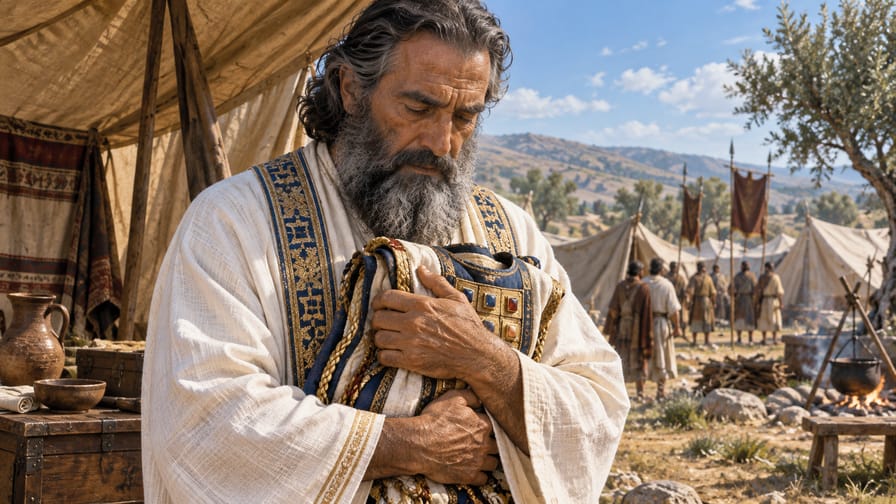
The figure of Abiathar (Hebrew: אֶבְיָתָר, ʾEḇyātār) is one of the most prominent in the Old Testament, especially during the period of the monarchy's transition in Israel, serving as a priest and a key advisor to King David. His story is marked by loyalty, priestly service, and ultimately, by a fall that exemplifies divine sovereignty and the seriousness of God's judgment. The analysis of his life offers rich theological perspectives from an evangelical Protestant viewpoint, underscoring themes such as divine providence, the nature of the priesthood, and Christocentric typology.
This in-depth study aims to explore the etymology of his name, the historical context in which he lived, the nuances of his character, his theological significance in the history of redemption, and the legacy he left in the Scriptures, always focusing on biblical authority and its relevance for understanding the Christian faith.
1. Etymology and meaning of the name
The name Abiathar, in Hebrew אֶבְיָתָר (ʾEḇyātār), is a theophoric name composed of two parts. The first part, ʾaḇ (אָב), means "father." The second part, yāṯār (יָתַר), can mean "to remain," "to exceed," "to be abundant," or "to be preeminent."
Thus, the name Abiathar is generally interpreted as "My father is excellence," "Father of abundance," or "Father is preeminent." Some interpretations suggest "Father of the remnant," which would be notably ironic and prophetic, considering he was the only survivor of the massacre of Nob.
The meaning of the name may reflect the hope or condition of the family at the time of his birth. In the biblical context, names frequently carried symbolic and prophetic weight. In the case of Abiathar, the name may have pointed to the greatness or divine provision manifested in his priestly lineage, or even his own survival and future prominence.
Although there are no significant variations of the name Abiathar in biblical languages that alter its fundamental meaning, and no other prominent biblical character shares this name, the uniqueness of his identity makes him a focal point in the narrative. The theological significance of his name, "Father of excellence," contrasts dramatically with his eventual fall, a reminder of human fragility even in those who hold positions of honor.
2. Historical context and biblical narrative
2.1 Family origin and genealogy
Abiathar was the son of Ahimelech (1 Samuel 22:20), who was high priest in Nob. He was the grandson of Ahitub and great-grandson of Phinehas, and a direct descendant of Eli through Ithamar (1 Samuel 14:3, 1 Samuel 22:20). This genealogy is crucial, as it connects Abiathar to the priestly lineage that God had promised to judge because of the sins of Eli and his sons Hophni and Phinehas (1 Samuel 2:27-36).
Abiathar's lineage represented the continuity of the Levitical priesthood, specifically from the house of Ithamar, the younger son of Aaron. His family played a central role in the religious life of Israel during the transition from the era of the judges to the monarchy.
2.2 Key life events and relationships
Abiathar's life unfolds during a period of great turmoil and transformation for Israel, from the end of Saul's reign, through the entire reign of David, until the beginning of Solomon's reign, approximately between the 11th and 10th centuries BC. The political and social context was one of monarchical consolidation, with Philistine threats and internal conflicts.
The first significant event in Abiathar's life is the massacre of Nob, ordered by King Saul. After David fled from Saul, he sought refuge in Nob, where Ahimelech, the high priest, gave him the showbread and Goliath's sword (1 Samuel 21:1-9). When Saul learned of this, he ordered the execution of Ahimelech and the entire priestly house in Nob.
Doeg the Edomite carried out the order, killing eighty-five priests (1 Samuel 22:18). Abiathar, the only son of Ahimelech, managed to escape the massacre and fled to David, taking the ephod with him (1 Samuel 22:20-21). This event marks the beginning of his long and complex relationship with the future king of Israel.
From that moment on, Abiathar became a loyal companion and an indispensable priest to David during his years as a fugitive. He consulted the Lord by means of the ephod on David's behalf on various occasions, such as in Keilah (1 Samuel 23:6, 9-12) and Ziklag (1 Samuel 30:7-8), providing divine guidance and legitimacy to David's actions.
With David's ascent to the throne, Abiathar was established as high priest, serving alongside Zadok (2 Samuel 8:17 1 Chronicles 18:16). This co-high priesthood is a peculiar arrangement, possibly reflecting the transition and the need to unite different factions or priestly lineages under the new Davidic monarchy.
His loyalty to David was again demonstrated during Absalom's rebellion. Abiathar, along with Zadok, remained faithful to David, although he was sent back to Jerusalem with the Ark of the Covenant and his sons to serve as spies, informing David about Absalom's plans (2 Samuel 15:24-29, 35-36 2 Samuel 17:15-16).
However, Abiathar's life takes a tragic turn near the end of David's reign. When David grew old and approached death, Abiathar supported Adonijah's attempt to usurp the throne, instead of Solomon, who was the successor chosen by God and by David (1 Kings 1:7). This decision was a fatal error, which aligned him with the adversaries of the divine plan.
After Solomon's coronation, Abiathar was banished from his priestly office and sent back to Anathoth, his property (1 Kings 2:26-27). Although Solomon spared his life because of his past loyalty to David and for having carried the Ark of the Lord, his removal from the priesthood marked the end of Eli's lineage in the high priesthood, thus fulfilling the prophecy of 1 Samuel 2:30-36.
3. Character and role in the biblical narrative
3.1 Analysis of character and flaws
Abiathar's character is multifaceted, revealing notable virtues, but also significant flaws. His escape from Nob demonstrates courage and a survival instinct. His decision to join David, a persecuted fugitive, attests to his loyalty and perhaps his perception of the divine anointing on David, in contrast to Saul's rejection.
As a priest, Abiathar demonstrated dedication to his office, consulting the Lord by means of the ephod at crucial moments for David. He was a vital link between David and the divine will, a figure of religious authority who lent legitimacy to David's actions. His presence with David during the years as a fugitive and his continuous service during David's reign underscore his initial importance and faithfulness.
However, Abiathar's great flaw lies in his involvement in Adonijah's conspiracy. This decision may have been motivated by loyalty to an older son of David, by political ambition, or by an aging that made him less spiritually discerning. By allying himself with Adonijah, he opposed God's will and David's choice, demonstrating a failure to discern or accept divine sovereignty in the royal succession.
This flaw is particularly grave for a high priest, whose primary function was to represent God before the people and the people before God. His fall serves as a reminder that even those in positions of great spiritual responsibility are not immune to errors of judgment and to the temptation to align with human interests to the detriment of the divine will.
3.2 Role and character development
Abiathar's role in the biblical narrative is predominantly priestly and consultative. He is the living link with the established priestly tradition, especially after the massacre of Nob, carrying the ephod and, therefore, the ability to consult God. His presence legitimized David in the eyes of the people and guaranteed divine guidance in his campaigns and decisions.
He represents the continuity and, at the same time, the transitoriness of the Levitical priesthood. His development in the narrative is from a faithful and indispensable priest to David, to a character who, at the end of his career, commits a critical error that results in his disgrace and the extinction of his lineage from the high priesthood. This trajectory highlights the importance of continuous obedience to God's will, even for those who served faithfully for many years.
4. Theological significance and typology
4.1 Role in redemptive history and prophecies
Abiathar's story is intrinsically linked to the redemptive history of Israel and the progressive revelation of God's plan. His removal from the priesthood is a direct fulfillment of the prophecy of judgment against the house of Eli, uttered in 1 Samuel 2:30-36. This prophecy promised that God would cut off the strength of Eli's house and that there would not be an old man in his house forever. Abiathar's banishment by Solomon (1 Kings 2:27) sealed this divine judgment, demonstrating God's faithfulness to His word, both in blessing and in discipline.
The substitution of the lineage of Ithamar (represented by Abiathar) by the lineage of Eleazar (represented by Zadok) in the high priesthood (1 Kings 2:35) has a profound theological significance. Zadok belonged to the lineage to whom God had promised a perpetual priesthood in Numbers 25:10-13, through Phinehas. Thus, Abiathar's fall is not merely a punitive event, but part of a greater plan of God to restore the integrity of the priesthood according to His own will and promises.
4.2 Prefiguration and Christocentric typology
From an evangelical Protestant perspective, the story of Abiathar, and of the Levitical priesthood in general, points to Christ in various ways. The Levitical priesthood, with its flaws and temporary nature, prefigures the need for a perfect and eternal priest. The removal of Abiathar and the instability of his priestly lineage underscore the imperfection and provisional nature of the Old Covenant.
Christ is the perfect High Priest, "according to the order of Melchizedek" (Hebrews 7:11-28), whose priesthood is neither transient nor subject to human flaws or death. He needs neither substitutes nor successors. Abiathar's fall and the change in the priestly lineage illustrate the need for a new and superior covenant, with a priest who can mediate perfectly between God and humanity (Hebrews 8:6).
Abiathar's ability to consult the Lord through the ephod prefigures the perfect and continuous communication that believers have with God through Christ, our great High Priest who intercedes for us (Hebrews 4:14-16). Direct access to God, which was restricted and mediated in the Old Testament, is now fully realized in Christ Jesus.
4.3 Connections with the New Testament
A notable reference to Abiathar in the New Testament occurs in Mark 2:26, where Jesus mentions that David ate the showbread "in the days of Abiathar, the high priest." This passage has been a subject of debate, because in 1 Samuel 21:1, it is Ahimelech, Abiathar's father, who is the high priest on that occasion. Evangelical scholars offer several explanations:
- Scribal error: A possible textual variation or a copying error in some manuscripts.
- "In the days of": The phrase epi Abiathar archiereos (ἐπὶ Ἀβιαθὰρ ἀρχιερέως) may mean "in the time of Abiathar, who became high priest," referring to a broader period when Abiathar was a prominent figure in the priesthood, even if his father was the chief high priest on that specific occasion.
- Prominence: Abiathar may have been so prominent, or even a "second high priest," that his name was synonymous with the priestly era, especially for being the survivor of Eli's house and David's future high priest.
Regardless of the exact explanation, Jesus' mention of Abiathar in Mark 2:26 confirms his continued relevance in the historical and theological memory of Israel, even centuries later, and serves to illustrate David's authority and, by extension, Jesus' own authority as "Lord even of the Sabbath."
5. Biblical-theological legacy and canonical references
5.1 Mentions and contributions
Abiathar is primarily mentioned in the books of 1 Samuel, 2 Samuel, 1 Kings, and 1 Chronicles. His story is a thread that connects the events of the end of Saul's reign, David's ascent, and the consolidation of the kingdom under Solomon. Although he did not contribute literary works, his life is a powerful narrative that illustrates fundamental theological principles.
His presence is felt at crucial moments: in David's flight, in consulting God, in loyalty during the rebellion, and, finally, in his fall. He is a character who, by his position and his actions, directly influences the history of God's people and the understanding of the priesthood.
5.2 Influence on biblical and Reformed theology
Abiathar's story has significant influence on biblical theology, especially in the understanding of the priesthood and divine sovereignty. The evangelical Protestant perspective often highlights the transitoriness and imperfection of the Levitical priesthood, using Abiathar's fall as a vivid example. Commentators like John Gill and Matthew Henry emphasize the fulfillment of the prophecy against Eli and God's justice manifested in Abiathar's banishment.
In Reformed theology, God's sovereignty is a central theme, and Abiathar's story powerfully illustrates it. God not only foretells the destiny of Eli's house, but also orchestrates events for this prophecy to be precisely fulfilled, even through human choices and failures. Zadok's ascent, from the lineage of Eleazar, is seen as part of God's sovereign plan to maintain the purity and integrity of the priesthood that points to Christ.
Abiathar's story also serves as a warning against ambition and alignment with human will to the detriment of divine will. For evangelical theologians, his failure to discern God's choice for Solomon is a reminder that faithfulness must be primarily to God, and not to individuals or political parties, no matter how close they may be.
Abiathar's legacy is, therefore, twofold: he is a symbol of faithfulness and priestly service in times of adversity, but also an example of the seriousness of divine judgment and the need for unconditional obedience. His life contributes to the understanding of the biblical canon by demonstrating the continuity of God's plan through the generations, the progressive revelation of the priesthood, and the inescapable need for a perfect mediator, who is Jesus Christ.