


Terah
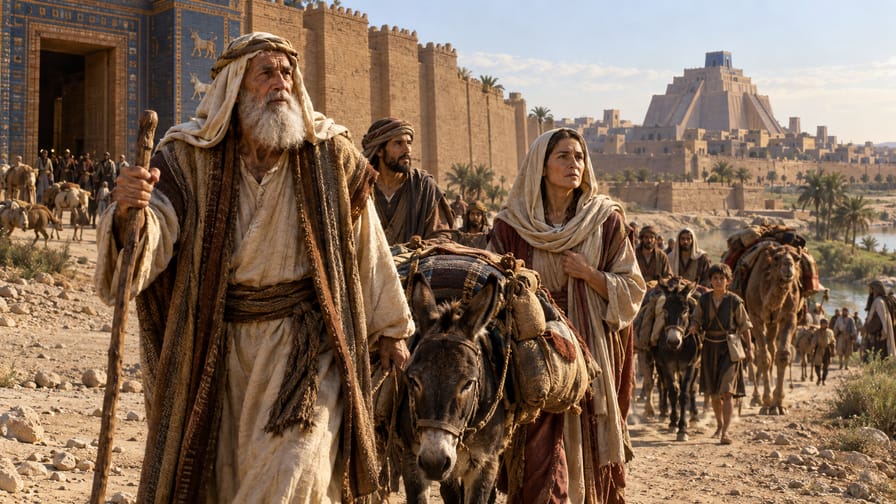
The figure of Terah, an antediluvian patriarch and father of Abram (later Abraham), occupies a crucial, though secondary, position in the biblical narrative of the Old Testament. His story, primarily outlined in the book of Genesis, serves as a vital link in the genealogy that connects post-diluvian humanity to the father of faith, Abraham, and, by extension, to the messianic lineage. From an evangelical Protestant perspective, the analysis of Terah must consider not only the narrated facts but also the theological implications of his actions and inactions within God's redemptive plan.
This entry delves into the etymology of his name, his historical-cultural context, the nuances of his character, his theological significance in salvation history, and the legacy he left in the Scriptures. The life of Terah, though briefly described, offers insights into God's faithfulness amidst idolatry and human pilgrimage, pointing to divine sovereignty in the choice and purpose of salvation.
1. Etymology and Meaning of the Name
The name Terah (Hebrew: תֶּרַח, Terach) is first mentioned in Genesis 11:24 as the father of Abram. Its etymology is a subject of debate among scholars, but the most common interpretations suggest meanings that may resonate with his history or the cultural context of the time.
One possible derivation is from the Hebrew root meaning "station," "post," or "stop," implying a place of rest or a stage in a journey. This interpretation is particularly interesting in light of the biblical narrative, where Terah begins a journey from Ur of the Chaldeans but settles in Haran, not reaching the promised land of Canaan, as recorded in Genesis 11:31-32.
Another etymological suggestion links Terach to the Aramaic word for "mountain goat" or "wild goat," perhaps indicating a characteristic of strength or robustness. However, this interpretation has less contextual support in the biblical narrative than the former, which aligns more with the events of his life.
The Septuagint transliterates the name as Tharra (Θαρρα), maintaining the Hebrew phonetics. In the New Testament, Terah is mentioned as Thara (Θαρα) in Luke 3:34, in the genealogy of Jesus Christ, and in Acts 7:2, in Stephen's discourse, demonstrating the consistency of the name across biblical languages.
The theological significance of the name, if related to "stop" or "station," may symbolize the interruption of a divinely orchestrated movement or the imperfection of human faith. Terah represents a point of transition, where the divine promise begins to manifest, but full obedience has not yet materialized, leaving the task for his son, Abram.
Although there are no other prominent biblical characters named Terah, his uniqueness and strategic position in the messianic lineage lend his name particular weight. He is the link between the post-diluvian world and the advent of the Israelite nation through Abraham, a patriarch who stopped on the way, but whose son would continue the journey of faith.
2. Historical Context and Biblical Narrative
2.1. Historical Period and Family Origin
Terah lived in the post-diluvian period, approximately in the third millennium B.C., according to biblical chronology. He is presented in Genesis 11:24 as the son of Nahor and a descendant of Shem, one of Noah's sons. This genealogy is crucial, as it establishes Terah's lineage within the Semitic line, which is the line through which the messianic promise would be transmitted.
He was born when his father Nahor was 29 years old and lived for 205 years, dying in Haran (Genesis 11:24-32). His birth marks a point in history where humanity had already spread after the Flood and the episode of the Tower of Babel, and the worship of multiple gods was common, even among the Semites.
The political, social, and religious context of Terah's time was dominated by the rise of city-states in Mesopotamia. Ur of the Chaldeans, his hometown, was an important Sumerian urban center, known for its advanced civilization, but also for its profound idolatry, with the prominent worship of the moon-god Nanna (or Sin).
This idolatrous reality is confirmed in Joshua 24:2, where Joshua reminds the people of Israel that their ancestors, including Terah, "served other gods" beyond the Lord, on the other side of the Euphrates River. This information is vital for understanding Abraham's call and the contrast between monotheistic faith and prevailing polytheism.
2.2. Main Events of Life and Geography
The biblical narrative of Terah's life is concise and focused on his paternity and a migratory journey. His sons are listed as Abram, Nahor, and Haran, with Haran being the father of Lot (Genesis 11:27). The premature death of Haran in Ur, in the presence of his father Terah, is a notable event, as this is unusual in the patriarchal narrative.
The central event in Terah's life is his decision to depart from Ur of the Chaldeans. Genesis 11:31 relates: "Terah took Abram his son, and Lot the son of Haran, his grandson, and Sarai his daughter-in-law, his son Abram's wife, and they went out with them from Ur of the Chaldeans to go to the land of Canaan but when they came to Haran, they settled there." This passage is fundamental to the history of salvation.
Terah's exact motivation for leaving Ur is not explicitly stated in Genesis. However, Acts 7:2-4, in Stephen's discourse, suggests that God appeared to Abraham "before he dwelt in Haran," calling him to leave his land. This implies that the divine initiative for the migration came from Abraham, and Terah accompanied him.
The journey from Ur of the Chaldeans, located in southern Mesopotamia, to Haran, in northern Mesopotamia (in the region of what is today Turkey), was a long and challenging trip. Haran was an important commercial and religious center, also dedicated to the worship of the moon-god Sin, similar to Ur. Terah's stop in Haran, where he remained until his death, is a significant turning point in the narrative.
The geography of his life, from Ur to Haran, is a microcosm of the divine call to a pilgrimage that, in Terah's case, was not completed. He died in Haran at 205 years old, and only after his death did Abram, now 75 years old, continue the journey to Canaan, according to God's explicit command in Genesis 12:1-4.
2.3. Relationships with Other Characters
Terah's relationships with his family are central. He is the father of Abram, which makes him the grandfather of Isaac and the great-grandfather of Jacob, establishing the patriarchal lineage. His relationship with Lot, his orphaned grandson, is also notable, as he took him along on the journey, demonstrating a sense of family responsibility.
Terah's importance lies primarily in being the father of Abraham, the recipient of the covenant promises. Although he himself is not the focus of the promises, his life is the necessary prelude to the beginning of Abraham's story, which is the true starting point of the nation of Israel and the progressive revelation of God.
3. Character and Role in the Biblical Narrative
3.1. Analysis of Character and Moral Failings
Terah's character, as revealed in the Scriptures, is complex and, in certain aspects, ambiguous. The Bible does not present him as a hero of faith, but as a patriarchal figure who, despite starting a journey of faith, does not complete it. His obedience was partial, evidenced by his decision to settle in Haran instead of proceeding to Canaan.
Terah's most significant failing, from a theological perspective, is his presumed idolatry. Joshua 24:2 clearly states that he and his ancestors "served other gods" besides the Lord. This contrasts sharply with the monotheism that God would establish through his son Abram. Idolatry was the norm in Ur and Haran, and Terah, apparently, was immersed in it.
The decision to stop in Haran can also be seen as a failure of faith or perseverance. Although he left Ur, an act that required considerable courage and detachment, he failed to complete the journey to the promised land. This may indicate a lack of full trust in divine direction or a preference for the comfort and familiarity of Haran, which was a cultural and religious center similar to Ur.
However, the narrative does not paint him as a villain. He demonstrates a sense of family responsibility by taking Abram, Lot, and Sarai with him. His initiative to leave Ur, even if not fully motivated by faith in Yahweh, was a crucial step that facilitated the fulfillment of God's purposes through Abraham.
3.2. Role Played and Key Decisions
Terah's primary role in the biblical narrative is that of progenitor and catalyst for Abram's journey. He is the father from whom the lineage of the promise originates. His life serves as a backdrop for the story of Abraham, highlighting God's sovereignty in calling a man from an idolatrous environment to a new faith and a new purpose.
Terah's key decision was to begin the journey from Ur of the Chaldeans towards Canaan. Although the motivation may have been the influence of Abram, who had already received a divine call (Acts 7:2-4), Terah's action was fundamental. He led the family caravan, taking responsibility for the relocation and settlement in a new place.
His stop in Haran, however, is equally significant. It marks the point where spiritual leadership and initiative passed from Terah to Abram. Only after Terah's death in Haran is Abram explicitly called by God to proceed alone to Canaan (Genesis 12:1). Terah's death symbolizes the end of an era and the beginning of the Abrahamic era of faith.
Terah's life, therefore, illustrates the transition from an era of widespread idolatry to the beginning of monotheistic revelation. He is a bridge between the past and the future of redemptive history, an instrument, even if imperfect, in God's hands to prepare the ground for the great covenant with Abraham.
4. Theological Significance and Typology
4.1. Role in Redemptive History and Progressive Revelation
The figure of Terah plays a fundamental role in redemptive history, not because of his own accomplishments of faith, but because of his strategic position in the lineage that leads to Abraham and, ultimately, to Christ. He is a vital link in the messianic genealogy, connecting the post-diluvian patriarchs to the father of faith.
His life illustrates God's sovereignty in carrying out His purposes even amidst human imperfection and idolatry. God chose Abram from a family that "served other gods" (Joshua 24:2), demonstrating that salvation does not depend on family righteousness, but on divine grace and election. This is a central theme in evangelical Protestant theology.
The interruption of Terah's journey in Haran serves as a theological contrast to Abram's complete obedience. While Terah stopped, Abram moved forward, demonstrating the faith and obedience necessary to inherit the promises. This emphasizes the importance of perseverance in faith and radical obedience to the divine call, a fundamental principle of Christian life.
4.2. Connection to Central Theological Themes
Terah's story connects with several central theological themes. Firstly, the theme of divine call and election. God calls Abram from an idolatrous context, and Terah, by initiating the journey, is an indirect instrument in this process. This highlights that the initiative for salvation always comes from God, not from man.
Secondly, pilgrimage and the promised land. Terah's journey from Ur to Haran, though incomplete, prefigures the journey of faith that Abraham and his descendants would undertake. Haran becomes a symbol of "half-obedience" or "stopping along the way," contrasting with the full entry into the promise of Canaan.
Thirdly, idolatry and separation. The mention of Terah's idolatry (Joshua 24:2) highlights the need for separation from the world and its false gods. God's call to Abraham is a call to come out of idolatry and worship only the Lord, a vital principle for Christian worship.
Fourthly, the sovereignty of God over human history. Terah's life, with its choices and limitations, is embedded within God's larger plan for redemption. Even his failures are used by God to drive the narrative towards the fulfillment of His promises through Abraham.
4.3. New Testament Citations and Christocentric Typology
Terah is explicitly mentioned in the New Testament in two genealogical and narrative passages. In Luke 3:34, he appears in the genealogy of Jesus, confirming his position as a direct ancestor of the Messiah. This underscores Terah's importance in salvation history, as he is a link in Christ's human lineage.
In Stephen's discourse in Acts 7:2-4, Terah's departure from Ur and his stay in Haran are contextualized with God's call to Abraham. Stephen states that God appeared to Abraham "while he was in Mesopotamia, before he dwelt in Haran," and that Abraham only departed for Canaan "after his father died." This emphasizes that Abraham's final departure was directly after Terah's death, marking a new beginning.
Terah's Christocentric typology is indirect. He does not directly prefigure Christ, but his story is part of the tapestry of divine providence that leads to the Messiah. His stop in Haran can be seen as a type of human inability to achieve the fullness of the promise without total obedience and divine intervention, setting the stage for Christ's perfect faith.
Terah's life, therefore, serves as a testament to God's grace operating through generations, purifying and directing the messianic lineage, even when individuals fail in their full obedience. He is a reminder that God's plan prevails, regardless of human imperfections.
5. Biblical-Theological Legacy and Canonical References
5.1. Mentions in Other Biblical Books and Theological Influence
Besides the mentions in Genesis, Terah is referenced in 1 Chronicles 1:26 in the genealogy of Shem, reaffirming his position in the patriarchal lineage. As already noted, Joshua 24:2 is crucial for revealing his idolatrous past, which has profound theological implications for Abraham's election.
In the New Testament, Luke 3:34 and Acts 7:2-4 are the canonical references that solidify Terah's importance in salvation history and in the genealogy of Christ. These passages demonstrate that his life and actions, though limited, were an integral part of the divine plan to bring the Messiah into the world.
Terah's influence on biblical theology lies primarily in his role as the genealogical link between post-diluvian humanity and the father of faith. He represents the transition point from the worship of many gods to Abrahamic monotheism, a fundamental movement in the history of God's progressive revelation.
His story illustrates the theology of prevenient grace and sovereign election. God acts to call and separate a people for Himself, beginning with Abraham, even though Abraham's family of origin was immersed in idolatry. This highlights the divine initiative in salvation and the unmerited nature of grace.
5.2. Presence in Interpretive Tradition and Reformed Theology
In Jewish interpretive tradition, Terah is often seen as a figure of limited faith or even an idolater who was redeemed by his son Abraham. Some Midrashim portray him as an idol maker, which accentuates the contrast with Abraham's monotheistic faith. However, his initiative to leave Ur is still recognized as a significant step.
In Christian theology, and particularly from an evangelical Protestant and Reformed perspective, Terah is studied primarily in relation to Abraham's story. He serves as a reminder of the fallen condition of humanity before divine intervention and of God's grace in calling individuals from pagan contexts into a covenant relationship.
Commentators such as John Calvin, in his "Institutes of the Christian Religion" and in his commentaries on Genesis, address Terah as part of God's providential plan, emphasizing that God is able to use even imperfect people for His purposes. Terah's stop in Haran is seen as an example of the need for persevering faith and complete obedience.
Terah's life is also a testament to God's patience and faithfulness. He planted the seed of the journey, and, although he did not see its final fulfillment, his son Abraham did. This highlights the continuity of the redemptive plan through generations and the certainty that God's Word will always be fulfilled.
5.3. Importance for Understanding the Canon
Terah's importance for understanding the biblical canon lies in his role as an indispensable genealogical and historical link. Without Terah, the lineage of Abraham and, consequently, the messianic lineage, would have a gap. He is part of the fundamental structure that links the universal history of humanity to the particular history of Israel and, ultimately, to salvation in Christ.
His story contextualizes Abraham's call, demonstrating the radicality of the separation God required and the depth of the idolatry from which Abraham was called. This establishes a pattern for understanding God's holiness and the need for an exclusive faith in Him, a recurring theme throughout the biblical canon.
In summary, Terah, although not a central character in terms of his own faith or accomplishments, is a figure of immense theological importance. He is the father of Abraham, the man through whom God inaugurated His covenant with Israel and prepared the way for the coming of the Messiah, Jesus Christ. His life underscores the sovereignty, grace, and faithfulness of God amidst the complexities of human history.