


Malachi
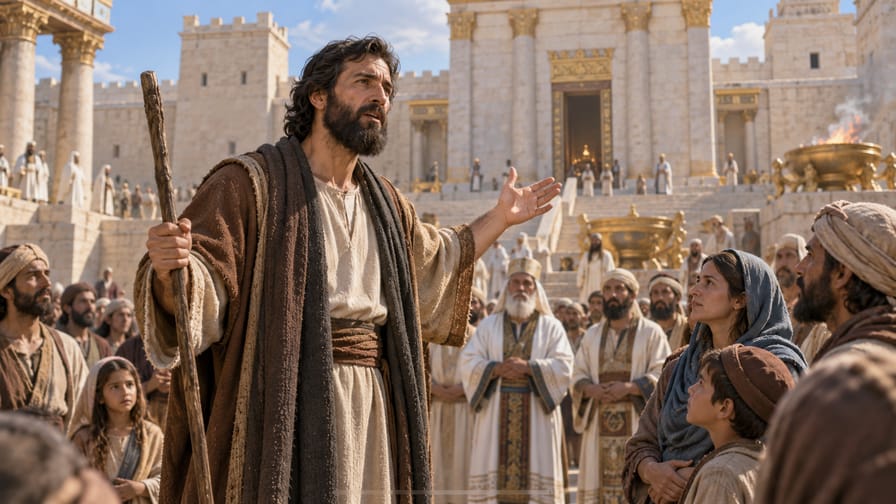
Malachi is the prophet whose book closes the Old Testament in the Protestant canon. The book presents itself as the oracle of the word of the Lord to Israel by Malachi (Malachi 1:1), addressed to the Jewish community that had returned from exile in Babylon and was living around the rebuilt temple in Jerusalem.
Apart from that superscription, the Bible gives no biographical information about him. We do not know his father, his tribe, his hometown or the circumstances of his call, and he is not mentioned in any other book of Scripture. What we have is his message: a series of debates between the Lord and a people who had grown tired of serving him, ending with the promise of a messenger who would prepare the way of the Lord and of the prophet Elijah before the great day of the Lord.
His very name raises a question discussed since antiquity, because in Hebrew it means my messenger, the same word used in Malachi 3:1. This article explains the name, presents honestly the debate over whether it is a proper name or a title, and shows why the book is so important for understanding John the Baptist and the coming of Jesus Christ.
1. Etymology and meaning of the name
The Hebrew Malʾakhi (מַלְאָכִי) is formed from malʾakh, messenger, with the suffix -i, which normally means my. The literal sense is therefore my messenger. The word malʾakh is used both for human envoys and for angels, and the prophets can also call a prophet or a priest a messenger of the Lord (Haggai 1:13; Malachi 2:7).
Some scholars suggest that Malʾakhi is a shortened form of a longer name such as Malʾakhiyah, messenger of the Lord, in the same way that Abi, the mother of Hezekiah in 2 Kings 18:2, is called Abijah in 2 Chronicles 29:1. The explanation is possible, but the longer form is not attested in the Bible, so it remains a hypothesis.
2. Historical context and biblical narrative
2.1 Family origin and genealogy
Scripture records no genealogy for Malachi. Unlike Zephaniah, Zechariah or Jeremiah, whose books name their fathers or origin (Zephaniah 1:1; Zechariah 1:1; Jeremiah 1:1), the superscription of Malachi gives only the name. That silence, together with the meaning my messenger, gave rise to an old discussion about whether Malachi is a personal name or a title.
Those who see it as a title point out that the Greek Septuagint renders Malachi 1:1 as by the hand of his messenger rather than as a proper name; that the Aramaic Targum adds that this messenger was Ezra the scribe; that the same word appears in 3:1 for the messenger who prepares the way; and that the heading the oracle of the word of the Lord also introduces Zechariah 9:1 and 12:1, which could suggest an anonymous collection. The Talmud also records a view identifying Malachi with Ezra, alongside the opinion that Malachi was his own name.
Those who see it as a proper name, the position of most conservative interpreters and the one followed here, note that every other prophetic book of the Old Testament bears the name of a prophet, and that the Hebrew expression by the hand of is normally followed by the name of a person, as in Haggai 1:1. It would be strange for the last book of the prophets to be the only anonymous one, and nothing in the Hebrew text attributes it to Ezra. Certainty is not possible, but the most natural reading of Malachi 1:1 is that Malachi was the prophet's name, a name that fitted his mission well.
The book gives no date, but its content points to the Persian period. The temple had been rebuilt and sacrifices were being offered (Malachi 1:7-10; 3:10), Judah was under a governor (1:8), and the problems the prophet denounces, such as corrupt priests, marriages with women who served other gods and neglect of the tithes, closely resemble those Nehemiah faced (Nehemiah 13:10-13; 13:23-29). For this reason most scholars place Malachi in the fifth century BC, around the time of Ezra and Nehemiah, often between about 460 and 430 BC. These dates are approximate.
2.2 Main events
The book does not narrate events in the prophet's life; it records his preaching. Its characteristic form is the disputation: the Lord makes a statement, the people object with a question, and the Lord answers. Six such exchanges can be identified.
In the first, the Lord declares I have loved you, and the people ask how; the answer recalls the choice of Jacob over Esau (Malachi 1:2-5). In the second, he rebukes the priests who despised his name by offering blind, lame and sick animals, and reminds them of his covenant with Levi (1:6-2:9). In the third, he condemns those who married the daughter of a foreign god and dealt treacherously with the wife of their youth, for the Lord was witness to that covenant (2:10-16).
In the fourth, answering the complaint where is the God of justice, the Lord announces: Behold, I send my messenger, and he will prepare the way before me; the Lord whom you seek will suddenly come to his temple and will purify the sons of Levi like a refiner's fire (2:17-3:5). In the fifth, he declares I the Lord do not change, calls the people to return and accuses them of robbing God in tithes and offerings (3:6-12). In the sixth, he answers those who said it is vain to serve God: a book of remembrance was written for those who feared the Lord, and for them the sun of righteousness shall rise with healing in its wings (3:13-4:3).
The book closes with two exhortations: remember the law of Moses, and look for the prophet Elijah, whom the Lord will send before the great and awesome day of the Lord to turn the hearts of fathers to their children and of children to their fathers (4:4-6). In the Hebrew Bible, which divides the book into three chapters, chapter 4 corresponds to 3:19-24.
3. Character and role in the biblical narrative
Since we know Malachi only through his message, anything said about him must come from the way he speaks. His style is direct and dialogical. He does not describe visions, as Zechariah does, but reasons with the people, quoting their objections and answering them with the word of the Lord. He shows deep concern for true worship, for the integrity of the priesthood, for faithfulness in marriage and for justice toward the hired worker, the widow, the orphan and the sojourner (Malachi 3:5).
His role in the history of revelation is unique. He spoke to a generation that had seen the return from exile and the rebuilding of the temple, but not the glory promised by earlier prophets. Discouragement had turned into indifference and cynicism. Malachi confronts that spiritual fatigue without softening the Lord's demands, yet his last words are of hope: the Lord has not forgotten his people and will come.
4. Theological significance
4.1 The love and faithfulness of God
The book begins with the declaration I have loved you (Malachi 1:2), and even the rebukes must be read in that light. The Lord's unchanging character is the foundation of Israel's survival: For I the Lord do not change; therefore you, O children of Jacob, are not consumed (3:6). Paul quotes Malachi 1:2-3 in Romans 9:13 to show that God's saving choice rests on his free mercy.
4.2 The messenger and the coming of the Lord
The promise of Malachi 3:1 is applied in the New Testament to John the Baptist. Jesus said of John: This is he of whom it is written, Behold, I send my messenger before your face (Matthew 11:10; Luke 7:27), and Mark opens his Gospel by joining this text to Isaiah 40:3 (Mark 1:2-3). If John is the messenger who prepares the way, then the Lord who comes to his temple is Jesus. The New Testament thus reads Malachi as announcing the coming of God himself in the person of his Son.
4.3 Elijah and the day of the Lord
The promise that Elijah would come (Malachi 4:5-6) is likewise fulfilled in John. The angel told Zechariah that John would go before the Lord in the spirit and power of Elijah, to turn the hearts of the fathers to the children (Luke 1:17). Jesus said that John was the Elijah who is to come, for those willing to accept it (Matthew 11:14; 17:10-13; Mark 9:11-13). John himself denied being Elijah in person (John 1:21), which shows that the fulfillment lies in his ministry and spirit, not in a literal return of the ancient prophet.
5. Legacy and canonical references
Malachi is named only in Malachi 1:1. His book, however, is quoted or echoed in the New Testament: Matthew 11:10, Mark 1:2 and Luke 7:27 cite Malachi 3:1; Luke 1:17 alludes to Malachi 4:5-6; Matthew 11:14, 17:10-13 and Mark 9:11-13 discuss the coming of Elijah; and Romans 9:13 quotes Malachi 1:2-3.
In the Protestant canon Malachi is the last book of the Old Testament, and after him no canonical prophet arose until John the Baptist. His final words, about a messenger, about Elijah and about the day of the Lord, form a natural bridge to the Gospels, which open with the fulfillment of those promises.
His name should not be confused with Malchiah (Jeremiah 21:1; 38:1), a different name built on melekh, king. And the word my messenger in Malachi 3:1 refers to the forerunner, not to the prophet himself.
6. Application for today
Malachi speaks to people who kept their religious practices but had lost their love for God. The danger is familiar: attending, giving and serving out of habit while the heart asks what profit there is in serving him (Malachi 3:14). The prophet calls us to offer God our best, not what is left over, and to see our worship, marriages, generosity and justice as expressions of reverence for his name.
The book also comforts those who fear the Lord in times of spiritual coldness. God hears when they speak with one another, and their names are written in his book of remembrance (Malachi 3:16-17). Faithfulness that seems unnoticed is not forgotten by him.
Above all, Malachi teaches us to wait for the Lord. The messenger came, and the Lord came to his temple in the person of Jesus Christ, who purifies his people and in whom the sun of righteousness has risen with healing. The same Lord will come again, and those who trust in him can await that day not with dread, but with the joy of calves leaping from the stall (Malachi 4:2).