


Jachin
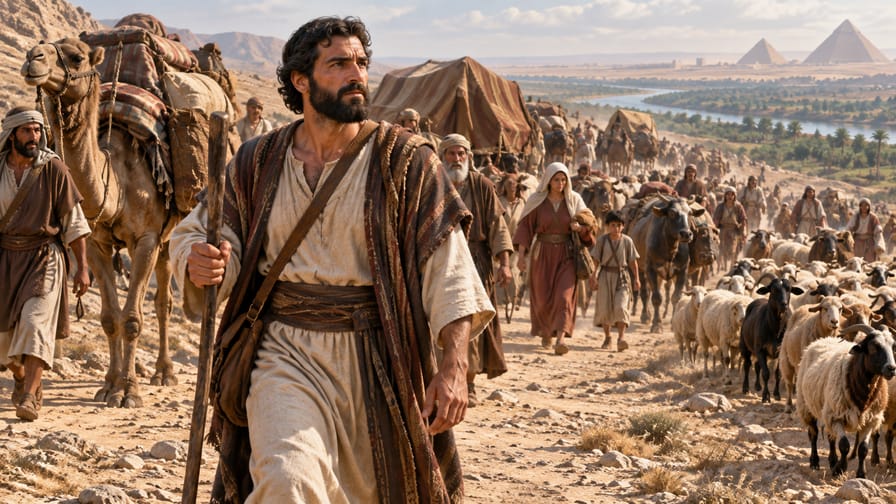
Jachin is one of the grandsons of the patriarch Jacob through his second son, Simeon. He appears in the list of Jacob's household who went down to Egypt (Genesis 46:10), in the record of the heads of the fathers' houses given just before the genealogy of Moses and Aaron (Exodus 6:15), and in the census taken on the plains of Moab, where he is named as the ancestor of the clan of the Jachinites (Numbers 26:12). In the Simeonite genealogy of Chronicles he appears to be called Jarib (1 Chronicles 4:24).
Scripture tells us almost nothing about Jachin as an individual. No word of his is recorded, no deed, no age, no wife or children by name. What the Bible does preserve is his place in the family of Israel: he is a son of Simeon, a grandson of Jacob and the head of a clan that continued for generations within the tribe of Simeon. An honest study of him must begin by admitting this silence and by resisting the temptation to fill it with imagination.
Even so, his name is not there by accident. The genealogies of Genesis, Numbers and Chronicles show how God kept his promise to make Jacob's family a great people, and Jachin is one of the links in that chain. Studying him helps us read these lists as what they are: the record of a faithful God working through ordinary names across the centuries.
1. Etymology and meaning of the name
The Hebrew form is יָכִין (Yakhin). It is built on the root kun (כון), which carries the ideas of being firm, standing fast and establishing. The form is a verb in the imperfect, so the name is usually understood as “he establishes” or “he will establish”. Many Hebrew names of this shape are shortened forms of a sentence with God as the subject, so the full sense may have been “God establishes”. This is a reasonable hypothesis, but the text itself gives only the short form.
The same word later became the name of one of the two bronze pillars Solomon set up at the porch of the temple (1 Kings 7:21; 2 Chronicles 3:17). There is no connection between the pillar and Simeon's son beyond the shared meaning of the word.
In 1 Chronicles 4:24 the list of Simeon's sons has Jarib (יָרִיב, Yariv, usually understood as “he contends” or “he pleads a cause”) in the position where the other lists have Jachin. Most interpreters take Jarib to be the same person, either as an alternative name or as the result of a difference in the transmission of the text. The exact reason for the difference cannot be determined with certainty.
2. Historical context and biblical narrative
2.1 Family origin and genealogy
Jachin's father, Simeon, was the second son of Jacob and Leah (Genesis 29:33). Simeon is remembered for his violent vengeance, together with Levi, on the men of Shechem (Genesis 34:25-31), for being held as a hostage in Egypt while his brothers returned to Canaan (Genesis 42:24), and for the stern words of Jacob at the end of his life: the anger of Simeon and Levi would lead to their being divided and scattered in Israel (Genesis 49:5-7).
Genesis and Exodus list six sons of Simeon, with Jachin as the fourth (Genesis 46:10; Exodus 6:15). The later lists in Numbers and Chronicles have five names, and some names appear in slightly different forms (Numbers 26:12-13; 1 Chronicles 4:24). Jachin, or Jarib, is present in every one of these lists. The Bible does not name his mother, his wife or any of his descendants individually.
2.2 Main events
The only event in which Jachin takes part is the descent of Jacob's family into Egypt during the famine. God had spoken to Jacob at Beersheba, telling him not to be afraid to go down to Egypt, because there he would make him into a great nation (Genesis 46:3). The list that follows, which includes Jachin, records the household that made that journey, seventy persons in all when Joseph's family is counted (Genesis 46:26-27).
From that point on Jachin is present only through his descendants. In the second census in the wilderness, taken on the plains of Moab near the end of the forty years, the tribe of Simeon is organized by clans, and one of them is the clan of the Jachinites (Numbers 26:12). The whole tribe then numbered 22,200 men (Numbers 26:14), far fewer than the 59,300 counted at the first census (Numbers 1:23). The text does not explain the decline. Some connect it with the plague after the sin at Baal-peor, in which a Simeonite leader named Zimri was directly involved (Numbers 25:6-14), but this is an inference, not a statement of the text.
After the conquest, Simeon received its inheritance in the midst of the territory of Judah (Joshua 19:1-9), and the Chronicler records the towns and later movements of Simeonite families (1 Chronicles 4:24-43). The Jachinites presumably shared this history, although they are not mentioned by name after Numbers.
3. Character and role in the biblical narrative
Because Scripture records nothing Jachin said or did, we cannot describe his personality, his faith or his failings. Anything more would be invention. What we can describe is his role. Jachin functions in the Bible as a founder: the man from whom a recognized clan of Israel took its name. When later Simeonites identified themselves, part of their identity was being “of Jachin”.
This role matters in the structure of the Pentateuch. The lists in Genesis 46, Exodus 6 and Numbers 26 are not decorative. They mark the transition from a single family to an organized people, and they prepare for the division of the land by tribes and clans (Numbers 26:52-56). Jachin is one of the names through which that transition is documented.
4. Theological significance
4.1 The promise kept in the genealogies
God had promised Abraham descendants beyond counting (Genesis 15:5) and repeated the promise to Jacob as he went down to Egypt (Genesis 46:3). The appearance of a clan of Jachinites in Numbers 26 is a small but concrete sign that the promise was being kept. The grandson who entered Egypt as part of one household became the head of a clan that stood at the edge of the promised land.
4.2 Judgment and grace in the tribe of Simeon
Jachin belonged to a tribe that lived under the words of Genesis 49:7. Its inheritance scattered within Judah (Joshua 19:1, 9) and its absence from the blessing of Moses (Deuteronomy 33) show that those words were not empty. Yet Simeon was never erased from Israel. The Simeonite genealogies were still preserved by the Chronicler (1 Chronicles 4:24-43), and the tribe appears among the sealed servants of God in Revelation 7:7. The family of Jachin stands within this pattern: discipline was real, but God did not abandon the people he had called.
4.3 Not to be confused with
Others bear the same name. A priest named Jachin appears among those who lived in Jerusalem after the exile (1 Chronicles 9:10; Nehemiah 11:10), and the twenty-first priestly division in the time of David fell to Jachin (1 Chronicles 24:17). The name was also given to the right-hand bronze pillar of Solomon's temple (1 Kings 7:21; 2 Chronicles 3:17). None of these is the son of Simeon.
5. Legacy and canonical references
Jachin, son of Simeon, is named in four passages. In Genesis 46:10 he is listed among the sons of Simeon who went down to Egypt with Jacob. In Exodus 6:15 he appears again among Simeon's sons in the record of the heads of the fathers' houses. In Numbers 26:12 he is the ancestor of the clan of the Jachinites in the census on the plains of Moab. In 1 Chronicles 4:24, where Simeon's sons are listed once more, the name Jarib stands in his place and is generally identified with him.
His legacy is his clan. The Bible does not tell us whether any of his descendants became well known, but it does record that the Jachinites were counted, numbered among the people of God and included in the division of the land that God had promised.
6. Application for today
Jachin reminds us that most of God's people live and die without a recorded story. Their names may survive only in a list, or not at all. Yet they are not forgotten by God. The Lord who counted the clans of Simeon also knows those who are his (2 Timothy 2:19), and in Christ their names are written in the book of life (Philippians 4:3; Revelation 21:27).
His name also points beyond itself. “He establishes” is a fitting confession for the believer. We do not establish ourselves; it is God who establishes us in Christ (2 Corinthians 1:21). A life that seems small, faithful in ordinary things and unnoticed by history, is not wasted when it rests on the God who keeps his promises across generations. Like Jachin's clan, we belong to a people carried by grace toward an inheritance we did not earn.
Finally, the history of Simeon's tribe invites sober reflection. Sin has consequences that can reach children and grandchildren, as Jacob's words about Simeon show. But the story does not end there. The same God who disciplines also preserves and restores. In Christ, in whom all the promises of God find their Yes (2 Corinthians 1:20), no believer is merely a name in a list: each one is known, kept and established.