


Huppim
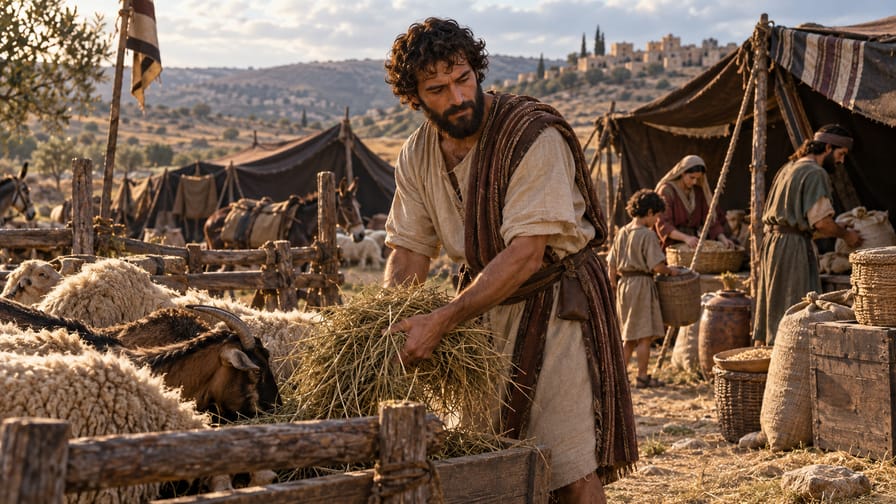
The figure of Hupim, though briefly mentioned in the Hebrew Scriptures, offers a valuable starting point for a profound biblical and theological analysis. His presence in the genealogical records of Israel, specifically in the tribe of Benjamin, underscores the meticulous divine attention to the preservation of the lineage and the fulfillment of covenantal promises. From an evangelical Protestant perspective, the inclusion of Hupim in the sacred canon is not accidental, but serves as a testament to God's sovereignty over history and the continuity of His redemptive plan, culminating in Christ Jesus.
This study will examine Hupim through onomastic, historical, characterological, and theological lenses, seeking to extract the broader meaning of his existence within the tapestry of biblical revelation. The analysis will focus on the inerrant authority of the Bible, exegetical precision, and typological relevance, as is characteristic of Reformed and conservative evangelical theology. Even an apparently secondary character like Hupim contributes to the understanding of God's faithfulness and the history of salvation.
1. Etymology and meaning of the name
The name Hupim (Hebrew: חֻפִּים, Ḥuppîm) appears in the list of descendants of Benjamin who went to Egypt with Jacob, as recorded in Genesis 46:21. The exact etymology of the name is a subject of some discussion among Hebraists, but Semitic roots often reveal meanings that can illuminate the context or destiny of the named individual.
One possible derivation for Ḥuppîm is from the root חפף (ḥāpap), which can mean "to cover," "to protect," or "to hide." In this sense, the name could connote "those who cover," "those who protect," or "coverings." While this interpretation is speculative, it aligns with the idea of clans or families providing covering or security within Israel's tribal structure.
It is crucial to note that the name Hupim is often associated with textual and orthographical variations in other biblical passages, which complicates exact identification. In Genesis 46:21, he is listed as one of the sons of Benjamin, alongside Muppim. In Numbers 26:39, in the genealogy of the tribe of Benjamin, we find the "clans of Shupham" (שֻׁפָם, Shūfām) and the "clans of Hupham" (חוּפָם, Ḥūfām), which are likely variants of Hupim and Muppim.
Even more complex is the record in 1 Chronicles 7:12, where "Shuppim" (שֻׁפִּים, Shuppîm) and "Huppim" (חֻפִּים, Ḥuppîm) are mentioned as sons of Ir (or Iri), a descendant of Benjamin. These onomastic variations, such as Muppim (מֻפִּים), Shuppim (שֻׁפִּים), and Shephupham (שְׁפוּפָם) in addition to Hupim, suggest a confusion or evolution in the transmission of names over time, but point to the same family lineage.
The theological significance of a name like Hupim, with its variations, lies in the biblical emphasis on the preservation of genealogies. Each name, even if obscure, attests to God's faithfulness in maintaining the promised seed and the covenant people. Textual variation, far from undermining biblical authority, reflects the nuances of textual transmission and the complexity of ancient records, which evangelical scholars approach with exegetical rigor.
2. Historical context and biblical narrative
The mention of Hupim is situated within the crucial context of the formation of the nation of Israel and the fulfillment of God's promises to Abraham. He is first introduced in Genesis 46:21, at the time of Jacob and his family's descent into Egypt. This event marks the beginning of Israel's period as a numerous family that would become a great nation, as foretold to Abraham in Genesis 12:2 and 15:5.
The precise historical period is around the 18th century BCE, when Jacob's family, consisting of seventy souls, entered Egypt to escape famine. The political and social context was that of the Egyptian Empire, under God's providence, who had raised Joseph to a position of power to preserve his family's lives (Genesis 45:7-8). The migration to Goshen, a fertile region, allowed Jacob's family to prosper and multiply.
Hupim is listed as one of the sons of Benjamin, the youngest son of Jacob and Rachel. His genealogy is vital for understanding the tribal structure of Israel. In Genesis 46:21, Benjamin's sons are named Bela, Becher, Ashbel, Gera, Naaman, Ehi, Rosh, Muppim, Huppim, and Ard. This list establishes the basis for the clans that would form the tribe of Benjamin.
The key biblical passages where Hupim and its variations appear are Genesis 46:21, Numbers 26:39 (as Shupham/Hupham), and 1 Chronicles 7:12 (as Shuppim/Huppim). The repetition and variation of these mentions in different biblical books, written at distinct times, confirm the importance of maintaining the genealogical record for Israel's identity, especially for land distribution and military organization.
The geography related to Hupim is, initially, the land of Canaan, where his father Benjamin was born, and later the land of Goshen in Egypt, where the family settled and multiplied. Later, the descendants of Hupim and his brothers settled in the tribal inheritance of Benjamin, a strategic region between the tribes of Ephraim and Judah, which included cities like Jerusalem (part of the border), Gibeah, and Ramah.
Hupim's relationship with other biblical characters is primarily through his family: his grandfather Jacob, his father Benjamin, and his brothers. Although there are no specific narratives about his interactions, his existence as part of the "house of Jacob" or "Israel" connects him directly to the patriarchal history and the founding of the nation. He represents a generation that experienced God's providence in Egypt before the Exodus.
3. Character and role in the biblical narrative
Due to the concise nature of the mentions of Hupim, the Bible does not offer explicit details about his personal character, virtues, flaws, or significant actions. He is, first and foremost, a name in a genealogical list, a link in the chain of God's redemptive history. However, his inclusion in these lists is not without significance for analyzing his role.
Hupim's main "role" in the biblical narrative is that of a progenitor. He is part of Jacob's "seed," which God promised to multiply and through whom all the families of the earth would be blessed (Genesis 28:14). His existence and offspring contributed directly to the demographic growth of Jacob's family in Egypt, transforming it from a clan into a numerous tribe.
The absence of a personal narrative for Hupim does not diminish his theological importance. On the contrary, it reminds us that God's faithfulness often manifests through "ordinary" individuals, whose lives, though not recorded in great deeds, are essential for the fulfillment of divine purposes. Hupim is an example of how every member of the covenant people, even the most obscure, has a place in God's plan.
His calling, implicit in his role as a son of Benjamin, was to contribute to the continuity of the lineage. In Ancient Near Eastern culture and biblical theology, having offspring was a blessing and a fundamental part of the covenant (Genesis 1:28). The proliferation of Jacob's family was a visible testament to God's blessing upon His people.
Thus, Hupim's "character" can be inferred as that of a man who, presumably, lived in obedience to the familial and tribal norms of his time. He was part of a community that, by divine providence, was preserved and prepared to become a nation under Moses' leadership. His life, though silent in the Scriptures, was a pillar for the formation of the tribe of Benjamin.
There is no character development for Hupim, as there is no narrative to be developed. He exists as a fixed point in the genealogy, a name that ensures the integrity of the Benjamite lineage. His inclusion in the genealogies of Genesis, Numbers, and Chronicles underscores the importance God attaches to the order and continuity of His chosen people.
4. Theological significance and typology
The figure of Hupim, despite his narrative obscurity, possesses a profound theological significance within redemptive history and the progressive revelation of God. He is a link in the genealogical chain that demonstrates God's unwavering faithfulness to His covenants, particularly the Abrahamic covenant.
The inclusion of Hupim in the genealogies serves as proof of God's meticulous providence in preserving the "seed" through which the Messiah would come. Each name in these lists, however briefly mentioned, is evidence of divine care in maintaining the unbroken lineage. Reformed theology emphasizes God's sovereignty over all details of history, and the genealogies are a testament to this.
Although Hupim is not a direct type of Christ in the classical sense of prefiguring a specific office or event, his existence contributes to the typology of the messianic lineage. The preservation of the tribe of Benjamin, of which Hupim is a progenitor, is part of the larger history that points to the coming of Christ. God's faithfulness in maintaining Jacob's offspring is a foreshadowing of God's faithfulness in fulfilling His promise of a Redeemer.
Hupim's connection to central theological themes is indirect, yet significant. His presence in the genealogies highlights the importance of God's **covenant** with Abraham, which promised numerous offspring (Genesis 17:6). Hupim's existence is a fulfillment of that promise, demonstrating God's **faithfulness** in keeping His word throughout the generations.
Furthermore, the inclusion of names like Hupim in the genealogies illustrates the doctrine of **sovereign grace**. God chose and preserved a family, not by inherent merit, but by His free and sovereign choice. Each name in Genesis 46 represents an individual who was saved from famine and brought to Egypt by God's providence through Joseph, setting the stage for the Exodus and the formation of the nation of Israel.
The genealogies, including that of Hupim, serve as a "map" of salvation history, culminating in Jesus Christ (Matthew 1:1-17 Luke 3:23-38). Although Hupim is not directly in the main Davidic/messianic lineage, he is part of covenant Israel, the people through whom the messianic promise would be realized. His existence is a piece of the larger puzzle that reveals God's redemptive plan.
5. Biblical-theological legacy and canonical references
Hupim's legacy lies not in great deeds or teachings, but in his canonical function as a vital link in the genealogy of Benjamin. His mentions in Genesis 46:21, Numbers 26:39, and 1 Chronicles 7:12, though brief and with variations, are crucial for the integrity of biblical records and for understanding Israel's tribal structure.
The repetition of Benjamin's genealogy in the book of Numbers, in the context of the desert census, is fundamental for military organization and land distribution in the Promised Land. The presence of Hupim (or its variants) ensures that the Benjamite lineage is fully accounted for, demonstrating divine order in the formation of His people (Numbers 1:1-4).
The book of Chronicles, written in a post-exilic period, emphasizes the importance of genealogies for restoring the identity and heritage of the people of Israel. For the Chronicler, lists of names like that of Hupim were essential for reconnecting the restored Israel to its covenantal roots and for the continuity of worship and messianic hope. Genealogical precision was a testament to God's faithfulness.
In the Jewish interpretive tradition, genealogies are seen as a record of God's blessing and the continuity of the chosen people. In the Christian tradition, especially in Reformed and evangelical theology, the inclusion of figures like Hupim in the genealogies is seen as evidence of the inspiration and inerrancy of Scripture, as well as God's sovereignty over history. Each name, however insignificant it may seem, is divinely preserved.
Evangelical commentators like John Gill and Matthew Henry, when addressing genealogies, highlight God's providence in preserving the families of Israel, even amidst captivities and dispersions. They see in these lists the basis for the promise of Abraham's seed and, ultimately, of Christ. The precision of the records is seen as a precursor to the precision of the messianic lineage in Jesus.
Hupim's importance for understanding the biblical canon lies in how he reinforces the cohesion and intentionality of Scripture. The Bible is not a random collection of texts, but a unified narrative of redemption. Even seemingly mundane genealogical details, such as the mention of Hupim, serve to solidify the historical and theological foundation upon which God's plan unfolds, pointing to the fullness of time in Christ Jesus (Galatians 4:4).