


Hanan
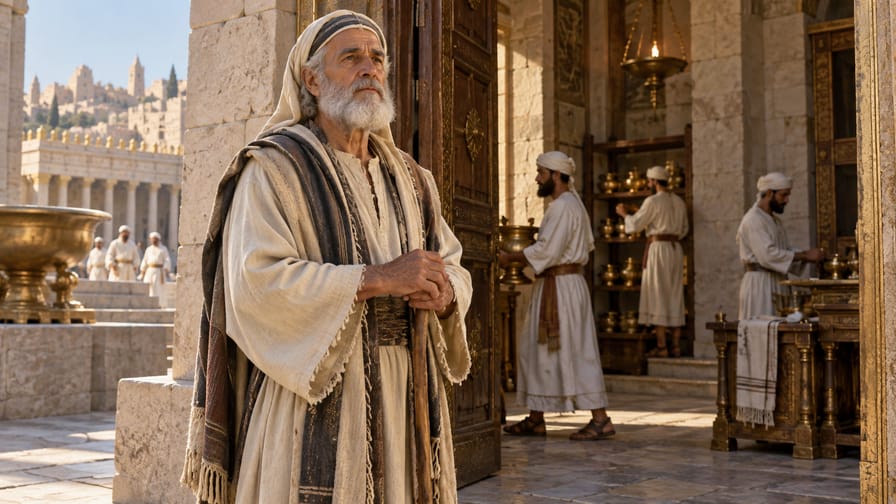
Hanan, son of Igdaliah, is mentioned only once in the Bible, in Jeremiah 35:4. He is described as “the man of God”, and his sons had a chamber in the house of the LORD in Jerusalem. It was in this room that the prophet Jeremiah brought the Rechabites and set wine before them, in one of the most vivid object lessons of his ministry.
Scripture tells us almost nothing else about him. It records no words or deeds of his, and no dates of his birth or death. Yet the one verse that names him places him in the temple during the last decades of the kingdom of Judah and attaches to him a title that the Old Testament reserves for those who served God in a special way.
This article looks at that verse with care, separates what the text says from what interpreters have suggested, and asks what this brief mention can teach believers today.
1. Etymology and meaning of the name
The Hebrew name חָנָן (Ḥānān) comes from the verb ḥānan, “to be gracious, to show favor”. It means “gracious” or “he has been gracious”, and it is probably a shortened form of names such as Hananiah (Ḥănanyāh, “the LORD has been gracious”) or Johanan. His father's name, Igdaliah (Yigdalyāhû), means “the LORD is great” or “the LORD will make great”. Both names are small confessions of faith in the God of Israel.
Hanan was a common name, and several other men in the Old Testament bear it (1 Chronicles 8:23, 38; 11:43; Ezra 2:46; Nehemiah 8:7; 10:10, 22, 26; 13:13). They are different people, from other families and periods. The Hanan of Jeremiah 35 is identified only by his father, Igdaliah, and by the title “man of God”.
2. Historical context and biblical narrative
2.1 Family origin and genealogy
The text gives only two family details: Hanan was the son of Igdaliah, and he had sons who were known by his name. It does not mention his tribe, and it does not say whether he was a priest or a Levite. Any claim about his lineage beyond this would be guesswork.
The expression “the sons of Hanan” most naturally refers to his children. Some interpreters have suggested that it could instead mean a group of disciples, in the way the Old Testament speaks of “the sons of the prophets” (2 Kings 2:3, 5). This is a hypothesis; the text does not settle the question.
The title “man of God” (ʼîš hāʼĕlōhîm) is significant. In the Old Testament it is given to Moses (Deuteronomy 33:1), Samuel (1 Samuel 9:6-10), Elijah (1 Kings 17:18, 24), Elisha (2 Kings 4:9), David (Nehemiah 12:24, 36) and other prophets, some of them unnamed (1 Kings 13:1). It usually marks a prophet or someone recognized as a special servant of God. Most translations apply the title to Hanan. The Hebrew word order, however, allows it to refer to Igdaliah, and a few translations read it that way. Either way, the family was associated with a person known for devotion to God.
2.2 Main events
Jeremiah 35 is set “in the days of Jehoiakim the son of Josiah, king of Judah” (Jeremiah 35:1), when the armies of Nebuchadnezzar had forced the Rechabites to leave their tents and take refuge in Jerusalem (Jeremiah 35:11). The LORD told Jeremiah to bring them into one of the chambers of the temple and offer them wine (Jeremiah 35:2).
Jeremiah took Jaazaniah and all the house of the Rechabites and brought them “into the chamber of the sons of Hanan the son of Igdaliah, the man of God, which was near the chamber of the officials, above the chamber of Maaseiah the son of Shallum, keeper of the threshold” (Jeremiah 35:3-4). The temple had many such rooms around its courts, used for storage, meetings and the work of priests and officials (1 Chronicles 28:12; Nehemiah 13:4-9). The location is precise: next to the room of the princes and above the room of a keeper of the threshold, an important office in the temple (2 Kings 25:18; Jeremiah 52:24). This suggests that the family of Hanan had a recognized place in the temple complex.
In that room Jeremiah set bowls of wine before the Rechabites, but they refused, because their ancestor Jonadab the son of Rechab had commanded them not to drink wine, build houses or plant vineyards (Jeremiah 35:5-10; compare 2 Kings 10:15-23). God then used their faithfulness to a human command to rebuke Judah, which had not listened to his repeated call (Jeremiah 35:12-17), and he promised that Jonadab would never lack a man to stand before him (Jeremiah 35:18-19).
The text does not explain why this particular room was chosen. Under Jehoiakim, Jeremiah faced hostility from priests, prophets and the king himself (Jeremiah 26:7-11; 36:23-26). Some suggest that the sons of Hanan were sympathetic to the prophet and opened their room to him, as the chamber of Gemariah the son of Shaphan was later used by Baruch to read the scroll of Jeremiah (Jeremiah 36:10). This is a reasonable hypothesis, but the Bible does not state it.
3. Character and role in the biblical narrative
Because the Bible records nothing Hanan said or did, we cannot describe his personality or his feelings. What we have is a single description: he was known as a man of God. That phrase implies a reputation for belonging to God and serving him, probably in a prophetic way.
His role in the narrative is to provide the setting. The chamber of his sons became the stage for a living parable. Inside the house of the LORD, in a room linked to a man of God, the obedience of the Rechabites exposed the disobedience of the people of Judah. Hanan himself does not speak in the story, but his name gives the scene its place and its weight.
4. Theological significance
4.1 Faithful servants in a time of decline
The reign of Jehoiakim was a time of injustice and spiritual rebellion (Jeremiah 22:13-17; 2 Kings 23:36-37). The mention of a man of God and of his sons in the temple reminds us that even in such times the LORD kept faithful people, as he had in the days of Elijah (1 Kings 19:18; Romans 11:4-5).
4.2 Obedience and the word of God
The chamber of the sons of Hanan is where the central lesson of Jeremiah 35 was taught: if a family could honor the command of a human ancestor for generations, how much more should God's people obey the word of their Lord (Jeremiah 35:14). The chapter joins judgment on disobedience with a promise of mercy to the faithful (Jeremiah 35:18-19).
4.3 From the temple chambers to Christ
A few years later the temple and all its rooms were burned by the Babylonians (Jeremiah 52:13). The Bible does not make Hanan a type of Christ, and we should not force one. The wider biblical story, however, shows that the true meeting place between God and his people is not a room in a building but Jesus himself, who spoke of the temple of his body (John 2:19-21), and through him the church becomes the dwelling of God by the Spirit (1 Corinthians 3:16; Ephesians 2:19-22).
5. Legacy and canonical references
Hanan the son of Igdaliah appears only in Jeremiah 35:4, where the chamber of his sons is identified as the place where Jeremiah received the Rechabites. The surrounding chapter, Jeremiah 35:1-19, gives the context of that meeting. He is not mentioned anywhere else in the Old Testament or in the New Testament, and the Bible does not tell us what became of him or of his sons when Jerusalem fell.
His legacy is small in words but meaningful: a name, a father, a room in the house of God and a title that summarizes a life. Few people in Scripture are remembered by so short a description, and few descriptions are more honorable.
6. Application for today
Hanan's life is summarized for us in three words: “the man of God”. We do not know his achievements, but we know how he was remembered. That invites a simple question: if our lives were reduced to one phrase, what would it be? The New Testament applies the same expression to believers shaped by Scripture and called to flee evil and pursue righteousness, faith, love, steadfastness and gentleness (1 Timothy 6:11; 2 Timothy 3:16-17).
His family's room also became a place where God's word was heard. We are not told that they did anything remarkable; they simply had a space, and that space served God's purpose on the day his prophet needed it. Our homes, time and resources can be offered in the same way, so that the word of God is spoken and obeyed.
Finally, the scene in the chamber of the sons of Hanan calls us to wholehearted obedience. The Rechabites were faithful to a human father. Christians have a greater reason for faithfulness: a Father who has spoken through his Son and who has made us his temple by his Spirit (Hebrews 1:1-2; 1 Corinthians 6:19-20).