


Hananiah
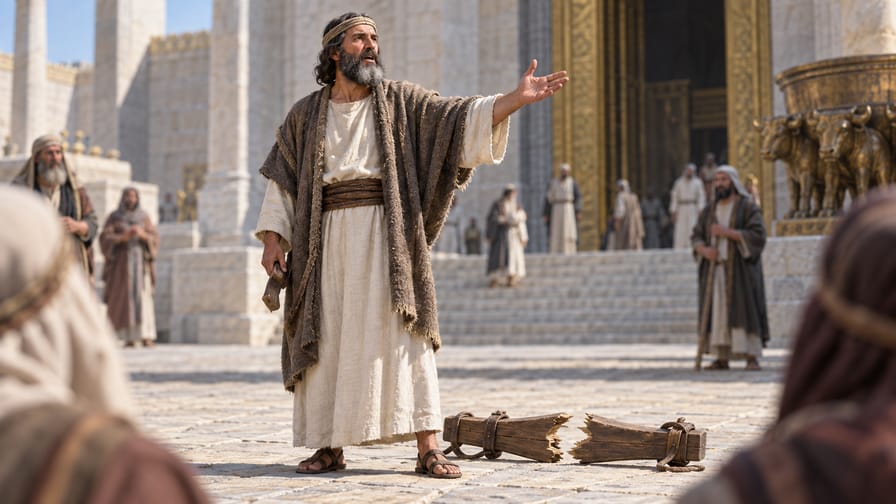
The figure of Cananias, though not one of the most prominent in the Hebrew Scriptures, offers valuable insights into the organization of Levitical worship and the importance of adoration in Israel. His mention, primarily in the book of 1 Chronicles, highlights a crucial period in Israel's history: the reign of David and the centralization of worship in Jerusalem.
The analysis of Cananias, from a Protestant evangelical perspective, emphasizes God's sovereignty in choosing and empowering His servants, the necessary reverence in worship, and the progressive revelation of the redemptive plan. He serves as an example of dedication and skill in sacred service, preparing the way for a deeper understanding of worship in Christ.
1. Etymology and Meaning of the Name
The name Cananias, transliterated from Hebrew, appears as Kenanyah (כְּנַנְיָה) or Kenanyahû (כְּנַנְיָהוּ). The longer form, Kenanyahû, is a common theophoric element in Hebrew names, indicating a connection with the divine name Yahweh (YHWH).
The etymological root of the name is kanan (כָּנַן), which means "to establish," "to confirm," "to direct," or "to prepare." Consequently, the literal meaning of Cananias is "Yahweh establishes," "Yahweh directs," or "Yahweh confirms." This meaning is deeply theological and reflects the belief in divine sovereignty over the lives and purpose of individuals.
This onomastic meaning is particularly relevant to the role that Cananias played. As one "established" or "directed" by Yahweh, he was empowered for a vital function in the organization of worship, especially in music and the transport of the Ark of the Covenant, as narrated in 1 Chronicles 15.
There are no other prominent biblical figures with the exact name of Cananias. It is important not to confuse him with phonetically similar names, such as Kenani (Qenani), who appears in Nehemiah 9:4 as a Levite, but with a distinct etymological root.
The theological significance of the name Cananias lies in its affirmation of divine agency. It suggests that the capacity and direction for sacred service come not from intrinsic human ability, but from God's provision and empowerment. This resonates with evangelical theology that emphasizes grace and the empowerment of the Holy Spirit for ministry.
2. Historical Context and Biblical Narrative
Cananias is mentioned in the context of David's reign, specifically during the period when the king sought to bring the Ark of the Covenant to Jerusalem and establish formal worship in the new capital. This period, approximately between 1010 and 970 BC, was a time of great political and religious consolidation for Israel.
The political context was the unification of the tribes under David and the establishment of Jerusalem as a political and religious center. Socially, there was a clear hierarchical structure, with the king at the top, followed by the priests and Levites, who performed crucial functions in worship and community life. Religion and politics were intrinsically linked.
Cananias' genealogy identifies him as a Levite, although his specific lineage is not detailed beyond that. However, his function places him among the Levitical clans responsible for the service of the tabernacle and, later, the temple. The Levites, descendants of Levi, were set apart by God for sacred service, as described in Numbers 3-4.
The main events of Cananias' life are centered on his participation in the transport of the Ark of the Covenant. After David's initial disastrous attempt to transport the Ark on an oxcart, resulting in Uzzah's death (2 Samuel 6:6-7 1 Chronicles 13:9-10), the king sought to carry out the transport according to divine instructions, using the Levites to carry the Ark on their shoulders (Exodus 25:14 Numbers 4:15).
The key biblical passages where Cananias appears are 1 Chronicles 15:22 and 1 Chronicles 15:27. In 1 Chronicles 15:22, he is described as the "chief of the Levites in music, because he was skillful in it" (sar-hammas̤śaʾ bammaśśaʾ kî mēḇîn hûʾ). This description highlights his dual function: leading the music and being a master in the transport or "burden" (masśaʾ).
In 1 Chronicles 15:27, his role is reaffirmed, where he, along with David and other Levites, wore robes of fine linen, actively participating in the festive procession. The geography related to Cananias includes Kiriath-Jearim (where the Ark was before being moved) and Jerusalem, the city to which the Ark was finally transported and where worship would be centralized.
His relationships with other important biblical figures include King David, who appointed him to this crucial function, and the other Levites and priests involved in the organization and execution of worship. Cananias was an integral part of the team that sought to restore order and reverence in the worship of Yahweh, under the leadership of David, the "man after God's own heart" (1 Samuel 13:14).
3. Character and Role in the Biblical Narrative
The analysis of Cananias' character, as revealed in the Scriptures, highlights his competence and dedication to God's service. The description in 1 Chronicles 15:22, "because he was skillful in it" (kî mēḇîn hûʾ), indicates not only skill, but also discernment and deep understanding of his task, both musical and ritualistic.
Among his virtues and spiritual qualities, skill and wisdom are notable. He was not only a talented musician but a leader capable of directing and instructing other Levites in the complex arrangement of music and sacred transport. This instructional capacity was vital to ensure that worship was performed appropriately and reverently, in contrast to the previous error in transporting the Ark.
The Scriptures do not document specific sins, weaknesses, or moral failures of Cananias. His mention is purely positive, focusing on his effective contribution to worship. This presents him as a model of a faithful and competent servant in the Old Testament context.
His specific calling and function were multifaceted: he was the chief of the Levites responsible for music and also for the transport of the Ark. Music was an integral part of Old Testament worship, with songs and instruments being used to praise God and accompany rituals, as seen in many Psalms.
The role played by Cananias was that of a liturgical leader and instructor. He ensured that the music was performed with excellence and that the transport of the Ark was done according to Mosaic law. His leadership was crucial for the success of David's second attempt to bring the Ark to Jerusalem, an event of immense theological and national importance.
Cananias' significant actions include his active participation in the Ark procession, dressing in fine linen alongside David (1 Chronicles 15:27), which denotes his position of honor and his dedication to service. His skill and wisdom were key decisions for David, who sought to establish worship that would please God and bless the nation.
Although the narrative does not detail "character development" in the modern sense, Cananias' appointment and the description of his skill underscore David's growing maturity in organizing worship. David learned from Uzzah's error and sought counsel and wisdom to establish ordered worship, and Cananias was a fundamental piece in that process.
4. Theological Significance and Typology
Cananias' role in Israel's redemptive history is significant, though indirect. He participates in God's progressive revelation by helping to establish ordered and reverent worship in Jerusalem, which was essential for the nation's spiritual life and the maintenance of the covenant. The transport of the Ark to Jerusalem was a fundamental step in the centralization of worship and the preparation for the construction of the temple.
The figure of Cananias, as a leader who facilitates God's presence (symbolized by the Ark) among His people through appropriate worship, can be seen as a prefiguration or Christocentric typology. He points to Christ in several ways. Firstly, Cananias, in his skill and wisdom in directing worship, prefigures Christ as the perfect High Priest (Hebrews 4:14-16), who establishes true worship "in spirit and truth" (John 4:24).
His function of ensuring the correct transport of the Ark, the place of God's presence, can be seen as a type of Christ, who not only brings God's presence to the world through His incarnation (John 1:14), but also establishes the way for believers to enter God's presence through His sacrifice (Hebrews 10:19-22). He is the true "director" of access to God.
The covenants and promises related to Cananias are indirect, linked to the Davidic Covenant (2 Samuel 7), which promised an eternal dynasty and an established kingdom. The organization of worship by David, with the help of figures like Cananias, was part of the foundation of that kingdom and its relationship with God.
There are no direct quotes or references to Cananias in the New Testament. However, the principles he embodies – the importance of ordered worship, excellence in service to God, and the need for reverence – are central themes in New Testament theology, which exhorts believers to offer their bodies as a living and holy sacrifice, a spiritual worship (Romans 12:1).
The connection with central theological themes is clear: obedience to divine law (in the transport of the Ark), faith in God's provision for worship, and the importance of worship as a means of communion with God. Uzzah's error and the subsequent correction with Cananias' appointment illustrate the seriousness of God's judgment on disobedience and His grace in restoring the correct path.
In summary, Cananias, in his role of ensuring proper worship and the transport of the Ark, points to Christ as the fulfillment of all worship. Christ is the true Temple, the true Ark of the Covenant (in whom the fullness of divinity dwells bodily, Colossians 2:9), and the only one who established a new and perfect form of worship under the New Covenant.
5. Biblical-Theological Legacy and Canonical References
The mentions of Cananias are exclusive to the book of 1 Chronicles (1 Chronicles 15:22, 27). Although he is not mentioned in other biblical books, his role reflects principles and practices that are widely addressed in the canon, especially in relation to worship and Levitical organization described in Leviticus and Numbers.
There are no literary contributions attributed to Cananias, such as authorship of books, Psalms, or epistles. His contribution lies in his example of faithful and competent service, which is an integral part of the historical narrative of the establishment of worship in Israel under David.
His influence on biblical theology lies in illustrating the importance of order, skill, and reverence in the worship of God. The narrative of Cananias reinforces the idea that God is not a God of confusion, but of peace and order (1 Corinthians 14:33, 40). This is fundamental to the theology of both the Old and New Testaments, which demands worthy and well-organized worship.
In the Jewish interpretive tradition, the organization of Levitical worship, including music and the transport of sacred objects, is seen as a model of dedication and holiness. Although Cananias is not a central figure, he fits into the valuing of Levitical service and music as an essential part of worship.
Intertestamental literature makes no specific mention of Cananias. However, it frequently reflects on the glory of the Temple and the importance of the priesthood and Levitical service, contexts in which Cananias' function would be implicitly valued.
In Reformed and evangelical theology, the treatment of Cananias, though brief, serves to reinforce the regulative principle of worship, which affirms that God is to be worshipped only in the way He Himself has commanded in His Word. David's correction of the Ark's transport, with the help of Levites like Cananias, is a classic example of the need for conformity to Scripture in all worship practices.
Cananias' importance for understanding the canon lies in his contribution to the narrative of David's reign, which is a focal point in salvation history. He helps to illustrate how David, a flawed king, nevertheless strove to honor God and establish a kingdom that prefigured the perfect kingdom of Christ. Cananias is a reminder of the value of every servant of God, even in seemingly minor roles, when fulfilled with excellence and dedication.