


Shuni
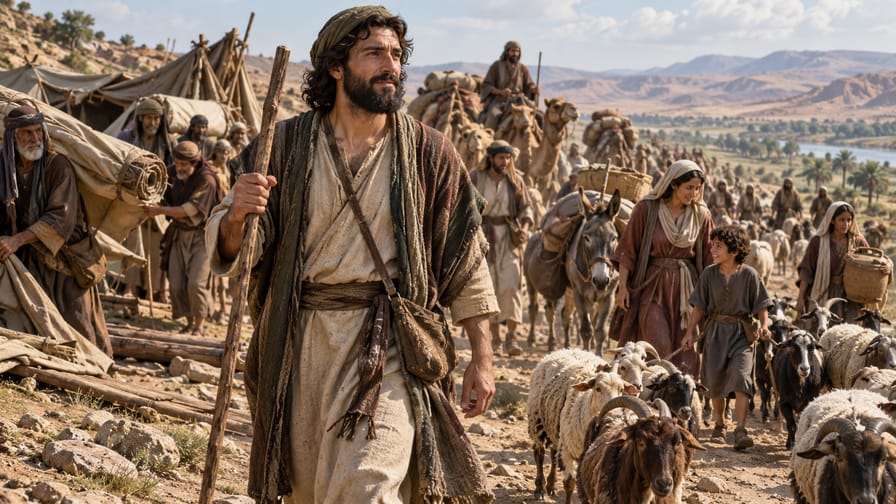
Shuni was a son of Gad and therefore a grandson of Jacob. His name appears in the list of Jacob's family who went down to Egypt (Genesis 46:16) and again in the census taken on the plains of Moab at the end of the wilderness years, where he is named as the founder of the clan of the Shunites within the tribe of Gad (Numbers 26:15).
That is all Scripture says about him directly. The Bible records no word, deed or detail of his life, and it would be wrong to invent one. Even so, his place in the genealogies is not meaningless. Through him and his brothers the promise made to Abraham took the shape of real families, and the clan that bore his name belonged to the Israel that left Egypt, crossed the wilderness and settled east of the Jordan.
This article sets out what can be affirmed with certainty, the context that helps to understand it and the lessons that such a brief mention can still teach the reader of the Bible.
1. Etymology and meaning of the name
The Hebrew name is Shuni (שׁוּנִי). In Numbers 26:15 the clan that descends from him is called ha-Shuni (הַשּׁוּנִי), “the Shunite”, a gentilic form that in Hebrew looks almost the same as the personal name. English versions render the clan as “the Shunites”.
The meaning of the name is uncertain. Unlike the names of Jacob's sons, which Genesis explains one by one, the names of Jacob's grandsons come without any explanation. Some older reference works proposed links with different Hebrew roots, but none of these proposals is secure, and it is better to admit that we do not know what the name meant to those who gave it. What is certain is that it was preserved with the same form in both passages where it appears, while the names of some of his brothers vary.
2. Historical context and biblical narrative
2.1 Family origin and genealogy
Shuni's father, Gad, was the seventh son of Jacob and the first son born to Zilpah, the servant Laban had given to Leah (Genesis 30:9-11). Leah named the child Gad, a word associated with good fortune, because she saw his birth as a sign of blessing. Gad's full brother was Asher (Genesis 30:12-13).
Genesis lists seven sons of Gad, and Shuni is the third of them (Genesis 46:16). The same seven appear in Numbers 26:15-17, each as the head of a clan, with small differences in the spelling of some names and one brother listed under a different name. Nothing is said about Shuni's mother, his wife or his children. The Bible does not give his age or any date connected with him.
2.2 Main events
The only event in which Shuni takes part is the migration of Jacob's family to Egypt. When the famine struck Canaan and Joseph invited his father to settle in the land of Goshen, God spoke to Jacob at Beersheba: “Do not be afraid to go down to Egypt, for there I will make you into a great nation” (Genesis 46:3). Shuni went down with his grandfather, his father and his uncles. The text counts him among the sixteen descendants of Zilpah (Genesis 46:18) and within the total of seventy persons of the house of Jacob who came into Egypt (Genesis 46:27).
After that the Bible is silent about him as an individual. The next time his name appears, centuries have passed, Israel has been enslaved and set free, and the people are camped on the plains of Moab by the Jordan. In the second census, the Lord commanded Moses and Eleazar to count the people by their clans, and there the Shunites appear as one of the seven clans of Gad (Numbers 26:1-4, 15). The tribe of Gad then numbered 40,500 men able to go to war (Numbers 26:18), fewer than the 45,650 of the first census (Numbers 1:24-25). The numbers of each clan are not given, so we do not know how large the Shunites were.
The Shunites shared in the history of their tribe. Gad, together with Reuben, asked Moses for the pasturelands east of the Jordan because they had many livestock, and received them on the condition that their fighting men would cross over and help conquer Canaan (Numbers 32:1-33). The Gadites kept their word (Joshua 4:12-13; 22:1-9), and their inheritance was described in Joshua 13:24-28. It is reasonable to suppose that the clan of the Shunites lived within that territory, but the Bible does not locate it specifically.
3. Character and role in the biblical narrative
The Bible does not describe Shuni's character. There is no speech, no action and no evaluation of him, positive or negative. Any attempt to describe his personality would be speculation, and a faithful study must say so plainly.
His role in the narrative is that of a link in the genealogy. The lists of Genesis 46 and Numbers 26 are not decoration. They show that the family which went down to Egypt as a small household of seventy became a people organized in tribes and clans, exactly as God had promised. Shuni stands at one of those points of transition: a grandson of Jacob who became the name of a clan.
4. Theological significance
4.1 The faithfulness of God in the genealogies
The two brief mentions of Shuni stand at the beginning and at the end of a long story. In Genesis 46 he is one of the few who go down to Egypt; in Numbers 26 his name identifies a clan of a people about to enter the promised land. Between the two lies the fulfillment of God's word to Jacob: “there I will make you into a great nation”. Shuni's name bears quiet witness that God did what he said.
4.2 Named before God
Scripture preserves the names of many people about whom it says almost nothing. This reminds us that God does not deal with his people as an anonymous mass. Through the prophet he says to Israel, “I have called you by name, you are mine” (Isaiah 43:1). The record of a name like Shuni is a small sign of that care, even if it should not be pressed to mean more than the text says.
4.3 The tribe in the blessings
Shuni's descendants belonged to a tribe that received specific words in Scripture. Jacob foretold that raiders would attack Gad, but that Gad would attack at their heels (Genesis 49:19), and Moses praised the tribe for carrying out the justice of the Lord with Israel (Deuteronomy 33:20-21). In Revelation twelve thousand are sealed from the tribe of Gad (Revelation 7:5). The Bible does not apply these words to the Shunites in particular, but they belonged to the people who received them.
5. Legacy and canonical references
Shuni is mentioned by name in only two passages. In Genesis 46:16 he appears among the sons of Gad who went down to Egypt with Jacob. In Numbers 26:15 he is named as the ancestor of the clan of the Shunites in the census on the plains of Moab. He does not appear in the list of Gadites in 1 Chronicles 5:11-17, which records other names from a later period. Those two verses are all the Bible says about him, and this article has sought not to add to them.
The Shunites should not be confused with the people of Shunem, a town in the territory of Issachar (Joshua 19:18). From there came Abishag the Shunammite (1 Kings 1:3) and the Shunammite woman who welcomed Elisha (2 Kings 4:8-37). The words sound alike in translation, but they have no connection with the son of Gad.
6. Application for today
Shuni teaches us something simple and important: faithfulness does not always leave a long record. Most believers will not have their stories told in books, and yet each one is known by name to God. A life lived in the ordinary course of a family, a work and a community is not wasted when it is lived within God's purpose.
His brief story also calls us to honesty in reading the Bible. It is tempting to fill silences with imagination, but reverence for Scripture means receiving what it says and not making it say more. The silence about Shuni points us away from the man and toward the God who keeps his promises across generations.
Finally, the genealogies remind us that God works through families and generations. What we pass on to our children and grandchildren matters. In Christ, all who believe become part of a larger family, and their names are written in heaven (Luke 10:20). That is a greater reason for joy than any fame on earth.