


Miriam
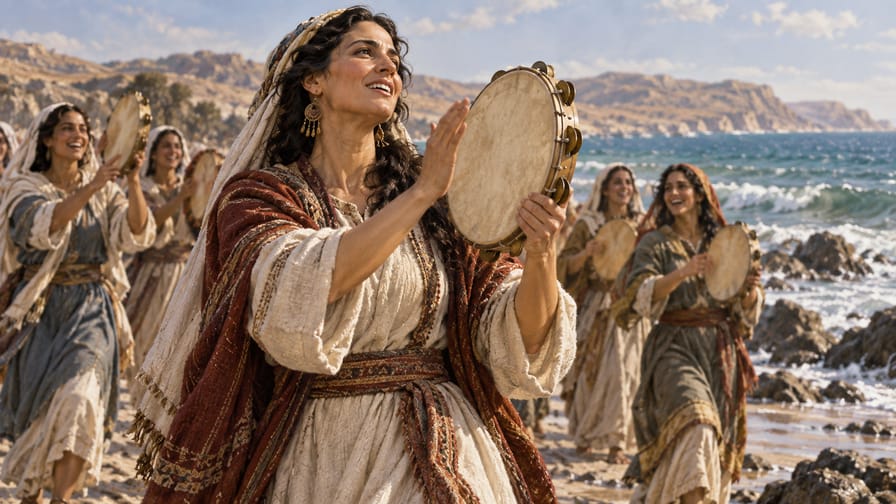
The figure of Miriam, prophetess and older sister of Moses and Aaron, emerges from the pages of the Old Testament as a complex and multifaceted personality, essential to the narrative of the Exodus and the formation of the nation of Israel. Her life, marked by acts of courage, leadership, and also by significant failures, offers rich insights for a deep biblical and theological analysis.
From a conservative evangelical Protestant perspective, the story of Miriam is viewed as a revelation of God's sovereignty in salvation history, of the importance of divinely instituted leadership, and of the consequences of disobedience. Her prophetic role and her position of co-leadership alongside her brothers highlight her as a woman of great influence and theological significance.
This study will examine the etymology of her name, her historical and narrative context, her character and role, her theological and typological significance, and her biblical-theological legacy, as revealed in the Scriptures and interpreted by the Reformed evangelical tradition.
1. Etymology and Meaning of the Name
The name Miriam, in Hebrew Miryam (מִרְיָם), is one of the oldest and most significant feminine names recorded in the Bible. Its etymology is a subject of debate among scholars, with various proposals offering different nuances for understanding its bearer and the context in which she lived.
One of the most widely accepted derivations connects Miryam to the Hebrew root marar (מָרַר), which means "to be bitter," "rebellious," or "obstinate." If this interpretation is correct, the name could mean "bitterness," "rebellion," or "she who is bitter," possibly in reference to the bitter slavery suffered by the Israelites in Egypt or even to an aspect of her own rebellious character later on.
Another popular theory suggests an Egyptian origin for the name, given the strong cultural influence of Egypt over the Israelites during the Exodus period. In this perspective, Miryam could derive from mry, an Egyptian term meaning "beloved" or "desired." Such a meaning would imply that Miriam was a child "loved" or "desired" by her parents, or perhaps a "beloved" of the Lord, an indication of her special role in the history of Israel.
Still another possibility links the name to the Aramaic root mara, meaning "lady" or "excellence," suggesting a meaning such as "lady" or "exalted." This interpretation would underscore her role of leadership and prominence within the Israelite community, as evidenced in passages such as Micah 6:4.
Although the exact etymology remains uncertain, the richness of these possibilities highlights the complexity and depth of Miriam's character. Each interpretation offers a lens through which we can view aspects of her life: the bitterness of slavery, the condition of being loved by God, and her position of leadership and authority.
It is important to note that the name Miriam does not recur for other notable figures in the Old Testament with the same prominence. In the New Testament, the Greek name Mariam (Μαριάμ) or Maria (Μαρία), which is the Hellenized form of Miryam, is commonly associated with several women, including Mary, the mother of Jesus, Mary Magdalene, and Mary of Bethany.
The theological significance of the name, regardless of its exact origin, lies in its association with a central figure in Israel's redemptive history. Miriam's name is intrinsically linked to the narrative of liberation from Egypt, the formation of the covenant people, and the manifestation of God's glory through His chosen leaders.
2. Historical Context and Biblical Narrative
Miriam's life is situated in the most formative period of Israel's history: the Exodus and the forty-year wilderness wandering. This period, generally dated between the 15th and 13th centuries B.C. (with the 15th century B.C. being the preferred dating by the conservative evangelical perspective for the Exodus, based on 1 Kings 6:1), was crucial for Israel's identity as God's chosen nation.
The political, social, and religious context of the time was dominated by Israelite slavery in Egypt, under the yoke of oppressive pharaohs. The biblical narrative describes a people groaning under forced labor, but whom God heard and promised to deliver (Exodus 2:23-25). It was in this scenario of oppression and divine expectation that Miriam was born and grew up.
Miriam was the daughter of Amram and Jochebed, both from the tribe of Levi, and the older sister of Aaron and Moses (Exodus 6:20 Numbers 26:59). Her genealogy places her at the heart of Israel's priestly and prophetic lineage, destining her family for a central role in divine plans.
The main events of Miriam's life can be traced chronologically through the Scriptures. Her first appearance occurs in Exodus 2:4-8, where, still young, she courageously watched over her brother Moses in the basket on the Nile River. Her initiative in approaching Pharaoh's daughter and suggesting a Hebrew nurse (her own mother) demonstrates remarkable shrewdness and courage, saving Moses' life and ensuring he was raised by his own family during his formative years.
After Israel's liberation from Egypt and the miraculous crossing of the Red Sea, Miriam emerges as a leader of worship and a prophetess. In Exodus 15:20-21, she leads the women of Israel in a song of victory and dance, celebrating divine deliverance. This is the first time she is explicitly called a prophetess, a title of great honor in the Old Testament.
However, Miriam's narrative also includes an episode of failure. In Numbers 12:1-15, she and Aaron criticize Moses, questioning his authority and his marriage to a Cushite woman. The true root of the complaint appears to have been jealousy and envy of Moses' unique position as God's direct spokesman: "Has the Lord spoken only through Moses? Has he not spoken through us also?" (Numbers 12:2).
As a result of this rebellion, Miriam is struck with leprosy, a divine punishment that demonstrates the seriousness of challenging God's authority in His chosen servant. Moses' intervention, crying out to God to heal her, reveals his humility and compassion. After seven days of isolation outside the camp, she is restored, and the people continue their journey, marking her importance to the community, which did not depart until she was reintegrated (Numbers 12:15).
The last record of her life is her death and burial in Kadesh (Numbers 20:1), an event that precedes the deaths of Aaron and Moses. The geography of her journey spans from Egypt, through the Red Sea, to various locations in the wilderness of Sin, Rephidim, and Kadesh, all crucial points in Israel's pilgrimage.
Her relationships with Moses and Aaron were of profound significance. Together, they formed the triad of divinely appointed leaders for Israel, as attested in Micah 6:4: "For I brought you up from the land of Egypt and redeemed you from the house of slavery and I sent before you Moses, Aaron, and Miriam." This passage underscores her role of co-leadership, though secondary to that of Moses, in leading God's people.
3. Character and Role in the Biblical Narrative
Miriam's character is presented in the Scriptures with a mixture of admirable virtues and human failures. Her trajectory offers a realistic view of the challenges and responsibilities of leadership, even among those chosen by God.
Among her virtues, the courage demonstrated in her youth stands out. By watching over her brother Moses on the Nile and intervening with Pharaoh's daughter (Exodus 2:4-8), Miriam displayed remarkable bravery and quick intelligence, acting decisively in a moment of great danger. This action not only saved Moses but also paved the way for Israel's future deliverance.
Her leadership and faith are evident in the Red Sea episode. As a prophetess, she led the women of Israel in a song of praise and dance, celebrating God's victory over Egypt (Exodus 15:20-21). This act of spontaneous and joyful worship demonstrates her ability to inspire and guide the people in moments of spiritual triumph, solidifying her role as a charismatic leader.
The title of "prophetess" (nevi'ah, נְבִיאָה) granted to Miriam is of utmost importance. It places her among the few women in the Old Testament to whom God granted this gift, indicating that she received and transmitted divine messages. Her voice was recognized as a prophetic voice in Israel, conferring upon her spiritual and moral authority.
However, the biblical narrative does not omit her failures. The incident in Numbers 12 reveals a darker side of her character: envy, jealousy, and pride. By questioning Moses' authority and his choice of wife, Miriam (and Aaron) demonstrated an excessive ambition for power and recognition, underestimating Moses' unique anointing by God (Numbers 12:1-2).
This sin of rebellion against Moses' divinely established authority was severely judged by God, who afflicted her with leprosy (Numbers 12:9-10). This punishment not only demonstrated God's holiness and the seriousness of disobedience but also served as a reminder to the entire community about the importance of respecting the leaders God raises up (cf. Deuteronomy 24:9).
Miriam's role in the biblical narrative is, therefore, complex. She is, simultaneously, a protector of Moses' childhood, a charismatic leader of worship, a prophetess inspired by God, and an admonitory example of the consequences of pride and envy. Her development as a character shows the journey of an individual who, despite great gifts and services, is not immune to the temptations of sin.
Her key actions and decisions, from watching over Moses to leading the song of the Red Sea and the rebellion in Hazeroth, shaped not only her own story but also the collective experience of Israel. She was a central figure in the guidance and spiritual formation of God's people during the wilderness wandering, although her authority was always subordinate to that of Moses, the mediator of the covenant.
4. Theological Significance and Typology
The life and ministry of Miriam hold deep theological significance in redemptive history and the progressive revelation of God. Her figure, as part of the Exodus triad of leaders, contributes to the understanding of divine providence, the nature of leadership, and the dynamics of God's relationship with His people.
From the perspective of Reformed evangelical theology, Miriam is seen as a servant of God who exemplifies both divine grace and the necessity of obedience. Her courage and faith early in her life demonstrate how God uses individuals for His sovereign purposes, even in adverse circumstances.
As a prophetess, Miriam prefigures the prophetic ministry in Israel, which would reach its apex in Christ, the supreme Prophet (Acts 3:22-23). Although she is not a direct typology of Christ in the redemptive sense, her role as God's spokesperson points to the divine communication that culminates in the incarnation of Jesus, the living Word of God.
Her leadership in the song of victory in Exodus 15 can be interpreted as a model of worship and celebration of redemption. This celebration of deliverance from Egypt points to the greater liberation that Christ would accomplish on the cross, freeing His people from sin and death. Miriam's song, therefore, resonates with the song of the redeemed in Christ (Revelation 5:9).
The episode of her rebellion and subsequent punishment by leprosy (Numbers 12) has crucial theological significance. It serves as a powerful warning against the sin of pride, envy, and rebellion against divinely instituted authority. This event underscores God's holiness and the seriousness of challenging His anointed ones, a principle that the New Testament echoes in its exhortations to submission to ecclesiastical authorities (Hebrews 13:17).
Miriam's leprosy, being a disease that made her unclean and separated her from the community, is a vivid illustration of sin and its consequences. Her restoration through Moses' intercession demonstrates God's grace and the power of intercessory prayer, pointing to Christ as the great Intercessor who purifies and restores His people (Romans 8:34).
Although Miriam is not directly quoted in the New Testament, the theological principles drawn from her story are widely applicable. The apostle Paul warns the Corinthians against grumbling and rebellion, using examples from the wilderness wandering (1 Corinthians 10:1-12), which implicitly includes the lesson of Miriam's punishment. Her story reinforces themes such as God's faithfulness, the necessity of obedience, divine justice, and intercession.
Miriam's connection to the leadership of Israel, as stated in Micah 6:4 ("For I brought you up from the land of Egypt and redeemed you from the house of slavery and I sent before you Moses, Aaron, and Miriam"), establishes her as an instrumental figure in God's plan of salvation. She is a testimony that God uses men and women in different capacities to fulfill His redemptive purposes, revealing His glory and the nature of His covenant.
5. Biblical-Theological Legacy and Canonical References
Miriam's legacy for biblical theology and the canon is enduring, although her treatment in later passages is concise. Her influence extends beyond the books of Exodus and Numbers, being recognized in other parts of the Old Testament and in Jewish and Christian interpretive tradition.
In addition to the detailed narratives in Exodus 2, Exodus 15, and Numbers 12, Miriam is mentioned in Numbers 20:1 in relation to her death and burial in Kadesh. This mention serves as a chronological and geographical marker in Israel's journey, indicating the end of an era of leadership before the entry into the Promised Land.
In Deuteronomy 24:9, Moses recalls what the Lord did to Miriam on the way, after they came out of Egypt, as a warning about leprosy. This canonical reference reinforces the theological significance of the episode of her punishment: it serves as a perpetual reminder of God's holiness and the consequences of disobedience and grumbling against divinely appointed leaders.
Perhaps the most significant reference to Miriam's legacy is found in Micah 6:4, where God reminds Israel of His faithfulness, stating that He sent Moses, Aaron, and Miriam to guide His people. This passage elevates Miriam to a co-leader status, an integral part of God's provision for His people, alongside her more famous brothers. This solidifies her position as one of the most important figures in Israel's early history.
In Reformed and evangelical theology, the figure of Miriam is often used to illustrate important principles. Her example of female prophetic leadership is valued, demonstrating that God empowers women for significant roles in His work. However, her sin of rebellion is also a point of emphasis, serving as an admonition about the dangers of pride and envy, even among the most gifted.
Jewish interpretive tradition, especially in the Midrash and the Talmud, frequently portrays Miriam with great reverence, naming her as one of the seven prophetesses of Israel and attributing to her a miraculous well ("Well of Miriam") that accompanied the Israelites in the wilderness, providing water. Although these traditions are not canonical, they reflect the high esteem in which Miriam was held.
For the understanding of the canon, Miriam is a vital link in the narrative of redemption. Her presence highlights the inclusion of women in active and significant roles in salvation history, challenging limited conceptions of leadership and service. She is a testament to God's sovereignty, which uses different individuals for His purposes.
In summary, Miriam is not merely a supporting character in the story of Moses but a figure with a rich theological legacy. Her life, with its triumphs and failures, offers perennial lessons on leadership, worship, obedience, and the consequences of sin, all seen through the lens of the grace and justice of a sovereign God, according to the conservative evangelical Protestant perspective.