


Lamech
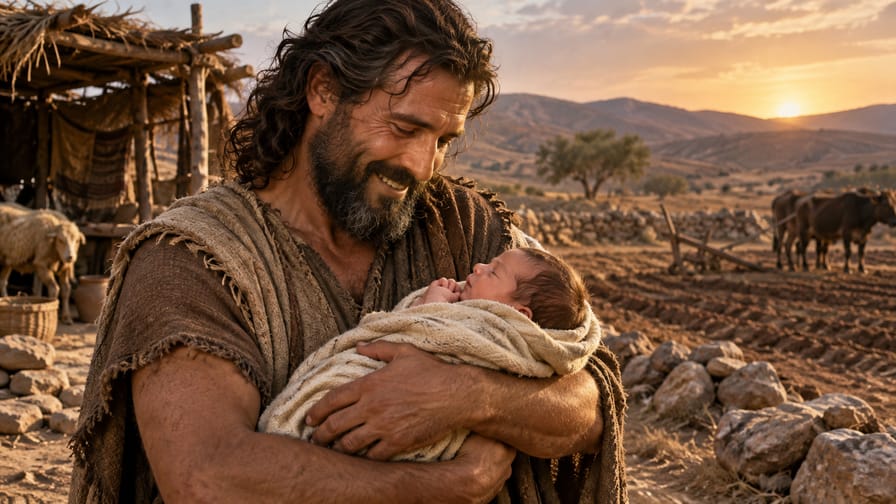
Lamech was the son of Methuselah and the father of Noah, in the line that descends from Adam through Seth (Genesis 5:25-31; 1 Chronicles 1:3). According to the Hebrew text he lived 777 years, and he is remembered above all for the words he spoke at the birth of his son: a hope that Noah would bring relief from the painful toil caused by the curse on the ground (Genesis 5:29).
Lamech appears in the genealogy that runs from Adam to Noah, a list marked by the solemn refrain “and he died”. Most of its members receive only numbers: the age at which they fathered a son, the years they lived afterward and the total of their days. Lamech is one of the few in that list whose entry includes something more. In his case it is a single sentence, the only words of his that Scripture preserves.
He is also named in the genealogy of Jesus in Luke 3:36. He should not be confused with the other Lamech of Genesis, a descendant of Cain, whose story is very different (Genesis 4:18-24). This article is about Lamech the son of Methuselah.
1. Etymology and meaning of the name
The Hebrew form is לֶמֶךְ (Lemekh). Its meaning is uncertain. No clear Hebrew root explains it, and the Bible offers no comment on the name, as it does for Noah's. Some scholars have proposed a connection with an Arabic word used for a strong young man, and others with an Akkadian term for a kind of priest or servant, but none of these proposals is certain. It is more honest to say that the meaning of Lamech's name is unknown than to build lessons on a guess.
By contrast, the text does comment on the name he gave his son. Noah (נֹחַ, Noach) sounds like the Hebrew word for rest, and Lamech's explanation uses the verb nacham (נחם), “to comfort, to give relief” (Genesis 5:29). The link is a play on sound and meaning, typical of Hebrew naming, rather than a strict derivation.
2. Historical context and biblical narrative
2.1 Family origin and genealogy
Lamech belonged to the line of Seth, the son given to Adam and Eve after the death of Abel (Genesis 4:25). The genealogy of Genesis 5 traces ten generations from Adam to Noah (Genesis 5:3-32; 1 Chronicles 1:1-4), and Lamech is the ninth. His grandfather was Enoch, who walked with God and was taken by him (Genesis 5:24), and his father was Methuselah, the longest-lived person recorded in Scripture, 969 years (Genesis 5:27).
Methuselah fathered Lamech at the age of 187 (Genesis 5:25). Lamech, at 182, fathered Noah (Genesis 5:28-29), and after that he lived 595 years and had other sons and daughters, whose names are not given (Genesis 5:30). All his days were 777 years, and he died (Genesis 5:31). His wife is not named. Through Noah he became the grandfather of Shem, Ham and Japheth (Genesis 5:32).
2.2 Main events
The only event described is the naming of Noah. When his son was born, Lamech called him Noah, saying, “Out of the ground that the LORD has cursed, this one shall bring us relief from our work and from the painful toil of our hands” (Genesis 5:29). The words recall the judgment of Genesis 3:17, where God cursed the ground because of Adam's sin and said that he would eat of it in painful toil. The Hebrew word for painful toil (ʿitsavon) occurs only in these passages of Genesis (Genesis 3:16-17; 5:29), which makes the connection clear.
If the numbers of the Masoretic text are added up, a few chronological observations follow. Lamech would have been born 874 years after the creation of Adam, so his life overlapped with Adam's by 56 years. He would have died five years before the flood, which came in Noah's six hundredth year (Genesis 7:6), and so before his father Methuselah, whose death falls in the year of the flood. These are calculations, not statements of the text, and the ancient Greek translation and the Samaritan Pentateuch give different figures for this genealogy. They should therefore be held with some caution.
3. Character and role in the biblical narrative
Scripture gives us one sentence from Lamech, and it reveals something of his heart. First, he speaks of God by his covenant name, the LORD, in keeping with the note in Genesis 4:26 that in the line of Seth people had begun to call upon the name of the LORD. Second, he is realistic: he does not deny the curse or the weariness of labor. Third, he hopes: he looks to God for relief and sees in the birth of his son a sign that relief might come.
We should not claim more than the text says. Lamech is not called righteous as Noah is (Genesis 6:9), and he is not said to have walked with God as Enoch did. We do not know how fully he understood his own words. But they stand in marked contrast with the wickedness and violence that filled the earth in those days (Genesis 6:5, 11-12). In a world heading toward judgment, Lamech named his son with hope.
His role in the narrative is that of a bridge. He links Enoch and Methuselah with Noah, and his words at Noah's birth prepare the reader for the flood story, in which God will both judge the corrupt world and preserve a family through his chosen servant.
4. Theological significance
4.1 Life under the curse
Lamech's words show that the consequences of the fall were a daily reality for the first generations. The ground resisted, work was painful, and death came to each one, as the refrain of Genesis 5 repeats. Scripture does not hide this. Paul teaches that creation was subjected to futility and groans as it waits for redemption (Romans 8:20-22). Lamech felt that groaning in his own hands.
4.2 Hope for rest
Lamech looked for relief through his son. The text does not say exactly how that hope was fulfilled, and interpreters differ. After the flood, when Noah offered sacrifices, the LORD smelled the pleasing aroma (the Hebrew nichoach, a word that echoes Noah's name) and said he would never again curse the ground because of man (Genesis 8:21). Noah is also described as a man of the soil who planted a vineyard (Genesis 9:20). Some see in these passages a partial answer to Lamech's hope. Yet the story of Noah also shows that sin remained after the flood (Genesis 8:21; 9:20-27). The full rest Lamech longed for is found only in Christ, who calls the weary to come to him and find rest (Matthew 11:28-29), and in the new creation, where there will no longer be anything accursed (Revelation 22:3).
4.3 In the line of promise
After the promise that the offspring of the woman would crush the serpent (Genesis 3:15), Genesis follows the line of Seth with special care. Lamech stands in that line, and Luke includes him among the ancestors of Jesus (Luke 3:36). He did not see the fulfillment, but his name is written in the family record that leads to the Son of God. Hebrews speaks of those who died in faith without receiving the things promised, having seen them from afar (Hebrews 11:13). Whether Lamech consciously belonged to that company, the text does not say, but his words fit that posture of expectant waiting.
4.4 Not to be confused with
Genesis mentions another Lamech, a descendant of Cain and son of Methushael (Genesis 4:18-24). That Lamech took two wives, Adah and Zillah, and boasted to them that he had killed a man for wounding him, claiming vengeance seventy-sevenfold (Genesis 4:23-24). Many readers note the contrast between the two men: one sings of revenge, the other speaks of comfort. They are different people in different lines, and their stories should not be mixed.
5. Legacy and canonical references
Lamech the son of Methuselah appears in three places in Scripture. In Genesis 5:25-31 we read of his birth, the birth and naming of Noah, the years of his life and his death; his name also appears in the notes about Methuselah's life after his birth (Genesis 5:26). In 1 Chronicles 1:3 he is listed in the genealogy from Adam that opens the book: Enoch, Methuselah, Lamech. In Luke 3:36 he appears in the genealogy of Jesus, where Noah is called the son of Lamech.
His legacy is his son Noah and, through Noah, all humanity after the flood. But his personal legacy is also the sentence he spoke: a confession that the curse is real and that relief must come from the LORD.
6. Application for today
Lamech's words sound familiar to anyone who works hard and feels its weight. He did not pretend that life was easy. Faith does not require us to deny the pain of work, the frustration of a world under the curse or the certainty of death. Like Lamech, we can speak honestly about the ground the LORD has cursed.
But Lamech did not stop at complaint. He turned his weariness into hope and placed that hope in what God would do through the next generation. Parents today can learn from him. The way we name, pray for and speak over our children can express trust that God is at work beyond our own lifetime. Lamech did not live to see the flood or its aftermath, yet his hope was not wasted.
Above all, Lamech points us to the rest that only Jesus gives. The comfort he hoped to find in Noah was partial and temporary. In Christ, God offers a Sabbath rest that remains for his people (Hebrews 4:9-10). The weary can come to him now, and one day the curse on creation will be removed entirely. That is the answer to Lamech's longing, and to ours.