


Joab
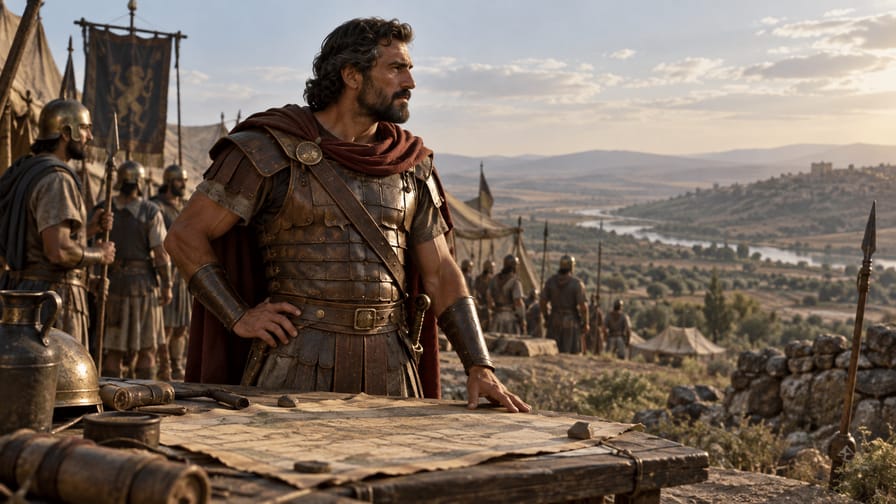
The figure of Joab, one of the most prominent and complex characters in the Old Testament, emerges as the commander of King David's army, playing a crucial role in the consolidation and maintenance of the kingdom of Israel. His story, detailed mainly in the books of 2 Samuel and 1 Kings, reveals a warrior of unquestionable courage and military cunning, but also a man marked by cruelty, vengeance, and political ambition.
From an evangelical Protestant perspective, the analysis of Joab offers valuable lessons on the nature of human leadership, divine sovereignty operating through imperfect instruments, and the complex interactions between loyalty, power, and morality. His trajectory is a case study on the inherent tensions in building and sustaining an earthly kingdom, which ultimately points to the necessity of a perfect King and Kingdom, embodied in Jesus Christ.
1. Etymology and Meaning of the Name
The name Joab, in Hebrew Yo'av (יוֹאָב), is a theophoric name, meaning a name that incorporates the name of God. It is composed of two parts: Yo (יוֹ), an abbreviated form of Yahweh (יהוה), the covenant name of God, and 'av (אָב), which means "father."
Therefore, the literal meaning of the name Joab is "Yahweh is father" or "Yahweh is my father." This meaning is common in Hebrew names that express a relationship of dependence or recognition of divine fatherhood, as in Abijah ("My father is Yahweh") or Abimelech ("My father is king").
Although the name itself carries a connotation of faith and recognition of divine sovereignty, Joab's life often contradicts the ideal implicit in his name. His actions, at times brutal and disobedient, contrast with the image of a son who reflects the nature of his heavenly Father.
There are no significant variations of the name Joab in biblical languages, being consistently transliterated from Hebrew. There are also no other prominent biblical characters with the same name, which makes his figure even more unique and memorable in the sacred narrative.
The theological significance of the name lies in the irony of its application to such a complex character. It reminds us that God's name can be invoked or associated with individuals who do not always live according to His precepts, highlighting God's grace that uses even imperfect people for His sovereign purposes.
2. Historical Context and Biblical Narrative
2.1 Family Origin and Genealogy
Joab was the son of Zeruiah, one of David's sisters (1 Chronicles 2:16). This made him King David's nephew, establishing a close family connection that would deeply influence his military and political career. He had two brothers, Abishai and Asahel, both notable warriors in their own right.
Asahel, known for his speed, was killed by Abner, the commander of Saul's army, in a pursuit after a battle (2 Samuel 2:18-23). This event would lay the groundwork for Joab's vengeance, a recurring theme in his life and actions.
2.2 Historical Period and Context
Joab's life unfolds during a crucial period in Israel's history: the transition from the divided kingdom under Saul to the united and consolidated monarchy under David (approximately 1010-970 BC). This was a time of intense military activity, with Israel seeking to establish its borders and sovereignty in the region.
The political context was one of constant struggle for power and influence, both within Israel and with neighboring nations such as the Philistines, Ammonites, and Arameans. David's ascent to the throne was not a peaceful process, and Joab was instrumental in the campaigns that ensured David's supremacy.
2.3 Key Life Events and Biblical Passages
Joab's career is marked by a series of decisive events. He is first mentioned as one of the "three sons of Zeruiah" who accompanied David in his ascent (2 Samuel 2:13). His military skill soon became evident.
After Asahel's death, Joab avenges his brother by killing Abner, an act that David publicly condemns but cannot punish due to Joab's strong position (2 Samuel 3:27-30). This incident establishes a pattern of David depending on Joab, even while disapproving of his actions.
He led the conquest of Jerusalem, a Jebusite stronghold, which David transformed into the capital of Israel (2 Samuel 5:6-9). For this feat, Joab was appointed commander of the army, a position he held for decades.
Joab was at the forefront of many of David's military campaigns, including the war against the Ammonites, where David committed adultery with Bathsheba and orchestrated Uriah's death. It was Joab who carried out David's order to place Uriah on the front lines to die (2 Samuel 11:14-17).
He played an ambivalent role in Absalom's rebellion. Initially, he advised David to allow Absalom to return from exile (2 Samuel 14:1-24). However, during the final battle, Joab disobeyed David's explicit order to spare Absalom and killed him (2 Samuel 18:9-15), an act that sealed the rebellion but deeply wounded the king.
After Absalom's revolt, David attempted to remove Joab from his post and replace him with Amasa, but Joab, in an act of vengeance and to protect his position, brutally murdered Amasa (2 Samuel 20:8-10). His influence and power were such that David again could not punish him.
In one of his last recorded acts, Joab participated in the census of Israel ordered by David, an act that displeased God (2 Samuel 24:1-9). He expressed reluctance to carry out the census but ultimately obeyed the king's order.
Joab's life culminated in tragedy. At the end of David's life, Joab supported Adonijah's attempt to usurp the throne, in opposition to Solomon, the successor chosen by God and David (1 Kings 1:7). For his misguided loyalty, he was executed by Solomon's order, fulfilling a final instruction from David (1 Kings 2:28-34).
2.4 Geography and Relationships
Joab's story is intrinsically linked to the main centers of David's kingdom. He operated in Hebron, where David was initially anointed king, and later in Jerusalem, the unified capital. His military campaigns took him to various regions, such as the land of Ammon (Rabbah) and Syria.
His most significant relationships were with David, whom he served with fierce loyalty, but also with acts of insubordination and cruelty. He interacted with other generals, such as Abner and Amasa, who became his victims. His relationship with Absalom and Adonijah was also central to the political conflicts of the time.
3. Character and Role in the Biblical Narrative
3.1 Character Analysis
Joab's character is a complex tapestry of virtues and vices. He was, above all, a fierce warrior, an unparalleled military leader, and a shrewd strategist. His loyalty to David, though at times questionable in its methods, was undeniable in its objective to protect the king and the kingdom.
He demonstrated exceptional courage in battle and relentless determination to achieve victory. His ability to lead men in combat and execute complex military plans was fundamental to the success of David's campaigns and the expansion of Israel's territory.
However, the same determination that made him an effective military leader also led him to cruelty and ruthlessness. Joab did not hesitate to use lethal force to eliminate threats, real or perceived, to his own position or the king's, often ignoring the law or David's expressed will.
3.2 Sins, Weaknesses, and Moral Failures
Joab's sins are notorious in the biblical narrative. Vengeance was a powerful motivator in his life, exemplified by the murder of Abner (2 Samuel 3:27), whom he saw as his brother Asahel's killer, but also as a dangerous political rival.
His direct disobedience to David in killing Absalom (2 Samuel 18:14) reveals a conviction that he knew what was best for the kingdom, even against the king's will. This act, though pragmatically effective in ending the rebellion, demonstrates a failure to submit to the authority of his leader.
The murder of Amasa (2 Samuel 20:10), his cousin and the new army commander appointed by David, is another example of his brutality and ambition. He eliminated a rival to maintain his own position of power, showing a ruthless and Machiavellian side.
His participation in David's census (2 Samuel 24:1-9), though reluctant, and his support for Adonijah in the attempt to usurp the throne (1 Kings 1:7) are examples of his failure to discern God's will and to submit to the divinely ordained succession.
3.3 Vocation, Calling, and Specific Function
Joab's vocation was clear: he was the commander-in-chief of Israel's army under King David's reign. His function was to lead military forces in battle, protect the kingdom, and execute the king's orders related to security and territorial expansion.
In this role, he was instrumental in transforming Israel from a collection of tribes into a unified and powerful nation. His actions, though often morally questionable, were effective in building and maintaining the Davidic kingdom, making him an indispensable figure for David.
3.4 Character Development
Joab's development throughout the biblical narrative is complex. He begins as a faithful companion of David during his flight from Saul. With David's ascent, he becomes the chief general, a pillar of military strength.
However, as the kingdom consolidates and political tensions rise, Joab appears to become more stubborn, autonomous, and prone to using brutal methods to solve problems or protect his own interests. His loyalty to David mixes with a strong dose of pragmatism and self-preservation, culminating in his tragic downfall by supporting the wrong side in the royal succession.
4. Theological Significance and Typology
4.1 Role in Redemptive History and Progressive Revelation
Joab, as a historical figure, played a significant role in redemptive history by being an instrument in the consolidation of the Davidic kingdom, which was central to God's covenant promises to David (2 Samuel 7:12-16). Although his actions were often flawed, God used his strength and cunning to establish the kingdom from which the Messiah would come.
Joab's story reveals the sovereignty of God operating even through imperfect and sinful human agents. He is a reminder that divine purposes do not depend on the moral perfection of His instruments, but on God's faithfulness to His own word and plan. His life illustrates the complexity of the human condition under divine providence.
4.2 Prefiguration or Christocentric Typology
Joab is not typologically a figure that directly or positively prefigures Christ. On the contrary, his life and character can be seen as an antithesis of the Messiah. While Joab ruled with force, cruelty, and manipulation, Jesus Christ rules with love, perfect justice, and sacrifice.
Joab's story, therefore, serves to highlight the need for a perfect King, who does not need to resort to violence or disobedience to establish His kingdom. His moral failures and eventual downfall point to the inadequacy of human leadership and to the glory of Christ's reign, which is righteous, merciful, and eternal (Hebrews 7:24-28).
4.3 Connection with Central Theological Themes
The narrative of Joab connects with several central theological themes from an evangelical Protestant perspective. Firstly, the doctrine of total depravity is evident in his actions. Even as a leader for God's people, Joab exhibits the depth of human sin, the thirst for power, and the ease with which vengeance and ambition can corrupt.
Secondly, the sovereignty of God is a prominent theme. Despite Joab's sinful intentions, God used him to fulfill His plans for David's kingdom. This does not mean that God approves of sin, but that He is capable of orchestrating events for His purposes, even through the sinful choices of men (Romans 8:28).
Joab's story also addresses the theme of judgment and the consequences of sin. Although David, for political reasons, did not immediately punish Joab for his crimes, divine and human judgment eventually reached him under Solomon's reign (1 Kings 2:5-6, 28-34), demonstrating that sin does not go unpunished forever.
4.4 Doctrine and Teachings Associated with the Character
Joab's life teaches about the complexity of leadership and the temptation of power. He serves as a case study on how loyalty can be corrupted by ambition and how military effectiveness does not necessarily translate into moral righteousness. The narrative warns against trusting imperfect human leaders and points to the perfection of divine leadership.
David's relationship with Joab also illustrates the tension between royal authority and military power, and the difficulties of a leader in dealing with powerful but morally compromised subordinates. David's failure to punish Joab for his earlier crimes is a point of reflection on the compromises leaders sometimes need to make, and how this can have future consequences.
5. Biblical-Theological Legacy and Canonical References
5.1 Mentions of the Character in Other Biblical Books
Joab is a central figure in the books of 2 Samuel and 1 Kings, where most of his story is narrated. He is also mentioned in 1 Chronicles, mainly in genealogies and records of David's military conquests (1 Chronicles 11:6 18:15), confirming his role as commander of the army.
The references in Chronicles tend to be more focused on his position and military acts, while Samuel and Kings delve deeper into the intrigues and complexities of his character and his relationships with David.
5.2 Influence on Biblical Theology
Joab's influence on biblical theology does not come through doctrines he articulated or by being an inspired author, but rather through his role in the history of David's kingdom. His life is a testament to God's providence, which uses all types of people for His purposes, including those who operate outside of divine moral standards.
He contributes to the theology of the monarchy in Israel, demonstrating the challenges and inherent tensions of human government, even under a king chosen by God like David. The complexity of Joab underscores the need for a king who is both powerful and just, a role that only the Messiah can fill.
5.3 Presence in Jewish and Christian Interpretive Tradition
In the Jewish tradition, Joab is often seen as an ambivalent character. He is praised for his loyalty and military effectiveness, but criticized for his cruelty and disobedience. Some rabbis consider him an example of how loyalty can be perverted, while others recognize his vital role in protecting David and the kingdom.
In the Christian tradition, especially in Reformed and evangelical theology, Joab is often used as an example of human depravity and the necessity of God's grace. His story is a reminder of the distinction between human justice and means and divine justice and purposes. He is a sharp contrast to the character of Christ, the perfect and sinless leader.
5.4 Treatment of the Character in Reformed and Evangelical Theology
Reformed and evangelical theology, with its strong emphasis on God's sovereignty and the total depravity of man, sees Joab as a vivid example of how God can use even the sinful actions of men to fulfill His purposes. John Calvin, for example, in his commentaries, often points to the providential hand of God controlling events, even when human agents act with impure motives.
Modern evangelical commentators, such as Derek Kidner and Walter Kaiser, in analyzing the figure of Joab, highlight the tension between the effectiveness of his actions and the immorality of his methods. They emphasize that, although God used Joab, He did not approve of his sinful attitudes, and the eventual judgment upon Joab serves as a reminder of divine justice.
5.5 Importance of the Character for Understanding the Canon
Joab's importance for understanding the canon lies in his contribution to the narrative of the Davidic monarchy, which is crucial for the messianic lineage. His story, with its shadows and complexities, paints a realistic picture of human government, contrasting it with the ideal of God's theocratic reign.
He helps us understand that the coming of the Messiah was not only to redeem individuals but also to establish a kingdom that transcended the flaws and imperfections of human kingdoms. The figure of Joab, therefore, is an essential element for fully appreciating the glory and necessity of the kingdom of Jesus Christ, the true and eternal King.