


James
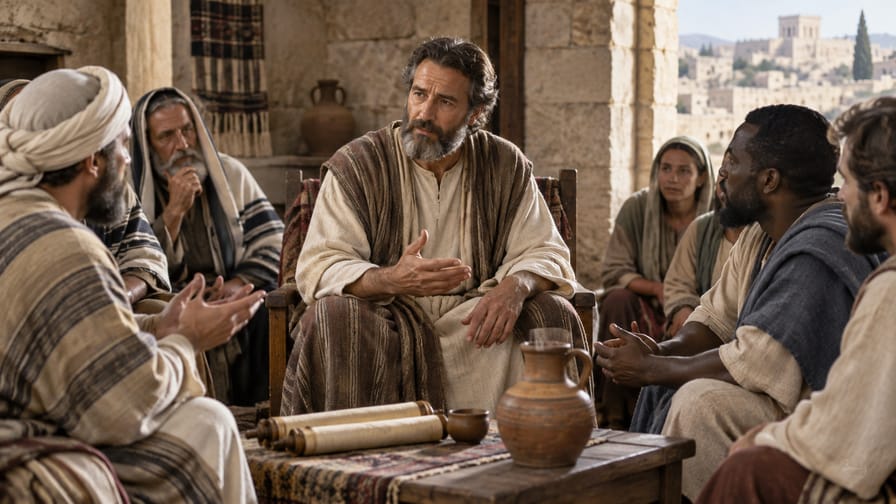
The figure of James, brother of the Lord Jesus Christ, emerges as a foundational pillar in the early church and a prophetic voice in the New Testament Scripture. His life, initially marked by unbelief, transformed into a testimony of unwavering faith and pastoral leadership. He is one of the most significant figures for understanding the development of Christian theology and the practice of the apostolic church.
This analysis will delve into the etymology of his name, contextualize his biblical history, examine his character and role, explore his theological and typological significance, and, finally, outline his enduring legacy within the canon and Christian tradition. The perspective adopted is Protestant evangelical, with an emphasis on biblical authority and rigorous exegesis.
1. Etymology and meaning of the name
The name James derives from the Greek Iakobos (Ἰάκωβος), which in turn is a transliteration of the Hebrew Ya‘akov (יַעֲקֹב). This name is a Greek form of the patriarchal name Jacob, one of the great ancestors of Israel. The corresponding Aramaic form would be Ya‘qov.
The etymological root of Ya‘akov is linked to the Hebrew verb ‘aqav (עָקַב), which means "to grasp by the heel" or "to supplant." This meaning is illustrated in the narrative of Jacob's birth, who was born grasping the heel of his twin brother Esau, as recorded in Genesis 25:26.
Literally, the name can be interpreted as "one who supplants" or "one who grasps by the heel." Symbolically, it carries the idea of perseverance, struggle, and ultimately, victory over adversities. This theme resonates with Jacob's own journey, who wrestled with God at Peniel (Genesis 32:22-32).
In the New Testament, besides James, the brother of the Lord, there are at least two other prominent figures with the same name: James, son of Zebedee and brother of John (one of the twelve apostles), and James, son of Alphaeus (another of the twelve apostles). There are also mentions of a "James the Less" (Mark 15:40), who may be the son of Alphaeus.
For this analysis, the primary focus will be on James, the brother of Jesus, a distinct figure of great importance. The distinction between the Jameses is crucial for New Testament exegesis, although the common name reflects the popularity of the name Jacob in Second Temple Judaism.
The theological significance of the name James, derived from Jacob, can be seen in the continuity of the covenant and the identity of the people of God. The name connects this leader of the early church directly to the patriarchal heritage, bestowing upon him a weight of legitimacy and tradition within the Jewish-Christian community.
2. Historical context and biblical narrative
2.1 Family origin and genealogy
James was one of Jesus' brothers, son of Mary and Joseph. The Scriptures explicitly mention his brothers as Joseph, Simon, and Judas, in addition to unnamed sisters (Matthew 13:55-56 Mark 6:3). This places him within the family of Jesus of Nazareth, with a humble, Galilean origin.
The historical period of his life spans the first century of the Christian era, from the birth of Jesus to approximately 60 A.D. He grew up in Nazareth, a small town in Galilee, under Roman occupation, in a Jewish social and religious environment.
2.2 Major life events
Initially, James and his brothers did not believe in Jesus as the Messiah. John 7:5 clearly states: "For even his own brothers did not believe in him." They even thought Jesus was out of his mind (Mark 3:21), reflecting the incomprehension and unbelief of his own family.
The conversion of James is a significant event, though not detailed in the Scriptures. Paul indicates that Jesus appeared to James after his resurrection (1 Corinthians 15:7). This appearance of the risen Christ was, without doubt, the decisive turning point in his life, transforming him from a skeptic into an fervent follower and leader.
After Jesus' ascension, James is seen among the disciples who persevered in prayer, together with the apostles and Mary, the mother of Jesus (Acts 1:14). This demonstrates his immediate integration into the core of the nascent church in Jerusalem.
He quickly ascended to a position of prominent leadership in the Jerusalem church. Paul describes him as one of the "pillars" of the church, alongside Peter and John (Galatians 2:9). His authority was such that even Peter, after being freed from prison, instructed that the news be taken to James (Acts 12:17).
The most famous role of James is his leadership at the Council of Jerusalem, recorded in Acts 15. He presided over the discussion regarding the necessity for Gentile converts to be circumcised and observe the Mosaic Law. His final decision, based on the Scriptures and the testimony of Peter and Paul, was fundamental for the future of the church.
James' proposal was that Gentiles did not need to be circumcised, but should abstain from food sacrificed to idols, from blood, from strangled animals, and from sexual immorality (Acts 15:19-21). This decision demonstrated pastoral wisdom and profound discernment of the Holy Spirit, preserving unity between Jews and Gentiles.
The geography of his ministry was centered in Jerusalem, the holy city. He was known as "James the Just," a title that reflects his reputation for piety and observance of the Law, which afforded him great respect among both Jewish Christians and non-Christian Jews in the city.
His relationship with Paul is complex, but crucial. Although they were leaders of different missionary fronts (Paul among the Gentiles, James among the Jews), they shared a common goal. Paul visited James in Jerusalem on several occasions (Acts 21:18 Galatians 1:19), seeking his approval and maintaining fellowship.
3. Character and role in the biblical narrative
3.1 Analysis of character and spiritual qualities
The character of James is primarily revealed through his leadership and his epistle. He is characterized by profound piety and an unwavering commitment to justice, so much so that he was known as "James the Just." This reputation earned him great respect in Jerusalem.
His conversion, from skeptic to leader, demonstrates humility and a willingness to recognize the truth, even when it challenged his preconceived notions. The appearance of the risen Christ to him was a powerful testimony that transformed his life and propelled him to service.
The Epistle of James is a direct reflection of his character. It exudes practical wisdom, a call to holiness, integrity, and authentic living out of faith. He emphasizes the importance of a faith that manifests itself in works, not as a means of salvation, but as genuine evidence of an inner transformation (James 2:14-26).
Among his virtues are wisdom, patience, and concern for the poor and marginalized (James 1:27 2:1-7). He condemned partiality and ostentation, promoting a faith that translates into acts of love and practical service to others.
3.2 Vocation and specific function
James' vocation was that of an apostolic leader in the mother church in Jerusalem. Although not one of the original twelve apostles, he is often referred to as an apostle in the broader sense of the term (Galatians 1:19), recognized for his authority and divine commission.
His primary function was to oversee the Christian community in Jerusalem, serving as a crucial bridge between Jewish tradition and the new faith in Christ. He was the main interlocutor for Jewish believers and a point of reference for Gentile missionaries, such as Paul.
At the Council of Jerusalem (Acts 15), his role was that of a wise arbiter and conciliator. He listened to the arguments of both sides (Judaizers and Paul/Barnabas) and rendered the decision that guided the early church, demonstrating his capacity for leadership and spiritual discernment.
3.3 Significant actions and development
James' actions reveal a leader with a strong sense of justice and a firm pastoral stance. His epistle warns against an uncontrolled tongue (James 3:1-12), covetousness (James 4:1-3), and the oppression of the rich over the poor (James 5:1-6). He exhorted believers to be "doers of the word, and not merely hearers" (James 1:22).
James' development is remarkable: from a skeptical brother who doubted Jesus' messianic identity, he became one of the most influential leaders of the early church, a man of deep prayer, and a canonical author. His transformation is a testament to the grace and resurrected power of Christ.
Christian tradition, outside the canon, relates that James led an ascetic life, spent much time in prayer, and had calloused knees, being known as "camel's knees." Although not canonical, this reinforces the image of his deep devotion and piety.
4. Theological significance and typology
4.1 Role in redemptive history and progressive revelation
James played a vital role in redemptive history by leading the mother church in Jerusalem, the cradle of Christianity. His leadership ensured the continuity and stability of the faith in a crucial transitional period, as the church was expanding beyond its Jewish roots.
His wisdom and discernment at the Council of Jerusalem were essential for the progressive revelation of God's will concerning the inclusion of the Gentiles. The decision not to require circumcision for Gentiles paved the way for the universal mission of the church, according to God's plan.
4.2 Prefiguration and Christocentric typology
As a leader of the New Testament church, James is not a typological figure in the prophetic sense of the Old Testament, which directly points to Christ. However, his life and teachings reflect and exemplify the ethics of the Kingdom of God and the character of Christ in significant ways.
James' emphasis on faith that produces works (James 2:17-26) is a direct echo of Jesus' teachings on the necessity of fruits that demonstrate true discipleship (Matthew 7:16-20). Saving faith is a living, active, and transformative faith that manifests itself in obedience and love for others, mirroring the character of Christ.
His concern for social justice, the poor, and the marginalized (James 1:27 2:1-7) reflects the heart of Jesus, who came to proclaim good news to the poor and set the oppressed free (Luke 4:18-19). James embodied the practical application of the gospel message.
4.3 Connection with central theological themes
The Epistle of James is fundamental for understanding several central theological themes. The relationship between faith and works is perhaps the most prominent, serving as a corrective to any erroneous interpretation of the Pauline doctrine of justification by faith alone (Romans 3:28 Ephesians 2:8-9).
James does not contradict Paul, but complements him, emphasizing that genuine faith is intrinsically active and will produce good works as its evidence. Faith without works is "dead" (James 2:26), not because works save, but because living faith inevitably manifests itself in obedience and love.
Other theological themes include divine wisdom (James 1:5 3:13-18), perseverance in trials (James 1:2-4), the importance of controlling the tongue (James 3:1-12), effective prayer (James 5:13-18), and the practical ethics of the Christian life. He is a theologian of orthopraxy, of the correct practice of faith.
4.4 Doctrine and teachings associated with the character
James' doctrine can be summarized in his call to authentic and practical faith. He teaches that pure and undefiled religion is "to visit orphans and widows in their affliction, and to keep oneself unstained from the world" (James 1:27). This underscores the social and ethical dimension of the Christian faith.
His theology is profoundly ethical, focused on sanctification and Christian character. He challenges believers to live consistently with their confession of faith, warning against hypocrisy and religious superficiality. Faith, for James, is more than an intellectual affirmation it is a life transformation.
5. Biblical-theological legacy and canonical references
5.1 Mentions of the character in other biblical books
James' importance is attested by his multiple mentions in other New Testament books. Besides his own epistle, he is cited in Acts of the Apostles as the leader of the Jerusalem church (Acts 12:17 15:13-21 21:18).
Paul mentions him in his epistles, recognizing him as one of the "pillars" of the church and brother of the Lord (Galatians 1:19 2:9). The appearance of the resurrected Christ to him is recorded in 1 Corinthians 15:7, solidifying his testimonial role.
5.2 Literary contributions
James' most significant literary contribution is the Epistle of James, one of the protocanonical books of the New Testament. This epistle is an ethical and practical treatise, full of wisdom and direct exhortations on authentic Christian living.
The style of the epistle resembles the wisdom literature of the Old Testament, such as Proverbs, with its short, incisive sentences, addressing a wide range of practical themes for the early Christian community and for believers of all ages.
5.3 Influence on biblical theology
James' influence on biblical theology is profound, especially in his articulation of the relationship between faith and works. He served as a necessary counterpoint to a possible misinterpretation of Pauline justification, ensuring that faith was not reduced to a mere intellectual assent.
His emphasis on the practice of faith, social responsibility, and personal holiness continues to be a pillar of Reformed and evangelical ethical theology. He reminds us that true religion manifests itself in active love and obedience to the Word of God.
5.4 Presence in interpretative tradition
In the Christian interpretative tradition, James has been a figure of great debate, especially during the Protestant Reformation. Martin Luther, in his pursuit of justification by faith alone (sola fide), even referred to the Epistle of James as "an epistle of straw," due to its apparent contradiction with Paul.
However, later Reformed theology and most modern evangelical theologians recognize the complementarity between James and Paul. They understand that Paul deals with justification before God (faith as cause), while James deals with justification before men (works as evidence of faith).
John Calvin, for example, defended the canonicity of the epistle and saw it as a valuable complement to Paul's teachings, emphasizing the need for a living and productive faith. Conservative evangelical interpretation values James' contribution to a balanced understanding of the Christian faith.
5.5 Importance for understanding the canon
The figure of James and his epistle are crucial for understanding the diversity and unity of the New Testament canon. He demonstrates that, although there were different emphases and approaches among the apostolic leaders, there was a fundamental unity in the doctrine and purpose of the gospel.
His inclusion in the canon reinforces the idea that Christian faith is not merely a matter of correct beliefs (orthodoxy), but also of correct living (orthopraxy). The Epistle of James remains a perennial challenge for all believers to live an authentic and fruitful faith in all areas of life.