


Isaiah
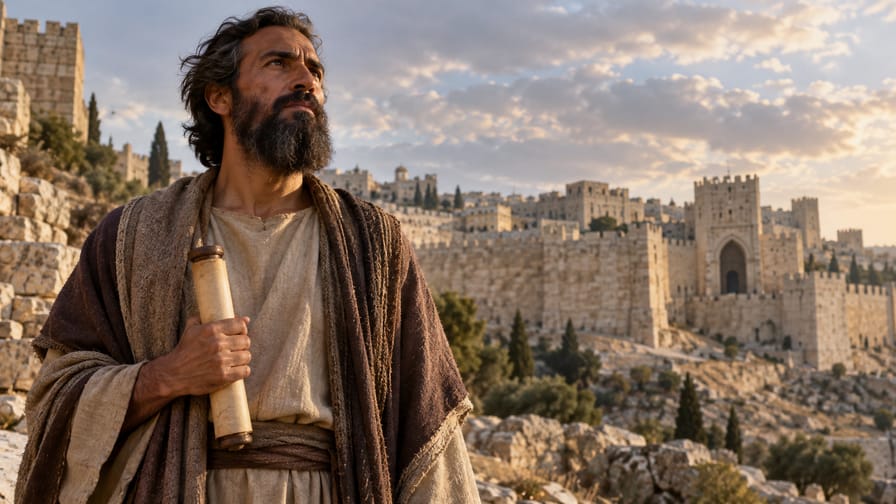
The figure of Isaiah emerges as one of the most prominent prophets of the Old Testament, whose ministry and message reverberate throughout all of Scripture. His work is a fundamental pillar for understanding biblical theology, especially concerning the sovereignty of God, divine judgment on sin, and the glorious hope of messianic salvation.
The book that bears his name is often called "the fifth Gospel" or "the mini-Bible" due to its theological breadth and the richness of its prophecies that point directly to Jesus Christ. From an evangelical Protestant perspective, Isaiah is seen as a divinely inspired prophet, whose words are authoritative and historically precise, progressively and detailedly revealing God's redemptive plan.
This analysis will seek to explore the depth of Isaiah, from the meaning of his name to his enduring theological relevance, covering his historical context, character, and the crucial role he played in the biblical narrative. Emphasis will be placed on the Christocentric connections and doctrinal contributions that solidify his place as one of the most important voices in divine revelation.
1. Etymology and meaning of the name
The name Isaiah, in Hebrew Yesha'yahu (יְשַׁעְיָהוּ), is profoundly significant and encapsulates the essence of his prophetic message. The etymological root of the name is composed of two parts: yesha', meaning "salvation" or "deliverance," and Yah, an abbreviated form of the divine name of God, Yahweh (יהוה).
Thus, the name Isaiah can be literally translated as "Yahweh is salvation" or "The salvation of Yahweh." This designation is not merely a label, but a theological declaration that prefigures the central content of his prophecies, which revolve around the salvation offered by God to His people, both in judgment and in redemption.
In the New Testament, the name is transliterated into Greek as Esaias (Ἠσαΐας), maintaining the same theological meaning. Although the name Isaiah is not common for other prominent biblical figures, its uniqueness highlights the importance and centrality of his ministry.
The theological significance of the name is immense, for the prophet whose name means "Yahweh is salvation" is precisely the one who will proclaim the coming of the Messiah, who is the personification and consummation of God's salvation. His name serves as a constant reminder that salvation does not come from human efforts or political alliances, but solely from the initiative and power of God.
For evangelical theology, the name of Isaiah is a powerful declaration of God's faithfulness in providing a Savior, echoing the promise of a Messiah who would bring complete redemption. He points to the character of God as the one and true Savior, a theme that permeates the entire book of Isaiah (cf. Isaiah 43:11 45:21-22).
2. Historical context and biblical narrative
The ministry of Isaiah occurred during one of the most tumultuous periods in Judah's history, spanning approximately from 740 to 681 B.C. He prophesied during the reigns of four kings of Judah: Uzziah, Jotham, Ahaz, and Hezekiah (Isaiah 1:1), witnessing events of great geopolitical and religious impact.
This was a time of intense Assyrian threat, with the Middle Eastern superpower, Assyria, expanding its empire and subjugating nations. Isaiah witnessed the fall of the Northern Kingdom (Israel) to Assyria in 722 B.C. (2 Kings 17:5-6) and the subsequent invasion of Judah by Sennacherib, the Assyrian king, during Hezekiah's reign (Isaiah 36-37).
The political context was one of unstable alliances and fear, while the social and religious context was marked by social injustice, widespread idolatry, and spiritual superficiality among God's people. The rich oppressed the poor, and religious rituals were often devoid of true devotion (cf. Isaiah 1:10-17 5:8-23).
Although the Bible does not provide extensive details about Isaiah's genealogy, he is identified as the son of Amoz (Isaiah 1:1). Jewish tradition, though extrabiblical, suggests that Amoz was the brother of King Amaziah, which would make Isaiah a member of the royal family or the high aristocracy of Jerusalem, which would explain his access to the kings.
His life was marked by crucial events, beginning with his call vision in the Temple, where he saw the Lord enthroned and experienced the purification of his lips (Isaiah 6:1-8). This call commissioned him to preach a message of judgment and redemption to a "hard-hearted" people.
During the reign of Ahaz, Isaiah confronted the king with the need to trust in God instead of seeking alliances with Assyria against the Syro-Ephraimite coalition (Isaiah 7:1-17). It was in this context that he delivered the famous prophecy of Immanuel (Isaiah 7:14). He also had two sons whose names were prophetic: Shear-Jashub ("A Remnant Shall Return," Isaiah 7:3) and Maher-Shalal-Hash-Baz ("Speedy to the Spoil, Swift to the Prey," Isaiah 8:1-4).
Later, during the reign of Hezekiah, Isaiah played a vital role in advising the king to trust in God in the face of Sennacherib's Assyrian invasion. He prophesied the miraculous deliverance of Jerusalem, which came to pass with the destruction of the Assyrian army by an angel of the Lord (Isaiah 37:33-38 2 Kings 19:35). These passages illustrate not only the prophet's faith, but also God's faithfulness in fulfilling His promises.
The geography of his ministry was centered in Jerusalem and the Kingdom of Judah, the capital and heart of Yahweh worship. His prophecies addressed both the local situation of Judah and the destiny of neighboring nations, such as Babylon, Assyria, Egypt, Moab, and Philistia (cf. Isaiah 13-23), demonstrating God's universal sovereignty.
Isaiah's relationships with the kings of Judah were complex. While he had a relationship of counsel and support with King Hezekiah, his interaction with Ahaz was one of confrontation due to the king's unbelief. He was a contemporary of the prophet Micah, who also prophesied in Judah during the same period, sharing themes of judgment and messianic hope (cf. Micah 4:1-3 with Isaiah 2:2-4).
3. Character and role in the biblical narrative
Isaiah's character, as revealed in the Scriptures, is that of a man of deep faith, unwavering courage, and radical obedience to God. From his call in chapter 6, where he saw himself as a "man of unclean lips" before the holiness of God, Isaiah demonstrated genuine humility and an acute awareness of divine majesty.
His vocation was that of a navi' (נָבִיא), a prophet, a spokesperson for Yahweh. He not only delivered verbal oracles but also performed symbolic acts that reinforced his message. The names of his sons, Shear-Jashub and Maher-Shalal-Hash-Baz, were living prophetic signs for the people of Judah, and he himself walked naked and barefoot for three years as a sign of the future humiliation of Egypt and Ethiopia (Isaiah 20:2-4).
Among his virtues stand out integrity and boldness in confronting kings and the people with the Word of God, even when the message was unpopular or required personal sacrifice. His insistence on trusting in God, in contrast to human alliances, demonstrates his unwavering faithfulness to the Lord (cf. Isaiah 30:1-7).
The Bible does not record specific sins or moral weaknesses of Isaiah, which is remarkable for such a prominent figure. However, his confession of unclean lips in Isaiah 6:5 serves as a reminder of his humanity and the need for divine grace for anyone who serves God.
Isaiah's role was multifaceted: he was a preacher of social justice, a denouncer of idolatry and religious hypocrisy, a counselor to kings, and above all, a herald of messianic hope. His significant actions and key decisions were always guided by divine revelation, such as his persistence in proclaiming the inviolability of Jerusalem under Hezekiah (Isaiah 37:6-7).
Throughout the narrative, Isaiah's character develops from a servant initially burdened by his unworthiness to a confident and resilient prophet, capable of enduring the opposition and unbelief of his own people. He embodies the figure of the true prophet, whose life and message are inseparable, entirely dedicated to the will of God.
4. Theological significance and typology
The theological significance of Isaiah is monumental, positioning him as one of the architects of God's progressive revelation in redemptive history. His book is an inexhaustible source for systematic theology, addressing themes such as the holiness of God, human sinfulness, judgment, grace, the remnant, divine sovereignty, and, crucially, the messianic promise.
The Christocentric prefiguration and typology in Isaiah are perhaps the richest in the entire Old Testament. He points to Christ in multiple ways, being the prophet who most clearly delineates the person and work of the Messiah. The prophecy of Immanuel in Isaiah 7:14 is cited in Matthew 1:23 as a fulfillment of Jesus' virgin birth.
Most notably, Isaiah presents the figure of the "Suffering Servant" in four distinct poems (Isaiah 42:1-4 49:1-6 50:4-9 52:13-53:12). Chapter 53, in particular, is a vivid and detailed description of the vicarious suffering of Jesus Christ, His atoning death, and His resurrection, being widely quoted in the New Testament to explain the nature of salvation (cf. Acts 8:32-35 Romans 10:16).
Other messianic prophecies include the "Prince of Peace" and the "Mighty God" who would be born as a child (Isaiah 9:6-7), and the "Branch from Jesse" who would rule with justice and bring universal peace (Isaiah 11:1-10). These passages are not mere predictions, but revelations of the divine identity and redemptive mission of the Messiah.
The New Testament frequently quotes Isaiah to authenticate Jesus' identity and the fulfillment of His ministry. Jesus Himself began His ministry by quoting Isaiah 61:1-2 in Luke 4:18-19, applying the prophet's words to Himself as the Anointed of the Lord who came to proclaim good news to the poor.
Isaiah's theology is marked by an emphasis on God's holiness (the "Holy One of Israel," a recurring title), which demands repentance and faith. He also introduces and develops the concept of the "remnant" (Isaiah 10:20-22), a faithful group that would survive judgment and be the seed of restoration, prefiguring the Church as the new Israel.
His eschatological prophecies about a new heaven and a new earth (Isaiah 65:17-25 66:22-24) provide the basis for the final hope of redemption. From an evangelical perspective, Isaiah not only foresaw the future but also revealed the nature of God's character and the scope of His plan of salvation, culminating in Christ and the consummation of His Kingdom.
5. Biblical-theological legacy and canonical references
Isaiah's legacy in biblical theology is immeasurable. His book is one of the most cited and alluded to works in the entire biblical canon, both in the New Testament and in post-exilic and intertestamental Jewish literature. He is mentioned in 2 Kings 19-20 and 2 Chronicles 26:22 and 32:20, 32, which recount events of his ministry and his proximity to the kings of Judah.
His authorship of the Book of Isaiah, though debated by some critical currents, is traditionally accepted in evangelical Protestant theology as the work of a single divinely inspired prophet, with its various sections (judgment, comfort, eschatology) forming a coherent whole under the inspiration of the Holy Spirit.
Isaiah's literary contributions are of unparalleled poetic and rhetorical richness, elevating prophecy to a level of literary art that continues to inspire. His language is frequently employed in Christian hymns, prayers, and sermons, solidifying his influence on piety and liturgy.
In Jewish interpretive tradition, Isaiah is revered as the prophet of consolation and messianic hope. The Dead Sea Scrolls, especially the Great Isaiah Scroll (1QIsaa), attest to the antiquity and importance of his book for the Qumran community and for Second Temple Judaism.
For Reformed and evangelical theology, Isaiah is a primary source for the doctrine of God's sovereignty, the total depravity of humanity, the necessity of grace, and the exclusivity of salvation in Christ. His emphasis on God's election and the role of the remnant strongly resonates with the doctrines of grace.
The importance of Isaiah for understanding the biblical canon is that he serves as a crucial bridge between the promises of the Old Testament and their fulfillment in the New Testament. He demonstrates the unity of God's redemptive plan and the continuity of His revelation, becoming indispensable for any serious study of biblical theology.
His book is a testimony to the inerrancy of Scripture and God's faithfulness in fulfilling each of His words, providing a solid foundation for Christian faith and hope in the second coming of Christ and the final establishment of His glorious Kingdom.