


Hiram
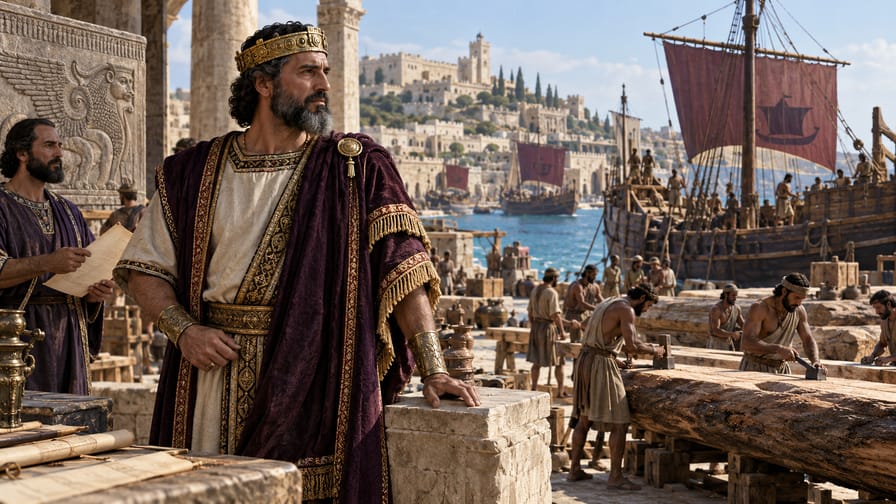
The figure of Hiram, king of Tyre, emerges in the Hebrew Scriptures as an instrumental character in the reigns of David and, especially, of Solomon. His relevance does not lie in a direct theological prominence or in being a worshiper of Yahweh, but rather in his providential role in the construction of the Temple in Jerusalem and the royal palace, central landmarks in the history of Israel.
The analysis of Hiram, from a Protestant evangelical perspective, emphasizes God's sovereignty in using individuals and nations outside the covenant to fulfill His redemptive purposes. He is a testament to God's common grace, which grants wisdom and abilities to all people, and to His capacity to orchestrate historical events for the glory of His name and the advancement of His plan.
1. Etymology and meaning of the name
The name Hiram appears in the Hebrew Scriptures in two main forms: Ḥîrām (חִירָם) and Ḥûrām (חוּרָם). The form Ḥîrām is more common in the books of Kings, while Ḥûrām is predominant in Chronicles. This variation may be attributed to dialectal, scribal differences, or a contraction of the original name.
The etymology of Hiram is a subject of academic debate, but the most accepted interpretations link the name to the Hebrew root ḥûrm, which can mean "noble" or "free-born". Thus, the name could be interpreted as "my brother is exalted" or "noble" or "free".
Another etymological possibility connects Hiram to the root ḥāram, which means "to dedicate" or "to consecrate". In this sense, the name could suggest "dedicated" or "consecrated," although this interpretation is less common among scholars. The association with nobility and exaltation seems more consistent with the representation of the king of Tyre.
There are no other prominent biblical characters who share this name, making Hiram of Tyre a unique figure in his mention. This uniqueness allows for a clear focus on his person and his actions, without confusion with homonyms that could dilute his significance.
From a theological point of view, the meaning of the name "noble" or "exalted" may, providentially, mirror Hiram's royal status and the high esteem in which he was held by David and Solomon. His nobility was not only of title but also of character, evidenced in his loyalty and generosity towards the kings of Israel.
Despite being a pagan king, his name carries a dignity that the biblical narrative seems to recognize. This underscores God's ability to use people from all backgrounds and cultures, elevating them to fulfill His purposes, even if they do not worship Him directly.
2. Historical context and biblical narrative
2.1. Historical period and political context
Hiram lived in the 10th century B.C., a period of great flourishing for the united kingdom of Israel under David and Solomon. Tyre, his capital, was one of the most prominent Phoenician city-states, known for its naval power, extensive trade routes, and skill in craftsmanship and construction.
At that time, Israel and Tyre enjoyed a strategic and mutually beneficial alliance. Israel, though militarily powerful and rich in agricultural resources, lacked Phoenician expertise in construction and maritime trade, while Tyre needed Israel's agricultural products.
The biblical narrative presents Hiram as a wise and diplomatic ruler, capable of forging and maintaining lasting relationships with regional powers. This alliance with Israel was crucial for the stability and prosperity of both kingdoms during a period of transition and consolidation of power in the Levant.
2.2. Relationship with David
The first mention of Hiram occurs in the context of the construction of David's palace in Jerusalem. After David had conquered Jerusalem and established his capital, Hiram sent him messengers, cedar wood, carpenters, and masons to build his royal house (2 Samuel 5:11 1 Chronicles 14:1).
This initial collaboration established a precedent for future cooperation between the two kingdoms. The supply of cedar from Lebanon and experienced craftsmen from Tyre was fundamental to the architectural grandeur David desired for his seat of government, a symbol of his divinely granted authority.
The relationship between David and Hiram was one of mutual respect and alliance, laying the groundwork for even more significant collaboration that would occur during Solomon's reign. This lasting friendship is a testament to the diplomatic skill of both monarchs.
2.3. Collaboration with Solomon and the building of the Temple
After David's death, Hiram sent a delegation to Solomon, expressing his continued loyalty and friendship (1 Kings 5:1). Solomon, in turn, leveraged this relationship to propose an alliance for the construction of the Temple, the most ambitious project of his reign.
Solomon requested Hiram to provide cedar and cypress wood from Lebanon, as well as Phoenician workers specialized in cutting and transporting the timber (1 Kings 5:6 2 Chronicles 2:3-10). In return, Solomon promised to supply Tyre with wheat and olive oil, essential for the city-state dependent on agricultural imports.
Hiram's response was enthusiastic, and he expressed praise to Yahweh for having given David a wise son to rule Israel (1 Kings 5:7 2 Chronicles 2:11-12). He diligently fulfilled his part of the agreement, sending enormous quantities of wood and a master craftsman named Huram-abi, who was skilled in all types of work (1 Kings 7:13-14 2 Chronicles 2:13-14).
The collaboration was not limited to wood and craftsmen. Hiram also provided ships and experienced sailors for Solomon's trading expeditions to Ophir, which brought large quantities of gold, precious stones, and almug wood (1 Kings 9:26-28 1 Kings 10:11 2 Chronicles 9:10-11).
However, the partnership had a point of contention. After 20 years of construction (7 years for the Temple and 13 for the palace), Solomon ceded 20 cities in Galilee to Hiram as part of a payment (1 Kings 9:10-11). Hiram, dissatisfied with the quality of the land, called the region Cabul, which means "worthless" or "nothing" (1 Kings 9:12-13).
Despite this disagreement, the alliance between Hiram and Solomon remained strong, and they continued to undertake joint ventures (1 Kings 9:14). The geography of Tyre, with its access to the Mediterranean Sea and the forests of Lebanon, was fundamental to the success of these ventures.
3. Character and role in the biblical narrative
3.1. Analysis of character and virtues
The biblical narrative portrays Hiram as an astute, diplomatic, and pragmatic leader. His wisdom is recognized by Solomon himself, who describes him as someone who has "great wisdom" (1 Kings 5:7). He demonstrated perceptiveness in recognizing Yahweh's blessing on Solomon and his kingdom.
One of his most notable qualities was loyalty. His friendship with David was transferred to Solomon, demonstrating a commitment that transcended mere political convenience. This loyalty was fundamental for the stability of the alliance and for the execution of the great construction projects.
Hiram also stood out for his generosity and willingness to share the resources and expertise of his kingdom. The supply of cedar, cypress, and, crucially, highly skilled craftsmen, was an act of great value for Israel, which did not possess such resources in abundance.
His character was marked by efficiency and organizational ability. He oversaw the complex logistics of cutting, transporting, and delivering timber, as well as the management of specialized labor, ensuring that the terms of the agreement were met promptly.
3.2. Weaknesses and moral failures (or absence thereof)
The Bible does not document explicit sins or moral failures of Hiram. He is presented positively in the narrative, as a valuable ally and a man of his word. His dissatisfaction with the cities of Cabul (1 Kings 9:12-13) is not portrayed as a moral failing, but as a pragmatic commercial assessment, revealing his keen sense of value and negotiation.
Although Hiram was a pagan king, a worshiper of Phoenician deities like Baal, the biblical narrative does not condemn him for his faith. On the contrary, it highlights his respectful attitude towards Yahweh and His providence. This illustrates the divine perspective that, even in a context of alliance with Israel, recognizes and utilizes the wisdom and abilities of non-believers for His own purposes.
His main "weakness," from a strict theological point of view, would be his non-adherence to faith in Yahweh. However, the Bible does not judge him for this in the context of his function, but rather presents him as an effective instrument in God's hands. This demonstrates God's common grace which extends to all humanity, allowing cooperation for the benefit of the kingdom.
3.3. Role played and significant actions
Hiram's role in the biblical narrative is fundamentally that of a strategic ally and a provider of essential resources. He was the main facilitator of the architectural grandeur of the Solomonic period, without whom the construction of the Temple and the royal palace would be unthinkable on the scale described.
His most significant actions include:
- The provision of high-quality cedar and cypress wood for David's palace and, subsequently, for the Temple and Solomon's palace (2 Samuel 5:11 1 Kings 5:6).
- The sending of highly skilled Phoenician craftsmen, including the master Huram-abi, who supervised and executed the most intricate work of the Temple (1 Kings 7:13-14 2 Chronicles 2:13-14).
- Participation in maritime commercial ventures with Solomon, sending ships and sailors for expeditions to Ophir, which enriched Israel with gold and other precious goods (1 Kings 9:26-28 2 Chronicles 9:10-11).
- The maintenance of an alliance of peace and cooperation for a long period, contributing to regional stability and the economic development of Israel.
The development of Hiram's character throughout the narrative is consistent. He is portrayed as a benevolent king, an astute negotiator, and a reliable partner, whose expertise and resources were vital for the completion of Israel's most sacred and important projects.
4. Theological significance and typology
4.1. Role in redemptive history and divine providence
The figure of Hiram is a powerful testimony to God's sovereignty and providence in redemptive history. Even though he was a pagan king, outside the Abrahamic and Mosaic covenants, God used him as an essential instrument for the construction of the Temple, the center of Yahweh's worship in Israel.
This demonstrates that divine providence extends beyond the borders of God's people, utilizing nations and individuals from diverse backgrounds to fulfill His plans. God is not limited to operating only through those who know and worship Him, but can mobilize any person or circumstance for His purposes (cf. Isaiah 45:1-7, regarding Cyrus).
Hiram's cooperation with Solomon to build the house of Yahweh underscores the truth that all things, including human abilities and material resources, belong to God and can be employed for His glory. The wisdom and expertise of the Phoenicians were gifts from God, given by His common grace.
4.2. Common grace and the universality of God's plan
Hiram is a classic example of the doctrine of common grace. God grants gifts, talents, wisdom, and resources to all humanity, regardless of their faith or covenant affiliation. The Phoenicians' skill in architecture, engineering, and navigation was a manifestation of this common grace.
This perspective highlights the universality of God's plan. Although the Temple was the center of worship in Israel, it was also conceived as a house of prayer for all peoples (Isaiah 56:7 cf. 1 Kings 8:41-43). The participation of a Gentile king in its construction prefigures, in a broader sense, the inclusion of the Gentiles in God's plan of salvation, which would be fully manifested in Christ.
Hiram's recognition of Yahweh's blessing on Solomon (1 Kings 5:7 2 Chronicles 2:11-12) is noteworthy. While not a conversion, it reveals a perception of the reality of the God of Israel, demonstrating that God can reveal Himself and be recognized even by those outside His explicit covenant, preparing the way for a broader understanding of His work.
4.3. No direct Christocentric typology, but theological principles
There is no direct Christocentric typology in Hiram that is, he is not a clear "type" of Christ or a specific aspect of His work. However, his figure illustrates important theological principles that find their fulfillment and ultimate meaning in Christ.
The Temple, whose construction Hiram facilitated, is itself a powerful type of Christ, who is the true Temple and the place where God dwells among humanity (John 2:19-21). The building of a physical place for God's presence points to Christ as the incarnation of divine presence (Colossians 2:9) and to the Church as the new spiritual Temple (1 Peter 2:5 Ephesians 2:20-22).
Thus, Hiram, by contributing to the physical Temple, participates in a larger narrative that points to the spiritual reality of God's dwelling, which is fully realized in Christ and His Church. He is a reminder that God uses the resources and skills of the world to build His house, whether physical or spiritual.
His material contribution to the glory of the Temple reflects the biblical theme that creation and its resources should be used for the worship and service of God. The cooperation between Israel and Tyre, mediated by Hiram, highlights the importance of collaboration and the utilization of diverse gifts for the building of God's kingdom.
5. Biblical-theological legacy and canonical references
5.1. Mentions in other biblical books and influence
Hiram is mentioned primarily in the books of 1 Kings and 2 Chronicles, which cover the period of the divided monarchy and the history of Israel and Judah. The references are consistent in their description of Hiram as an essential ally of David and Solomon, and a key partner in the great construction projects.
His figure does not appear prominently in other prophetic or poetic books, but his influence is felt in the description of the glory and wealth of Solomon's reign. The grandeur of the Temple and the palace, described in detail in the Scriptures, owes much to the contribution of Hiram and the Phoenicians.
The cooperation between Israel and Tyre, mediated by Hiram, is a notable example of how international politics and commerce can be used by God to advance His purposes. This alliance contributed to a period of unprecedented peace and prosperity for Israel, allowing for the religious and political consolidation of the kingdom.
5.2. Presence in interpretive tradition and evangelical theology
In the Jewish and Christian interpretive tradition, Hiram is generally viewed positively. He is often praised for his wisdom, loyalty, and generosity. Ancient and medieval commentators highlight him as an example of a Gentile who, though not a worshiper of Yahweh, acted with justice and contributed to God's work.
In Reformed and evangelical theology, Hiram serves as an exemplary case of the doctrine of common grace and divine sovereignty. He illustrates that God is not confined to working only through His covenant people, but can and indeed does use non-believers, their abilities, and their resources to fulfill His plans.
Commentators such as John Goldingay and Raymond B. Dillard, in their analyses of Kings and Chronicles, respectively, highlight Hiram's providential role. They emphasize that, even in the absence of explicit faith in Yahweh, Hiram's wisdom and skill were divine gifts, employed for the building of God's sanctuary.
The story of Hiram also challenges an exclusivist view of God's work, showing that He can operate through unexpected means and people. This reinforces the breadth of God's power and influence over all creation and all nations.
5.3. Importance for understanding the canon
Hiram's importance for understanding the canon lies in several points. He contextualizes the golden age of Israel, showing that the rise of David and Solomon did not occur in a vacuum, but was facilitated by strategic international relations.
His story demonstrates the practical and material dimension of building God's kingdom on earth. The Temple was not built by instant miracle, but through planning, resources, hard work, and cooperation, with God orchestrating every detail through human agents.
Hiram also serves as a reminder of the continuity of God's plan through the generations, from the Davidic covenant to Solomon, and of God's faithfulness in providing the means for His promises to be fulfilled. He is a vital piece in the puzzle of Israel's history, contributing to the splendor that prefigured the glory of the Messiah.
In summary, Hiram, king of Tyre, is more than a secondary character. He is a theologically rich figure who exemplifies God's sovereignty, the extent of His common grace, and the way He uses all things for the fulfillment of His eternal purposes, even through pagan kings who, unknowingly, serve the God of Israel.