


Zerubbabel
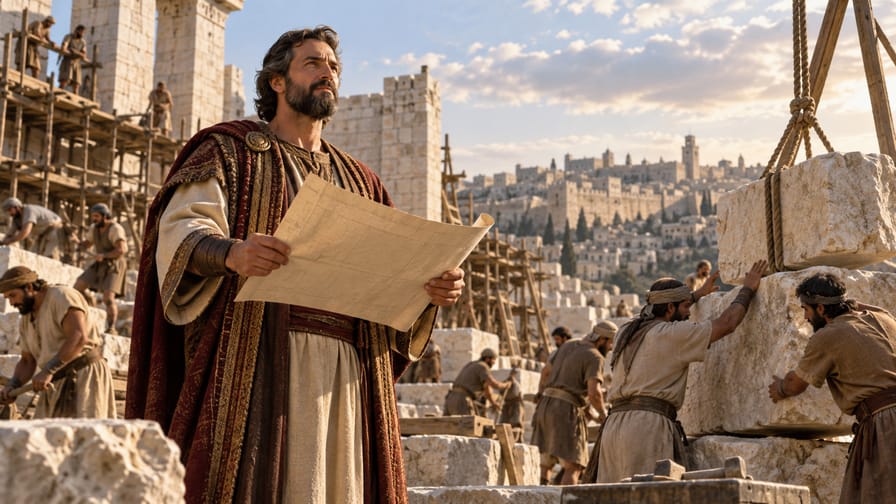
The figure of Zerubbabel emerges in the Hebrew Scriptures as a central leader in the post-exilic period, playing a crucial role in the restoration of Judah after the Babylonian captivity. His story, intrinsically linked to the reconstruction of the Temple in Jerusalem, is permeated by challenges, faith, and divine intervention.
This article seeks to offer an in-depth biblical and theological analysis of Zerubbabel, exploring his onomastic significance, the historical context of his life, his character, and the theological relevance his trajectory holds, especially from a conservative evangelical Protestant perspective.
Understanding his contribution is vital for tracing the continuity of the Davidic lineage and for discerning the messianic prefigurations that point to Jesus Christ, the true builder of the spiritual temple.
1. Etymology and meaning of the name
The name Zerubbabel (Hebrew: זְרֻבָּבֶל, Zerubbabel) is of Babylonian or Persian origin, reflecting the period of exile in which he was born. The most widely accepted etymology derives the name from a combination of Akkadian and Hebrew elements, suggesting a meaning deeply tied to his birth context.
The first part of the name, Zerub (זְרֻ), is generally associated with the Semitic root zara' (זָרַע), which means "to sow" or "seed." The second part, Babel (בָּבֶל), clearly refers to the city of Babylon, the location of Israel's captivity.
Therefore, the predominant literal meaning for Zerubbabel is "seed of Babylon" or "born in Babylon." This meaning is not only geographical but also symbolic, as he represented the hope of a new generation born in exile, destined to return and rebuild.
Some scholars propose an alternative derivation, suggesting that zeru might come from zera' in the sense of "dispersed" or "scattered," resulting in "one who was dispersed in Babylon." However, the interpretation of "seed of Babylon" is more common and aligns better with the idea of a new lineage sprouting on foreign soil but destined for Israel.
Although there are no other prominent biblical characters with the exact name of Zerubbabel, the name itself carries deep theological significance. It points to God's faithfulness in preserving the Davidic lineage even amidst captivity, ensuring that the Messianic promise would remain alive.
Zerubbabel's name is a testimony to divine sovereignty, which transforms a period of judgment and dispersion into fertile ground for the continuity of His promises, culminating in restoration and the hope of the Messiah.
2. Historical context and biblical narrative
2.1. Historical period and context
Zerubbabel lived in the post-exilic period, approximately between 538 BC and 515 BC, a time of great significance for Israel's history. This period was marked by the end of the Babylonian captivity and the beginning of Persian domination, which allowed the Jews to return to their homeland.
The political context was shaped by the decree of Cyrus the Great in 538 BC, which authorized the Jews to return to Jerusalem and rebuild the Temple (Ezra 1:1-4). This act was a remarkable fulfillment of the prophecies of Jeremiah (Jeremiah 29:10) and Isaiah (Isaiah 44:28 45:13), demonstrating God's sovereignty over human empires.
Socially and religiously, the Jewish community was in a state of vulnerability and discouragement. The return was not easy, and the reconstruction of the Temple faced strong opposition from neighboring peoples, such as the Samaritans, who attempted to sabotage the work (Ezra 4:1-5).
2.2. Family origin and genealogy
Zerubbabel was of royal lineage, a direct descendant of King David. The Scriptures identify him as the son of Shealtiel (Ezra 3:2 Haggai 1:1 Matthew 1:12 Luke 3:27), which placed him as the legitimate heir to the Davidic throne, although Judah was under foreign rule and without its own king.
A genealogical question arises in 1 Chronicles 3:19, where Zerubbabel is listed as the son of Pedaiah, Shealtiel's brother. Evangelical commentators, such as F. F. Bruce, suggest that Shealtiel may have been his legal father (via levirate marriage or adoption) or that Pedaiah may have been his biological father, but Shealtiel was the legally recognized progenitor due to his position as the first son or heir to the throne.
Regardless of the complexity, the New Testament genealogies in Matthew and Luke confirm Zerubbabel's Davidic lineage, connecting him directly to the ancestry of Jesus Christ (Matthew 1:12-13 Luke 3:27). This highlights his importance in salvation history and the continuity of the Messianic promise.
2.3. Main events and relationships
Zerubbabel led the first group of exiles who returned to Jerusalem under Cyrus's decree (Ezra 2:2). He was appointed governor of Judah by the Persian king, a position that invested him with civil authority to oversee the restoration of the province.
The main events of his life include organizing the return, rebuilding the altar and celebrating Passover (Ezra 3:2-6), and laying the foundations of the Second Temple in 536 BC (Ezra 3:8-13). This was a moment of great joy and hope, although the older ones who remembered Solomon's Temple wept at the modesty of the new foundation.
However, opposition from the Samaritans and other neighboring peoples led to a halt in the Temple's construction for about 16 years (Ezra 4:1-24). During this period of discouragement and stagnation, Zerubbabel and the high priest Joshua (or Jeshua) were confronted and encouraged by the prophets Haggai and Zechariah.
The prophets Haggai and Zechariah (c. 520 BC) played a vital role in reviving the spirit of the people and their leaders (Haggai 1:1-11 Zechariah 4:6-10). Their divinely inspired messages impelled Zerubbabel and Joshua to resume the Temple work, despite opposition and lack of resources.
With prophetic help and encouragement, Zerubbabel and Joshua persevered. The Temple was finally completed and dedicated in 515 BC, in the sixth year of the reign of Darius I (Ezra 6:13-15). This triumph marked the restoration of Yahweh worship in Jerusalem and the reaffirmation of Jewish identity.
The central geography of Zerubbabel's narrative is Jerusalem and the province of Judah, but his journey began in Babylon and was influenced by the Persian kings Cyrus and Darius. His relations with the high priest Joshua, the prophets Haggai and Zechariah, and the Persian kings are fundamental to understanding his success and divine intervention.
3. Character and role in the biblical narrative
3.1. Analysis of character and virtues
Zerubbabel's character, as revealed in the Scriptures, is that of a pious, resilient, and obedient leader to God's will. Although the Scriptures do not provide a detailed description of his personality, his actions and the way he responded to challenges reveal remarkable spiritual qualities.
One of his most prominent virtues was faith. Despite the enormous task of leading a discouraged and impoverished people back to their land and rebuilding their center of worship, Zerubbabel demonstrated trust in God's promise. He initiated the Temple work, even in the face of limited resources and strong opposition (Ezra 3:8-13).
His perseverance is evident in how he resumed the Temple construction after a 16-year hiatus. The exhortation of the prophets Haggai and Zechariah was not merely a rebuke, but a call to the revival of commitment, to which Zerubbabel responded with obedience and renewed vigor (Haggai 1:12-15).
He also demonstrated courage in facing the opposition of the Samaritans and Persian officials who tried to hinder the work. His leadership, together with Joshua's, was crucial to keep the people focused on the divine task, trusting in God's provision amidst adversity (Ezra 5:1-5).
3.2. Vocation and specific role
Zerubbabel's vocation was unique: he was the governor of Judah, a civil and political leader appointed by the Persian empire, but also an instrument of God for the restoration of His people and His Temple. His role was executive leadership, organizing the return and supervising the reconstruction.
He was neither a priest nor a prophet, but his civil authority was vital to protect and mobilize the community. As a descendant of David, he represented the continuity of the royal lineage, keeping alive the Messianic hope for the people of Israel.
His most significant actions include leading the first return of exiles, supervising the reestablishment of the altar and religious festivals, and, above all, directing the reconstruction of the Temple. He was the human instrument through whom the glory of God would return to His sanctuary in Jerusalem.
The development of his character can be seen in the transition from a leader who began the work with enthusiasm, went through a period of discouragement and interruption, and was finally re-energized by the prophetic word to complete the task. This journey reflects the struggles and triumphs of faith amidst the realities of life.
Zechariah's message, "Not by might nor by power, but by my Spirit," says the LORD of hosts (Zechariah 4:6), was directed directly to Zerubbabel. This passage encapsulates his role: a leader who depended not on his own ability or limited resources, but on the empowering power of the Holy Spirit to fulfill the divine will.
4. Theological significance and typology
4.1. Role in redemptive history and Christocentric typology
The theological significance of Zerubbabel is multifaceted, with a prominent role in Israel's redemptive history and a rich Christocentric typology. His life and work are a crucial link in the progressive revelation of God's plan for salvation.
He represents God's faithfulness in preserving the Davidic lineage, ensuring that the promise of the Messiah, who would come from the root of Jesse (Isaiah 11:1), would not be broken. His inclusion in Jesus' genealogies in Matthew and Luke (Matthew 1:12-13 Luke 3:27) underscores this continuity.
Zerubbabel's most significant function was the reconstruction of the Temple. In this work, he acts as a type of Christ. Just as Zerubbabel led the building of the physical Temple that would be the center of God's worship, Jesus Christ is the builder and the spiritual Temple Himself, where God dwells through the Spirit (John 2:19-21 Ephesians 2:19-22).
The prophecy of Zechariah 6:12-13, which speaks of the "Man whose name is Branch" (tsemakh, צֶמַח), who will build the temple of the LORD and will sit as priest on his throne, is clearly Messianic. Although Zerubbabel was the builder of the physical temple, he prefigured the One who would build the eschatological and eternal temple, Jesus Christ Himself.
4.2. Covenants, prophecies, and fulfillment
The Davidic covenant (2 Samuel 7:12-16), which promised a descendant of David to reign forever, finds in Zerubbabel a point of continuity after the exile. He is the human link that keeps alive the hope of a Davidic king, even when earthly kingship had ceased in Israel.
The prophecies of Haggai and Zechariah addressed to Zerubbabel are full of theological significance. Haggai 2:6-9 predicts that the glory of the second Temple, though modest in its initial construction, would be greater than that of the first, not for its material splendor, but by the coming of the "Desire of all nations" (Haggai 2:7), a clear Messianic allusion.
The prophecy of Haggai 2:23, where God promises to make Zerubbabel a "signet ring", is of particular importance. The signet ring was a symbol of royal authority and divine election. In this passage, God reaffirms His choice of Zerubbabel as His servant, guaranteeing the preservation of his lineage and the future manifestation of the Messiah.
The reference in Zechariah 4:7 about the "capstone" (or "headstone", 'eben hārō'š, אֶבֶן הָרֹאשׁ) that Zerubbabel would bring to complete the Temple, amidst acclamations of "Grace, grace to it!", is a prefiguration of Christ's work. He is the cornerstone of the Church, the spiritual Temple, and the consummation of God's grace (Ephesians 2:20 1 Peter 2:6-7).
The prophecies of Haggai and Zechariah, though immediately applicable to Zerubbabel and the reconstruction of the Temple, transcend their immediate context to point to a greater fulfillment in Jesus Christ. He is the true "Branch", the "Desire of the nations" and the "Cornerstone" who completes the work of God.
4.3. Connection with theological themes
Zerubbabel's story is intrinsically linked to central theological themes such as God's faithfulness to His covenant, divine sovereignty over human history, the importance of obedience and faith amidst adversity, and Messianic hope. He exemplifies the truth that God uses imperfect human instruments to accomplish His perfect purposes.
His life demonstrates that the work of God is not accomplished by human power or military might, but by the Spirit of God (Zechariah 4:6), a fundamental principle of evangelical theology regarding divine empowerment in Christian life and service. Zerubbabel's story is a testimony to God's empowering grace.
5. Biblical-theological legacy and canonical references
5.1. Mentions in other biblical books and influence
Zerubbabel is mentioned in several books of the biblical canon, attesting to his importance in the narrative of Israel's history. He appears prominently in Ezra (chapters 2-6), where his leadership in the return and reconstruction of the Temple is detailed.
The prophetic books of Haggai and Zechariah are largely dedicated to encouraging and prophesying about Zerubbabel and Joshua, the high priest. These prophecies not only spurred the completion of the Temple but also revealed crucial aspects of God's Messianic plan.
In the New Testament, Zerubbabel is cited in the genealogies of Jesus Christ in Matthew 1:12-13 and Luke 3:27. His inclusion in these lists is fundamental for establishing the credibility of Jesus' Davidic lineage, confirming Him as the legitimate heir to the promise of David's throne.
His influence on biblical theology is profound, especially in post-exilic theology of restoration and hope. Zerubbabel's story solidifies the doctrine of God's perseverance in fulfilling His promises, even when the situation seems desperate and the people flawed.
5.2. Treatment in interpretative tradition and evangelical theology
In the Jewish interpretative tradition, Zerubbabel is revered as one of the great leaders of the restoration, a key figure in the reconstruction of Jewish identity and worship after the exile. He is seen as a symbol of renewal and resilience for the people of Israel.
In Christian theology, and particularly in Reformed and evangelical theology, Zerubbabel is celebrated not only as a faithful leader but also as a significant type of Christ. His role as builder of the Temple and descendant of David is interpreted as a prefiguration of Jesus' work as the Builder of the spiritual Temple (the Church) and the eternal King of the Davidic lineage.
Evangelical commentators, such as John Calvin and Matthew Henry, frequently highlight Zerubbabel's dependence on God's grace and Spirit, as emphasized in Zechariah 4:6. His story serves as a powerful reminder that God's work is accomplished not by human strength, but by divine power.
Zerubbabel's relevance for understanding the canon lies in his function as a historical and theological bridge between the exile and the coming of the Messiah. He represents the continuity of God's promise, the restoration of His people, and the preparation for the full manifestation of Christ.
His life and leadership exemplify God's sovereignty in orchestrating historical events and raising up leaders to fulfill His redemptive purposes, culminating in the incarnation, death, and resurrection of Jesus Christ, the true Temple and eternal King.