


Paul
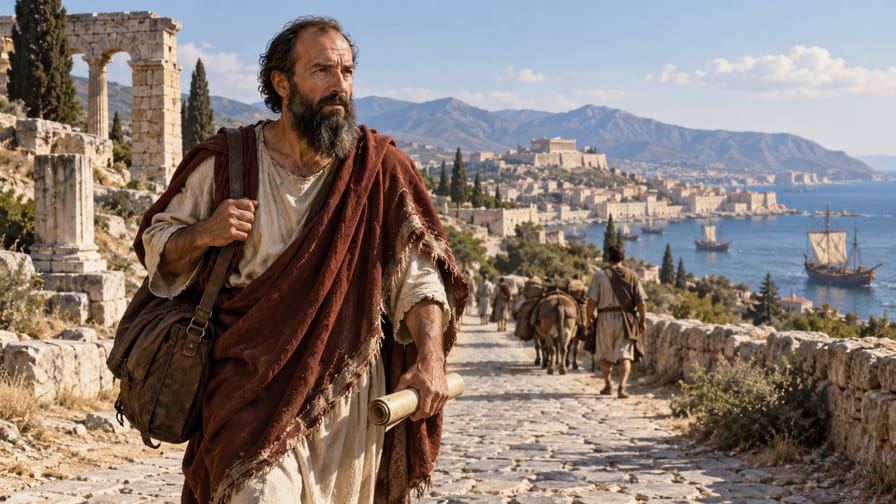
The figure of Paul, originally known as Saul of Tarsus, represents one of the most significant pillars of early Christianity and Christian theology. His life, marked by a dramatic conversion and a tireless apostolic ministry, transformed him from a zealous persecutor of the church into its most prominent missionary and theologian.
This entry will explore the depth of his person and legacy, from the etymology of his name to his canonical and theological influence, from an evangelical Protestant perspective that emphasizes biblical authority and the centrality of Christ.
1. Etymology and Meaning of the Name
The apostle Paul is known by two names in the Scriptures: Saul and Paul. His birth name was Saul (in Greek, Saulos, Σαῦλος in Hebrew, שָׁאוּל, Sha'ul), which is the Greek form of the Hebrew name of the first king of Israel, from the tribe of Benjamin, the same tribe as Paul (Philippians 3:5).
The name Sha'ul means "asked for," "prayed for," or "borrowed" (from God). This name reflected the Jewish tradition of naming children after illustrious figures or with meanings that expressed the parents' hope.
The change or adoption of the name Paul (in Greek, Paulos, Παῦλος in Latin, Paulus) is recorded in Acts 13:9, during his first missionary journey, specifically after confronting the magician Elymas, also known as Bar-Jesus, in the presence of the proconsul Sergius Paulus. The name Paulus is of Latin origin and means "small" or "humble."
This onomastic transition is theologically significant. While some suggest that Paul adopted the proconsul's name as an honor, the more common interpretation is that he already possessed Roman citizenship and, therefore, a Latin name from birth. From Acts 13 onward, Luke, the author of the book, predominantly refers to him as Paul.
The choice or public adoption of the name Paul, which means "small," may have been an expression of his humility and his new purpose, contrasting with the prominence of his Hebrew name. This new name resonated with his self-declaration of being "the least of the apostles" (1 Corinthians 15:9) and "the least of all the saints" (Ephesians 3:8), reflecting his profound awareness of divine grace.
For many theologians, the change of name from Saul to Paul symbolizes a transition from his Jewish and Pharisaic identity to his identity as an apostle to the Gentiles. The name Saulos was appropriate for the zealous Jew who persecuted Christians, but Paulos, the "small one," was more fitting for the humble servant of Christ who dedicated himself to bringing the gospel to non-Jews.
This duality of names, and the subsequent predominance of Paul, underscores the radical transformation wrought by God's grace in his life. The name "small" came to represent the giant of faith who, through human weakness, manifested divine strength (2 Corinthians 12:9-10).
2. Historical Context and Biblical Narrative
2.1 Family Origin and Education
Paul was born in Tarsus, an important city in Cilicia (modern-day Turkey), around 5-10 A.D. (Acts 21:39 22:3). He was a Diaspora Jew, born free and a Roman citizen by birthright, which afforded him significant privileges (Acts 22:25-28). His family belonged to the tribe of Benjamin, and he was a Pharisee, "a son of Pharisees" (Philippians 3:5 Acts 23:6).
His education was exemplary. In Jerusalem, he was instructed at the feet of Gamaliel, one of the most respected rabbis of that era (Acts 22:3). This implied a profound knowledge of the Mosaic Law, Pharisaic traditions, and the Old Testament, which would later prove crucial for his theological argumentation.
2.2 Persecution and Conversion
Before his conversion, Paul (then Saul) was a zealous Pharisee and a fierce persecutor of Christians, believing he was serving God by eradicating what he considered a heresy (Galatians 1:13-14 Philippians 3:6). He was present and approved of the stoning of Stephen, the first Christian martyr (Acts 7:58 8:1).
His life was dramatically transformed on his journey to Damascus, where he intended to arrest Christians and bring them to Jerusalem. There, he encountered the resurrected Jesus Christ himself in a heavenly light, which temporarily blinded him and called him to be his apostle to the Gentiles (Acts 9:1-19 22:6-16 26:12-18). This event is central to the New Testament narrative and to Paul's own identity.
2.3 Apostolic Ministry and Missionary Journeys
After his conversion and a period of seclusion and learning in Arabia (Galatians 1:17-18), Paul began his ministry, which is detailed primarily in the book of Acts of the Apostles. He undertook three major missionary journeys, establishing churches and preaching the gospel in vast regions of the Roman Empire.
- First Missionary Journey (c. 46-48 A.D.): Accompanied by Barnabas and John Mark, Paul traveled to Cyprus and various cities in Asia Minor (Galatia), such as Antioch in Pisidia, Iconium, Lystra, and Derbe (Acts 13-14).
- Jerusalem Council (c. 49 A.D.): Paul and Barnabas participated in the council that discussed the necessity for Gentile converts to observe the Mosaic Law, especially circumcision. The decision was favorable to the Gentiles, reaffirming salvation by grace through faith (Acts 15 Galatians 2:1-10).
- Second Missionary Journey (c. 49-52 A.D.): With Silas and later Timothy and Luke, Paul revisited the churches in Asia Minor and, guided by the Holy Spirit, crossed into Europe, preaching in Philippi, Thessalonica, Berea, Athens, and Corinth (Acts 15:36-18:22).
- Third Missionary Journey (c. 53-57 A.D.): Paul spent a considerable time in Ephesus (about three years), strengthening the churches and facing opposition. From there, he traveled again through Macedonia and Achaia, before returning to Jerusalem (Acts 18:23-21:16).
2.4 Imprisonments and Martyrdom
Upon returning to Jerusalem, Paul was arrested under false accusations of defiling the Temple (Acts 21:27-36). After being tried by several Roman governors (Felix, Festus) and by King Agrippa II, he appealed to Caesar (Acts 25:11), which led to him being sent to Rome.
In Rome, Paul spent at least two years under house arrest, proclaiming the kingdom of God and teaching about the Lord Jesus Christ with all boldness and without hindrance (Acts 28:30-31). Christian tradition, though not explicitly detailed in the Bible, asserts that Paul was released, undertook a fourth missionary journey (perhaps to Spain), and was again arrested and martyred in Rome under Emperor Nero, around 64-68 A.D., beheaded as a Roman citizen.
3. Character and Role in the Biblical Narrative
3.1 The Zealous Pharisee and the Transformed Apostle
Paul's character is complex and multifaceted, revealing a radical transformation by God's grace. Before his conversion, he was a man of intense religious zeal, but misguided. His passion for the Law and Jewish traditions led him to persecute the church with relentless ferocity (Galatians 1:13-14), sincerely believing he was pleasing God.
After his encounter with Christ, that same zeal was redirected and purified. He became equally passionate about Christ and the propagation of the gospel, demonstrating unwavering dedication, courage in the face of adversity, and remarkable resilience in the face of suffering (2 Corinthians 11:23-28). His life became a living testimony to the transforming power of the gospel.
3.2 Virtues and Spiritual Qualities
Paul displayed an impressive range of Christian virtues. His unwavering faith in Christ was the foundation of his ministry and his hope (Romans 1:17 Philippians 3:9). He demonstrated profound humility, recognizing himself as the "foremost of sinners" (1 Timothy 1:15) and attributing all his success to the grace of God (1 Corinthians 15:10).
His perseverance was legendary, enduring imprisonments, floggings, shipwrecks, hunger, and dangers of all kinds for the sake of the gospel (2 Corinthians 11:23-27). Paul's courage was evident in his willingness to preach in hostile synagogues, before governors and emperors, and to face opposition from both Jews and Gentiles.
Furthermore, Paul was a man of great love for the brethren and for the lost. His epistles overflow with affection, pastoral concern, and a desire for the edification of the churches. He identified with his sheep, weeping with those who wept and rejoicing with those who rejoiced (Romans 12:15 1 Thessalonians 2:7-8). His discipline and self-control were manifest in his life and in his call to "discipline his body" (1 Corinthians 9:27).
3.3 Weaknesses and Character Development
Although great, Paul was not without weaknesses. His energetic nature, which propelled him to zeal, could also manifest itself in moments of impatience, such as in the dispute with Barnabas concerning John Mark (Acts 15:36-40). He also mentioned a "thorn in the flesh," an unspecified affliction that kept him humble and dependent on God's grace (2 Corinthians 12:7-10).
The development of his character is a journey of continuous sanctification. From an arrogant persecutor, he became a humble servant from a rigid legalist, a herald of grace from a man focused on rituals, a preacher of freedom in Christ. His life is a testament that God's grace not only saves but also profoundly transforms.
3.4 Vocation and Specific Role
Paul's vocation was unique: to be the "apostle to the Gentiles" (Romans 11:13 Galatians 2:7-9). He was divinely commissioned to bring the gospel of Christ to non-Jews, breaking down cultural and religious barriers. His role was multifaceted:
- Missionary and Church Planter: He traveled extensively, founding Christian communities throughout the eastern Mediterranean.
- Theologian and Doctrinal Teacher: His epistles are the primary source for much of Christian doctrine, explaining soteriology, ecclesiology, and Christian ethics.
- Pastor and Counselor: He cared for the churches he founded, offering direction, correction, and encouragement through his letters.
- Apologist: He vigorously defended the gospel against false doctrines and legalism, from both Jews and Gentiles.
His role was crucial for the transition of Christianity from a Jewish movement to a universal faith. He was God's chosen instrument to articulate the implications of Christ's work for all nations.
4. Theological Significance and Typology
4.1 Role in Redemptive History and Progressive Revelation
Paul's theological contribution is monumental. He was the primary interpreter of the meaning of Christ's death and resurrection for the history of salvation. His theology is intrinsically Christ-centered, seeing in Christ the fulfillment of all Old Testament promises and the climax of God's redemptive history.
Paul articulated how salvation, promised to Abraham (Galatians 3:6-9) and prefigured in the Law, is now realized in Christ Jesus, available to all, Jews and Gentiles, by faith. He demonstrated that the Law could not justify, but pointed to the need for a Savior (Romanos 3:20 Gálatas 3:24).
4.2 Central Theological Themes
Pauline theology is rich and vast, encompassing various themes crucial for evangelical Christian faith:
- Justification by faith: Paul's central doctrine is that salvation is not achieved by works of the Law, but by God's grace, through faith in Jesus Christ (Romans 3:28 Ephesians 2:8-9). This concept was fundamental to the Protestant Reformation.
- Union with Christ: Believers are united with Christ in his death and resurrection, resulting in a new identity and a new life (Galatians 2:20 Romans 6:3-11). This union is the basis of sanctification and future hope.
- The Grace of God: Paul emphasized the unmerited and sovereign nature of divine grace as the source of all salvation and empowerment for service (Romans 5:20-21 2 Corinthians 12:9).
- The Body of Christ: He developed the metaphor of the church as the body of Christ, with Christ as the head and believers as interconnected members, each with distinct gifts and functions (1 Corinthians 12:12-27 Ephesians 4:15-16).
- Eschatology: Paul addressed the hope of Christ's second coming, the resurrection of the dead, and the consummation of the Kingdom of God (1 Thessalonians 4:13-18 1 Corinthians 15:51-57).
- New Creation: In Christ, the believer is a "new creation" (2 Corinthians 5:17), and God's work in Christ is leading to a cosmic renewal.
4.3 Covenants and Fulfillment in Christ
Paul deeply understood the continuity and discontinuity between the Old and New Testaments. He saw the Abrahamic covenant as God's original promise to bless all nations, fulfilled in Christ (Galatians 3:8, 16). The Mosaic Law, though holy and good, served as a "guardian" to lead to Christ (Galatians 3:24), revealing sin and humanity's inability to achieve righteousness on its own.
His covenant theology highlights that salvation has always been by faith, and that the inclusion of Gentiles into the people of God was not a novelty but the fulfillment of the divine plan revealed from the beginning (Romans 9-11 Ephesians 2:11-22).
4.4 Absence of Direct Typology in Christ
Unlike figures such as Moses or David, Paul is not typologically a direct prefiguration of Christ. Nevertheless, his ministry and suffering serve as an exemplary pattern for Christian life and apostolic service. He saw himself as an imitator of Christ (1 Corinthians 11:1), and his life of sacrifice and dedication to the gospel reflects the model of the Savior himself. His personal experience of being transformed by grace is, in itself, a testimony to the saving power of Christ.
5. Biblical-Theological Legacy and Canonical References
5.1 Literary Contributions and Canonical Influence
Paul's most tangible contribution to the biblical canon consists of his thirteen (or fourteen, if Hebrews is attributed to him) epistles. These letters, written to churches and individuals, constitute approximately a quarter of the New Testament and are the primary source of his theology. They include:
- Major Epistles: Romans, 1 and 2 Corinthians, Galatians.
- Prison Epistles: Ephesians, Philippians, Colossians, Philemon.
- Pastoral Epistles: 1 and 2 Timothy, Titus.
- Eschatological Epistles: 1 and 2 Thessalonians.
These letters are not merely historical documents, but are considered God-inspired Scripture (2 Timothy 3:16), providing doctrine, instruction, correction, and exhortation for all times. Peter himself recognized the authority of Paul's letters, referring to them as "Scriptures" (2 Peter 3:15-16).
5.2 Presence in Interpretive Tradition and Evangelical Theology
Paul's influence extends far beyond the canon. He is a central figure in Christian interpretive tradition. Church Fathers, such as Augustine, were profoundly shaped by his theology. In the Protestant Reformation, Pauline doctrines of justification by faith, sovereign grace, and Christian liberty were rediscovered and became the pillars of Protestantism.
In contemporary evangelical theology, Paul continues to be an inexhaustible source of study and application. His emphasis on the authority of the Scriptures, the centrality of Christ, the need for global evangelization, and the life transformed by the Holy Spirit resonates deeply with evangelical values. Evangelical theologians such as John Stott, F.F. Bruce, and N.T. Wright (though with nuances in some interpretations) have dedicated extensive works to Pauline exegesis and theology.
His life and teachings are seen as the model for cross-cultural mission, apologetics, and the formation of vibrant communities of faith. The understanding of the gospel and Christian life would be drastically impoverished without Paul's contributions.
5.3 Importance for Understanding the Canon
Paul plays a crucial role in understanding the unity and coherence of the biblical canon. He demonstrates how the Old Testament points to Christ and how the new covenant in Christ fulfills the ancient promises. His theology acts as a hermeneutical bridge between the two parts of the Bible, revealing the continuity of God's redemptive plan.
His letters provide the doctrinal framework for the Christian faith, explaining the implications of Christ's work for individual and collective life. Without Paul's theological clarity, many aspects of the gospel, such as justification, sanctification, and the nature of the church, would be less understood. He is, therefore, indispensable for a robust biblical theology and for the identity of the Christian church.