


Ezra
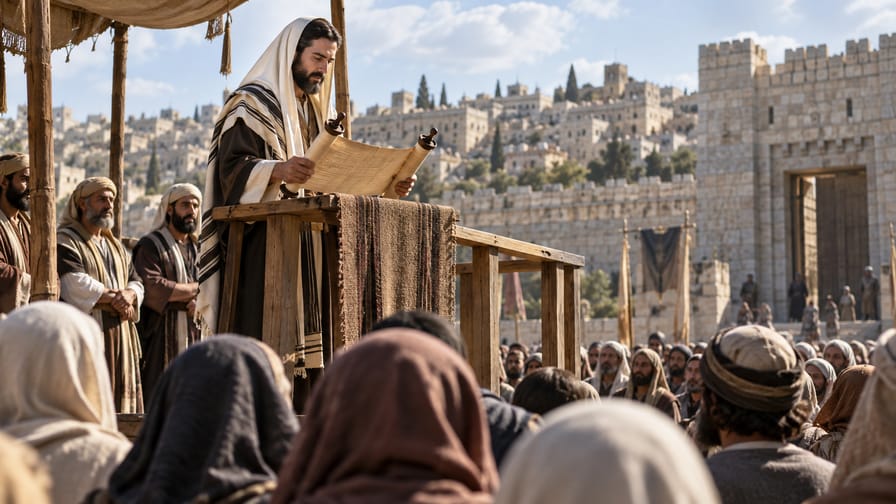
The figure of Ezra stands out in the post-Babylonian exile period as one of the main leaders responsible for the spiritual and social restoration of the Jewish community in Jerusalem. His story, recorded primarily in the book that bears his name and in the book of Nehemiah, is a testament to God's sovereignty in preserving His people and His Word.
As a priest and scribe, Ezra combined religious authority with a deep knowledge of the Law of Moses, becoming a catalyst for a religious revival and the reaffirmation of Israel's identity. His life and ministry are crucial for understanding the formation of post-exilic Judaism and the preservation of the Old Testament canon.
1. Etymology and Meaning of the Name
1.1 Original Name and Linguistic Derivation
The name Ezra derives from the Hebrew ‘Ezrā’ (עֶזְרָא), which means "help" or "aid". The etymological root is ‘āzar (עָזַר), a common Hebrew verb meaning "to help", "to succor", or "to assist". This meaning is deeply representative of the role that Ezra played in the history of Israel.
In the Septuagint, the Greek translation of the Old Testament, the name is transliterated as Esdras (Ἔσδρας). This Greek form is the basis for the name in Portuguese and many other Western languages. The persistence of this form underscores the importance of his figure in the Judeo-Christian tradition.
1.2 Literal and Symbolic Meaning
Literally, the name Ezra points to someone who brings help or who is a source of aid. In the context of his life, this name proves to be prophetic, as he was the divine instrument to help the people of Israel return to obedience to the Law of God and rebuild their spiritual identity.
The meaning of the name resonates with divine providence, for God raised up Ezra as an "aid" at a critical moment in Israel's history. After the return from exile and the rebuilding of the Temple, the people needed moral and spiritual restoration, and Ezra was the instrument for this work of renewal.
1.3 Other Characters and Theological Significance
Although there are no other prominent biblical characters with the exact name of Ezra, the idea of "help" is central to biblical theology, often attributed to God Himself as the "help" of His people (Psalm 46:1). The name of Ezra, therefore, symbolizes the help that comes from God through His servants.
Theologically, the name of Ezra underscores the truth that God always provides leaders and resources for the restoration and faithfulness of His people. He not only signifies "help" but also personifies the divine help that was extended to Israel through his dedication and ministry.
2. Historical Context and Biblical Narrative
2.1 Historical Period and Context
Ezra acted in the post-exilic period, specifically during the reign of Artaxerxes I, king of Persia (465-424 B.C.). His arrival in Jerusalem is dated to the seventh year of Artaxerxes' reign, which corresponds to approximately 458 B.C. This period follows the first and second waves of returning exiles, led by Zerubbabel and Jeshua.
The Temple had already been rebuilt and dedicated (Ezra 6), but the community in Jerusalem faced significant challenges. There was a great need for social organization, spiritual revival, and reaffirmation of the Law of God, which had been neglected during the exile and in the early years of the return.
2.2 Genealogy and Family Origin
The book of Ezra presents his detailed genealogy, which connects him directly to Aaron, the first high priest of Israel. He is described as the son of Seraiah, son of Azariah, and so on, tracing his lineage back to Aaron (Ezra 7:1-5). This priestly ancestry confers upon Ezra unquestionable authority to deal with the religious and ritual matters of the people.
This genealogy is not merely a historical record it establishes Ezra's legitimacy as a qualified priest to interpret and apply the Law. His priestly lineage was fundamental for his leadership to be accepted by the Jewish community, which deeply valued the priestly order established by God.
2.3 Main Life Events and Relationships
The biblical narrative begins with the description of Ezra as a scribe skilled in the Law of Moses (Ezra 7:6). He was in Babylon when he was commissioned by King Artaxerxes I to go to Jerusalem to implement the Law of God and organize the religious life of the community (Ezra 7:11-26).
The journey from Babylon to Jerusalem was undertaken with great dependence on God, with Ezra proclaiming a fast and seeking divine protection (Ezra 8:21-23). After four months, they arrived safely, bringing with them offerings for the Temple and the royal decree for the restoration of religious order.
One of Ezra's first and most impactful actions was to confront the problem of mixed marriages with foreign women, which were prohibited by Mosaic Law and threatened the purity of Israel's identity (Ezra 9:1-2). Upon learning of this transgression, Ezra manifested deep anguish, tore his garments, and prostrated himself in prayer and confession before God (Ezra 9:3-15).
This prayer of confession moved the people to repentance. Under Ezra's leadership, a solemn covenant was made to separate from foreign wives and their children, an act of radical reform to restore the nation's holiness (Ezra 10:1-17). This demonstrates Ezra's firmness in applying the Law, even if it implied difficult decisions.
Years later, Ezra reappears in the book of Nehemiah, playing a fundamental role in the public reading of the Law to the people gathered in Jerusalem (Nehemiah 8:1-8). He read the Law from daybreak until midday, explaining it so that the people would understand it, resulting in great weeping and repentance, followed by joy at the rediscovery of the Word of God (Nehemiah 8:9-12).
Under the guidance of Ezra and Nehemiah, the people celebrated the Feast of Tabernacles with unprecedented joy since the days of Joshua (Nehemiah 8:13-18). This was followed by a great day of fasting and national confession, where the history of God's faithfulness and Israel's unfaithfulness was recapitulated, culminating in the renewal of a formal covenant with God (Nehemiah 9-10).
3. Character and Role in the Biblical Narrative
3.1 Analysis of Character and Virtues
Ezra's character is marked by an unwavering dedication to the Law of God. Scripture states that he "had prepared his heart to seek the Law of the Lord, and to do it, and to teach in Israel statutes and ordinances" (Ezra 7:10). This threefold calling – to seek, to do, and to teach – defines his essence.
He demonstrates himself to be a man of deep piety and prayer. His intercession for the sins of the people (Ezra 9) is not a formality but an expression of his identification with Israel's suffering and guilt. He does not hesitate to weep, fast, and prostrate himself before God in an act of sincere humiliation.
His courage is evident in leading the perilous journey from Babylon to Jerusalem without military escort, relying solely on divine protection (Ezra 8:22). He also displayed moral courage in confronting a sin as deeply rooted as mixed marriages, which had been neglected by other leaders.
3.2 Vocation and Specific Function
Ezra's vocation is twofold: priest and scribe. As a priest, he had the authority to officiate in the Temple and interpret ritual precepts. As a scribe, his function was even more innovative and crucial for post-exilic Judaism. The scribe was a scholar and master of the Law, responsible for its copying, preservation, interpretation, and teaching.
The Hebrew term for scribe, sōp̄ēr (סוֹפֵר), denotes someone proficient in writing, but in Ezra's context, this transcends mere transcription. He was a "scribe skilled in the Law of Moses" (Ezra 7:6), which qualified him as an expert and supreme authority in the Word of God in his generation.
3.3 Role in the Biblical Narrative and Significant Actions
Ezra's role was that of a spiritual reformer and a restorer of Israel's theocratic identity. He not only brought the Law but implemented it, purifying the community of sinful practices and reorienting the people towards obedience to divine commandments. His arrival marked a decisive turning point for the post-exilic community.
His key actions include leading the return from Babylon, the reform of mixed marriages, the public reading and explanation of the Law, and leading the renewal of the covenant. Each of these actions demonstrated his commitment to the authority of Scripture and the holiness of God's people.
He served as a model of leadership that prioritizes the Word of God above all else, not only in its study and teaching but also in its practical application in the life of the community. Ezra's life is a powerful example of how a godly leader can profoundly influence the faith and practice of a nation.
4. Theological Significance and Typology
4.1 Role in Redemptive History and Progressive Revelation
Ezra plays a vital role in redemptive history by ensuring the preservation of Israel's identity and the Mosaic Law after the exile. God's faithfulness in restoring His people and maintaining His covenant is clearly demonstrated through Ezra's ministry. He was a crucial link in the chain of progressive revelation, ensuring that the foundation of Israel's faith – the Torah – remained intact and central.
Without Ezra's work, the post-exilic community could have been diluted culturally and religiously, compromising the messianic lineage and the preparation for the coming of Christ. His reform was an act of divine preservation, maintaining Israel as a distinct people, guardian of God's promises and revelation.
4.2 Prefiguration or Christocentric Typology
Although Ezra is not a direct type of Christ in the sense of a messianic king or prophet, his figure offers important parallels and prefigurations of the ministry of Jesus Christ. His dedication to the Law and his role as a teacher and interpreter of the Word of God can be seen as a precursor to Christ's role as the Teacher par excellence (John 13:13) and the incarnate Word itself (John 1:1).
Ezra sought the purity of God's people through obedience to the Law, and Christ came to purify His people in a much deeper way, not merely through the Law, but through His own life, death, and resurrection, establishing a New Covenant (Hebrews 9:14-15). Ezra's zeal for the holiness of God's people echoes Christ's zeal for His Church, whom He "purified for Himself a people for His own possession, zealous for good works" (Titus 2:14).
Ezra's prayer of confession for the sins of the people (Ezra 9) can be seen as a type of priestly intercession, pointing to Jesus Christ as our perfect High Priest, who continuously intercedes for us (Hebrews 7:25). Ezra, as a mediator of the Law and God's will for His people, reflects, on a smaller scale, Christ's role as the one mediator between God and men (1 Timothy 2:5).
4.3 Connection with Central Theological Themes
Ezra's ministry is intrinsically linked to several central theological themes from an evangelical Protestant perspective. The authority of Scripture is primary: Ezra is the example of a leader who grounds his entire life and ministry in the Word of God. Obedience to the Law is not seen as legalism but as the expected response to God's grace and faithfulness (Deuteronomy 6:24-25).
The need for repentance and reform is vividly illustrated in Ezra's response to mixed marriages. The holiness of God's people, their separation from pagan nations, is a constant theme, crucial for the preservation of the covenant. The sovereignty of God is evident in how He moves the heart of the Persian king and Ezra to accomplish His will of restoration (Ezra 7:27-28).
5. Biblical-Theological Legacy and Canonical References
5.1 Mentions in Other Biblical Books and Literary Contributions
The figure of Ezra is predominantly found in the books of Ezra and Nehemiah. Traditionally, the book of Ezra is attributed to him, and many scholars believe that he may also have played a role in the compilation and editing of the books of Chronicles. His expertise as a scribe qualified him for such editorial and preservation tasks.
Beyond his authorship, Jewish tradition, especially that referring to the Great Synagogue, attributes to Ezra a fundamental role in the organization and canonization of the books of the Hebrew Old Testament. While this is more tradition than an explicit biblical statement, it reflects the perception of his authority and influence over the Torah and the Prophets.
5.2 Influence on Biblical Theology and Interpretative Tradition
Ezra's influence on biblical theology is immense. He consolidated the role of the Law (Torah) as the center of religious and social life in post-exilic Judaism. Under his leadership, the focus shifted from the Temple as the sole center of worship to the synagogue as a place for studying the Law, paving the way for rabbinic Judaism.
In the Christian interpretive tradition, Ezra is seen as a model of piety, dedication to Scripture, and reforming leadership. His story is often cited to emphasize the importance of the reading of the Word of God, repentance, and radical obedience to divine commandments. He is an archetype of the leader who submits to and teaches the Law of God.
5.3 Treatment in Reformed and Evangelical Theology
In Reformed and evangelical theology, Ezra is highly valued as an example of faithfulness to the inerrant Word of God. His life illustrates the doctrine of Sola Scriptura, where Scripture is the ultimate authority for faith and practice. Ezra's priority to seek, do, and teach the Law resonates with the evangelical commitment to expository preaching and biblical discipleship.
He is frequently studied in contexts of revival and reform, as his work in Jerusalem demonstrated how the rediscovery and application of the Law of God can lead to profound spiritual and social transformation. Evangelical theology sees in Ezra a reminder of the constant need to return to the Scriptures for the renewal of the Church.
Although not cited by name in the New Testament, Ezra's legacy is undeniable, as he helped shape the Jewish context in which Jesus and the apostles operated. The emphasis on the Torah, the existence of synagogues, and the figure of the scribe as a master of the Law are all elements that flourished from Ezra's work and are fundamental to understanding the New Testament background.