


Dan
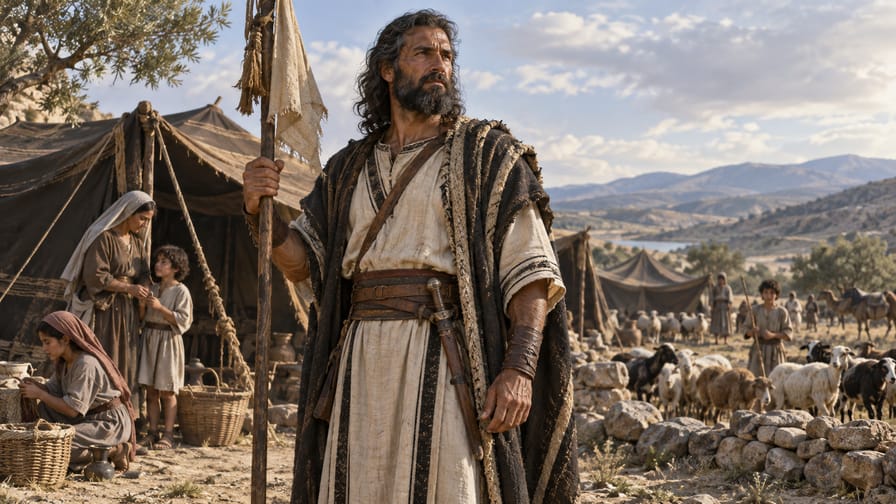
The figure of Dan, both as a patriarch and as the tribe that originated from him, occupies a complex and, at times, enigmatic place in the Holy Scriptures. His history and legacy intertwine with crucial themes of biblical theology, such as covenant faithfulness, divine judgment, and the consequences of apostasy. The analysis of Dan offers a valuable lens for understanding the dynamic of faith and unfaithfulness in Israel's history.
From his family origin to the eschatological implications of his omission in Revelation, Dan represents a fascinating case study. This entry will explore the etymology of the name, the historical context, the multifaceted character of the tribe, its theological significance, and its canonical legacy, always from the perspective of evangelical Protestantism, which values the inerrant authority of the Word of God and its relevance for Christian life.
1. Etymology and meaning of the name
The name Dan, in Hebrew Dān (דָּן), derives from the verbal root din (דִּין), which means "to judge," "to defend," or "to vindicate." This meaning is explicitly articulated in the account of his birth in Genesis 30:6, where Rachel, his surrogate mother, declares: "God has vindicated me He has also heard my voice and given me a son. So she called him Dan."
The choice of name reflects Rachel's belief that God had vindicated her in her barrenness, granting her a son through her servant Bilhah. Thus, the literal meaning of Dan is "Judge" or "He judged." This name carries a strong theological connotation of justice and divine intervention, a recurring theme in Israel's history.
Although Dan is the most prominent name, there are no significant variations of the name in other biblical languages that alter its fundamental meaning. The form Dān is consistent in the Hebrew texts. It is important to note that there are no other prominent biblical figures with the same name, which makes the analysis of the patriarch and the tribe of Dan unique.
The theological significance of the name Dan in the biblical context is profound. It points to one of God's fundamental attributes: His justice and sovereignty as the supreme judge. Rachel recognizes God's hand in her situation, attributing to Him the role of vindicator. This establishes a precedent for the tribe of Dan, which, in theory, should reflect this divine characteristic in its conduct.
The expectation that the tribe of Dan would be an agent of justice is reinforced in Jacob's blessing in Genesis 49:16, which declares: "Dan shall judge his people, as one of the tribes of Israel." This prophecy, uttered hundreds of years before the judges, suggests a prominent judicial role for the tribe, a role that would be, in part, fulfilled by figures like Samson.
However, as we shall see, the history of Dan tragically deviates from this initial ideal. The theological irony lies in the discrepancy between the name that evokes divine justice and the actions of the tribe, which frequently leaned towards injustice, idolatry, and apostasy. This tension between the meaning of the name and historical reality is central to understanding Dan's legacy.
2. Historical context and biblical narrative
2.1 Family origin and genealogy
Dan was the fifth son of Jacob and the first of Bilhah, Rachel's servant, born around 1900 BC (considering traditional chronology). His conception and birth are recorded in Genesis 30:4-6, as part of Jacob's complex family dynamic, marked by the rivalry between Rachel and Leah to have children. Dan, along with Naphtali, formed the "sons of Bilhah," serving as a means for Rachel to have offspring through her servant.
The genealogy of Dan, though not as detailed as that of other tribes, is established through his father Jacob, the patriarch of Israel. His lineage is crucial for the formation of the twelve tribes, which would become the nation of Israel. In Numbers 26:42-43, the clans of Dan are mentioned: the Shuhamites and the Hushim, descendants of Hushim and Shuham, the sons of Dan.
2.2 Key events and biblical passages
The history of Dan, as a patriarch, is brief, but that of the tribe is extensive and marked by significant events. During the Exodus, the tribe of Dan was the second largest in number, with 62,700 men fit for war (Numbers 1:39), and marched in the rear guard of the camp, under the banner of Ephraim (Numbers 2:31).
After the conquest of Canaan, the tribe of Dan received a territorial inheritance in the coastal region, northwest of Judah and southwest of Ephraim, including cities like Zorah and Eshtaol (Joshua 19:40-48). However, the Danites had great difficulty expelling the Amorites from their territory, being confined to the mountains (Judges 1:34).
This difficulty in establishing themselves in their original inheritance led to a massive migration of the tribe. In Judges 18, it is narrated how a part of the tribe of Dan sent spies, who discovered the city of Laish, a peaceful and isolated place. Six hundred men of Dan, seeking a new home, conquered Laish and renamed it Dan, settling in the extreme north of Israel (Judges 18:27-29).
This event is crucial, for the city of Dan became the northern border of Israel, giving rise to the expression "from Dan to Beersheba" (Judges 20:1 1 Samuel 3:20 2 Samuel 3:10), which denoted the entire extent of Israelite territory. Unfortunately, this migration also marked the beginning of a profound apostasy, as the Danites stole Micah's idols and established their own idolatrous priesthood in Dan (Judges 18:30-31).
One of the most famous characters associated with the tribe of Dan is Samson, the judge, whose story is told in Judges 13-16. Born in Zorah, Samson was a Nazirite from the womb and a powerful instrument in God's hands against the Philistines, despite his personal failures. His Danite origin is an important point, showing that, even amidst the tribe's decline, God still raised up individuals to fulfill His purposes.
The city of Dan also became a center of idolatry under the reign of Jeroboam I, the first king of the Northern Kingdom (Israel). To prevent the people of Israel from going up to Jerusalem to worship, Jeroboam set up two golden calves, one in Bethel and the other in Dan (1 Kings 12:28-30). This act consolidated Dan as a symbol of apostasy and separation from God.
3. Character and role in the biblical narrative
3.1 Character of the patriarch and the tribe
The patriarch Dan, son of Jacob, is little detailed in the Scriptures. His individual personality is almost indistinguishable, except for the meaning of his name and his father's prophecy. Most of the analysis of Dan's "character" falls upon the tribe descended from him, whose actions and destiny are widely recorded.
The tribe of Dan is initially presented as numerous and powerful, capable of marching in the rear guard, protecting the camp of Israel (Numbers 2:31). This suggests strength and a position of responsibility. However, their inability to fully conquer their inheritance in Canaan (Judges 1:34) reveals a weakness in their faith and obedience, or perhaps a lack of persistent determination.
The migration of the Danites to the north, as narrated in Judges 18, exposes an opportunistic character and, regrettably, a propensity for idolatry. They not only covet the land of Laish but also steal Micah's idols and establish a center of pagan worship. This action demonstrates a clear failure in their calling to be a tribe that would "judge" and uphold God's justice.
Jacob's prophecy in Genesis 49:17 describes Dan as "a serpent by the way, a viper in the path, that bites the horse's heels, so that its rider falls backward." This image is ambiguous it can suggest shrewdness in war and victory through unexpected tactics, as seen in Samson. However, it can also allude to a treacherous or deceptive character, a shadow that hangs over the tribe, especially in its apostasy.
3.2 Role and significant actions
Dan's main role in the biblical narrative is that of one of the twelve tribes of Israel, with an inheritance and responsibility in the promised land. Jacob's blessing, "Dan shall judge his people" (Genesis 49:16), points to a role of leadership and discernment. Samson, the Danite judge, exemplifies this facet, although his personal life was marked by failures. He was an instrument of God to deliver Israel, demonstrating divine sovereignty even through imperfect vessels.
The most significant actions of the tribe of Dan include its migration to the north and the establishment of a center of idolatry in its new city. This event is not just a geographical note but a theological turning point, marking the beginning of the institutionalization of idol worship in Israel. The city of Dan, alongside Bethel, would become a pillar of the religious and political schism of the Northern Kingdom under Jeroboam I (1 Kings 12:28-30).
The tribe of Dan, therefore, plays a crucial role as an example of disobedience and its consequences. Its history serves as a prophetic warning to Israel about the dangers of spiritual complacency, idolatry, and the failure to fully trust in God's provision and promises. Dan's trajectory illustrates human frailty and the constant temptation to deviate from the divine covenant.
4. Theological significance and typology
4.1 Role in redemptive history and theological themes
The history of Dan, though often dark, plays an instructive role in Israel's redemptive history. It illustrates the progressive revelation of God's justice and grace in the face of persistent human unfaithfulness. The name Dan, meaning "Judge," dramatically contrasts with the reality of his tribe, which failed to uphold justice and pure worship.
A central theological theme associated with Dan is that of covenant faithfulness. The tribe of Dan received a specific inheritance but failed to possess it completely and, worse still, established idolatry in its new land (Judges 18:30-31). This serves as a testimony to the seriousness of covenant obligations and the consequences of disobedience, a pattern that repeats throughout Israel's history.
Idolatry and apostasy are the most prominent sins of the tribe of Dan. From the establishment of the Levitical priest in Dan, serving a stolen idol, to Jeroboam's golden calves, the city of Dan became synonymous with turning away from the LORD. This underscores the importance of exclusive worship of God and the biblical condemnation of any form of religious syncretism.
Despite the tribe's failures, God still worked through a Danite, Samson, to bring deliverance to His people. Although Samson is not a perfect type of Christ, his story demonstrates God's sovereignty in using imperfect instruments to fulfill His redemptive purposes. God can use even those from a lineage marked by apostasy to manifest His power and judgment.
4.2 Connection with eschatological themes and the omission in Revelation 7
The absence of the tribe of Dan from the list of the twelve sealed tribes in Revelation 7:5-8 is one of the most intriguing and debated questions in evangelical theology. While all other tribes are named, and Levi and Joseph (represented by Manasseh and Ephraim) are included, Dan is replaced by Manasseh and, in some interpretations, by Levi.
There is no explicit explanation in the text of Revelation for the omission of Dan. However, the evangelical Protestant perspective, which values the coherence and unity of the Scriptures, seeks theological reasons for this exclusion. The most common interpretation associates Dan's omission with its history of apostasy and idolatry in the Old Testament.
The tribe of Dan was the first to establish institutionalized idolatry in Israel (Judges 18) and, later, one of the main centers of Jeroboam's golden calf worship (1 Kings 12). Some commentators view this omission as an eschatological judgment on Dan's persistent unfaithfulness and apostasy, or as a symbol that idolatry excludes from the community of the redeemed.
Another, less common interpretation suggests that Dan became so synonymous with idolatry that it was associated with evil, and therefore, some church fathers, like Irenaeus, even speculated that the Antichrist could come from the tribe of Dan. Although this idea is not supported by direct biblical evidence, it demonstrates the gravity with which Dan's apostasy was viewed.
The absence of Dan in Revelation 7, therefore, serves as a powerful reminder of the seriousness of the sin of idolatry and the importance of persevering faithfulness to God. For evangelical theology, it reinforces the doctrine that, although salvation is by grace, the life of a believer must be marked by obedience and exclusive worship of God, warning against the risk of apostasy for the community of faith.
5. Biblical-theological legacy and canonical references
5.1 Mentions in other biblical books and influence
The tribe of Dan, and the city that bears its name, are frequently mentioned throughout the Old Testament canon. The expression "from Dan to Beersheba" (Judges 20:1 1 Samuel 3:20 2 Samuel 17:11 1 Kings 4:25) became a metonymy for the entire territorial extent of Israel, demonstrating Dan's geographical and symbolic importance as the northern limit.
Dan's influence on biblical theology is felt primarily through its history as a negative example of apostasy and a prophetic warning. The founding of the idolatrous center in Dan, perpetuated by Jeroboam I, is a recurring theme in the prophets' condemnation of the kings of Israel, who frequently pointed to idolatry as the cause of the Northern Kingdom's fall (2 Kings 10:29 2 Kings 17:22-23).
Despite this, the figure of Samson, a Danite, is a reminder of God's sovereignty that operates beyond tribal failures. He is listed among the heroes of faith in Hebrews 11:32, demonstrating that individual faith can emerge and be honored even in contexts of spiritual decline. This shows that God's grace can transcend collective limitations and sins.
In the New Testament, apart from the issue in Revelation 7, there are no direct mentions of Dan. However, the themes of idolatry, apostasy, and covenant faithfulness, exemplified by Dan's history, are fundamental to Christian ethics and theology, serving as a backdrop for exhortations against idolatry and spiritual unfaithfulness in the church (1 Corinthians 10:14 Colossians 3:5).
5.2 Treatment in Reformed and Evangelical Theology
In Reformed and evangelical theology, the figure of Dan is often used to illustrate important principles of the doctrine of the covenant and the holiness of God. Dan's history is seen as a clear case of Israel's breaking of the covenant with the LORD and the devastating consequences that follow, both for the tribe and for the nation as a whole.
Reformed commentators, such as John Calvin, emphasize that Jacob's prophecy concerning Dan as a serpent (Genesis 49:17) has an ambiguous fulfillment, reflecting both military shrewdness and the treacherous nature of the tribe in its apostasy. The omission of Dan in Revelation 7 is widely interpreted as a symbol of divine judgment on idolatry and lack of perseverance in faith.
For conservative evangelical theology, the history of Dan serves as a call to vigilance against syncretism and spiritual compromise within the church. The temptation to mix the worship of God with worldly or idolatrous practices is a constant, and Dan's experience is a somber reminder of the consequences of yielding to this temptation. The purity of worship is a pillar of Christian faith.
In summary, Dan, the patriarch and his tribe, represents a solemn warning within the biblical canon. His history is a testimony to God's justice, which judges unfaithfulness, but also to His grace, which can raise instruments of salvation even amidst decay. Dan's legacy invites us to a profound reflection on perseverance in faith, the exclusivity of worship of God, and the eternal ramifications of our spiritual choices, serving as a mirror for the church of all ages.