


Asbel
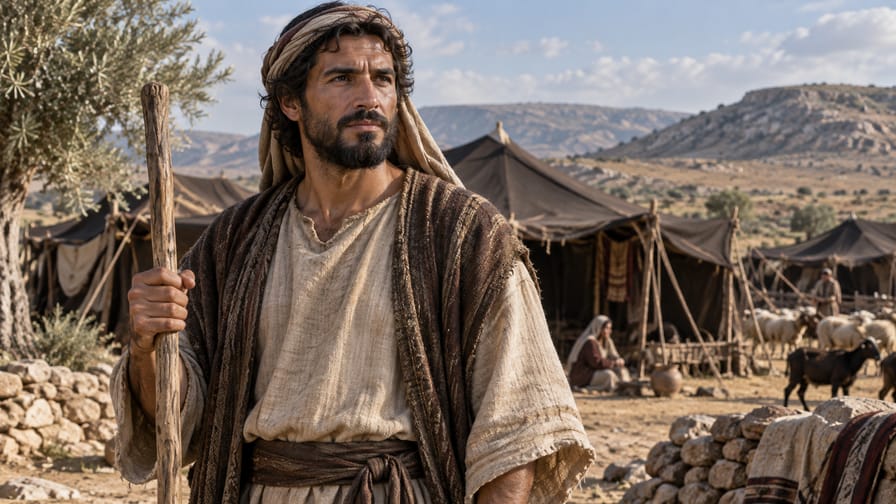
The figure of Asbel, though not prominent in biblical narratives, holds an intrinsic significance within Old Testament theology, especially regarding the formation and structuring of the tribes of Israel. He is a vital link in the patriarchal genealogy, connecting divine promises to a specific lineage that would culminate in the nation chosen by God. His mention, though brief, underscores divine faithfulness in the preservation of descendants and in the execution of His redemptive plan, according to the evangelical Protestant perspective.
This study seeks to explore the relevance of Asbel, not from great deeds or speeches, but from his existence as an integral part of salvation history. The analysis will delve into his onomastic meaning, his historical and genealogical context, his implicit role in the biblical narrative, and the theological implications of his presence in the Scriptures. The adopted perspective will be that of Reformed and evangelical theology, which values the authority of the Scriptures and the centrality of Christ in all biblical revelation.
Even in secondary characters, the Word of God reveals divine purposes and eternal principles. The life of Asbel, though devoid of biographical details, serves as a reminder of God's sovereignty over history and over every individual, however discreet their apparent contribution to the great drama of redemption.
1. Etymology and meaning of the name
The name Asbel (or Ashbel) appears in the Hebrew text as ʾAšbēl (אַשְׁבֵּל). Its etymological root is the subject of some discussion among scholars, but the most accepted interpretations point to meanings connected with the idea of "man of Baal" or "fire of Baal," or perhaps "I will build" or "I will bring."
The derivation of the name from ʾiš (אִישׁ), meaning "man," combined with Baʿal (בַּעַל), a term that can mean "lord" or "owner" and was also the name of a Canaanite deity, suggests the translation "man of Baal." This interpretation, though common, raises questions about the practice of theophoric names with pagan gods among the patriarchs.
However, it is important to note that the term Baʿal, before becoming exclusively associated with the Canaanite god, was an honorific title for "lord" or "master." Thus, the name could simply mean "man of the Lord" or "man of the Master," without an explicit pagan connotation in its more remote origin, although this distinction may have been lost over time.
Another etymological line suggests a connection with the root bānāh (בָּנָה), "to build," or yābal (יָבַל), "to bring," which could lead to meanings such as "I will build" or "I will bring." These interpretations are less common but offer alternatives that avoid direct association with Baal, the Canaanite god.
In the Old Testament context, names often carried deep and prophetic meanings, reflecting hopes, circumstances of birth, or even future qualities of the individual or their descendants. Although the exact meaning of Asbel may be debated, his inclusion in divinely inspired genealogies is of utmost importance.
There are no other notable biblical characters with the same name, which makes Asbel a singular name in its appearance in the Scriptures. The theological significance of the name, therefore, lies less in its isolated literal meaning and more in its function within the genealogical narrative and the history of the covenant.
His existence as a name in the lineage of Israel, regardless of its exact etymology, attests to God's providence in the formation of His people. The preservation of names, even those that might have ambiguous connotations, demonstrates the way God works through the historical reality of His people, redeeming and utilizing even elements that could be problematic.
2. Historical context and biblical narrative
2.1 Family origin and genealogy
Asbel is mentioned in the Scriptures as one of the sons of Benjamin, the twelfth and last son of Jacob (Israel) and the second son of Rachel, who died giving birth to Benjamin. His first mention occurs in Genesis 46:21, in the list of those who went down to Egypt with Jacob.
The Genesis passage records: "The sons of Benjamin: Bela, Becher, Asbel, Gera, Naaman, Ehi, Rosh, Muppim, Huppim, and Ard" (Genesis 46:21). This list is crucial as it documents the formation of the seventy souls who constituted Jacob's family upon entering Egypt, marking the beginning of Israel's journey as a people.
The genealogy of Asbel is reiterated in other books, consolidating his position as patriarch of one of the families of the tribe of Benjamin. In Numbers 26:38, during the second census in the wilderness, he is listed again: "The sons of Benjamin, according to their families: of Bela, the family of the Belaites of Asbel, the family of the Ashbelites of Ahiram, the family of the Ahiramites".
This mention in Numbers is significant because it shows that, centuries after the descent into Egypt, the descendants of Asbel had prospered and formed a distinct family or clan within the tribe of Benjamin. The family of the "Ashbelites" (hāʾašbēlî) was a recognized unit in the tribal structure of Israel.
A third mention of Asbel and his brothers appears in 1 Chronicles 8:1, where the genealogy of Benjamin is detailed again: "Benjamin begot Bela his firstborn, Asbel the second, Aharah the third". Here, the order of the sons may vary slightly in relation to Genesis, but the presence of Asbel is consistent.
2.2 Historical period and context
The historical period of Asbel is situated at the end of the patriarchal era, around the 18th century BC, when Jacob and his family moved to Egypt. This was a time of transition, where Jacob's family, which was a nomadic group of shepherds, was about to become a nation under divine protection in Egypt.
The political context of the time was dominated by Egypt, a regional superpower that offered refuge to Jacob's family. Socially, Jacob's family was distinct, maintaining their identity and monotheistic religious practices amidst a polytheistic culture. The migration to Egypt was a crucial event, fulfilling God's prophecy to Abraham about future slavery and liberation (Genesis 15:13-14).
The life of Asbel, like that of his brothers, was lived under the shadow of the covenant promise made to Abraham, Isaac, and Jacob. He was part of the "seed" through whom God would fulfill His promises of land, posterity, and blessing for all nations (Genesis 12:1-3).
The geography related to Asbel is initially Canaan, his homeland, and then Egypt, specifically the land of Goshen, where Jacob's family settled. He and his descendants remained in Egypt for approximately 400 years, growing in number until they became a great nation.
The relevance of Asbel, therefore, lies not in his individual actions, but in his existence as a link in the chain of redemptive history. He is one of the founders of one of the twelve tribes of Israel, each with a distinct role in the development of the nation and in the divine plan.
3. Character and role in the biblical narrative
The Bible offers no explicit details about Asbel's character, nor does it record any specific actions, speeches, or events from his life. He is mentioned exclusively in genealogical lists, a common aspect for many characters in the Scriptures, especially in the formative stages of Israel's history.
The absence of direct biographical information does not diminish his theological importance but redefines it. Asbel's role in the biblical narrative is primarily that of a progenitor. He is one of the twelve sons of Benjamin and, consequently, one of Jacob's grandsons, serving as a founding ancestor of one of the families of the Benjamite tribe.
His function is that of a genealogical link, ensuring the continuity of Benjamin's lineage and, by extension, of the nation of Israel. In a culture where genealogy was fundamental to identity, inheritance, and status, being named as a founder of a family was an honor and a responsibility.
The inclusion of Asbel in the lists of Genesis, Numbers, and Chronicles underscores the precision and importance God attributes to the maintenance of genealogical records. These records are not mere lists, but proof of God's faithfulness in fulfilling His promises of posterity and a numerous nation to Abraham.
While we cannot attribute specific virtues or weaknesses to Asbel based on the biblical text, we can infer his role from his placement in the Scriptures. He represents one of the many individuals who, by their mere existence and procreation, contributed to the development of God's chosen people.
His "character" can be understood collectively, as part of the patriarchal family who, despite their human flaws, were chosen by God to be the recipient and vehicle of His promises. Asbel was part of the covenant community, living under God's authority and providence.
The development of the character, in this case, is not individual, but collective. The "family of the Ashbelites" (Numbers 26:38) is the development of his existence, showing that his lineage prospered and became a recognizable part of Israel's tribal structure, contributing its strength and identity to the tribe of Benjamin.
From an evangelical theological perspective, the absence of details about Asbel can be interpreted as a reminder that God's faithfulness does not depend on the prominence or heroic actions of every individual. God fulfills His purposes through ordinary people, many of whom will never have their deeds recorded in grand narratives.
4. Theological significance and typology
The theological significance of Asbel, like that of many other minor genealogical characters, lies in his contribution to the history of redemption and the progressive revelation of God's plan. His existence is proof of God's faithfulness to His covenant promises, especially the promise to Abraham of numerous descendants (Genesis 12:2 15:5).
The inclusion of Asbel in the biblical genealogies serves to authenticate the lineage of Israel, showing how the people developed from a family to become a nation. Each name in these lists is a crucial link in the chain leading to the fulfillment of the messianic promises, which culminate in Jesus Christ.
From the perspective of Reformed and evangelical theology, Christocentric typology is fundamental. Although Asbel is not a direct typological figure of Christ in the sense of prefiguring aspects of His life or ministry, he is part of the lineage that prefigures the coming of the Messiah. He is a "vessel" through whom the promised seed is preserved.
The lineage of Asbel, as part of the tribe of Benjamin, contributes to the history of Israel, which, in its entirety, points to Christ. The tribe of Benjamin, though small, produced significant figures such as the first king of Israel, Saul (1 Samuel 9:1-2), and later, the apostle Paul (Romans 11:1 Philippians 3:5), who was one of the greatest heralds of the gospel of Christ.
The existence of Asbel demonstrates the doctrine of God's sovereignty in the election and preservation of His people. God chose Jacob's family to be His peculiar people, and He orchestrated historical events, including the formation of the tribes and their families, to fulfill His redemptive purposes (Deuteronomy 7:6-8).
The life of Asbel, as part of the covenant community, is intrinsically linked to central theological themes such as faith, corporate obedience, and the grace of God. Although we have no record of his individual faith, his inclusion in the lineage of the promise underscores the divine grace that operates through the generations.
The perseverance of Asbel's lineage through centuries, documented in the census of Numbers, is a testimony to God's faithfulness in keeping His covenant. This reinforces confidence in God's promise that He will always fulfill His Word, regardless of the circumstances or the prominence of the individuals involved.
In summary, Asbel, as a link in the genealogical chain, points to God's patient and providential work in preparing the way for the Messiah. His story is a microcosm of the grand narrative that God is building His kingdom through people, places, and times, all culminating in the saving work of Jesus Christ.
5. Biblical-theological legacy and canonical references
The legacy of Asbel is primarily that of an ancestor whose name was preserved in the biblical canon, ensuring the integrity and continuity of Israel's genealogies. His importance lies in his contribution to the tribal structure and national identity of God's people, a fundamental aspect for understanding redemptive history.
The mentions of Asbel in Genesis 46:21, Numbers 26:38, and 1 Chronicles 8:1 are the direct canonical references. These passages, though brief, are crucial for demarcating the families within the tribe of Benjamin, which would play a significant role in Israel's history.
There are no literary contributions attributed to Asbel, nor any mentions of him in the New Testament. Nevertheless, his presence in the Old Testament genealogies influences biblical theology by demonstrating God's meticulous attention to the covenant lineage, which is essential for tracing Christ's ancestry.
In Jewish interpretative tradition, genealogies are seen as fundamental to tribal identity and inheritance. The family of the Ashbelites would have had its own history and territory within the tribe of Benjamin, although these details are not recorded in the Bible, they would have been important for the collective memory of Israel.
In Christian tradition, especially in Reformed and evangelical theology, the importance of figures like Asbel is viewed through the lens of salvation history. He is one of many who ensured the continuity of the promised "seed," through whom the Redeemer would come. The genealogical precision in the Old Testament is seen as a testament to the veracity of Christ's incarnation, which fulfilled the prophecies about His lineage.
Evangelical commentators such as John Gill, Matthew Henry, and Charles Ryrie, when addressing genealogies, frequently emphasize divine providence in the preservation of these lines. They see each name, including Asbel, as a piece in the intricate puzzle of redemption history, which God meticulously assembled throughout the centuries.
The absence of further information about Asbel serves to reinforce the idea that glory belongs to God, not to men. Even individuals who are not protagonists of grand narratives are an essential part of the divine plan. His existence is a testament to God's sovereign grace operating through all generations.
Thus, the figure of Asbel, though peripheral, is fundamental for understanding the biblical canon as an organic and cohesive whole, where each part, however small, contributes to the revelation of God's character and to the unfolding of His eternal plan of salvation in Jesus Christ. His life, though silent in the Scriptures, speaks of God's faithfulness and the importance of every link in the chain of redemptive history.