


Uri
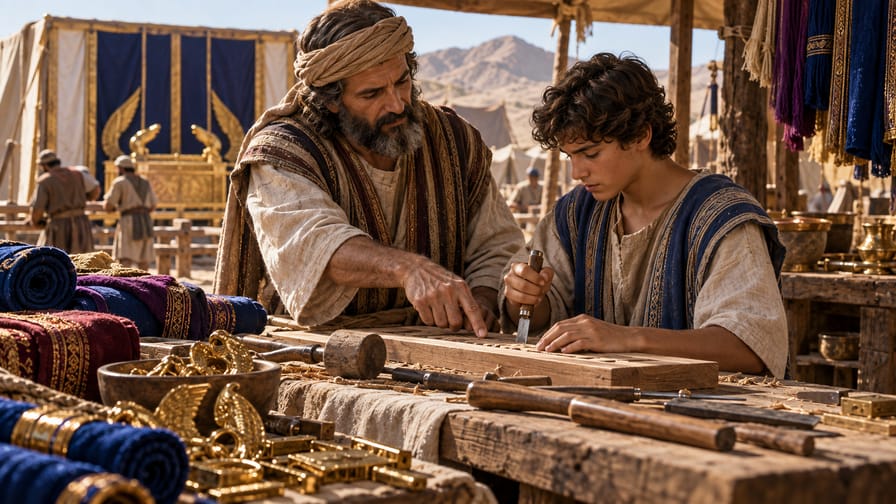
The figure of Uri, though not one of the most prominent characters in biblical narratives, plays a crucial and symbolically rich role in the history of redemption. He is primarily known as the father of Bezalel, the chief artisan divinely chosen for the construction of the Tabernacle in the wilderness. His importance lies not in extensively recorded direct actions, but in his lineage and in the fatherhood of an individual uniquely gifted by the Holy Spirit for the work of God.
This biblical and theological analysis, from an evangelical Protestant perspective, will seek to explore the etymology, historical context, inferred character, theological significance, and legacy of Uri. We will address how his life, though briefly mentioned, fits into the grand tapestry of God's redemptive plan, highlighting divine sovereignty in choosing and equipping for the service of the Kingdom.
Exegetical precision and faithfulness to the Scriptures will guide this exploration, recognizing the authority of God's Word as the primary source of all theological knowledge. The study of Uri invites us to reflect on the importance of generational faithfulness and the divine provision of talents for God's glory.
1. Etymology and Meaning of the Name
The name Uri (אוּרִי) is of Hebrew origin and is relatively simple in its construction. It derives from the Hebrew root אוּר ('ur), which means "light," "fire," or "flame." When combined with the first-person singular possessive suffix (י, -i), the name can be interpreted as "my light" or "my flame."
This etymological meaning is profoundly symbolic in the biblical context. Light is often associated with the presence of God, divine revelation, truth, and life. For example, God is described as light in Psalm 27:1 and 1 John 1:5, and His Word is a lamp to the feet and a light for the path (Psalm 119:105).
The association with "light" or "fire" can also evoke the glory of God manifested in the wilderness, such as the pillar of fire guiding Israel (Exodus 13:21) or the fire consuming the sacrifice on the altar. Thus, the name Uri may suggest a connection with divine presence and spiritual illumination, although there is no explicit mention in the Scriptures about Uri's own luminous character.
It is important to note that there are other biblical characters named Uri, though less prominent than Bezalel's father. One is Uri, father of Geber, one of Solomon's twelve governors, responsible for the region of Gilead (1 Kings 4:19). Another is Uri, one of the temple gatekeepers who married foreign women during the time of Ezra (Ezra 10:24).
However, the most significant Uri for biblical theology is, undoubtedly, the father of Bezalel, from the tribe of Judah. The repetition of the name in different contexts underscores its popularity in antiquity, but the intrinsic meaning of "my light" remains as a theological backdrop for any bearer of the name, suggesting a potential connection with divine illumination.
The theological significance of the name Uri, in the context of Bezalel's father, can be seen as a foreshadowing of the divine light that would empower his son. God's choice of Bezalel for such a sacred work, being "filled with the Spirit of God" (Exodus 31:3), reflects divine light and wisdom being manifested through his lineage. The name, therefore, can be interpreted as an omen of the light of wisdom and discernment that God would pour out upon the family.
2. Historical Context and Biblical Narrative
Uri lived during a crucial period in Israel's history: the departure from Egypt (the Exodus) and the forty years of wandering in the wilderness. This period is dated approximately between the 15th and 13th centuries BC, depending on the chronology adopted for the Exodus. The political, social, and religious landscape was one of transition and the formation of a new nation.
Israel had been liberated from Egyptian slavery through powerful acts of God, under the leadership of Moses and Aaron. On Mount Sinai, God established a covenant with the people, giving them the Law and instructions for the construction of the Tabernacle, the center of worship and divine presence among them (Exodus 19-31).
Uri's genealogy is fundamental to understanding his position. He is identified as the son of Hur, from the tribe of Judah (Exodus 31:2 35:30 38:22 1 Chronicles 2:20). The tribe of Judah was the royal tribe, from which the lineage of David and, ultimately, the Messiah would come (Genesis 49:10). This tribal connection already elevates the importance of Uri and his family.
His father, Hur, is a notable figure, though also with few direct mentions. Hur is remembered for supporting Moses' arms during the battle against the Amalekites in Rephidim, along with Aaron (Exodus 17:10-12). He was also one of the elders whom Moses left in charge of Israel, along with Aaron, when he went up Mount Sinai to receive the Law (Exodus 24:14).
Hur's association with Moses and Aaron in moments of leadership and crisis suggests that he was a figure of trust, wisdom, and authority. Uri's lineage, therefore, is a lineage of faith, service, and leadership within the Israelite community, which may have been a factor in the divine choice of his son, Bezalel.
The key biblical passages where Uri is mentioned are primarily in the books of Exodus and 1 Chronicles. In Exodus 31:2, God says to Moses: "See, I have called by name Bezalel, the son of Uri, the son of Hur, of the tribe of Judah." The same identification is repeated in Exodus 35:30 and 38:22. In 1 Chronicles 2:20, the genealogy of Judah reaffirms: "Hur begot Uri, and Uri begot Bezalel."
The geography associated with Uri is the Sinai wilderness, where the Tabernacle was built. This was a place of pilgrimage and total dependence on God, where Israel's identity as a holy nation was being forged. Bezalel's work, and by extension Uri's lineage, was intrinsically linked to the manifestation of God's glory in that arid environment.
Uri's relationships with other biblical characters are crucial. Besides his father Hur, he is connected to Moses and Aaron through Hur's proximity to them. More importantly, his relationship as Bezalel's father places him at the center of divine provision for Israel's worship. Bezalel was the chief artisan tasked with executing the divine instructions for the Tabernacle, and the mention of his fatherhood by Uri is a way of anchoring his identity and authority.
3. Character and Role in the Biblical Narrative
Uri's character is not directly described in the Scriptures there are no narratives detailing his actions, words, or decisions. His figure is almost exclusively defined by his fatherhood of Bezalel, which leads us to infer aspects of his character from the context and the divine choice of his son. The Bible often highlights the importance of lineage and family upbringing in the lives of individuals.
God's choice of Bezalel, who filled him "with the Spirit of God, in wisdom, in understanding, in knowledge, and in all manner of workmanship" (Exodus 31:3), suggests that Bezalel came from a family environment that valued faith and obedience to God. It is reasonable to infer that Uri, as father, and Hur, as grandfather, were men of integrity and faith, who cultivated an environment conducive to the development of such gifts in their son and grandson.
Uri's virtues, therefore, can be seen indirectly through the quality of his son. Piety, dedication to God, and reverence for divine law were likely part of Uri's character, as such qualities were essential for the formation of an individual who would be divinely empowered for such a holy work. The absence of any record of Uri's failures or sins, in contrast to other biblical characters, suggests a life of righteousness, though this is an argument from silence.
Uri's primary role in the biblical narrative is that of being Bezalel's father. His specific calling or function is not explicitly mentioned beyond that. However, his existence is crucial for establishing Bezalel's identity, granting him a respectable lineage from the tribe of Judah, connected to the prominent Hur.
This seemingly secondary role of Uri is, in fact, theologically significant. He represents generational faithfulness and God's providence in raising leaders and workers through faithful families. Bezalel's ability was not merely an individual gift, but also the result of an inheritance and a family environment that honored God.
Uri's significant actions and key decisions are not recorded. He is an example of how, in God's economy, not everyone is called to the front lines or to publicly recognized heroic deeds. There is immense value in being part of the lineage, in raising and nurturing those who will be called by God for great works. Uri is a vital link in this chain of divine service and purpose.
The absence of character development for Uri in the biblical narrative does not diminish his importance. On the contrary, it emphasizes God's sovereignty in choosing and empowering, and the way He works through individuals and families, often in discreet but essential ways for the fulfillment of His plans.
Uri's relevance lies in his position as an ancestor of a divinely inspired man, demonstrating that faithfulness and spiritual legacy can be transmitted through generations. His life, though obscure, is a testimony to the theology of election and God's prevenient grace that prepares the way for His purposes.
4. Theological Significance and Typology
The figure of Uri, as Bezalel's father, is deeply embedded in redemptive history and the progressive revelation of God. His theological importance does not lie in his direct actions, but in his connection with the construction of the Tabernacle, which was the center of worship and God's presence in Israel. The Tabernacle, in turn, is one of the richest Christocentric types in the Old Testament.
The Tabernacle prefigured the person and work of Jesus Christ in several ways. It was the place where God dwelt among His people (Exodus 25:8), pointing to Jesus as Immanuel, God with us (Matthew 1:23), and to Him as the true temple where the fullness of deity dwells bodily (Colossians 2:9). The glory of God that filled the Tabernacle (Exodus 40:34-35) finds its fulfillment in the glory of Christ (John 1:14).
Bezalel's work, inspired and empowered by the Holy Spirit to create the Tabernacle with all its beauty and precision, points to the perfection of Christ's work in salvation and to the Spirit's work in equipping believers. Bezalel's artistic skill, stemming from a divine source, reflects the beauty of holiness and the excellence that God requires in His worship.
In terms of covenants, Uri and his lineage are connected to the Sinaitic Covenant, where God established the foundations for worship and communion with His people. The construction of the Tabernacle was a central command of this covenant, essential for maintaining Israel's relationship with Yahweh. Uri's participation, through his son, ensures that divine provision for this covenant was complete.
Although Uri is not cited in the New Testament, the typology of the Tabernacle and the Levitical priesthood is extensively explored in the Epistle to the Hebrews. The author of Hebrews demonstrates how the Tabernacle, its rituals, and its priests were shadows of heavenly realities and of Christ's perfect sacrifice (Hebrews 8:5 9:1-14). Bezalel's work, and by extension Uri's lineage, contributed to the formation of these "shadows" that would reveal the glory of Christ.
Uri's connection with central theological themes is rich. His lineage from the tribe of Judah connects him with the messianic promise (Genesis 49:10). Bezalel's empowerment by the Spirit of God (Exodus 31:3) is an early and potent example of the doctrine of divine inspiration and equipping for service. This prefigures the promise of the Holy Spirit in the New Testament, who empowers believers for service and worship (Acts 1:8 Romans 12:6-8).
Bezalel's work, under Uri's lineage, also illustrates the importance of detailed obedience to God's commandments. Every part of the Tabernacle was made according to the "pattern" shown to Moses (Exodus 25:9, 40). This meticulous obedience is a central theme in evangelical faith, emphasizing that true worship and service to God must be done according to His Word.
In summary, Uri, through his son Bezalel and the work of the Tabernacle, points to God's sovereignty in equipping His people, to the centrality of Christ as the true Tabernacle and High Priest, and to the work of the Holy Spirit in empowering believers for service and worship that glorify God. He represents the divine providence that prepares the way for the manifestation of God's glory in the history of redemption.
5. Biblical-Theological Legacy and Canonical References
Uri's legacy, though indirect, is deeply rooted in biblical theology and the history of Israel. His canonical mentions are direct, but his impact extends through his son Bezalel and the work of the Tabernacle. He is mentioned in Exodus 31:2, 35:30, and 38:22, always as the father of Bezalel. Furthermore, 1 Chronicles 2:20 includes him in the genealogy of the tribe of Judah, solidifying his position in the royal lineage.
Uri's most significant contribution to biblical theology lies in demonstrating God's sovereignty in choosing and equipping individuals for His service. The election of Bezalel, an artisan, for such a sacred work, and the mention of his ancestry through Uri and Hur, underscores that God uses people from all walks of life and from lineages that He Himself establishes.
In Jewish and Christian interpretive tradition, the figure of Bezalel is often celebrated as the first example of an individual "filled with the Spirit of God" for a specific task, predating the prophets and kings. Consequently, Uri is recognized as an essential part of this blessed lineage. Commentators like John Calvin highlight God's grace in equipping artisans with wisdom, showing that even manual skills are divine gifts to be employed for God's glory.
Reformed and evangelical theology emphasizes that all gifts and talents come from God and should be used for His glory (1 Peter 4:10-11). The story of Bezalel, son of Uri, serves as a primary example of this truth. It demonstrates that creativity, art, and technical skill are not merely secular, but can be profoundly spiritual and sanctified when dedicated to the Lord.
There are no direct references to Uri in intertestamental literature, but the importance of the Tabernacle and, later, the Temple, is a recurring theme. The excellence of the construction and the divine inspiration behind it, of which Uri is a part through his son, would have been presupposed in the valuing of these sacred structures.
Uri's importance for understanding the canon lies in his contribution to the Exodus narrative and the formation of the nation of Israel. He is a reminder that the history of redemption is built not only on great leaders but also on faithful individuals in their positions, who prepare the way for the fulfillment of divine purposes. His lineage from Judah, which would culminate in David and in Christ, reinforces the continuity and providence of God's plan.
In summary, Uri is a silent testament to God's sovereignty that chooses, equips, and blesses lineages for the advancement of His kingdom. His life teaches us about the importance of generational faithfulness, the valuing of spiritual gifts in all spheres of life, and the centrality of Christ as the fulfillment of all Old Testament shadows, including the glorious Tabernacle that his son helped to build.