


Jeshua
1. Etymology and Meaning of the Name
The name Jeshua, transliterated from the Hebrew יֵשׁוּעַ (Yeshua), is a shortened and later form of the name יְהוֹשֻׁעַ (Yehoshua), known in English as Joshua. This variation reflects a post-exilic linguistic tendency to shorten theophoric names, while nonetheless retaining their essential meaning and deep etymological root. The Aramaic form of the name is also יֵשׁוּעַ, reflecting Aramaic influence on the Hebrew language of the time.
The etymological root of the name Jeshua derives from the Hebrew verb יָשַׁע (yasha'), which means "to save," "to deliver," or "to help." Thus, the literal and symbolic meaning of the name Jeshua is "Yahweh is salvation," "Yahweh saves," or "He saves." This meaning is intrinsically linked to God's identity and purpose in the history of the redemption of Israel and humanity.
In biblical languages, in addition to Yeshua and Yehoshua, the name finds its Greek equivalent in Ἰησοῦς (Iēsous), which is the form by which Jesus Christ is known in the New Testament. This etymological connection underscores the profound theological continuity between the characters who bore this name and the central figure of the Christian faith, Jesus himself.
Various biblical figures bore the name or variations of it. The most prominent in the Old Testament, besides the post-exilic high priest, is Joshua (Yehoshua), son of Nun, the successor of Moses who led Israel in the conquest of Canaan (Numbers 13:16). The existence of multiple characters with this name or its variants demonstrates the centrality of the theme of salvation in Israelite faith.
The theological significance of the name Jeshua, especially in the biblical context, is immense. It is not merely a label but a declaration of faith about God's character and work. The name anticipates and points to divine salvation, culminating in the person of Jesus Christ, whose own name (Iēsous) explicitly declares that "He will save His people from their sins" (Matthew 1:21).
2. Historical Context and Biblical Narrative
2.1. Period and Context
The biblical figure of Jeshua, the high priest, emerges prominently in the post-exilic period of Israel's history, specifically after the return of the Jews from Babylonian captivity to Judah. This period, which extends approximately from 538 to 444 BC, is marked by the domination of the Persian Empire, which permitted the return of the exiles through the decree of Cyrus the Great (Ezra 1:1-4).
The political and social context was one of reconstruction and reestablishment. After decades of exile, the land of Judah lay desolate, and the city of Jerusalem, including the Temple, was in ruins. The people faced immense challenges, from material reconstruction to the restoration of religious identity and civic life under Persian sovereignty.
Religiously, the period was one of renewed fervor for the Law of Moses and the purity of worship. The experience of exile had instilled a deep consciousness of sin and the need for obedience to Yahweh. The reestablishment of the Temple and priestly rituals was seen as essential for the restoration of the covenant and God's presence among His people.
2.2. Family Origin and Genealogy
Jeshua was the son of Jozadak (Ezra 3:2), who was taken captive to Babylon along with other Levites and priests in the exile (1 Chronicles 6:15). He belonged to the priestly line of Aaron, descending from the house of Zadok, which was the legitimate and prominent priestly line from the time of David and Solomon (1 Chronicles 6:1-15).
His genealogy connected him directly to the Mosaic priesthood, conferring upon him the necessary authority and legitimacy to lead the reestablishment of worship in Jerusalem. The restoration of the priestly line through Jeshua was crucial for the continuity of the system of sacrifices and the mediation between God and Israel.
2.3. Key Events and Relationships
The biblical narrative presents Jeshua as one of the central figures in the return from exile and the reconstruction of Jerusalem. He led the first group of exiles who returned to Jerusalem, together with Zerubbabel, the governor of the Davidic lineage (Ezra 2:2 Nehemiah 7:7). This partnership between the priest and the civil leader is a significant theme.
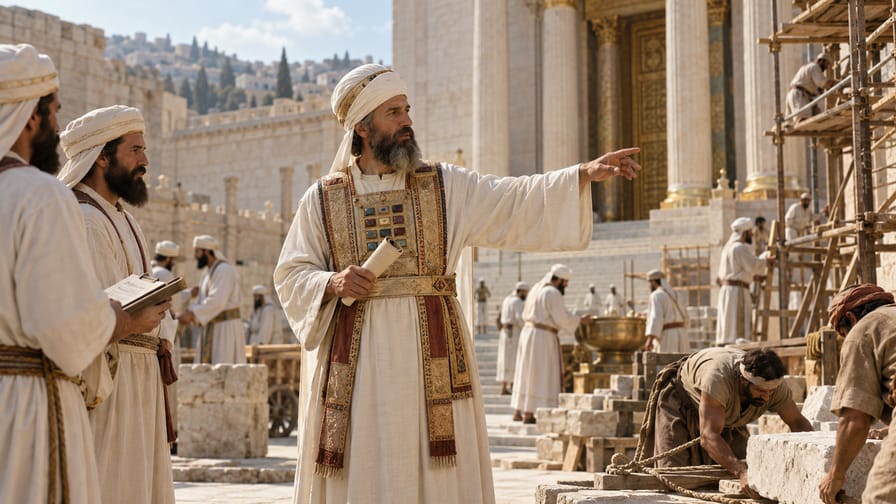
One of his first acts after the return was the reconstruction of the altar of burnt offering on the site of the destroyed Temple and the reinstitution of daily sacrifices, even before the Temple proper was rebuilt (Ezra 3:2-6). This act of faith and obedience was fundamental for restoring the worship of Yahweh.
Under the leadership of Jeshua and Zerubbabel, the foundations of the second Temple were laid with great celebration, though also with tears from those who remembered the glory of the first Temple (Ezra 3:8-13). The work, however, faced strong opposition from neighboring peoples, who sought to discourage and frustrate the builders (Ezra 4:1-5).
After a period of stagnation in the reconstruction, God raised up the prophets Haggai and Zechariah to encourage Jeshua and Zerubbabel to resume the work. The prophetic messages were directed directly to them, exhorting them to courage and trust in divine provision (Haggai 1:1, 12, 14 2:2, 4 Zechariah 3:1-10 6:11-14).
Thanks to the perseverance and obedience of the leaders and the people, the second Temple was finally completed and dedicated in 515 BC (Ezra 6:14-15). Jeshua was also involved in the process of covenant renewal under the leadership of Nehemiah and Ezra, reaffirming the people's commitment to the Law of God (Nehemiah 9:4-5 10:9).
Key biblical passages that describe the life and ministry of Jeshua include Ezra 2-6, Nehemiah 7-10, and the prophetic books of Haggai and Zechariah. His work was geographically centered in Jerusalem and the region of Judah, which was the Persian province of Yehud, demonstrating his local influence and responsibility.
3. Character and Role in the Biblical Narrative
3.1. Qualities and Vocation
The character of Jeshua, as revealed in the Scriptures, is marked by a deep faithfulness to God and an unwavering commitment to the restoration of worship and the community of Israel. He proved to be a courageous spiritual leader, ready to assume responsibilities in a time of great difficulty and opposition.
Among his virtues and spiritual qualities, obedience to the Word of God and readiness to act according to His instructions stand out. His initiative in reconstructing the altar and reinstituting sacrifices immediately after the return from exile (Ezra 3:2-3) demonstrates his priority in the worship of Yahweh, even in the face of adverse conditions and threats from neighboring peoples.
The biblical narrative does not document specific sins, weaknesses, or moral failures of Jeshua, which is notable for a character of such prominence. On the contrary, his image is consistently positive, presenting him as an example of pious and integral leadership, essential for the spiritual restoration of Israel.
His primary calling was that of High Priest, a function that placed him as the chief mediator between God and the people, responsible for overseeing worship, offering sacrifices, and teaching the Law. He was the guardian of the Temple's sanctity and the purity of worship, crucial elements for Israel's identity as a covenant nation.
3.2. Role and Significant Actions
The role of Jeshua in the biblical narrative was multifaceted, combining spiritual, administrative, and prophetic leadership. He not only reinstituted the rituals but also worked tirelessly on the physical reconstruction of the Temple, acting as an agent of divine providence to restore the center of Jewish faith.
His partnership with Zerubbabel, the civil governor, is a model of cooperation between the religious and political spheres, both divinely instituted for the good of the people. While Zerubbabel represented the Davidic authority and physical reconstruction, Jeshua represented the Aaronic authority and spiritual and cultic restoration (Haggai 1:1, 12).
The significant actions of Jeshua include leadership in the reconstruction of the altar (Ezra 3:2), the laying of the foundations of the second Temple (Ezra 3:8-9), resistance to Samaritan opposition (Ezra 4:1-5), and obedience to the prophetic exhortations of Haggai and Zechariah to resume and complete the work of the Temple (Haggai 1:12 Zechariah 3:1-10).
The development of Jeshua's character throughout the narrative is particularly evidenced in Zechariah's visions. In the vision of chapter 3, Jeshua is depicted before the Angel of the Lord, accused by Satan, but justified and purified by God, who clothes him with clean garments and promises him a future of service and the coming of the "Branch" (Zechariah 3:1-10). This vision not only validates his priesthood but also elevates him to a prophetic and typological status.
4. Theological Significance and Typology
4.1. Role in Redemptive History and Christocentric Typology
The role of Jeshua in Israel's redemptive history is crucial, marking the transition from exile to restoration and the reestablishment of the covenant community in Judah. He is a key figure in the progressive revelation of God's plan of salvation, acting as a vital link between the Mosaic priesthood and the eternal priesthood of Christ.
His figure is rich in prefiguration or Christocentric typology, pointing to Jesus Christ in various ways. Firstly, the very name Jeshua (Yeshua), meaning "Yahweh saves," is a direct anticipation of the name and mission of Jesus (Iēsous), who came to "save His people from their sins" (Matthew 1:21).
Secondly, Jeshua's role as High Priest, who led the people in the reestablishment of worship and the offering of sacrifices for the atonement of sins (Ezra 3:2-3), prefigures the work of Jesus as the great High Priest. Christ, in contrast to the Levitical priests who offered sacrifices repeatedly, offered Himself once for all, a perfect and effective sacrifice (Hebrews 7:27 9:11-14).
The vision of Zechariah 3 is particularly powerful in its typological dimension. In it, Jeshua is purified by God, having his filthy garments (representing the sin and impurity of the people) removed and replaced with clean garments and a pure turban (Zechariah 3:3-5). This miraculous purification of the high priest points to the purification that Christ would definitively accomplish, not only for Himself but for all who believe in Him, making them righteous before God.
Furthermore, God's promise to Jeshua that he would see the coming of the "Branch" (צֶמַח, tsemach), a messianic title (Zechariah 3:8), and the symbolic crowning in Zechariah 6:11-13, where he receives a crown to be placed upon the head of the "Branch" who will build the Temple of the Lord and be a priest on His throne, establishes an unmistakable prophetic link with Jesus Christ. Christ is the priest-king who builds the true spiritual Temple, the Church (1 Peter 2:5).
4.2. Theological and Doctrinal Connections
Jeshua's story is intrinsically linked to the central theological themes of salvation, faith, obedience, judgment, and grace. His leadership in the restoration of the Temple and worship demonstrated the people's faith in God's promises to restore them after the exile. His obedience in restarting the sacrifices was an act of acknowledging the need for atonement and God's grace.
Jeshua's experience in the book of Zechariah 3, where he is divinely purified, illustrates the doctrine of justification by God's grace. Although he was a human and imperfect high priest, God purified him and commissioned him for service, prefiguring the justification believers receive in Christ, not by their own merit, but by the imputation of Christ's righteousness.
The connection between Jeshua, the temple, and the priesthood is vital for understanding the progressive revelation of Christ's work. The Temple rebuilt by Jeshua was a type of Christ's body (John 2:19-21) and of the Church. The Levitical priesthood, in which Jeshua served, was a shadow of the superior and eternal priesthood of Christ (Hebrews 7:11-28).
Although Jeshua is not directly quoted in the New Testament, the themes and prophecies associated with him are extensively developed. The letter to the Hebrews, in particular, explores the superiority of Jesus' priesthood in relation to the Levitical priesthood, emphasizing that Christ is the perfect High Priest, who does not require daily sacrifices, for He offered a single and sufficient sacrifice (Hebrews 9:12).
The figure of Jeshua, therefore, serves as a powerful illustration of God's faithfulness in keeping His promises, of the need for a mediator, and of the anticipation of the Messiah. He is a reminder that salvation, since the Old Testament, has always been the work of Yahweh, and that all paths of redemption point to the "Branch," Jesus Christ.
5. Biblical-Theological Legacy and Canonical References
5.1. Mentions and Contributions
Jeshua's legacy is solidly established in the canonical books of the Old Testament. He is prominently mentioned in Ezra (e.g., Ezra 2:2 3:2, 8 5:2 10:18), Nehemiah (e.g., Nehemiah 7:7 12:1, 10, 26), Haggai (e.g., Haggai 1:1, 12, 14 2:2, 4), and Zechariah (e.g., Zechariah 3:1, 3, 6, 8, 9 6:11). These references establish him as an indispensable leader in the post-exilic restoration.
His most significant contribution was the restoration of the priesthood and Temple worship in Jerusalem. By leading the reconstruction of the altar and the Temple, Jeshua ensured the continuity of Yahweh's worship according to the Law of Moses. He helped preserve Israel's religious identity in a critical period, preparing the ground for the development of Second Temple Judaism.
Jeshua's influence on biblical theology is felt primarily through his typology. He represents the continuity of God's covenant with Israel and divine faithfulness even amidst judgment and exile. His purification and commissioning in Zechariah 3 are powerful declarations of God's grace and sovereignty in qualifying and using His servants.
5.2. Interpretive Tradition and Reformed Theology
In the Jewish interpretive tradition, Jeshua is recognized as one of the "Men of the Great Assembly" and one of the great leaders who reestablished the Law and religious order after the return from exile. His figure is seen as a pillar of restoration and an example of priestly piety.
In the Christian tradition, especially in Reformed and evangelical theology, Jeshua is valued not only for his historical leadership but, above all, for his typological significance. Evangelical commentators such as John Calvin, Matthew Henry, and John Gill highlight how Jeshua, the high priest, points to Jesus Christ, the eternal and perfect High Priest.
The vision of Zechariah 3, in particular, is a focal point for Reformed theology when discussing the doctrine of justification. The removal of Jeshua's filthy garments and the imposition of clean garments are often interpreted as a vivid illustration of the imputation of Christ's righteousness to believers, who are declared righteous not by their own merits, but by God's grace.
The figure of Jeshua, along with Zerubbabel, also serves to illustrate the theology of the Messiah as King and Priest, a central theme that finds its definitive fulfillment in Jesus Christ. The union of these two functions in the person of Christ is one of the great truths of the Christian faith, as predicted by the prophets and fully revealed in the New Testament (Hebrews 7:1-3).
5.3. Importance for the Canon and Conclusion
Jeshua's importance for understanding the biblical canon lies in how his story weaves God's narrative with His people, from exile to messianic hope. He is a testament to God's faithfulness in preserving a remnant and in fulfilling His promises of restoration and redemption, even in times of adversity.
His life and ministry are essential for understanding the continuity of the divine plan of salvation that spans the Old Testament and culminates in Christ. He is a crucial link connecting the old covenant with the promise of the new covenant, the Levitical priesthood with the Melchizedekian priesthood of Christ.
In summary, Jeshua, the post-exilic high priest, is much more than a name in the priestly genealogy. He is a faithful leader, a restorer of worship, and, above all, a prophetic type of the coming Messiah. His story is a reminder of the persistence of God's grace and the certainty of the coming of a Savior who would purify His people and establish an eternal priesthood, a kingdom of righteousness and peace, in fulfillment of all divine promises.